ANTHER AND POLLEN
CULTURE
Presentation by
MANTESH.SM
PALM 7018
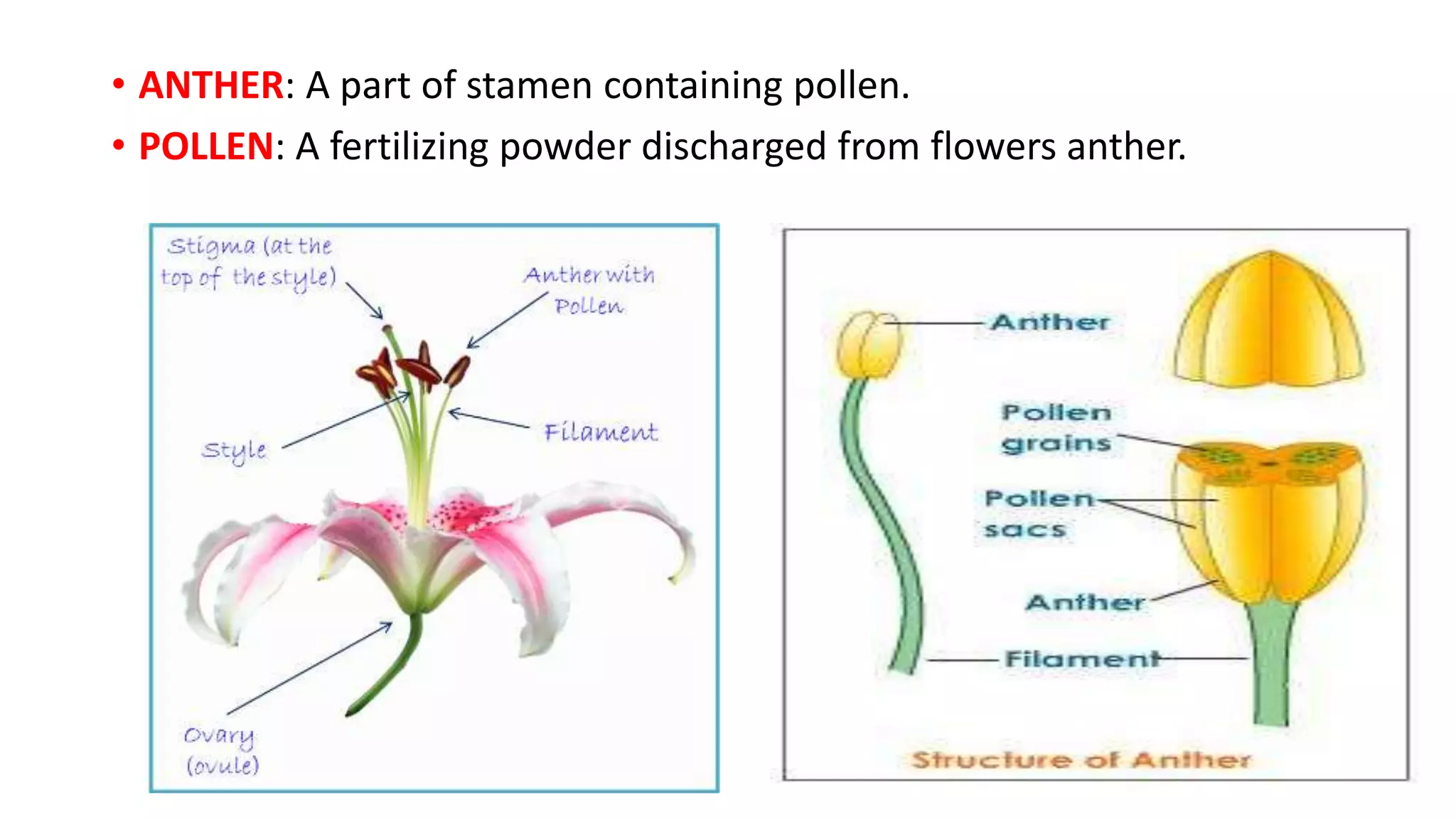
• ANTHER: A part of stamen containing pollen.
• POLLEN: A fertilizing powder discharged from flowers anther.
HISTORY
• W.TULECKE(1953)
First observed that mature pollen grains of Ginkgo biloba
(gymnosperm) can be induced to proliferate in culture to form haploid
callus.
• S.GUHA AND S.C MAHESWARI(1964)
First reported the direct development of embryos from microspores of
Datura innoxia, by the culture of excised anther.
• J.P. BOURGIN AND J.P.NITSCH(1967)
Obtained complete haploid plantlets from anther culture of Nicotiana
tabacum.
Anther culture
• Culturing of anther obtained from unopened flower
bud in the nutrient medium under aseptic condition.
callus tissue or embryoids from anther, that give rise
to haploid plantlets either though organogenesis or
embryogenesis.
Pollen culture
• Pollen or microspore culture is an in vitro technique
by which the pollen grains preferably at the
uninucleated stage, are squeezed out aseptically
from the intact anther and then cultured on nutrient
medium.
• The microspores develop into haploid embryoids or
callus tissue that give rise to haploid plantlets by
embryogenesis or organogenesis.
Androgenesis
• Androgenesis is the in vitro development of haploid
plants originating from totipotent pollen grains
through a series of cell division and differentiation.
It is of two types:
1)Direct androgenesis
2)Indirect androgenesis
1)Direct androgeneis:-
The microspores behaves like a zygote and undergoes
change to form enbryoid which ultimately give rise to a plantlet.
2) Indirect Androgenesis:
The microspores divide repeatedly to form a callus tissue
which differentiates into haploid plantlets.
Principle of anther and pollen culture
• The production of haploid plants is to exploit the totipotency
of microspore .
• In this process the normal development and function of the
pollen cell to become a male gamete is stopped and is
diverted forcely to a new metabolic pathway for vegetative
cell division .
Method of anther culture
1)Collection of unopened flower buds.
2)Surface sterilized with 70% ethanol.
3)Anthers excised from flower buds and kept separately.
4)Anthers in first meiotic division is selected by acetocarmine test.
5)Inoculated in the medium containing glutamine, L-serine and inositol.
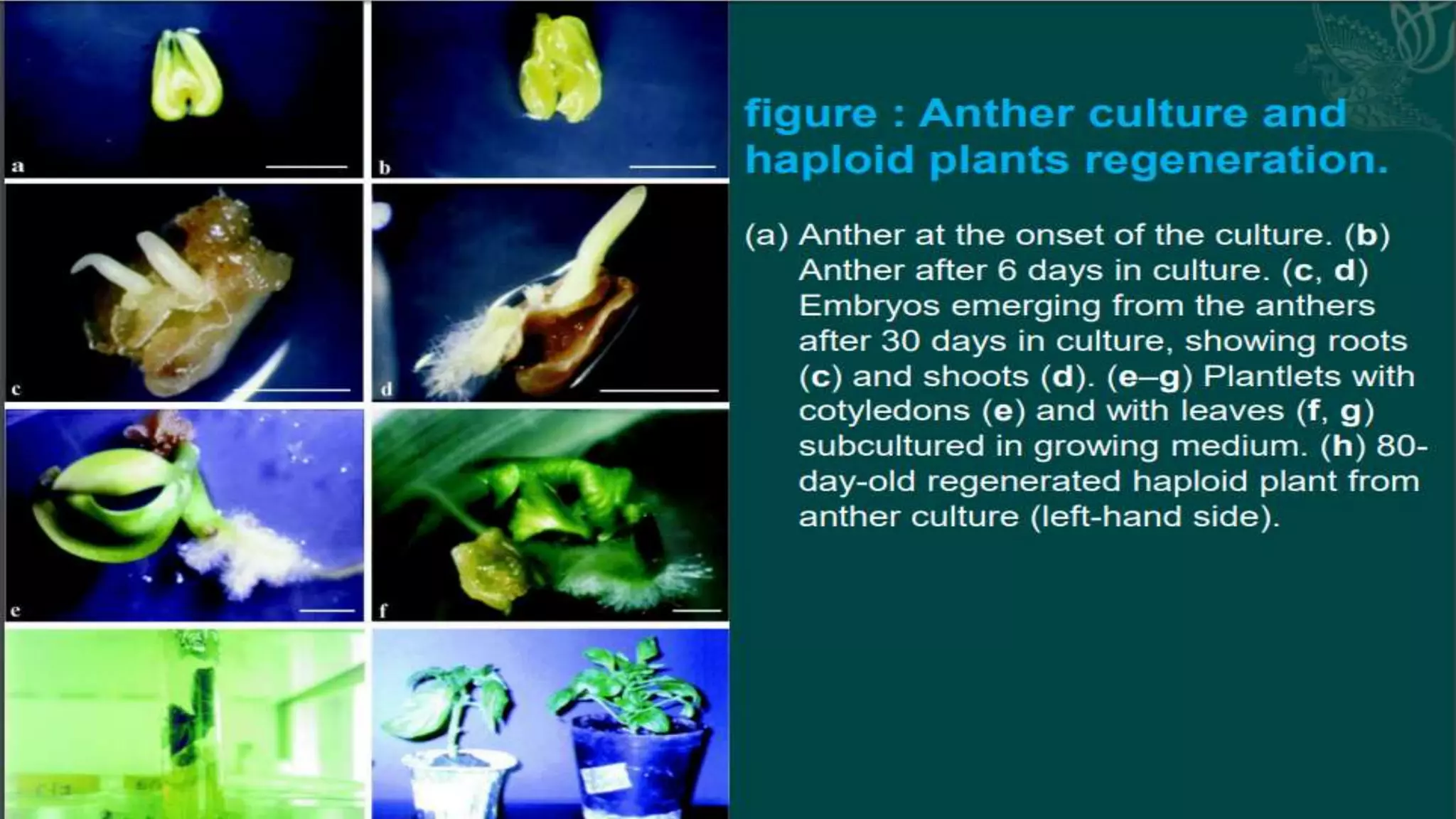
6). Incubated the culture at 25°C for 15 days. Here, anthers grow in to
embryoids.
7)Embryoids transfer to rooting medium under 3000 lux illumination
after 4-5 weeks the embryoids became plantlets.
8)For acclimatization, transfer to green house.
METHOD OF POLLEN CULTURE
1)Anther collected from flower buds and pollen grains are isolated and
about 50 anthers are placed in small sterile beaker containing 20 ml of
liquid basal medium (MS or White or Nitsch)
2) Anthers are then pressed against the side of beaker with the sterile
glass rod to squeeze out the pollens.
3) The homogenized anthers are then filtered through a nylon sieve to
remove that the anther tissue debris.
4) The filtrate or pollen suspension is then centrifuged at low speed
( 500-800 rpm/min) for five minutes. The supernatant containing fine
debris is discarded and pellet of pollen is suspended in fresh liquid
medium and washed twice by repeated centrifugation and
resuspended in fresh liquid medium.
5) A 2.5 ml of pollen suspension(usually 10³ to10 4/ml) is pipetted off
and is spread in 5 cm petridish. Pollens are best grown in liquid
medium but, if necessary, they can be grown by plating very soft agar
added medium.
6) Petridishes are incubated at 27-30°C under low intensity of white
cool light (500 lux,16 hr).
7) Young embryoids can be observed after 30 days. The embryoids
ultimately give rise to haploid plantlets.
Factors influencing anther and pollen
culture
1) Genotype of donor plants:
The genotype of the donor plant plays a significant
role in determining the frequency of pollen production.
Example :- Hordeum of each genotype differs with respect to
androgenic response in anther culture.
2)STAGE OF THE MICROSPORE
Anthers are more productive when cultured at
uninucleate microspore stage.
Example : Barley, Wheat, Rice, etc.
3) CULTURE MEDIUM:
• For anther culture, medium requirements vary with genotype and
the age of the anther as well as condition under which donor plants
are grown.
• Incorporation of activated charcoal into the medium has stimulated
the induction of androgenesis.
• The iron in the medium plays a very important role for the induction
of haploids .
• Potato extracts, coconut milk and growth regulators like auxin and
cytokinin are used for anther and pollen culture.
4)Temperature:
• Temperature enhance the induction frequency of microspore
androgensis.
• The low temperature treatment to anther or flower bud enhance the
haploid formation.
• The low temperature effects the number of factors such as
dissolution of microtubules, lowering of absscisic acid, maintenance
of higher ratio of viable pollen capable of embryogenesis.
5)Physiological status of donor plant
• Physiological status of donor plant such as water stress nitrogen
requirement and age of donor plant highly affect the pollen
embryogenesis.
• Plants starved of nitrogen may give more responsive anthers
compared to those that are well fed with nitrogenous fertilizers.
Advantages of anther culture
• simple.
• Less time consuming.
• Responsive
Disadvantages
• Requires skill to remove anthers without causing
damage.
• Not much successful in case of cereal crop.
• Risk of chimera and callus formation from anther wall.
APPLICATIONS:
1)For mutation study.
2) For plant breeding and crop improvement.
3) To obtain the secondary metabolites.
Eg. Hyoscyamus niger obtain by anther culture having higher alkaloid
content.
4) Haploids are used in molecular biology and genetic engineering.
Example:- Haploid tissue of Arabidopsis and Lycopersicon have been
used for the transfer and expression of three genes from Escherchia
coli.

Anther and pollen culture

  • 1.
  • 2.
    • ANTHER: Apart of stamen containing pollen. • POLLEN: A fertilizing powder discharged from flowers anther.
  • 3.
    HISTORY • W.TULECKE(1953) First observedthat mature pollen grains of Ginkgo biloba (gymnosperm) can be induced to proliferate in culture to form haploid callus. • S.GUHA AND S.C MAHESWARI(1964) First reported the direct development of embryos from microspores of Datura innoxia, by the culture of excised anther. • J.P. BOURGIN AND J.P.NITSCH(1967) Obtained complete haploid plantlets from anther culture of Nicotiana tabacum.
  • 4.
    Anther culture • Culturingof anther obtained from unopened flower bud in the nutrient medium under aseptic condition. callus tissue or embryoids from anther, that give rise to haploid plantlets either though organogenesis or embryogenesis.
  • 5.
    Pollen culture • Pollenor microspore culture is an in vitro technique by which the pollen grains preferably at the uninucleated stage, are squeezed out aseptically from the intact anther and then cultured on nutrient medium. • The microspores develop into haploid embryoids or callus tissue that give rise to haploid plantlets by embryogenesis or organogenesis.
  • 6.
    Androgenesis • Androgenesis isthe in vitro development of haploid plants originating from totipotent pollen grains through a series of cell division and differentiation. It is of two types: 1)Direct androgenesis 2)Indirect androgenesis
  • 7.
    1)Direct androgeneis:- The microsporesbehaves like a zygote and undergoes change to form enbryoid which ultimately give rise to a plantlet. 2) Indirect Androgenesis: The microspores divide repeatedly to form a callus tissue which differentiates into haploid plantlets.
  • 8.
    Principle of antherand pollen culture • The production of haploid plants is to exploit the totipotency of microspore . • In this process the normal development and function of the pollen cell to become a male gamete is stopped and is diverted forcely to a new metabolic pathway for vegetative cell division .
  • 9.
    Method of antherculture 1)Collection of unopened flower buds. 2)Surface sterilized with 70% ethanol. 3)Anthers excised from flower buds and kept separately. 4)Anthers in first meiotic division is selected by acetocarmine test. 5)Inoculated in the medium containing glutamine, L-serine and inositol.
  • 10.
    6). Incubated theculture at 25°C for 15 days. Here, anthers grow in to embryoids. 7)Embryoids transfer to rooting medium under 3000 lux illumination after 4-5 weeks the embryoids became plantlets. 8)For acclimatization, transfer to green house.
  • 13.
    METHOD OF POLLENCULTURE 1)Anther collected from flower buds and pollen grains are isolated and about 50 anthers are placed in small sterile beaker containing 20 ml of liquid basal medium (MS or White or Nitsch) 2) Anthers are then pressed against the side of beaker with the sterile glass rod to squeeze out the pollens. 3) The homogenized anthers are then filtered through a nylon sieve to remove that the anther tissue debris. 4) The filtrate or pollen suspension is then centrifuged at low speed ( 500-800 rpm/min) for five minutes. The supernatant containing fine debris is discarded and pellet of pollen is suspended in fresh liquid medium and washed twice by repeated centrifugation and resuspended in fresh liquid medium.
  • 14.
    5) A 2.5ml of pollen suspension(usually 10³ to10 4/ml) is pipetted off and is spread in 5 cm petridish. Pollens are best grown in liquid medium but, if necessary, they can be grown by plating very soft agar added medium. 6) Petridishes are incubated at 27-30°C under low intensity of white cool light (500 lux,16 hr). 7) Young embryoids can be observed after 30 days. The embryoids ultimately give rise to haploid plantlets.
  • 16.
    Factors influencing antherand pollen culture 1) Genotype of donor plants: The genotype of the donor plant plays a significant role in determining the frequency of pollen production. Example :- Hordeum of each genotype differs with respect to androgenic response in anther culture.
  • 17.
    2)STAGE OF THEMICROSPORE Anthers are more productive when cultured at uninucleate microspore stage. Example : Barley, Wheat, Rice, etc.
  • 18.
    3) CULTURE MEDIUM: •For anther culture, medium requirements vary with genotype and the age of the anther as well as condition under which donor plants are grown. • Incorporation of activated charcoal into the medium has stimulated the induction of androgenesis. • The iron in the medium plays a very important role for the induction of haploids . • Potato extracts, coconut milk and growth regulators like auxin and cytokinin are used for anther and pollen culture.
  • 19.
    4)Temperature: • Temperature enhancethe induction frequency of microspore androgensis. • The low temperature treatment to anther or flower bud enhance the haploid formation. • The low temperature effects the number of factors such as dissolution of microtubules, lowering of absscisic acid, maintenance of higher ratio of viable pollen capable of embryogenesis.
  • 20.
    5)Physiological status ofdonor plant • Physiological status of donor plant such as water stress nitrogen requirement and age of donor plant highly affect the pollen embryogenesis. • Plants starved of nitrogen may give more responsive anthers compared to those that are well fed with nitrogenous fertilizers.
  • 21.
    Advantages of antherculture • simple. • Less time consuming. • Responsive
  • 22.
    Disadvantages • Requires skillto remove anthers without causing damage. • Not much successful in case of cereal crop. • Risk of chimera and callus formation from anther wall.
  • 23.
    APPLICATIONS: 1)For mutation study. 2)For plant breeding and crop improvement. 3) To obtain the secondary metabolites. Eg. Hyoscyamus niger obtain by anther culture having higher alkaloid content. 4) Haploids are used in molecular biology and genetic engineering. Example:- Haploid tissue of Arabidopsis and Lycopersicon have been used for the transfer and expression of three genes from Escherchia coli.