ESTABLISHMENT OF ANIMAL
TISSUE CULTURE LAB
Submitted by:-
Keshav Poswal
Department of Biotechnology
Kurukshetra University Kurukshetra-
136119
CONTENT:
1. Cell culture
2. Animal tissue culture
3.Laboratory design : Planning , construction & service , layout of aseptic room ,incubation ,
preparation area
4.Planning : ventilation , accommodation , renovation
5.Layout of sterile handling area : sterile handling area , LFH , quarantine & containment ,
service bench
6.Incubation : incubators , hot room
7.Preparation area : media preparation , Washup , Storage
8.Equipment's used in tissue culture lab
CELL CULTURE:
It is the process by which cells are grown under
controlled conditions , generally outside of their
environment.
Or
It can defined as the process of cultivating cells and tissues outside the body of an
organisms (invitro) in an artificial environment , which stimulates the invitro conditions
Such as temperature , nutrition and protection from microorganisms.
ANIMAL CELL CULTURE:
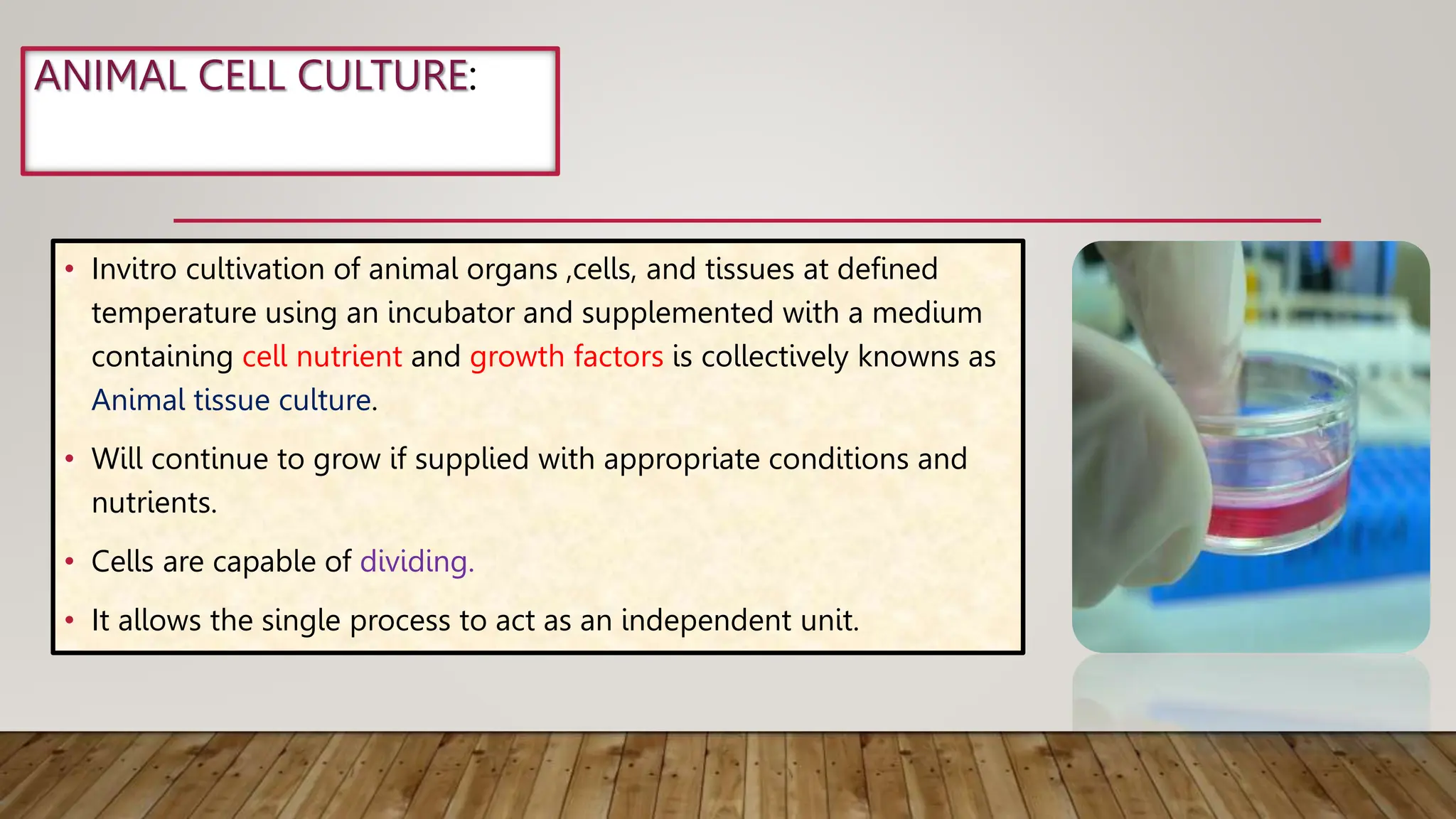
• Invitro cultivation of animal organs ,cells, and tissues at defined
temperature using an incubator and supplemented with a medium
containing cell nutrient and growth factors is collectively knowns as
Animal tissue culture.
• Will continue to grow if supplied with appropriate conditions and
nutrients.
• Cells are capable of dividing.
• It allows the single process to act as an independent unit.
Laboratory design
Planning
Construction and service
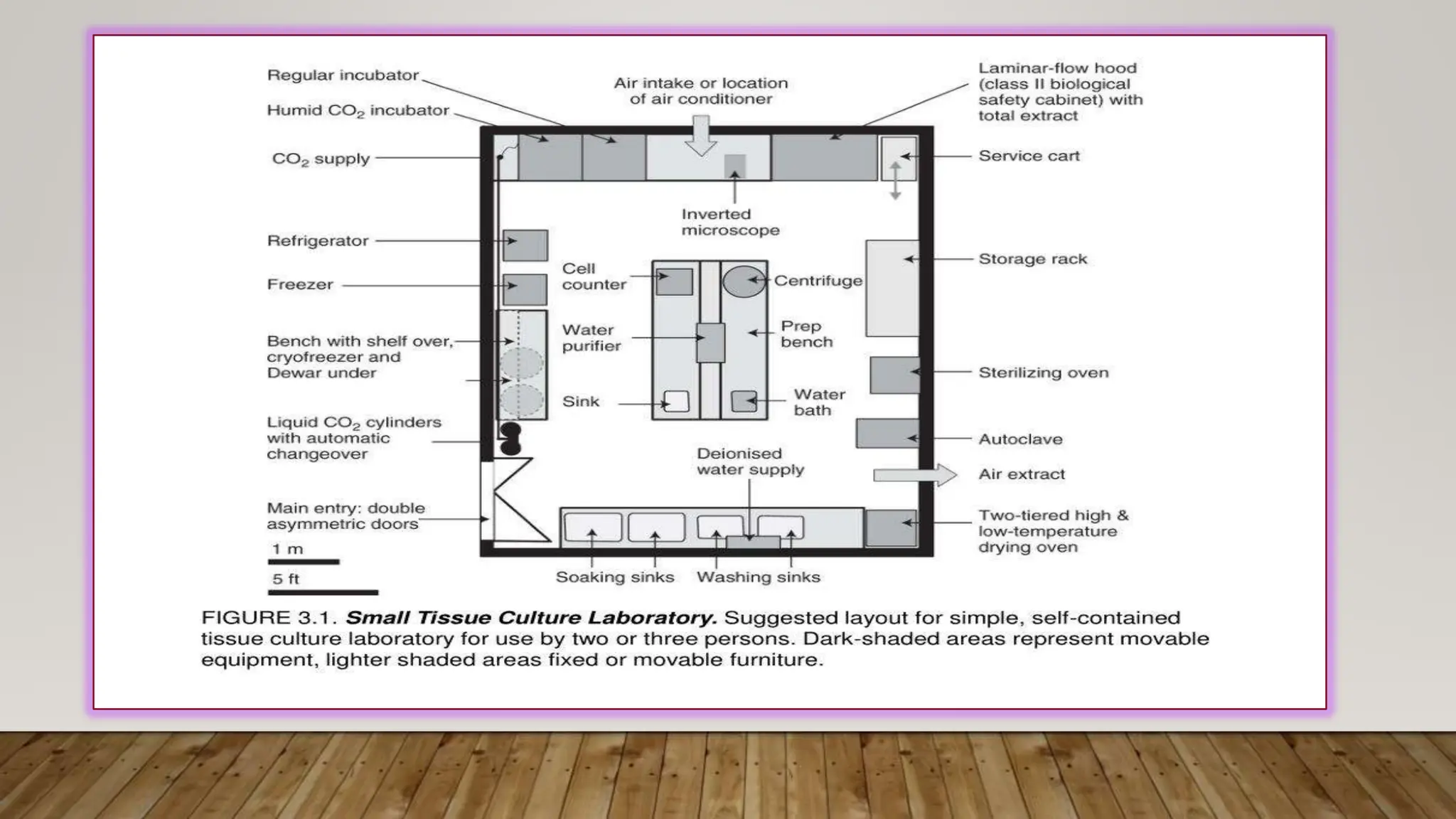
Layout of Aseptic room
Incubation
Preparation Area
PLANNING CONSTRUCTION &
SERVICE
LAYOUT OF ASEPTIC
ROOM
INCUBATION PREPARATION
AREA
VENTILLATION LOCATION STERILE HANDLING
AREA
INCUBATORS MEDIA
PREPARATION
ACCOMADATION SUPPLY OF FILTETRED
AREA
LAMINAR AIR FLOW HOT ROOMS WASH UP
RENOVATIONS EASY CLEANING &
SUITABLE DRAINAGE
SYSTEM
QUARANTINE AND
CONTAINMENT
STORAGE
ACCESS ELECTRICITY & GAS
SUPPLY
SERVICE BENCH
QUARANTINE VACCUM LINE
1.PLANNING
• The major requirement that distinguishes tissue culture from most other
laboratory techniques is the need to maintain asepsis.
• The tissue culture laboratory must be dust free & have no traffic.
• Several consideration need to be taken in planning a new accommodation.
• Old labs- modifying ventilation & air conditioning , structural modification will be
expensive.
• New labs- Integrative and innovative design
• Facilities may be positioned for ergonomic and energy saving reasons.
a.) ventillation
Pressure
balance
Positive Pressure - avoid influx of
contaminated air into surroundings of lab
Negative Pressure – usage of human
material
Positive pressure buffer zone- preparation
area and microscope
Laminar air
flow hoods
Position of air inlets and extracts.
Duct laminar air flow hoods- Improve air
circulation & remove excess heat (300-500W)
Decontamination with formaldehyde
b.)accommodation:
space-
Largest area- culture operation accommodating laminar-flow hoods,
cell counters , centrifuges , incubators , microscopes , and
arrangement for media , stocks if reagents , glassware's & plastics
etc.
Second largest – area for wash up preparation and sterilization
Third largest- area for storage
Fourth largest- area for incubation
Staff
members-
No of laminar
flow hood
depends on
no of staff
members
,duration of
their work per
week.
12 laminar air
hoods / 50
people
Aseptic
area
plant facility is accessible but not contagious
to tissue culture labs
Windows – high heat generations , UV influx
and incursion of microorganisms
Windows can be disadvantage to tissue
culture laboratory if they are not properly
sealed.
hoods
Space between hoods should be 500 mm (2ft)
Motion movement
Minimize interference in airflow between
hoods
Space best filled with removable cart or trolley
for bottles , flasks reagents , and a notebook
Incubation
area
Large no of flasks or large
volume flasks (sealed)
incubated in hot rooms.
Open plates and dishes
incubated in humid Co2
incubator.
Preparation
area
• Close to aseptic area
that they are service
• outside wall to allow
for heat extractions
from ovens and
steam vents from
autoclaves
Facilities
for washing
up and for
sterilization
should be
located
Servicing
aseptic
area
Elevator or ramp suffice
Maximum load capacity of ramp
without any mechanical help
storage
Space required for
disposable plastics
Cell line work with liquid
nitrogen
C. RENOVATIONS
• There are some significant structural limitations:
• choose the location carefully
• To avoid space constraints
• Awkward projections into the room that will limit
flexibility
a.) access
b.)
quarantine
• Screening for mycoplasma
in new cell lines and
biopsies
• Containment of biopsies
and cell line posing
biohazard
Doorways must be wide enough and high
enough .
Ceiling have sufficient clearance to allow the
installation of equipment such as laminar air
flow hoods, incubators , and autoclaves.
Doorways and spacing between equipment
provide access for maintenance.
II. CONSTRUCTION AND SERVICE
The rooms should be supplied with filtered air , should be regarded as buffer zones & should also receive filtered air but at positive pressure.
The rooms should be designed for easy cleaning & cover the floor with a vinyl or other dustproof finish.
Lab should be separated from the preparations , washups , & sterilization areas .
Service that are required include power, combustible gas (domestic methane , propane , etc.,) CO2 , compressed air and vacuum.
Electricity is cleaner & generally easier to manage from a safety standpoint.
Gas flow metres or electronic gas blenders – correct gas mixture
Vacuum line- evacuating culture flasks.
Collection vessel- prevent fluid , vapor or some containment from entering the vacuum line and pump.
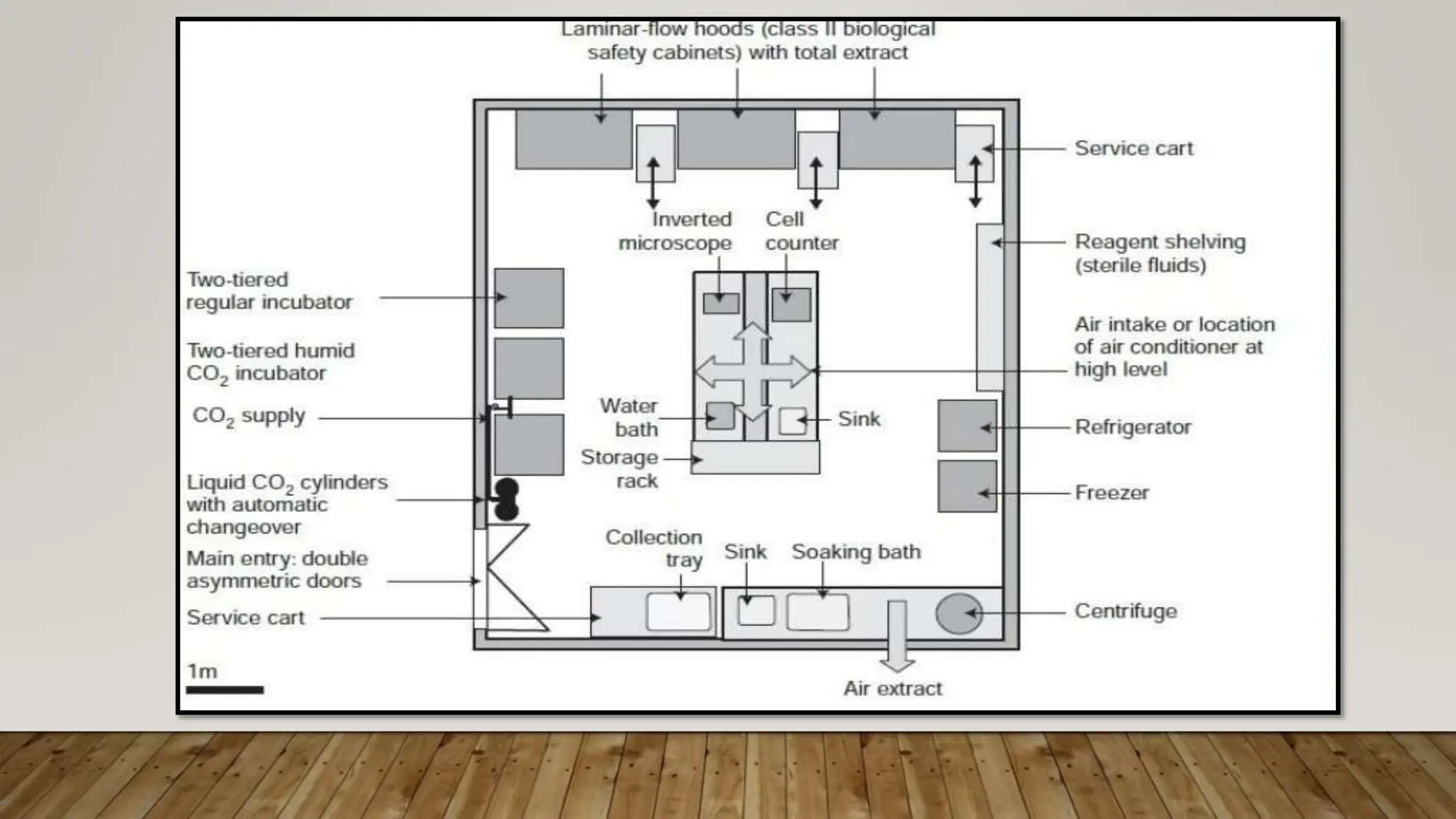
IV. LAYOUT OF ASEPTIC ROOM OR SUITE
Six main function
– sterile handling ,
incubation ,
preparation ,
washup ,
sterilization and
storage.
Sterile gradient-
for sterile
handling (if single
room) & it should
be at one end of
the room.
Wash up and
sterilization
facilities at other
end
In between –
Preparation ,
storage and
incubation
Preparation area
should be
adjacent to the
washups and
sterilization areas.
Storage &
Incubators should
be readily
accessible to the
sterile working
area.
Sterile handling
area
• Sterile area restricted
• No traffic or disturbance
• Absence of laminar hoods – use separate
room or cubicle
• Plastic laminate topped bench ( plain
white or neutral gray- facilitate
observation of cultures, dissection, etc. &
allow accurate reading of pH )
• Bench- Freestanding or sealed to wall
• Less expensive than sterile rooms.
• Hoods- operator’s arm enter
• Laminar flow wall or ceiling units – operator is
part of work area
• Wear sterile caps and gowns
• Legroom with space for pumps, aspirators.
• Chairs with adjustable seat & height
• Cart or trolley or folding flap (300-500mm)
Laminar
Quarantine &
containment
• Separate room with door or lock
• Separate incubators , freezer , Refrigerator ,
centrifuge , supplies and disposal.
• Newly imported cell lines or biopsies (free of
contamination –mycoplasma , HIV , Hepatitis B)
• Act as level II containment – biohazard cabinet
or pathogen trap (at higher level of
containment.)
Service bench
• Position of bench -Close to sterile handling
area
• Drawer units below and open shelves above
• Store sterile glassware's , plastics , pipettes ,
screw caps , syringes etc.
• For Other accessory equipment- small
centrifuge etc.
V. INCUBATION
A .Incubators
• Clean air , low disturbance level & minimal traffic
will give your incubation area a better chance of
avoiding dust , spores etc.
• Less expensive and economical in term of space
• More than 2- less convenient
• Lose more heat & slow to recover
• Per person-0.2 m cube of incubation space with
0.5m square shelf space.
b. Hot rooms
• Less expensive than two incubators .
• Insulated to prevent cold spots.
• Avoid wooden furnishings - harbors infestation
• Stainless steel bench or plastic laminate should be provided.
• Use demountable shelving and space shelf supports to support the shelving without sagging.
• Small bench ( with inverted microscope ,notebook flasks etc. ) –should be provided
• A small LFH located in the room (3ft wide)
• Temperature - +_ 0.5 degree Celsius
• Temperature depends – thermostat sensor , circulation of air in the room ,nature of the
isolation , & evolution of heat by other apparatus
HEATER- fan heater provide heat , run continuously.
Approx. 2-3kw per 20 m cube required
Power of heating element – proportional controller.
AIR CIRCULATION – Fan positioned on the opposite side of room & ensure maximum circulation
more than 2*2 m room – ducting necessary
long rectangular room- false wall must be built at either end .
THERMOSTAT– ‘’Proportional controller’’
There should be two separate heaters H1 & H2- having thermostat – HT1 & HT2
HT1- set at 37 degree Celsius & HT2 set at 38 degree Celsius
OVERHEATING- Arise because of :
* increase of room temperature
*heat produced from apparatus
ACCESS- Doors should be well insulated and easily closed , adequate heating , good circulation.
Hatch leading into tissue culture area and insulated coat as well
THERMOMETER- Temperature recorder should be record installed
chart should be placed and changed weekly
One high level and one low level warning light should be placed beside the chart.
VI. PREPARATION AREA
Area for media preparation-
• Accommodate balances , Ph meter , osmometer etc.
• Reagents – salt solutions & EDTA
• Preparation area should be clean & quiet.
• Preparation and sterilization in hoods.
• Extra horizontal laminar flow hood should be provided in sterile area for
filtering .
• Incubator space – for quality control of sterile area
• Heat stable solutions & equipment can be autoclaved or dry-heat sterilized
A. Media
preparation
b. washups
• Wash up and sterilization facilities – outside tissue culture lab
• Autoclaves , ovens & distillation – should be in separate rooms with
extraction fan
• Space for drying glassware's , sorting pipettes , packaging and
sealing packs for sterilization
• Space for- pipette washer & dyer.
• Sinks –stainless steel or polypropylene & should be deep
enough(450mm , 18 inch
• Sink- better to be too high than two low
• Raised edge- to avoid spillage
• Four taps – single cold water tap , combined hot & cold mixer , cold
tap for hose connection &nonmetallic for deionized water .
• Deionized water provision
Equipment used in tissue culture lab
REQUIREMENT?
ESSENTIAL BENEFICIAL USEFUL
1.LAMINAR AIR FLOW HOOD
• Provide - Sterile Environment
• Air is filtered through a HEPA (high efficiency particulate air )
filter before exiting the cabinet.
• Classified at levels I, II, III
• Class I cabinets – simplest & easiest to maintain , offer least
sterile protection to cell culture
• Class II cabinets – most widely used & offer good protection to
both the operator & cell culture (air is heap filtered)
• Class III cabinets – completely sealed units & used for more
hazardous types of work
• Cabinet’s surface should be wiped with ethanol both before &
after use.
• Cabinet are also equipped with UV light used to sterilize the
surface of cabinet
TYPES OF LAMINAR FLOW CABINETS
Horizontal
laminar
flow
• Direction of air flow which comes
from above then changes direction &
is processed across the work in a
horizontal direction
• The constant flow of filtered air
provides material & product
protection .
Vertical
laminar
flow
• Function equally well as horizontal
laminar flow cabinets
• Laminar air directed vertically
downwards onto the working area
• Provide greater operator protection
Horizontal laminar air flow hood Vertical laminar air flow hood
COMPONENTS AND PARTS OF LAMINAR FLOW-
Cabinets
Working station
Filter pad / pre filter
Fan / bowler
UV lamp
Fluorescent lamp
HEPA filter
WHAT KIND OF HOOD SHOULD BE USED?
Large
enough (4ft
wide * 2 ft
deep )
Quiet
Easily
cleaned
Comfortable
to sit
II. Pipette cylinders
• Also called – pipette hods
• Made from – polypropylene
• Freestanding and distributed
• One per workstation
• Sufficient no in reserve to allow
full cylinder to stand for 2 h in
disinfectant
III. Aspiration
pump
Aspirators are used for
the removal and disposal
of liquids
Aspiration pump creates
a vacuum in the
collection bottle which
pulls in liquid due to
differential pressure
IV. Inverted microscope
• Inverted microscope is a microscope with its light source &
condenser on the top , above the stage pointing down , while
the objectives and turret are below the stage pointing up.
• Useful – observing living cells at the bottom of a large
container ( ex. tissue culture flask)
under more natural condition.
- Nikon marking ring - useful accessory (inserted in nosepiece
)
v. Centrifuge
• Centrifuge is the instrument used to separate the particles from a
solution according to their size , shape density , viscosity of the
medium and the rotor speed by using centrifugal force .
• Done at 80-100 g
• Higher gravity causes damage & promote agglutination of pellet
• There are basic two types of centrifuge used –
• BIGGER SIZED CENTRIFUGE COMMONLY KNOWN AS CENTRIFUGE
ITSELF
• SMALLER ONES – MICROFUGES OR MICRO CENTRIFUGES
• For large Scale suspension culture – large capacity refrigerated
centrifuge
VI. Dissecting microscope
• Also called stereo microscope
• Long working distance between 25 & 150 mm
• low magnification ability & specimen manipulated by
performing the small dissection under the microscope
• Light specimen also observed
• Used in embryonic organs or tissue from smaller invertebrates.
• Counting monolayer colonies & picking small colonies in agar.
VII. Cell counter or hemocytometer
• Used for counting the no of cell
• Automated cell counters sample the culture ,
quantify , classify , & describe cell
populations using both electrical and optical
properties
• Essential for quantitative growth kinetics.
• Two types- 1. Semi automated
• II. Fully automated
VIII. Incubator
• It is a device used to grow & maintain cell cultures
• Maintains- optimal temperature , humidity , & other conditions.(CO2 ,
O2 content )
• Used to culture both bacterial as well as eukaryotic cell .
• Vary in size from tabletop to units the size of small form.
• Most incubators include timer some can be programmed to cycle
through temperature.
• It should be corrosion resistant & easily cleaned
• Heated water jacket in incubator – avoiding cold spots formation
HUMID CO2 INCUBATOR
• These are designed to provide ideal tissue culture conditions with high
resistance to contamination.
• It gives control over the contamination with simplicity of operation & reliable
performance
• In these controlled atmosphere is achieved by using a humidifying tray and
controlling the CO2 tension with a CO2 – monitoring device which draws air
from the incubator into a sample chamber , determines the concentration of
CO2 , and air injects pure CO2 into the incubator to make up and deficiency.
• More expensive
• Air circulation – by fan (keep both the CO2 level and temperature uniform)
VIII. Temperature Recorder
• Range – (- 50 degree C - + 200
degree C)
• Monitor frozen storage , freezing of
cell ,incubators & sterilizing ovens.
• Monitored regularly for uniformity
IX .Roller Racks
• Used –scale up monolayer culture
• Calculated – no of cell required ,
maximum attainable cell density &
surface area of the bottles
• Bottle length- gives maximum yield
• Easier to locate in hot room
X. Magnetic stirrer
• Device consist of a rotating magnet or a
stationary electromagnet that creates
rotating magnetic field .
• Device should be capable of maintaining
several culture simultaneously
XI .Water purifier
• Required – rinsing glassware , dissolving
powdered media , & diluting concentrates
• Reverse osmosis – charcoal filtration
deionization & micropore filtration
XII.CCD camera and monitor
Use for taking information or convert it
into an image or video
Highly sensitive photon detector
High resolution
Sensitivity – standard (high sensitivity
causes over illumination)
Black & white- better resolution
XIII Steam sterilizer (Autoclave)
• Device used to sterilize all forms of microorganisms such as bacteria ,
fungi , protozoa etc. under high pressure steam at 121 degree C or
more for 15-20 minutes depending on the size of load & contents
• Invented by Charles Chamberland in 1884
• Principle on it work – boiling point of water is directly proportional to
the pressure when the volume is constant
• Pressure directly proptional to temperature ( when the temperature
increases proportionately i.e. for about 15 pounds of pressure per
squares inch the temperature rises to 121 degree c.
Auto ----self
Clavis ---self locking device
MAIN COMPONENTS
Heating
elements
Temperature
controller
Pressure
sensor
Chamber Door gasket
Solenoid
valve
Water level
sesnor
DIFFERENT TYPES OF AUTOCLAVES
Heat autoclave – the most
common source for autoclaving is
heating.
In these autoclave should
maintain a temperature of at least
246 degree for half an hour.
Both dry heat and heat are used .
For steam heat autoclaves –
heated water vapours used
Gas autoclave : also known as
chemiclaves
It uses vapor solution to sterilize
the contents.
Formaldehyde gas & ethylene
oxide are the sterilizing agents
used in gas autoclaves.
They consume lesser heat and take
lesser time to complete the cycle
Laboratory
autoclaves-
They are used
for general
lab work ,
component
and stability
testing , core
hardening ,
drying
glassware and
sterilizing
Stovetop
autoclaves – In
such autoclaves
the tools should
always be
separated to
allow the steam
to penetrate the
load evenly. It is
the simplest
autoclave.
Ultraviolet
autoclaves –
They
produce UV
light that
kills the
unwanted
disease
causing
organisms.
Cold
sterilization
autoclaves
– They use
a cold
sterilization
liquid to
sterilize the
contents
• Measure hydrogen ion
activity in water based
solutions indicating its
acidity or alkalinity
• Required in the absence
of phenol red indicator
PH
METER
osmometer
• Measures osmotic strength of a
solution
• It defines total no of solute particles
within the liquid that contribute the
osmotic pressure .
• Depressing freezing point &
elevating vapor pressure
Glassware washing machine
• Used for washing lab glassware's
• Water for washing should be heated
to a minimum of 80 degree C
• There should be a facility of
deionized water rinse
• Lined with stainless steel
osmometer Glassware
washing machine
storage
Refrigerator
• Efficient and cheaper
• Eliminating defrosting need
• Tissue culture reagents – 20degree C
• Cold room installation necessary in case
of more than 3 or 4 people
• Freeze room not recommended
• Autodefrost freezer – bad for some
reagents (enzymes antibiotics etc )
Cyrostorage container
• Cell lines in continues culture are
likely suffer from a genetic instability
as their passage no increases so it is
essential to prepare working stocks of
the cell and preserve them in
cryogenic storage.
Liquid nitrogen storage-
• Liquid nitrogen storage provides a long term
storage with low liquid nitrogen evaporation
• There are two main types of liquid nitrogen
storage system :
• Vapour phase – this system minimise the risk
of explosion with Cyrostorage tubes
• Liquid phase – this system usually have longer
static holding time
STERILE LIQUID HANDLING – PIPETTING AND
DISPENSING
• Pipettes and pipettors –
• Common laboratory instrument used for transferring milliliter volumes of liquid
• This pipette have gradations along their sides to calculate volume of liquid aspirated or
dispensed
• This instrument is commonly used with a pipette dispenser which enhance the liquid transfer
through the development of a partial vacuum
• These are reusable , sterilizable or disposable
• Primitive liquid transfer method is not recommended lead to liquid entering to oral cavity
• Pipette pump is used for glass pipettes & enable the liquid volume to be controlled
• Most popular pipette dispenser type is pipet-aid
• It consist – nose cone : where pipette is attached , two trigger : for dispensing
• Some pipette aids have a stand attached to the handle that allows the pipet – aid to rest on its
side without removing the pipette
REPETITIVE DISPENSING
LARGE VOLUME DISPENSING
• Dispense by pouring
• In case of small volume - 100-ml
pipette or graduated bottle or bag
may be adequate
• In case of large volume – peristaltic
pump necessary
• Known as Cornwall syringe
• Liquid is alternately taken into
syringe using a simple two way valve
• Process is semiautomatic & repetitive
• Peristaltic pump used
Laboratory backups
Computer &
Network
Upright
microscope
Low
temperature
freezer
Confocal
microscope
PCR cycler
UPRIGHT MICROSCOPE
• Required for chromosome analysis ,
mycoplasma detection , &
Autoradiography
• The source of transmitted light & the
condenser are located below the stage ,
pointing up.
• The objectives are placed on the top of
the stage , pointing down .
• The specimen is observed from the top
through the lid of a Petri dish or a
coverslip
LOW TEMPERATURE FREEZER
1.Generate lot of Heat. 2.Such
freezers should be located in
well ventilated rooms
3.Freezing is done at -70
degree C to -90 degree C
CONFOCAL MICROSCOPE
• It uses fluorescence optics
• Laser light is focused onto a defined spot at a specific within the
sample
• It lead to emission of fluorescent light at exactly this point
• Having several advantage over widefield optical microscope –
• Ability to control depth of field
• Elimination or reduction of background information away from the
focal plane
• Capability to collect serial optical sections from thick specimens
• Work on confocal microscopy
• Image obtained has better contrast & less hazy
• Creates sharp image
SPECIALIZED EQUIPMENT
Flow
cytometer
Colony
counter
Centrifugal
elutriator
Microinjection
Flow cytometer
• Method for cell analysis
• Determine cell volume in a fluid stream that circulated
quickly as they flowed in front of viewing aperture
• Fluidics, optics & electronics – three principal
components of flow cytometer
• Fluidic- transport sample from sample tube to the flow
cell.
• Optics – brain of flow cytometer
• The photocurrent from the detector is digitized and
analyzed to be saved for subsequent analysis.
Centrifugal elutriator – adapted centrifuge used for
separating cells of different types
It is highly effective and costly
Microinjection – these are used to inject anything directly into
the cells
Example : for Nuclear transplantation & Dye injection
Colony counter – designed for quick & accurate counting
of bacterial & mould colonies in petri dishes
Consumable items
Pipettes
Hemocytometer
Culture vessel
Sterile containers
Syringes and needles
Sterilization filters
Paper & towel
disinfectant
The title of this presentation is :-Establishment of animal tissue culture lab that focuses on various parameters like the design & layout of tissue culture lab , equipment's used in animal tissue culture lab

The title of this presentation is :-Establishment of animal tissue culture lab that focuses on various parameters like the design & layout of tissue culture lab , equipment's used in animal tissue culture lab

  • 1.
    ESTABLISHMENT OF ANIMAL TISSUECULTURE LAB Submitted by:- Keshav Poswal Department of Biotechnology Kurukshetra University Kurukshetra- 136119
  • 2.
    CONTENT: 1. Cell culture 2.Animal tissue culture 3.Laboratory design : Planning , construction & service , layout of aseptic room ,incubation , preparation area 4.Planning : ventilation , accommodation , renovation 5.Layout of sterile handling area : sterile handling area , LFH , quarantine & containment , service bench 6.Incubation : incubators , hot room 7.Preparation area : media preparation , Washup , Storage 8.Equipment's used in tissue culture lab
  • 3.
    CELL CULTURE: It isthe process by which cells are grown under controlled conditions , generally outside of their environment. Or It can defined as the process of cultivating cells and tissues outside the body of an organisms (invitro) in an artificial environment , which stimulates the invitro conditions Such as temperature , nutrition and protection from microorganisms.
  • 4.
    ANIMAL CELL CULTURE: •Invitro cultivation of animal organs ,cells, and tissues at defined temperature using an incubator and supplemented with a medium containing cell nutrient and growth factors is collectively knowns as Animal tissue culture. • Will continue to grow if supplied with appropriate conditions and nutrients. • Cells are capable of dividing. • It allows the single process to act as an independent unit.
  • 5.
    Laboratory design Planning Construction andservice Layout of Aseptic room Incubation Preparation Area
  • 7.
    PLANNING CONSTRUCTION & SERVICE LAYOUTOF ASEPTIC ROOM INCUBATION PREPARATION AREA VENTILLATION LOCATION STERILE HANDLING AREA INCUBATORS MEDIA PREPARATION ACCOMADATION SUPPLY OF FILTETRED AREA LAMINAR AIR FLOW HOT ROOMS WASH UP RENOVATIONS EASY CLEANING & SUITABLE DRAINAGE SYSTEM QUARANTINE AND CONTAINMENT STORAGE ACCESS ELECTRICITY & GAS SUPPLY SERVICE BENCH QUARANTINE VACCUM LINE
  • 8.
    1.PLANNING • The majorrequirement that distinguishes tissue culture from most other laboratory techniques is the need to maintain asepsis. • The tissue culture laboratory must be dust free & have no traffic. • Several consideration need to be taken in planning a new accommodation. • Old labs- modifying ventilation & air conditioning , structural modification will be expensive. • New labs- Integrative and innovative design • Facilities may be positioned for ergonomic and energy saving reasons.
  • 9.
    a.) ventillation Pressure balance Positive Pressure- avoid influx of contaminated air into surroundings of lab Negative Pressure – usage of human material Positive pressure buffer zone- preparation area and microscope Laminar air flow hoods Position of air inlets and extracts. Duct laminar air flow hoods- Improve air circulation & remove excess heat (300-500W) Decontamination with formaldehyde
  • 10.
    b.)accommodation: space- Largest area- cultureoperation accommodating laminar-flow hoods, cell counters , centrifuges , incubators , microscopes , and arrangement for media , stocks if reagents , glassware's & plastics etc. Second largest – area for wash up preparation and sterilization Third largest- area for storage Fourth largest- area for incubation Staff members- No of laminar flow hood depends on no of staff members ,duration of their work per week. 12 laminar air hoods / 50 people
  • 11.
    Aseptic area plant facility isaccessible but not contagious to tissue culture labs Windows – high heat generations , UV influx and incursion of microorganisms Windows can be disadvantage to tissue culture laboratory if they are not properly sealed. hoods Space between hoods should be 500 mm (2ft) Motion movement Minimize interference in airflow between hoods Space best filled with removable cart or trolley for bottles , flasks reagents , and a notebook
  • 12.
    Incubation area Large no offlasks or large volume flasks (sealed) incubated in hot rooms. Open plates and dishes incubated in humid Co2 incubator. Preparation area • Close to aseptic area that they are service • outside wall to allow for heat extractions from ovens and steam vents from autoclaves Facilities for washing up and for sterilization should be located
  • 13.
    Servicing aseptic area Elevator or rampsuffice Maximum load capacity of ramp without any mechanical help storage Space required for disposable plastics Cell line work with liquid nitrogen
  • 14.
    C. RENOVATIONS • Thereare some significant structural limitations: • choose the location carefully • To avoid space constraints • Awkward projections into the room that will limit flexibility
  • 15.
    a.) access b.) quarantine • Screeningfor mycoplasma in new cell lines and biopsies • Containment of biopsies and cell line posing biohazard Doorways must be wide enough and high enough . Ceiling have sufficient clearance to allow the installation of equipment such as laminar air flow hoods, incubators , and autoclaves. Doorways and spacing between equipment provide access for maintenance.
  • 18.
    II. CONSTRUCTION ANDSERVICE The rooms should be supplied with filtered air , should be regarded as buffer zones & should also receive filtered air but at positive pressure. The rooms should be designed for easy cleaning & cover the floor with a vinyl or other dustproof finish. Lab should be separated from the preparations , washups , & sterilization areas . Service that are required include power, combustible gas (domestic methane , propane , etc.,) CO2 , compressed air and vacuum. Electricity is cleaner & generally easier to manage from a safety standpoint. Gas flow metres or electronic gas blenders – correct gas mixture Vacuum line- evacuating culture flasks. Collection vessel- prevent fluid , vapor or some containment from entering the vacuum line and pump.
  • 19.
    IV. LAYOUT OFASEPTIC ROOM OR SUITE Six main function – sterile handling , incubation , preparation , washup , sterilization and storage. Sterile gradient- for sterile handling (if single room) & it should be at one end of the room. Wash up and sterilization facilities at other end In between – Preparation , storage and incubation Preparation area should be adjacent to the washups and sterilization areas. Storage & Incubators should be readily accessible to the sterile working area.
  • 20.
    Sterile handling area • Sterilearea restricted • No traffic or disturbance • Absence of laminar hoods – use separate room or cubicle • Plastic laminate topped bench ( plain white or neutral gray- facilitate observation of cultures, dissection, etc. & allow accurate reading of pH ) • Bench- Freestanding or sealed to wall
  • 21.
    • Less expensivethan sterile rooms. • Hoods- operator’s arm enter • Laminar flow wall or ceiling units – operator is part of work area • Wear sterile caps and gowns • Legroom with space for pumps, aspirators. • Chairs with adjustable seat & height • Cart or trolley or folding flap (300-500mm) Laminar
  • 22.
    Quarantine & containment • Separateroom with door or lock • Separate incubators , freezer , Refrigerator , centrifuge , supplies and disposal. • Newly imported cell lines or biopsies (free of contamination –mycoplasma , HIV , Hepatitis B) • Act as level II containment – biohazard cabinet or pathogen trap (at higher level of containment.) Service bench • Position of bench -Close to sterile handling area • Drawer units below and open shelves above • Store sterile glassware's , plastics , pipettes , screw caps , syringes etc. • For Other accessory equipment- small centrifuge etc.
  • 23.
    V. INCUBATION A .Incubators •Clean air , low disturbance level & minimal traffic will give your incubation area a better chance of avoiding dust , spores etc. • Less expensive and economical in term of space • More than 2- less convenient • Lose more heat & slow to recover • Per person-0.2 m cube of incubation space with 0.5m square shelf space.
  • 25.
    b. Hot rooms •Less expensive than two incubators . • Insulated to prevent cold spots. • Avoid wooden furnishings - harbors infestation • Stainless steel bench or plastic laminate should be provided. • Use demountable shelving and space shelf supports to support the shelving without sagging. • Small bench ( with inverted microscope ,notebook flasks etc. ) –should be provided • A small LFH located in the room (3ft wide) • Temperature - +_ 0.5 degree Celsius • Temperature depends – thermostat sensor , circulation of air in the room ,nature of the isolation , & evolution of heat by other apparatus
  • 26.
    HEATER- fan heaterprovide heat , run continuously. Approx. 2-3kw per 20 m cube required Power of heating element – proportional controller. AIR CIRCULATION – Fan positioned on the opposite side of room & ensure maximum circulation more than 2*2 m room – ducting necessary long rectangular room- false wall must be built at either end . THERMOSTAT– ‘’Proportional controller’’ There should be two separate heaters H1 & H2- having thermostat – HT1 & HT2 HT1- set at 37 degree Celsius & HT2 set at 38 degree Celsius OVERHEATING- Arise because of : * increase of room temperature *heat produced from apparatus ACCESS- Doors should be well insulated and easily closed , adequate heating , good circulation. Hatch leading into tissue culture area and insulated coat as well THERMOMETER- Temperature recorder should be record installed chart should be placed and changed weekly One high level and one low level warning light should be placed beside the chart.
  • 27.
    VI. PREPARATION AREA Areafor media preparation- • Accommodate balances , Ph meter , osmometer etc. • Reagents – salt solutions & EDTA • Preparation area should be clean & quiet. • Preparation and sterilization in hoods. • Extra horizontal laminar flow hood should be provided in sterile area for filtering . • Incubator space – for quality control of sterile area • Heat stable solutions & equipment can be autoclaved or dry-heat sterilized A. Media preparation
  • 29.
    b. washups • Washup and sterilization facilities – outside tissue culture lab • Autoclaves , ovens & distillation – should be in separate rooms with extraction fan • Space for drying glassware's , sorting pipettes , packaging and sealing packs for sterilization • Space for- pipette washer & dyer. • Sinks –stainless steel or polypropylene & should be deep enough(450mm , 18 inch • Sink- better to be too high than two low • Raised edge- to avoid spillage • Four taps – single cold water tap , combined hot & cold mixer , cold tap for hose connection &nonmetallic for deionized water . • Deionized water provision
  • 30.
    Equipment used intissue culture lab
  • 31.
  • 32.
    1.LAMINAR AIR FLOWHOOD • Provide - Sterile Environment • Air is filtered through a HEPA (high efficiency particulate air ) filter before exiting the cabinet. • Classified at levels I, II, III • Class I cabinets – simplest & easiest to maintain , offer least sterile protection to cell culture • Class II cabinets – most widely used & offer good protection to both the operator & cell culture (air is heap filtered) • Class III cabinets – completely sealed units & used for more hazardous types of work • Cabinet’s surface should be wiped with ethanol both before & after use. • Cabinet are also equipped with UV light used to sterilize the surface of cabinet
  • 33.
    TYPES OF LAMINARFLOW CABINETS Horizontal laminar flow • Direction of air flow which comes from above then changes direction & is processed across the work in a horizontal direction • The constant flow of filtered air provides material & product protection . Vertical laminar flow • Function equally well as horizontal laminar flow cabinets • Laminar air directed vertically downwards onto the working area • Provide greater operator protection
  • 34.
    Horizontal laminar airflow hood Vertical laminar air flow hood
  • 35.
    COMPONENTS AND PARTSOF LAMINAR FLOW- Cabinets Working station Filter pad / pre filter Fan / bowler UV lamp Fluorescent lamp HEPA filter
  • 36.
    WHAT KIND OFHOOD SHOULD BE USED? Large enough (4ft wide * 2 ft deep ) Quiet Easily cleaned Comfortable to sit
  • 37.
    II. Pipette cylinders •Also called – pipette hods • Made from – polypropylene • Freestanding and distributed • One per workstation • Sufficient no in reserve to allow full cylinder to stand for 2 h in disinfectant III. Aspiration pump Aspirators are used for the removal and disposal of liquids Aspiration pump creates a vacuum in the collection bottle which pulls in liquid due to differential pressure
  • 38.
    IV. Inverted microscope •Inverted microscope is a microscope with its light source & condenser on the top , above the stage pointing down , while the objectives and turret are below the stage pointing up. • Useful – observing living cells at the bottom of a large container ( ex. tissue culture flask) under more natural condition. - Nikon marking ring - useful accessory (inserted in nosepiece )
  • 39.
    v. Centrifuge • Centrifugeis the instrument used to separate the particles from a solution according to their size , shape density , viscosity of the medium and the rotor speed by using centrifugal force . • Done at 80-100 g • Higher gravity causes damage & promote agglutination of pellet • There are basic two types of centrifuge used – • BIGGER SIZED CENTRIFUGE COMMONLY KNOWN AS CENTRIFUGE ITSELF • SMALLER ONES – MICROFUGES OR MICRO CENTRIFUGES • For large Scale suspension culture – large capacity refrigerated centrifuge
  • 40.
    VI. Dissecting microscope •Also called stereo microscope • Long working distance between 25 & 150 mm • low magnification ability & specimen manipulated by performing the small dissection under the microscope • Light specimen also observed • Used in embryonic organs or tissue from smaller invertebrates. • Counting monolayer colonies & picking small colonies in agar.
  • 41.
    VII. Cell counteror hemocytometer • Used for counting the no of cell • Automated cell counters sample the culture , quantify , classify , & describe cell populations using both electrical and optical properties • Essential for quantitative growth kinetics. • Two types- 1. Semi automated • II. Fully automated
  • 42.
    VIII. Incubator • Itis a device used to grow & maintain cell cultures • Maintains- optimal temperature , humidity , & other conditions.(CO2 , O2 content ) • Used to culture both bacterial as well as eukaryotic cell . • Vary in size from tabletop to units the size of small form. • Most incubators include timer some can be programmed to cycle through temperature. • It should be corrosion resistant & easily cleaned • Heated water jacket in incubator – avoiding cold spots formation
  • 43.
    HUMID CO2 INCUBATOR •These are designed to provide ideal tissue culture conditions with high resistance to contamination. • It gives control over the contamination with simplicity of operation & reliable performance • In these controlled atmosphere is achieved by using a humidifying tray and controlling the CO2 tension with a CO2 – monitoring device which draws air from the incubator into a sample chamber , determines the concentration of CO2 , and air injects pure CO2 into the incubator to make up and deficiency. • More expensive • Air circulation – by fan (keep both the CO2 level and temperature uniform)
  • 44.
    VIII. Temperature Recorder •Range – (- 50 degree C - + 200 degree C) • Monitor frozen storage , freezing of cell ,incubators & sterilizing ovens. • Monitored regularly for uniformity IX .Roller Racks • Used –scale up monolayer culture • Calculated – no of cell required , maximum attainable cell density & surface area of the bottles • Bottle length- gives maximum yield • Easier to locate in hot room
  • 45.
    X. Magnetic stirrer •Device consist of a rotating magnet or a stationary electromagnet that creates rotating magnetic field . • Device should be capable of maintaining several culture simultaneously XI .Water purifier • Required – rinsing glassware , dissolving powdered media , & diluting concentrates • Reverse osmosis – charcoal filtration deionization & micropore filtration XII.CCD camera and monitor Use for taking information or convert it into an image or video Highly sensitive photon detector High resolution Sensitivity – standard (high sensitivity causes over illumination) Black & white- better resolution
  • 46.
    XIII Steam sterilizer(Autoclave) • Device used to sterilize all forms of microorganisms such as bacteria , fungi , protozoa etc. under high pressure steam at 121 degree C or more for 15-20 minutes depending on the size of load & contents • Invented by Charles Chamberland in 1884 • Principle on it work – boiling point of water is directly proportional to the pressure when the volume is constant • Pressure directly proptional to temperature ( when the temperature increases proportionately i.e. for about 15 pounds of pressure per squares inch the temperature rises to 121 degree c. Auto ----self Clavis ---self locking device
  • 47.
  • 49.
    DIFFERENT TYPES OFAUTOCLAVES Heat autoclave – the most common source for autoclaving is heating. In these autoclave should maintain a temperature of at least 246 degree for half an hour. Both dry heat and heat are used . For steam heat autoclaves – heated water vapours used
  • 50.
    Gas autoclave :also known as chemiclaves It uses vapor solution to sterilize the contents. Formaldehyde gas & ethylene oxide are the sterilizing agents used in gas autoclaves. They consume lesser heat and take lesser time to complete the cycle
  • 51.
    Laboratory autoclaves- They are used forgeneral lab work , component and stability testing , core hardening , drying glassware and sterilizing Stovetop autoclaves – In such autoclaves the tools should always be separated to allow the steam to penetrate the load evenly. It is the simplest autoclave.
  • 52.
    Ultraviolet autoclaves – They produce UV lightthat kills the unwanted disease causing organisms. Cold sterilization autoclaves – They use a cold sterilization liquid to sterilize the contents
  • 54.
    • Measure hydrogenion activity in water based solutions indicating its acidity or alkalinity • Required in the absence of phenol red indicator PH METER
  • 55.
    osmometer • Measures osmoticstrength of a solution • It defines total no of solute particles within the liquid that contribute the osmotic pressure . • Depressing freezing point & elevating vapor pressure Glassware washing machine • Used for washing lab glassware's • Water for washing should be heated to a minimum of 80 degree C • There should be a facility of deionized water rinse • Lined with stainless steel
  • 56.
  • 57.
    storage Refrigerator • Efficient andcheaper • Eliminating defrosting need • Tissue culture reagents – 20degree C • Cold room installation necessary in case of more than 3 or 4 people • Freeze room not recommended • Autodefrost freezer – bad for some reagents (enzymes antibiotics etc ) Cyrostorage container • Cell lines in continues culture are likely suffer from a genetic instability as their passage no increases so it is essential to prepare working stocks of the cell and preserve them in cryogenic storage.
  • 58.
    Liquid nitrogen storage- •Liquid nitrogen storage provides a long term storage with low liquid nitrogen evaporation • There are two main types of liquid nitrogen storage system : • Vapour phase – this system minimise the risk of explosion with Cyrostorage tubes • Liquid phase – this system usually have longer static holding time
  • 59.
    STERILE LIQUID HANDLING– PIPETTING AND DISPENSING • Pipettes and pipettors – • Common laboratory instrument used for transferring milliliter volumes of liquid • This pipette have gradations along their sides to calculate volume of liquid aspirated or dispensed • This instrument is commonly used with a pipette dispenser which enhance the liquid transfer through the development of a partial vacuum • These are reusable , sterilizable or disposable • Primitive liquid transfer method is not recommended lead to liquid entering to oral cavity • Pipette pump is used for glass pipettes & enable the liquid volume to be controlled • Most popular pipette dispenser type is pipet-aid • It consist – nose cone : where pipette is attached , two trigger : for dispensing • Some pipette aids have a stand attached to the handle that allows the pipet – aid to rest on its side without removing the pipette
  • 60.
    REPETITIVE DISPENSING LARGE VOLUMEDISPENSING • Dispense by pouring • In case of small volume - 100-ml pipette or graduated bottle or bag may be adequate • In case of large volume – peristaltic pump necessary • Known as Cornwall syringe • Liquid is alternately taken into syringe using a simple two way valve • Process is semiautomatic & repetitive • Peristaltic pump used
  • 61.
  • 62.
    UPRIGHT MICROSCOPE • Requiredfor chromosome analysis , mycoplasma detection , & Autoradiography • The source of transmitted light & the condenser are located below the stage , pointing up. • The objectives are placed on the top of the stage , pointing down . • The specimen is observed from the top through the lid of a Petri dish or a coverslip
  • 63.
    LOW TEMPERATURE FREEZER 1.Generatelot of Heat. 2.Such freezers should be located in well ventilated rooms 3.Freezing is done at -70 degree C to -90 degree C
  • 64.
    CONFOCAL MICROSCOPE • Ituses fluorescence optics • Laser light is focused onto a defined spot at a specific within the sample • It lead to emission of fluorescent light at exactly this point • Having several advantage over widefield optical microscope – • Ability to control depth of field • Elimination or reduction of background information away from the focal plane • Capability to collect serial optical sections from thick specimens • Work on confocal microscopy • Image obtained has better contrast & less hazy • Creates sharp image
  • 65.
  • 66.
    Flow cytometer • Methodfor cell analysis • Determine cell volume in a fluid stream that circulated quickly as they flowed in front of viewing aperture • Fluidics, optics & electronics – three principal components of flow cytometer • Fluidic- transport sample from sample tube to the flow cell. • Optics – brain of flow cytometer • The photocurrent from the detector is digitized and analyzed to be saved for subsequent analysis.
  • 67.
    Centrifugal elutriator –adapted centrifuge used for separating cells of different types It is highly effective and costly Microinjection – these are used to inject anything directly into the cells Example : for Nuclear transplantation & Dye injection Colony counter – designed for quick & accurate counting of bacterial & mould colonies in petri dishes
  • 68.
    Consumable items Pipettes Hemocytometer Culture vessel Sterilecontainers Syringes and needles Sterilization filters Paper & towel disinfectant