prof. dr. Andreas Voss
Radboud UMC & CWZ
Nijmegen
The Netherlands
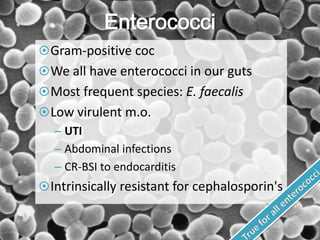
 Gram-positive coc
 We all have enterococci in our guts

 Most frequent species: E. faecalis
 Low virulent m.o.
– UTI
– Abdominal infections
– CR-BSI to endocarditis
 Intrinsically resistant for cephalosporin's
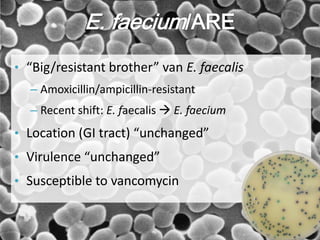
• “Big/resistant brother” van E. faecalis
– Amoxicillin/ampicillin-resistant
– Recent shift: E. faecalis  E. faecium

• Location (GI tract) “unchanged”

• Virulence “unchanged”
• Susceptible to vancomycin
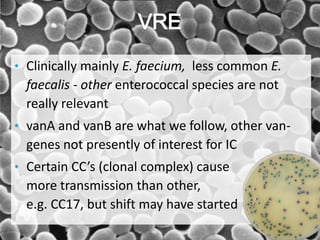
• Clinically mainly E. faecium, less common E.

faecalis - other enterococcal species are not
really relevant
• vanA and vanB are what we follow, other van-

genes not presently of interest for IC
• Certain CC’s (clonal complex) cause

more transmission than other,
e.g. CC17, but shift may have started
Meningitis
BSI
Endocarditis

Neonatal infections

Intra-abdominal
infection
UTI

BSI

Pneumonia

Wond infection

Patient: low immunity, many AB, high co-morbidity

UTI
Surgical infections
 Enterococci are the second most common cause of

nosocomial infections in the US, responsible for 10 to
20% of all such infections in the US and for
approximately 8% of all nosocomial bloodstream
infections.
 Concern about VRE is related to the potential for
nosocomial transmission, the lack of antibiotics to treat
infections caused by this organism, and the possibility
that the vancomycin-resistant genes present in VRE can
be transferred to other gram-positive microorganisms
such as Staphylococcus aureus.
VRE

Wisplinghoff et al. Clinical Infectious Diseases 2004; 39:309–17
 In Europe, an important community reservoir of VRE

existed in the 1980s and 1990s which has been
associated with the massive use of avoparcin as growth
promotor in animal husbandry.
 The Europe-wide ban on the use of avoparcin in April

1997 resulted in a substantial reduction in the
prevalence of VRE colonization in farm animals and
non-hospitalized persons .
EARS June 2011
 Contact isolation
 Single room !!!!!
 personal toilet/bathroom, …

 Gown & gloves

 Hand hygiene
 Cleaning & disinfection of
environment !!!!!!
… en elders
 This first episode of VRE outbreaks (2011-12) in Dutch hospitals

was followed by a period of 10 years in which there were cases
of hospital-acquired infections by VRE, but no large hospital
outbreaks.
 During this period, however, colonization rates with ampicillin-

resistant, vancomycin-susceptible E. faecium belonging to the
HA-E.faecium subpopulation substantially increased, as did
nosocomial infections with these clones, indicating both
enhanced capabilities of cross-transmission and pathogenicity
 Not one cause, but multiple “wrongs”

at the same time
 Swiss-Cheese-Accident Model
(hand)hygiene
Maintenance/tech.
Bad luck

Work pressure

Cleaning
AB-policies
Maintenance/tech.

AB-policies

(Hand) hygiene

Cleaning

Work pressure
Bad luck
Maintenance/tech.

AB-policies

(Hand) hygiene

Cleaning

VRE
outbreak

Work pressure
Bad luck
 Bad luck
 virulent clone
 Amount of work
 integration of departments in one location,
additional “flexibility”, ..
 Cleaning & disinfection
 vacant responsibilities
 Maintenance/technik
 bed-pan washers
 Discipline & behavior
 White coats & watches
 hand hygiene
 Microbiology
 Epidemiology
 Infection Control
 Politics
 Antibiotic stewardship
 Decolonization
 Sensitivity and specificty of the different agars
 Impact of selective enrichment
 Comparison of different chromeagars
 Problem during outbreak
 takes to long (2 days)
 too much hands-on time
 availibility
 Detection of E. faecium, CC17, van A and van B
 Outbreak = great opportunity for validation

 ProblemPCR
 validation= double effort/work
 alleen CC17, terwijl inmiddels ook andere CC’s
 detectie “faecium” minder gevoelig
 AFLP
 CWZ standard, (>3 different AFLP protocols)
 MLST
 Problem typing
 AFLP: 3 methods = 3 different clusters
 MLST: money & time, differentiation
 Malditof for typing
 = factor combining temperature and time
 Bed-pan washers were validated according to

European Norm volgens
A60 = the effect of 1 min 80°C
 A0 values
 >60
cleaning, contact with healthy skin
 >600 semi-critical, in contact with broken skin or
mucouse membrances
>3000 critical, in contact with sterile tissue
Problem: A0-value “norm” okay, but bed-pans
still VRE+
 in-vitro experiment to determine A0 value:
Outbreak strain = 160
 In addition bed-pans visibly soiled = A0-value says

nothing about how “clean” something is
 How many culture (sets) to say that

someone is a VRE carrier?
 at least 5 sets

 How long does a patient stays VRE+
 cohort study VRE+ patients
 at least a year (nat. guidelines), longer?
 Cleaning & vacant responsibilities

 Improving hand hygiene
 Roomservice
 Roomservice-plus

 Nurses
 Nurse-assistents
 Housekeeping

Thus, who does it after
the merge?

If they do it, are they
doing it well?
 External certified

company validated bedpan washers according to
EN
 When checking – their
methods they were not
okay.
 Who is resposnible?

Zijn externe bedrijven te vertrouwen
 Is the VRE outbreak related to the local use of

antibiotics
 The ICU uses SDD – any effect?
 No proof that SDD or SOD increases chance of

VRE colonization (but most trials in countries
with low VRE prevalence)
 We do know that cephalosporin use (including

in ICU) selects for enterococci and VRE
 In the Netherlands: of the 15 hospitals with VRE

problems 10 (71%) used SDD compared to about
50% in general
 93% of the patients received antibiotics in the

last 3 months before the first pos VRE culture
 versus <50% of VRE- patients

 54% had antibiotics at the moment of their first

pos VRE culture
 On average patients had 2.85 different
antibiotics before their first pos VRE culture
(range 0-10)
 Only 0.9% had previously received vancomycin
% of pts with a certain antibiotic
 Change

of (empiric) treatment regiments

 Change

treatment guideline



implementation of new guidelines



lunch meetings

 Monitoring

of ciprofloxacin-use after the

implementation
ciprofloxacin ddd/1000 admissions

250

intervention
200

150

100

50

0
December 2012 Januari 2013 Februari 2013

Maart 2013
 If you thing you are out of trouble – things

might change surprisingly quickly
 look at you E. faecium epidemiology

 Basic infection control and environmental

cleaning are of up-most importance
 prevent vacant responsibilities
 check your disinfection procedures

VRE 7th GCC

  • 1.
    prof. dr. AndreasVoss Radboud UMC & CWZ Nijmegen The Netherlands
  • 2.
     Gram-positive coc We all have enterococci in our guts  Most frequent species: E. faecalis  Low virulent m.o. – UTI – Abdominal infections – CR-BSI to endocarditis  Intrinsically resistant for cephalosporin's
  • 3.
    • “Big/resistant brother”van E. faecalis – Amoxicillin/ampicillin-resistant – Recent shift: E. faecalis  E. faecium • Location (GI tract) “unchanged” • Virulence “unchanged” • Susceptible to vancomycin
  • 4.
    • Clinically mainlyE. faecium, less common E. faecalis - other enterococcal species are not really relevant • vanA and vanB are what we follow, other van- genes not presently of interest for IC • Certain CC’s (clonal complex) cause more transmission than other, e.g. CC17, but shift may have started
  • 5.
  • 6.
     Enterococci arethe second most common cause of nosocomial infections in the US, responsible for 10 to 20% of all such infections in the US and for approximately 8% of all nosocomial bloodstream infections.  Concern about VRE is related to the potential for nosocomial transmission, the lack of antibiotics to treat infections caused by this organism, and the possibility that the vancomycin-resistant genes present in VRE can be transferred to other gram-positive microorganisms such as Staphylococcus aureus.
  • 7.
    VRE Wisplinghoff et al.Clinical Infectious Diseases 2004; 39:309–17
  • 8.
     In Europe,an important community reservoir of VRE existed in the 1980s and 1990s which has been associated with the massive use of avoparcin as growth promotor in animal husbandry.  The Europe-wide ban on the use of avoparcin in April 1997 resulted in a substantial reduction in the prevalence of VRE colonization in farm animals and non-hospitalized persons .
  • 11.
  • 12.
     Contact isolation Single room !!!!!  personal toilet/bathroom, …  Gown & gloves  Hand hygiene  Cleaning & disinfection of environment !!!!!!
  • 13.
  • 14.
     This firstepisode of VRE outbreaks (2011-12) in Dutch hospitals was followed by a period of 10 years in which there were cases of hospital-acquired infections by VRE, but no large hospital outbreaks.  During this period, however, colonization rates with ampicillin- resistant, vancomycin-susceptible E. faecium belonging to the HA-E.faecium subpopulation substantially increased, as did nosocomial infections with these clones, indicating both enhanced capabilities of cross-transmission and pathogenicity
  • 15.
     Not onecause, but multiple “wrongs” at the same time  Swiss-Cheese-Accident Model
  • 16.
  • 17.
  • 18.
  • 19.
     Bad luck virulent clone  Amount of work  integration of departments in one location, additional “flexibility”, ..  Cleaning & disinfection  vacant responsibilities  Maintenance/technik  bed-pan washers  Discipline & behavior  White coats & watches  hand hygiene
  • 20.
     Microbiology  Epidemiology Infection Control  Politics  Antibiotic stewardship  Decolonization
  • 22.
     Sensitivity andspecificty of the different agars  Impact of selective enrichment  Comparison of different chromeagars  Problem during outbreak  takes to long (2 days)  too much hands-on time  availibility
  • 23.
     Detection ofE. faecium, CC17, van A and van B  Outbreak = great opportunity for validation  ProblemPCR  validation= double effort/work  alleen CC17, terwijl inmiddels ook andere CC’s  detectie “faecium” minder gevoelig
  • 24.
     AFLP  CWZstandard, (>3 different AFLP protocols)  MLST  Problem typing  AFLP: 3 methods = 3 different clusters  MLST: money & time, differentiation  Malditof for typing
  • 25.
     = factorcombining temperature and time
  • 26.
     Bed-pan washerswere validated according to European Norm volgens A60 = the effect of 1 min 80°C  A0 values  >60 cleaning, contact with healthy skin  >600 semi-critical, in contact with broken skin or mucouse membrances >3000 critical, in contact with sterile tissue
  • 29.
    Problem: A0-value “norm”okay, but bed-pans still VRE+  in-vitro experiment to determine A0 value: Outbreak strain = 160  In addition bed-pans visibly soiled = A0-value says nothing about how “clean” something is
  • 31.
     How manyculture (sets) to say that someone is a VRE carrier?  at least 5 sets  How long does a patient stays VRE+  cohort study VRE+ patients  at least a year (nat. guidelines), longer?  Cleaning & vacant responsibilities  Improving hand hygiene
  • 33.
     Roomservice  Roomservice-plus Nurses  Nurse-assistents  Housekeeping Thus, who does it after the merge? If they do it, are they doing it well?
  • 35.
     External certified companyvalidated bedpan washers according to EN  When checking – their methods they were not okay.  Who is resposnible? Zijn externe bedrijven te vertrouwen
  • 37.
     Is theVRE outbreak related to the local use of antibiotics  The ICU uses SDD – any effect?
  • 38.
     No proofthat SDD or SOD increases chance of VRE colonization (but most trials in countries with low VRE prevalence)  We do know that cephalosporin use (including in ICU) selects for enterococci and VRE  In the Netherlands: of the 15 hospitals with VRE problems 10 (71%) used SDD compared to about 50% in general
  • 39.
     93% ofthe patients received antibiotics in the last 3 months before the first pos VRE culture  versus <50% of VRE- patients  54% had antibiotics at the moment of their first pos VRE culture  On average patients had 2.85 different antibiotics before their first pos VRE culture (range 0-10)  Only 0.9% had previously received vancomycin
  • 40.
    % of ptswith a certain antibiotic
  • 41.
     Change of (empiric)treatment regiments  Change treatment guideline  implementation of new guidelines  lunch meetings  Monitoring of ciprofloxacin-use after the implementation
  • 42.
  • 43.
     If youthing you are out of trouble – things might change surprisingly quickly  look at you E. faecium epidemiology  Basic infection control and environmental cleaning are of up-most importance  prevent vacant responsibilities  check your disinfection procedures