Acinetobacter baumannii
an update
Dr.T.V.Rao MD
7/7/2017 Dr.T.V.Rao MD @Acinetobacter baumannii 1
Recent History of
Acinetobacter
baumannii
• The bacteria made a large
resurgence in the early Iraq
war. Many soldiers injured
in Afghanistan and the
Iraq/Kuwait region showed
A. baumannii infections in
their bloodstreams, and
returning soldiers showed
debilitating soft tissue
infection
7/7/2017 Dr.T.V.Rao MD @Acinetobacter baumannii 2
Learning from
Iraq War
• In outpatients fatal
pneumonia were described
by Acinetobacter after use
no more effective antibiotics.
Severe wound infection and
multidrug-resistant
Acinetobacter baumannii by
Osteomyelitis were
diagnosed among American
soldiers who had been
wounded in combat
operations in Iraq and
Afghanistan.7/7/2017 Dr.T.V.Rao MD @Acinetobacter baumannii 3
Acinetobacter
baumannii a Important
Hospital associated
Infection
• Acinetobacter baumannii has
evolved as a hospital pathogen,
due in part to excessive and
inappropriate use of antibiotics.
Its transmission has been
associated with war, natural
disasters, and just about any
other instance where one
observes an influx in hospital
trauma admissions and increased
transfer of patients and staff
from one hospital to the next
7/7/2017 Dr.T.V.Rao MD @Acinetobacter baumannii 4
Acinetobacter
baumannii becoming a
Superbug
• Increasing carbapenem
resistance among
Acinetobacter species is
particularly troubling,
because it is very often
associated with multidrug
resistance and because it is
occurring in the context of
increases in the incidence of
Acinetobacter infection
7/7/2017 Dr.T.V.Rao MD @Acinetobacter baumannii 5
Acinetobacter
baumannii is …..
• Acinetobacter baumannii is a
small, rod-shaped, opportunistic
bacteria. This pathogen
generally affects people with
compromised immune systems,
especially those in hospital
settings like intensive care units.
This bacteria, like many other
species, has become increasingly
resistant to all forms of
antibiotics7/7/2017 Dr.T.V.Rao MD @Acinetobacter baumannii 6
A. baumannii has
several methods that it
uses to be an effective
pathogen
• Beta-lactamase, an enzyme
that breaks down penicillin.
• Resistance islands, genes
that encode more enzymes
to block other classes of
antibiotics.
• biofilm formation, a sort of
protective covering that
makes antibiotics unable to
get into the bacteria.
7/7/2017 Dr.T.V.Rao MD @Acinetobacter baumannii 7
Effect of A. baumannii
can make one a
carrier
• Full infections are rare in
healthy people.
Nevertheless, A.
baumannii can still
colonize a healthy person,
though they show no
symptoms. People who are
asymptotically colonized
are called carriers, as they
can spread it to others.
7/7/2017 Dr.T.V.Rao MD @Acinetobacter baumannii 8
How A. baumannii Spreads
• This primarily occurs in person-
to-person contact (physically
touching) or through
contaminated surfaces in a
hospital. Additionally, these
bacteria can live on a person's
skin, and even in a clean
environment (such as a clean
counter top) for many days
before dying.
7/7/2017 Dr.T.V.Rao MD @Acinetobacter baumannii 9
Acinetobacter
baumannii causes many
ailments, including:
• infection of the blood
(sepsis),
• infection of the skin
and muscle,
• pneumonia,
• meningitis, and even
• urinary tract
infection.
7/7/2017 Dr.T.V.Rao MD @Acinetobacter baumannii 10
Identification at
Resource poor
laboratories
• The differentiation in routine
laboratories is based on the
metabolic activities. However, the
precise differentiation of the
species with standard methods is
often not possible. Therefore,
four Genomospecies were
summarized for Acinetobacter
baumannii Acinetobacter
calcoaceticus complex.
Acinetobacter species can
ferment glucose and thus do not
belong to the so-called "non-
fermenters7/7/2017 Dr.T.V.Rao MD @Acinetobacter baumannii 11
Acinetobacter
Genus identification
• Acinetobacter is gram negative and in
the coccobacillus form when in its
stationary phase but can be rod-
shaped during periods of rapid
growth. It is oxidase negative, indole
negative, catalase positive, and
hemolytic. Acinetobacter can be
cultured on routine laboratory media
due to its ability to use various
sources of nutrition and will grow at
44°C. These standard laboratory
techniques will identify the genus but
will not identify the species.
7/7/2017 Dr.T.V.Rao MD @Acinetobacter baumannii 12
Automation gives
more precise
Identification
• There are automated
methods available
today to quickly and
accurately identify an
isolate at the species
level
7/7/2017 Dr.T.V.Rao MD @Acinetobacter baumannii 13
Newer Methods to
Identify A baumannii
• These methods are phenotypic,
utilizing biochemistry and
assimilation tests usually done
manually to identify the genus
and species of bacteria in less
time. To identify an A. baumannii
isolate, a couple of analyzers that
could be used are Microscan
WalkAway (Dade Behring, West
Sacramento, CA) and Vitek 2
(bioMérieux, Marcy l'Etoile,
France).
7/7/2017 Dr.T.V.Rao MD @Acinetobacter baumannii 14
Automation helps In
Antibiotic Sensitivity
testing too
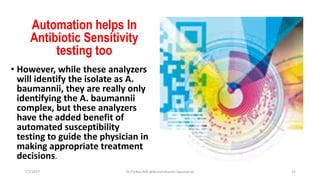
• However, while these analyzers
will identify the isolate as A.
baumannii, they are really only
identifying the A. baumannii
complex, but these analyzers
have the added benefit of
automated susceptibility
testing to guide the physician in
making appropriate treatment
decisions.
7/7/2017 Dr.T.V.Rao MD @Acinetobacter baumannii 15
Molecular Testing Methods for Identification
• Another method of
identification is molecular
testing. Molecular testing
can identify an isolate down
to the genotype. A couple of
molecular methods used in
laboratories today are
pulsed-field gel
electrophoresis (PFGE) and
16s rRNA sequencing.
7/7/2017 Dr.T.V.Rao MD @Acinetobacter baumannii 16
Why We Need
Molecular Methods
• These molecular methods
are not only useful in
identifying causes of
bacterial infection, but they
can aid a hospital in its
infection control measures,
highlighting areas of
weakness, and can identify
the source of hospital-
acquired infections.
7/7/2017 Dr.T.V.Rao MD @Acinetobacter baumannii 17
Pulsed-field gel
electrophoresis
• Pulsed-field gel
electrophoresis is a
type of gel
electrophoresis used
to separate large
molecules of DNA up
to 2000 kb. This
procedure uses 3
electric fields instead
of 1
7/7/2017 Dr.T.V.Rao MD @Acinetobacter baumannii 18
Emerging Molecular
Methods
• A second molecular method
employed in bacterial
identification is 16s ribosomal
DNA (rDNA) sequencing. In this
method, DNA is isolated from
bacterial colonies and
amplified with primers
selective for the 16s rDNA. The
rDNA can then be sequenced
and results can be compared
to Acinetobacter genotypes on
public-domain sequence
databases such as GenBank.
7/7/2017 Dr.T.V.Rao MD @Acinetobacter baumannii 19
Acinetobacter Baumannii therapy
• The agent of choice are carbapenems [imipenem
(ZIENAM), meropenem (MERONEM)] is recommended.
However, differences in sensitivity may exist with respect
to the two substances, ie with proven sensitivity to
imipenem may not be automatically inferred on sensitivity
to meropenem and vice versa. As a further treatment
option has recently become doripenem are available.
However, the frequency of resistance to carbapenems in
recent years has increased significantly worldwide.
7/7/2017 Dr.T.V.Rao MD @Acinetobacter baumannii 20
Beta-lactamase
inhibitors
• Beta-lactamase inhibitors,
especially sulbactam
(COMBACTAM), possess
intrinsic activity against
Acinetobacter baumannii. The
sulbactam monotherapy is not
recommended for serious
infections. The combination
with a Betalaktamantibiotikum
no increase in activity appears
to result..
7/7/2017 Dr.T.V.Rao MD @Acinetobacter baumannii 21
Tigecycline has bacteriostatic activity against
multidrug-resistant Acinetobacter.
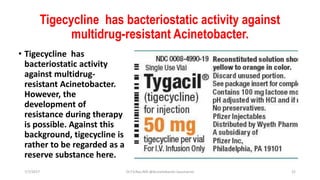
• Tigecycline has
bacteriostatic activity
against multidrug-
resistant Acinetobacter.
However, the
development of
resistance during therapy
is possible. Against this
background, tigecycline is
rather to be regarded as a
reserve substance here.
7/7/2017 Dr.T.V.Rao MD @Acinetobacter baumannii 22
Colistin in Drug
Resistant strains
• As therapeutic
alternatives, the
aminoglycosides come
(in combination with
another active
antibiotic) into
consideration. Colistin
is used for treating
infections caused by
pan-resistant strains.
7/7/2017 Dr.T.V.Rao MD @Acinetobacter baumannii 23
Prevention with
Hand Washing
• The key to reducing A.
baumannii infections is to
control contact with patients
using hand hygiene. Hand
hygiene has been shown in many
studies to be the most protective
factor that any provider can do
to prevent transmission of
infectious agents to their
patients.7/7/2017 Dr.T.V.Rao MD @Acinetobacter baumannii 24
Hand Washing most
effective to stop spread of
Drug Resistant Bacteria
• Simply running their
hands under water and
with a small amount of
soap can vastly
decrease the risk of
transmission. This tactic
has shown marked
drops in infection rates
since the early 19th
century.
7/7/2017 Dr.T.V.Rao MD @Acinetobacter baumannii 25
Environmental
Cleansing
• The next most logical and
effective method is
environmental cleansing, which
takes the form of sterilizing
surfaces and equipment. High-
grade cleaning agents such as
bleach can destroy the outer
coating of the bacteria.
However, to truly sterilize
equipment like surgical
instruments, high pressure and
heat are needed.
7/7/2017 Dr.T.V.Rao MD @Acinetobacter baumannii 26
Practice Hand Washing Save
many Lives
7/7/2017 Dr.T.V.Rao MD @Acinetobacter baumannii 27
References
• A Review of Acinetobacter baumannii as a Highly Successful Pathogen
in Times of War Callie Camp, MS, MT(ASCP)CM; Medscape resource
Infectious diseases
7/7/2017 Dr.T.V.Rao MD @Acinetobacter baumannii 28
•Program Created by Dr.T.V.Rao MD for benefit of
Medical and Paramedical Professionals for Global
resources on Infectious diseases
Email
doctortvrao@gmail.com
7/7/2017 Dr.T.V.Rao MD @Acinetobacter baumannii 29

Acinetobacter baumannii an update

  • 1.
    Acinetobacter baumannii an update Dr.T.V.RaoMD 7/7/2017 Dr.T.V.Rao MD @Acinetobacter baumannii 1
  • 2.
    Recent History of Acinetobacter baumannii •The bacteria made a large resurgence in the early Iraq war. Many soldiers injured in Afghanistan and the Iraq/Kuwait region showed A. baumannii infections in their bloodstreams, and returning soldiers showed debilitating soft tissue infection 7/7/2017 Dr.T.V.Rao MD @Acinetobacter baumannii 2
  • 3.
    Learning from Iraq War •In outpatients fatal pneumonia were described by Acinetobacter after use no more effective antibiotics. Severe wound infection and multidrug-resistant Acinetobacter baumannii by Osteomyelitis were diagnosed among American soldiers who had been wounded in combat operations in Iraq and Afghanistan.7/7/2017 Dr.T.V.Rao MD @Acinetobacter baumannii 3
  • 4.
    Acinetobacter baumannii a Important Hospitalassociated Infection • Acinetobacter baumannii has evolved as a hospital pathogen, due in part to excessive and inappropriate use of antibiotics. Its transmission has been associated with war, natural disasters, and just about any other instance where one observes an influx in hospital trauma admissions and increased transfer of patients and staff from one hospital to the next 7/7/2017 Dr.T.V.Rao MD @Acinetobacter baumannii 4
  • 5.
    Acinetobacter baumannii becoming a Superbug •Increasing carbapenem resistance among Acinetobacter species is particularly troubling, because it is very often associated with multidrug resistance and because it is occurring in the context of increases in the incidence of Acinetobacter infection 7/7/2017 Dr.T.V.Rao MD @Acinetobacter baumannii 5
  • 6.
    Acinetobacter baumannii is ….. •Acinetobacter baumannii is a small, rod-shaped, opportunistic bacteria. This pathogen generally affects people with compromised immune systems, especially those in hospital settings like intensive care units. This bacteria, like many other species, has become increasingly resistant to all forms of antibiotics7/7/2017 Dr.T.V.Rao MD @Acinetobacter baumannii 6
  • 7.
    A. baumannii has severalmethods that it uses to be an effective pathogen • Beta-lactamase, an enzyme that breaks down penicillin. • Resistance islands, genes that encode more enzymes to block other classes of antibiotics. • biofilm formation, a sort of protective covering that makes antibiotics unable to get into the bacteria. 7/7/2017 Dr.T.V.Rao MD @Acinetobacter baumannii 7
  • 8.
    Effect of A.baumannii can make one a carrier • Full infections are rare in healthy people. Nevertheless, A. baumannii can still colonize a healthy person, though they show no symptoms. People who are asymptotically colonized are called carriers, as they can spread it to others. 7/7/2017 Dr.T.V.Rao MD @Acinetobacter baumannii 8
  • 9.
    How A. baumanniiSpreads • This primarily occurs in person- to-person contact (physically touching) or through contaminated surfaces in a hospital. Additionally, these bacteria can live on a person's skin, and even in a clean environment (such as a clean counter top) for many days before dying. 7/7/2017 Dr.T.V.Rao MD @Acinetobacter baumannii 9
  • 10.
    Acinetobacter baumannii causes many ailments,including: • infection of the blood (sepsis), • infection of the skin and muscle, • pneumonia, • meningitis, and even • urinary tract infection. 7/7/2017 Dr.T.V.Rao MD @Acinetobacter baumannii 10
  • 11.
    Identification at Resource poor laboratories •The differentiation in routine laboratories is based on the metabolic activities. However, the precise differentiation of the species with standard methods is often not possible. Therefore, four Genomospecies were summarized for Acinetobacter baumannii Acinetobacter calcoaceticus complex. Acinetobacter species can ferment glucose and thus do not belong to the so-called "non- fermenters7/7/2017 Dr.T.V.Rao MD @Acinetobacter baumannii 11
  • 12.
    Acinetobacter Genus identification • Acinetobacteris gram negative and in the coccobacillus form when in its stationary phase but can be rod- shaped during periods of rapid growth. It is oxidase negative, indole negative, catalase positive, and hemolytic. Acinetobacter can be cultured on routine laboratory media due to its ability to use various sources of nutrition and will grow at 44°C. These standard laboratory techniques will identify the genus but will not identify the species. 7/7/2017 Dr.T.V.Rao MD @Acinetobacter baumannii 12
  • 13.
    Automation gives more precise Identification •There are automated methods available today to quickly and accurately identify an isolate at the species level 7/7/2017 Dr.T.V.Rao MD @Acinetobacter baumannii 13
  • 14.
    Newer Methods to IdentifyA baumannii • These methods are phenotypic, utilizing biochemistry and assimilation tests usually done manually to identify the genus and species of bacteria in less time. To identify an A. baumannii isolate, a couple of analyzers that could be used are Microscan WalkAway (Dade Behring, West Sacramento, CA) and Vitek 2 (bioMérieux, Marcy l'Etoile, France). 7/7/2017 Dr.T.V.Rao MD @Acinetobacter baumannii 14
  • 15.
    Automation helps In AntibioticSensitivity testing too • However, while these analyzers will identify the isolate as A. baumannii, they are really only identifying the A. baumannii complex, but these analyzers have the added benefit of automated susceptibility testing to guide the physician in making appropriate treatment decisions. 7/7/2017 Dr.T.V.Rao MD @Acinetobacter baumannii 15
  • 16.
    Molecular Testing Methodsfor Identification • Another method of identification is molecular testing. Molecular testing can identify an isolate down to the genotype. A couple of molecular methods used in laboratories today are pulsed-field gel electrophoresis (PFGE) and 16s rRNA sequencing. 7/7/2017 Dr.T.V.Rao MD @Acinetobacter baumannii 16
  • 17.
    Why We Need MolecularMethods • These molecular methods are not only useful in identifying causes of bacterial infection, but they can aid a hospital in its infection control measures, highlighting areas of weakness, and can identify the source of hospital- acquired infections. 7/7/2017 Dr.T.V.Rao MD @Acinetobacter baumannii 17
  • 18.
    Pulsed-field gel electrophoresis • Pulsed-fieldgel electrophoresis is a type of gel electrophoresis used to separate large molecules of DNA up to 2000 kb. This procedure uses 3 electric fields instead of 1 7/7/2017 Dr.T.V.Rao MD @Acinetobacter baumannii 18
  • 19.
    Emerging Molecular Methods • Asecond molecular method employed in bacterial identification is 16s ribosomal DNA (rDNA) sequencing. In this method, DNA is isolated from bacterial colonies and amplified with primers selective for the 16s rDNA. The rDNA can then be sequenced and results can be compared to Acinetobacter genotypes on public-domain sequence databases such as GenBank. 7/7/2017 Dr.T.V.Rao MD @Acinetobacter baumannii 19
  • 20.
    Acinetobacter Baumannii therapy •The agent of choice are carbapenems [imipenem (ZIENAM), meropenem (MERONEM)] is recommended. However, differences in sensitivity may exist with respect to the two substances, ie with proven sensitivity to imipenem may not be automatically inferred on sensitivity to meropenem and vice versa. As a further treatment option has recently become doripenem are available. However, the frequency of resistance to carbapenems in recent years has increased significantly worldwide. 7/7/2017 Dr.T.V.Rao MD @Acinetobacter baumannii 20
  • 21.
    Beta-lactamase inhibitors • Beta-lactamase inhibitors, especiallysulbactam (COMBACTAM), possess intrinsic activity against Acinetobacter baumannii. The sulbactam monotherapy is not recommended for serious infections. The combination with a Betalaktamantibiotikum no increase in activity appears to result.. 7/7/2017 Dr.T.V.Rao MD @Acinetobacter baumannii 21
  • 22.
    Tigecycline has bacteriostaticactivity against multidrug-resistant Acinetobacter. • Tigecycline has bacteriostatic activity against multidrug- resistant Acinetobacter. However, the development of resistance during therapy is possible. Against this background, tigecycline is rather to be regarded as a reserve substance here. 7/7/2017 Dr.T.V.Rao MD @Acinetobacter baumannii 22
  • 23.
    Colistin in Drug Resistantstrains • As therapeutic alternatives, the aminoglycosides come (in combination with another active antibiotic) into consideration. Colistin is used for treating infections caused by pan-resistant strains. 7/7/2017 Dr.T.V.Rao MD @Acinetobacter baumannii 23
  • 24.
    Prevention with Hand Washing •The key to reducing A. baumannii infections is to control contact with patients using hand hygiene. Hand hygiene has been shown in many studies to be the most protective factor that any provider can do to prevent transmission of infectious agents to their patients.7/7/2017 Dr.T.V.Rao MD @Acinetobacter baumannii 24
  • 25.
    Hand Washing most effectiveto stop spread of Drug Resistant Bacteria • Simply running their hands under water and with a small amount of soap can vastly decrease the risk of transmission. This tactic has shown marked drops in infection rates since the early 19th century. 7/7/2017 Dr.T.V.Rao MD @Acinetobacter baumannii 25
  • 26.
    Environmental Cleansing • The nextmost logical and effective method is environmental cleansing, which takes the form of sterilizing surfaces and equipment. High- grade cleaning agents such as bleach can destroy the outer coating of the bacteria. However, to truly sterilize equipment like surgical instruments, high pressure and heat are needed. 7/7/2017 Dr.T.V.Rao MD @Acinetobacter baumannii 26
  • 27.
    Practice Hand WashingSave many Lives 7/7/2017 Dr.T.V.Rao MD @Acinetobacter baumannii 27
  • 28.
    References • A Reviewof Acinetobacter baumannii as a Highly Successful Pathogen in Times of War Callie Camp, MS, MT(ASCP)CM; Medscape resource Infectious diseases 7/7/2017 Dr.T.V.Rao MD @Acinetobacter baumannii 28
  • 29.
    •Program Created byDr.T.V.Rao MD for benefit of Medical and Paramedical Professionals for Global resources on Infectious diseases Email doctortvrao@gmail.com 7/7/2017 Dr.T.V.Rao MD @Acinetobacter baumannii 29