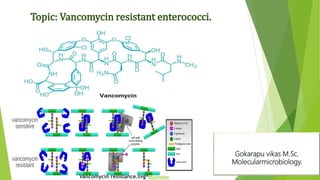
Vancomycin resistance.svg-Mcstrother
Gokarapu vikas M.Sc.
Molecularmicrobiology.
Topic: Vancomycin resistant enterococci.
Classification of the antibiotic.
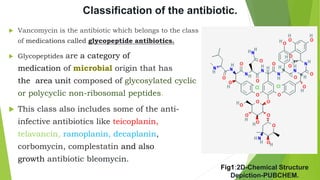
 Vancomycin is the antibiotic which belongs to the class
of medications called glycopeptide antibiotics.
 Glycopeptides are a category of
medication of microbial origin that has
the area unit composed of glycosylated cyclic
or polycyclic non-ribosomal peptides.
 This class also includes some of the anti-
infective antibiotics like teicoplanin,
telavancin, ramoplanin, decaplanin,
corbomycin, complestatin and also
growth antibiotic bleomycin.
Fig1:2D-Chemical Structure
Depiction-PUBCHEM.
Mode of Action (MoA).
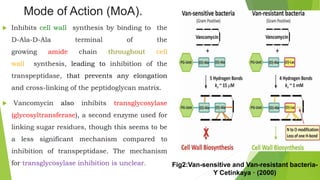
 Inhibits cell wall synthesis by binding to the
D-Ala-D-Ala terminal of the
growing amide chain throughout cell
wall synthesis, leading to inhibition of the
transpeptidase, that prevents any elongation
and cross-linking of the peptidoglycan matrix.
 Vancomycin also inhibits transglycosylase
(glycosyltransferase), a second enzyme used for
linking sugar residues, though this seems to be
a less significant mechanism compared to
inhibition of transpeptidase. The mechanism
for transglycosylase inhibition is unclear. Fig2:Van-sensitive and Van-resistant bacteria-
Y Cetinkaya · (2000)
Mode of Action (MoA) contd..,
 The results looks similar as that achieved by use of beta-lactam
antibiotics, however it differs in the binding to a distinct site,
and moving totally different molecular targets.
 Glycopeptides area unit large molecules, and can't tolerate the porin
channels found within the outer membrane of gram-negative micro-
organisms, creating them ineffective against gram negative micro-
organisms.
 Vancomycin antibiotics are refered as the Time-dependent killing
antibiotic.
 Vancomycin's activity is reduced in the presence of biofilms.
 Bactericidal (for most gram-positive bacteria)
Synergistic action with aminoglycosides against some gram positives
Causative bacteria and types bacterial diseases.
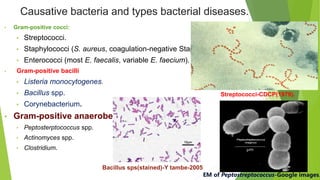
• Gram-positive cocci:
• Streptococci.
• Staphylococci (S. aureus, coagulation-negative Staph).
• Enterococci (most E. faecalis, variable E. faecium).
• Gram-positive bacilli
• Listeria monocytogenes.
• Bacillus spp.
• Corynebacterium.
• Gram-positive anaerobes:
• Peptosterptococcus spp.
• Actinomyces spp.
• Clostridium.
Streptococci-CDCP(1979).
Bacillus sps(stained)-Y tambe-2005
EM of Peptostreptococcus-Google images.
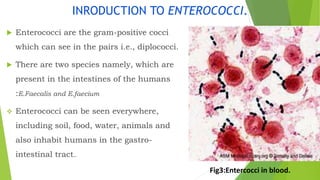
INRODUCTION TO ENTEROCOCCI.
 Enterococci are the gram-positive cocci
which can see in the pairs i.e., diplococci.
 There are two species namely, which are
present in the intestines of the humans
:E.Faecalis and E.faecium
 Enterococci can be seen everywhere,
including soil, food, water, animals and
also inhabit humans in the gastro-
intestinal tract..
Fig3:Entercocci in blood.
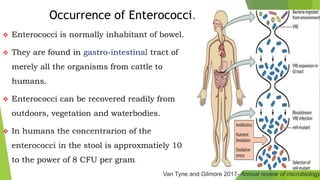
Occurrence of Enterococci.
 Enterococci is normally inhabitant of bowel.
 They are found in gastro-intestinal tract of
merely all the organisms from cattle to
humans.
 Enterococci can be recovered readily from
outdoors, vegetation and waterbodies.
 In humans the concentrarion of the
enterococci in the stool is approxmatiely 10
to the power of 8 CFU per gram.
Van Tyne and Gilmore 2017- Annual review of microbiology
Type of antibiotic resistance.
 There are 5 different types of phenotypes-VanA, VanB, VanC, VanD, and
VanE.
 2 of those are (VanA and VanB) are mediated by new gene clusters which are
not previsouly seen in the Enterococci faecalis and Enterococci faecium.
 VanA-resistant strains possess inducible, high-level resistance to
vancomycin antibiotic and teicoplanin. The details of vancomycin
resistance have been seen on the vanA gene cluster found on the
transposon, or “jumping” genetic element, Tn1546.
 VanB isolates were initially believed to be inducibly resistant to more modest
levels of vancomycin but are susceptible to teicoplanin.
 The VanC resistance phenotype was described in E.casseliflavus and
E. gallinarum, which demonstrate intrinsic, low-level resistance to
vancomycin and are susceptible to teicoplanin.
Phenotypic resistance:
Genotypic resistance mechanisms.
VanA glycopeptide resistance:
The vanA sequence and different genes concerned within the regulation
and expression of antibiotic resistance (vanR, vanS, vanH, vanX, and
vanZ) area unit situated on a ten to 581-bp deoxyribonucleic
acid (Tn1546) of E.faecium, which regularly resides on a cellular
inclusion. Expression of those genes ends up in the synthesis of
abnormal peptidoglycan precursors terminating in d-Ala–d-
lactate rather than d-Ala–d-Ala. Antibiotic binds to d-Ala–d-Lac with
markedly lower affinity than it will to the traditional dipeptide molecule.
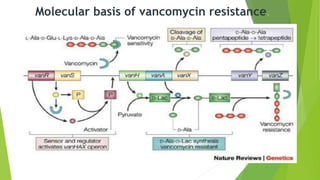
(i) VanA protein is a ligase of altered substrate specificity which
produces D-Ala–D-Lac in preference to D-Ala–D-Ala
(ii) VanH protein is a D-hydroxy acid dehydrogenase which creates a
pool of D-lactate for use in the above reaction .
(iii) VanX protein is a D,D-dipeptidase lacking activity against D-Ala–D-
Lac.
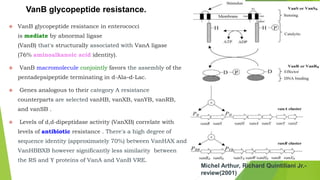
VanB glycopeptide resistance.
 VanB glycopeptide resistance in enterococci
is mediate by abnormal ligase
(VanB) that's structurally associated with VanA ligase
(76% aminoalkanoic acid identity).
 VanB macromolecule conjointly favors the assembly of the
pentadepsipeptide terminating in d-Ala–d-Lac.
 Genes analogous to their category A resistance
counterparts are selected vanHB, vanXB, vanYB, vanRB,
and vanSB .
 Levels of d,d-dipeptidase activity (VanXB) correlate with
levels of antibiotic resistance . There's a high degree of
sequence identity (approximately 70%) between VanHAX and
VanHBBXB however significantly less similarity between
the RS and Y proteins of VanA and VanB VRE.
Michel Arthur, Richard Quintiliani Jr.-
review(2001)
Molecular basis of vancomycin resistance.
VanC-glycopeptide resistance.
 Low-level resistance to antibiotic is typical of E.gallinarum, E.
casseliflavus, and E. flavescens. The ester sequences of the
vanC-1 sequence in E.gallinarum, the vanC-2 sequence in E.
casseliflavus, and therefore the vanC-3 sequence in E.
flavescens.
 VanC ligase of E.gallinarum favors the assembly of a
pentapeptide terminating in d-Ala–d-Ser. Substitution of d-Ser
for d-Ala is plausible to weaken the binding of antibiotic to the
novel pentapeptide.
 Insertional inactivation of vanC-1 unmasks the concomitant
production of the d-Ala–d-Ala pentapeptide in E. gallinarum .
VanD,VanE-glycopeptide resistance
 VanD: Partial sequencing of the ligase gene showed that
it was distinct from but similar to
the vanA and vanB ligase genes.
 VanD appears to be located on the chromosome and is
not transferable to other enterococci.
 VanE: The vanE vancomycin resistance gene has
recently been described in E. faecalis BM4405, which is
resistant to low levels of vancomycin and susceptible to
teicoplanin.
Economic burden-Numbers and facts.
• 30% – All deaths that were bacterial infection related in pre-antibiotic America.
• $20 / 1.6€ billion – Excess healthcare costs of resistant infections in the US/EU.
• 8 / 2.5 million – Excess hospital days caused by resistant infections in the US / EU.
• 30% – Antimicrobial component of pharmaceutical budgets in the US.
• 1.6% – Antibiotic allotment of all drugs in development by major pharmaceutical companies.
• 4 – Multinational pharmaceutical companies with antibiotics divisions.
• $1.1 billion – Cost of unnecessarily prescribed antibiotics in the US.
• 48% – Proportion of US hospitals that have adopted stewardship policies.
• 36% – People that correctly answered that antibiotics do not kill viruses in an EU survey.
• 24.6 million – Pounds of antibiotics used non-therapeutically on animals in the US per year..
• 300,000 – Pounds of streptomycin (24) and oxytetracycline (40) sprayed on produce in the US.
Fair, Richard J., and Yitzhak Tor (2014).
Clinical case study.
 In the case study- Cetinkaya, Yesim, Pamela Falk, and C. Glen Mayhall. "Vancomycin-resistant
enterococci." Clinical microbiology reviews 13.4 (2000): 686-707.
 A study was conducted in the department of Microbiology, Government
Medical College and Hospital, Chandigarh, India. The main intuition of the
study was to detect gastrointestinal carriage of VRE among paediatric
patients of age below 5 years. Rectal swabs from 65 children (39 males and
26 females) from paediatric ICU who were hospitalized for longer than 48 h
were screened for gastrointestinal carriage of VRE.
 Of the 65 patients, a total of 28 enterococci were isolated. Out of those , 23
were VRE; four were identified as E. faecium, and the remaining 19 were
identified as E. faecalis.
 So 23 (35.3%) patients (14 males and 9 females) carried VRE in their
gastrointestinal tract. All the VRE isolates were susceptible to linezolid.
Case study contd..,
o In this case study we can see the high rate of VRE carriage(35%)
was observed in the India as compared to studies of the low VRE
colonization on admission to the ICU from Europe (2.7%), US
(12.3%), South America (7%) and other Asian countries (5.3%).
o We can conclude from the above described case-study that we need
to study and understand the epidimelogy of the VRE ,in keeping in
mind of the Indian context and also we need to restrict the use of
freeflow of the antibiotics use.
Drug resistance: Implications.
 Antibiotic resistance ends up in higher medical prices, prolonged
hospital stays, and enhanced mortality.
 The world desperately must make strict rules
for the approaching and prescribing and use of the antibiotics.
 Even with the new antibiotics the risk of the resistance of bacteria is a
threat.
 Behaviour changes should additionally embrace actions to cut
back the unfold of infections through vaccination, hand laundry,
and sensible food hygiene.
 A growing number of infections – such as pneumonia, tuberculosis,
gonorrhoea, and salmonellosis – are becoming harder to treat as the
antibiotics used to treat them become less effective.
 Antibiotic resistance can affect anyone, of any age, in any country.
Effective ways to prevent the antibiotic resistance.
Source:biomerix 2018
Conclusion.
 As an emerging Microbiologist, I think the issue of the resistance to the
antibiotics by the bacteria is not a thing to be ignored–it is as similar as a
nuclear winter. We need to keep in mind that the bacteria has survived almost
all the catastrophes since their origin from the paleoproterozoic era (roughly
1.8 billion years ago). Bacteria being able to adapt to the harsh conditions all
over the time, tells us that we cannot hold them for long period of time with
our age old antibiotics and human stupidity of the use of Over-use
of antibiotics.
After investing so much of valuable time and money in the
research, we are not able to produce any new antibiotics(other than modifiying
old antibiotics) so we need to make clear one thing clear to ourselves that
antibiotic resistance is a near threat to mankind.
REFERENCES:
1. García-Solache, Mónica, and Louis B. Rice. "The Enterococcus: a model of
adaptability to its environment." Clinical microbiology reviews 32.2 (2019).
2. Fair, Richard J., and Yitzhak Tor. "Antibiotics and bacterial resistance in the 21st
century." Perspectives in medicinal chemistry 6 (2014).
3. Arthur, Michel, and Richard Quintiliani. "Regulation of VanA-and VanB-type
glycopeptide resistance in enterococci." Antimicrobial agents and
chemotherapy 45.2 (2001).
4. Cetinkaya, Yesim, Pamela Falk, and C. Glen Mayhall. "Vancomycin-resistant
enterococci." Clinical microbiology reviews 13.4 (2000)
“A post-antibiotic era means an end to modern
medicine as we know it. Things as common as
strep throat or a child’s scratched knee could once
again kill.”
Margaret Chan
(Director-General of the World Health Organization)
– 2012.
vancomycin
THANKING YOU.
THE END.

Vancomycin resistant enterococci.

  • 1.
    Vancomycin resistance.svg-Mcstrother Gokarapu vikasM.Sc. Molecularmicrobiology. Topic: Vancomycin resistant enterococci.
  • 2.
    Classification of theantibiotic.  Vancomycin is the antibiotic which belongs to the class of medications called glycopeptide antibiotics.  Glycopeptides are a category of medication of microbial origin that has the area unit composed of glycosylated cyclic or polycyclic non-ribosomal peptides.  This class also includes some of the anti- infective antibiotics like teicoplanin, telavancin, ramoplanin, decaplanin, corbomycin, complestatin and also growth antibiotic bleomycin. Fig1:2D-Chemical Structure Depiction-PUBCHEM.
  • 3.
    Mode of Action(MoA).  Inhibits cell wall synthesis by binding to the D-Ala-D-Ala terminal of the growing amide chain throughout cell wall synthesis, leading to inhibition of the transpeptidase, that prevents any elongation and cross-linking of the peptidoglycan matrix.  Vancomycin also inhibits transglycosylase (glycosyltransferase), a second enzyme used for linking sugar residues, though this seems to be a less significant mechanism compared to inhibition of transpeptidase. The mechanism for transglycosylase inhibition is unclear. Fig2:Van-sensitive and Van-resistant bacteria- Y Cetinkaya · (2000)
  • 4.
    Mode of Action(MoA) contd..,  The results looks similar as that achieved by use of beta-lactam antibiotics, however it differs in the binding to a distinct site, and moving totally different molecular targets.  Glycopeptides area unit large molecules, and can't tolerate the porin channels found within the outer membrane of gram-negative micro- organisms, creating them ineffective against gram negative micro- organisms.  Vancomycin antibiotics are refered as the Time-dependent killing antibiotic.  Vancomycin's activity is reduced in the presence of biofilms.  Bactericidal (for most gram-positive bacteria) Synergistic action with aminoglycosides against some gram positives
  • 5.
    Causative bacteria andtypes bacterial diseases. • Gram-positive cocci: • Streptococci. • Staphylococci (S. aureus, coagulation-negative Staph). • Enterococci (most E. faecalis, variable E. faecium). • Gram-positive bacilli • Listeria monocytogenes. • Bacillus spp. • Corynebacterium. • Gram-positive anaerobes: • Peptosterptococcus spp. • Actinomyces spp. • Clostridium. Streptococci-CDCP(1979). Bacillus sps(stained)-Y tambe-2005 EM of Peptostreptococcus-Google images.
  • 6.
    INRODUCTION TO ENTEROCOCCI. Enterococci are the gram-positive cocci which can see in the pairs i.e., diplococci.  There are two species namely, which are present in the intestines of the humans :E.Faecalis and E.faecium  Enterococci can be seen everywhere, including soil, food, water, animals and also inhabit humans in the gastro- intestinal tract.. Fig3:Entercocci in blood.
  • 7.
    Occurrence of Enterococci. Enterococci is normally inhabitant of bowel.  They are found in gastro-intestinal tract of merely all the organisms from cattle to humans.  Enterococci can be recovered readily from outdoors, vegetation and waterbodies.  In humans the concentrarion of the enterococci in the stool is approxmatiely 10 to the power of 8 CFU per gram. Van Tyne and Gilmore 2017- Annual review of microbiology
  • 8.
    Type of antibioticresistance.  There are 5 different types of phenotypes-VanA, VanB, VanC, VanD, and VanE.  2 of those are (VanA and VanB) are mediated by new gene clusters which are not previsouly seen in the Enterococci faecalis and Enterococci faecium.  VanA-resistant strains possess inducible, high-level resistance to vancomycin antibiotic and teicoplanin. The details of vancomycin resistance have been seen on the vanA gene cluster found on the transposon, or “jumping” genetic element, Tn1546.  VanB isolates were initially believed to be inducibly resistant to more modest levels of vancomycin but are susceptible to teicoplanin.  The VanC resistance phenotype was described in E.casseliflavus and E. gallinarum, which demonstrate intrinsic, low-level resistance to vancomycin and are susceptible to teicoplanin. Phenotypic resistance:
  • 9.
    Genotypic resistance mechanisms. VanAglycopeptide resistance: The vanA sequence and different genes concerned within the regulation and expression of antibiotic resistance (vanR, vanS, vanH, vanX, and vanZ) area unit situated on a ten to 581-bp deoxyribonucleic acid (Tn1546) of E.faecium, which regularly resides on a cellular inclusion. Expression of those genes ends up in the synthesis of abnormal peptidoglycan precursors terminating in d-Ala–d- lactate rather than d-Ala–d-Ala. Antibiotic binds to d-Ala–d-Lac with markedly lower affinity than it will to the traditional dipeptide molecule. (i) VanA protein is a ligase of altered substrate specificity which produces D-Ala–D-Lac in preference to D-Ala–D-Ala (ii) VanH protein is a D-hydroxy acid dehydrogenase which creates a pool of D-lactate for use in the above reaction . (iii) VanX protein is a D,D-dipeptidase lacking activity against D-Ala–D- Lac.
  • 10.
    VanB glycopeptide resistance. VanB glycopeptide resistance in enterococci is mediate by abnormal ligase (VanB) that's structurally associated with VanA ligase (76% aminoalkanoic acid identity).  VanB macromolecule conjointly favors the assembly of the pentadepsipeptide terminating in d-Ala–d-Lac.  Genes analogous to their category A resistance counterparts are selected vanHB, vanXB, vanYB, vanRB, and vanSB .  Levels of d,d-dipeptidase activity (VanXB) correlate with levels of antibiotic resistance . There's a high degree of sequence identity (approximately 70%) between VanHAX and VanHBBXB however significantly less similarity between the RS and Y proteins of VanA and VanB VRE. Michel Arthur, Richard Quintiliani Jr.- review(2001)
  • 11.
    Molecular basis ofvancomycin resistance.
  • 12.
    VanC-glycopeptide resistance.  Low-levelresistance to antibiotic is typical of E.gallinarum, E. casseliflavus, and E. flavescens. The ester sequences of the vanC-1 sequence in E.gallinarum, the vanC-2 sequence in E. casseliflavus, and therefore the vanC-3 sequence in E. flavescens.  VanC ligase of E.gallinarum favors the assembly of a pentapeptide terminating in d-Ala–d-Ser. Substitution of d-Ser for d-Ala is plausible to weaken the binding of antibiotic to the novel pentapeptide.  Insertional inactivation of vanC-1 unmasks the concomitant production of the d-Ala–d-Ala pentapeptide in E. gallinarum .
  • 13.
    VanD,VanE-glycopeptide resistance  VanD:Partial sequencing of the ligase gene showed that it was distinct from but similar to the vanA and vanB ligase genes.  VanD appears to be located on the chromosome and is not transferable to other enterococci.  VanE: The vanE vancomycin resistance gene has recently been described in E. faecalis BM4405, which is resistant to low levels of vancomycin and susceptible to teicoplanin.
  • 14.
    Economic burden-Numbers andfacts. • 30% – All deaths that were bacterial infection related in pre-antibiotic America. • $20 / 1.6€ billion – Excess healthcare costs of resistant infections in the US/EU. • 8 / 2.5 million – Excess hospital days caused by resistant infections in the US / EU. • 30% – Antimicrobial component of pharmaceutical budgets in the US. • 1.6% – Antibiotic allotment of all drugs in development by major pharmaceutical companies. • 4 – Multinational pharmaceutical companies with antibiotics divisions. • $1.1 billion – Cost of unnecessarily prescribed antibiotics in the US. • 48% – Proportion of US hospitals that have adopted stewardship policies. • 36% – People that correctly answered that antibiotics do not kill viruses in an EU survey. • 24.6 million – Pounds of antibiotics used non-therapeutically on animals in the US per year.. • 300,000 – Pounds of streptomycin (24) and oxytetracycline (40) sprayed on produce in the US. Fair, Richard J., and Yitzhak Tor (2014).
  • 15.
  • 16.
     In thecase study- Cetinkaya, Yesim, Pamela Falk, and C. Glen Mayhall. "Vancomycin-resistant enterococci." Clinical microbiology reviews 13.4 (2000): 686-707.  A study was conducted in the department of Microbiology, Government Medical College and Hospital, Chandigarh, India. The main intuition of the study was to detect gastrointestinal carriage of VRE among paediatric patients of age below 5 years. Rectal swabs from 65 children (39 males and 26 females) from paediatric ICU who were hospitalized for longer than 48 h were screened for gastrointestinal carriage of VRE.  Of the 65 patients, a total of 28 enterococci were isolated. Out of those , 23 were VRE; four were identified as E. faecium, and the remaining 19 were identified as E. faecalis.  So 23 (35.3%) patients (14 males and 9 females) carried VRE in their gastrointestinal tract. All the VRE isolates were susceptible to linezolid.
  • 17.
    Case study contd.., oIn this case study we can see the high rate of VRE carriage(35%) was observed in the India as compared to studies of the low VRE colonization on admission to the ICU from Europe (2.7%), US (12.3%), South America (7%) and other Asian countries (5.3%). o We can conclude from the above described case-study that we need to study and understand the epidimelogy of the VRE ,in keeping in mind of the Indian context and also we need to restrict the use of freeflow of the antibiotics use.
  • 18.
    Drug resistance: Implications. Antibiotic resistance ends up in higher medical prices, prolonged hospital stays, and enhanced mortality.  The world desperately must make strict rules for the approaching and prescribing and use of the antibiotics.  Even with the new antibiotics the risk of the resistance of bacteria is a threat.  Behaviour changes should additionally embrace actions to cut back the unfold of infections through vaccination, hand laundry, and sensible food hygiene.  A growing number of infections – such as pneumonia, tuberculosis, gonorrhoea, and salmonellosis – are becoming harder to treat as the antibiotics used to treat them become less effective.  Antibiotic resistance can affect anyone, of any age, in any country.
  • 19.
    Effective ways toprevent the antibiotic resistance. Source:biomerix 2018
  • 20.
    Conclusion.  As anemerging Microbiologist, I think the issue of the resistance to the antibiotics by the bacteria is not a thing to be ignored–it is as similar as a nuclear winter. We need to keep in mind that the bacteria has survived almost all the catastrophes since their origin from the paleoproterozoic era (roughly 1.8 billion years ago). Bacteria being able to adapt to the harsh conditions all over the time, tells us that we cannot hold them for long period of time with our age old antibiotics and human stupidity of the use of Over-use of antibiotics. After investing so much of valuable time and money in the research, we are not able to produce any new antibiotics(other than modifiying old antibiotics) so we need to make clear one thing clear to ourselves that antibiotic resistance is a near threat to mankind.
  • 21.
    REFERENCES: 1. García-Solache, Mónica,and Louis B. Rice. "The Enterococcus: a model of adaptability to its environment." Clinical microbiology reviews 32.2 (2019). 2. Fair, Richard J., and Yitzhak Tor. "Antibiotics and bacterial resistance in the 21st century." Perspectives in medicinal chemistry 6 (2014). 3. Arthur, Michel, and Richard Quintiliani. "Regulation of VanA-and VanB-type glycopeptide resistance in enterococci." Antimicrobial agents and chemotherapy 45.2 (2001). 4. Cetinkaya, Yesim, Pamela Falk, and C. Glen Mayhall. "Vancomycin-resistant enterococci." Clinical microbiology reviews 13.4 (2000)
  • 22.
    “A post-antibiotic erameans an end to modern medicine as we know it. Things as common as strep throat or a child’s scratched knee could once again kill.” Margaret Chan (Director-General of the World Health Organization) – 2012.
  • 23.