Year in IPC 6/23/17
Andreas Voss 1
Elaine Larson,	RN,	PhD,	FAAN,	CIC
Anna	C.	Maxwell	Professor	of	Nursing Research
Associate Dean	for Research
Columbia	University	School	of	Nursing
Andreas	Voss,	MD,	PhD,	FSHEA,	FESCMID
Professor	of	Infection Control,	Radboudumc
Clinical Microbiologist,	CWZ,	Nijmegen,	NL
both	speakers	declare	no	conflict	of	interest
Storr et	al.	Antimicrob Resist Infect	Control	(2017)	6:6	
Boyce ARIC	(2016)	5:10	
Do	you think to	know all that is	needed about
(nosocomial)	virus	infections
Not me!
Chow	&	Mermel,	Open	Forum	Infectious Diseases 2017,	DOI:	10.1093/o	d/ofx006
Year in IPC 6/23/17
Andreas Voss 2
Imagine	that	you	are	in	charge	of	cleanining
the	rest-rooms	of	a	large	fasility
Your	problem:	
Males	that	can’t	aim	and	the	consequent	“spillage”
How	to	use	human	factors	engineering	for	help?
Give	them	an	aim	à 80%	less	spillage
Bateson	et	al.	Biol.	Lett.	(2006)	2,	412–414	doi:10.1098/rsbl.2006.0509	
We	examined the effect	of	
an image	of	a	pair	of	eyes
on	contributions to an
honesty box	used to collect	
money	for drinks	in	a	
university coffee	room.
Bateson	et	al.	Biol.	Lett.	(2006)	2,	412–414	doi:10.1098/rsbl.2006.0509	
This finding provides
the first	evidence from a	
naturalistic setting	of	
the importance of	cues	
of	being watched,	and
hence reputational
concerns,	on	human	
cooperative behaviour.
… leave your money at the back doors
King	et	al.	Health	Psychol. 2016	Jan;35(1):96-101.
Year in IPC 6/23/17
Andreas Voss 3
King	et	al.	Health	Psychol. 2016	Jan;35(1):96-101.	
Visitors to the ICU	were exposed to an
olfactory prime	(“clean”	citrus smell)	using
an aroma	dispenser	and “eyes”
Choice smell determined in	earlier study
(“cleanest &	freshest”)
King	et	al.	Health	Psychol. 2016	Jan;35(1):96-101.	
olfactory >	eyes
male	>	female eyes
Priming works
(47%	vs.	15%)
If you don’t
cite yourself,	
who will?
Bob	Weinstein
Tartari et	al.		Antimicrob Reistance Infect	Control	2017;6:45
Tartari et	al.		Antimicrob Reistance Infect	Control	2017;6:45 De	Geyter et	al.	ARIC	(2017)	6:24
Year in IPC 6/23/17
Andreas Voss 4
De	Geyter et	al.	ARIC	(2017)	6:24
To control	the	outbreak,	the	
sinks and their plumbings were
replaced by new	ones with
another structure
drains
screens water
Hopman et	al		ARIC	2017;6:59
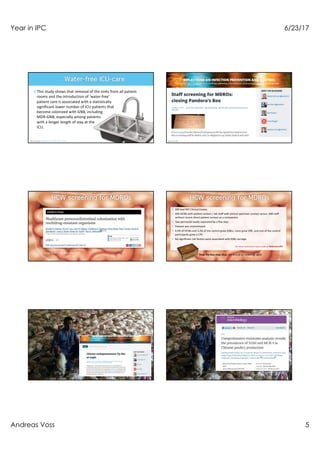
¤ The	aim of	this study was	to evaluate the effect	of	removal of	sinks from the
Intensive	Care	Unit	(ICU)	patient rooms	and the introduction of	‘water-free’	
patient care	on	gram-negative bacilli colonization rates.	
¤ 2-year	pre/post	quasi-experimental study that compared monthly gram-
negative bacilli colonization rates pre- and post-intervention using
segmented regression analysis	of	interrupted time	series	data	
¤ Five	ICUs of	a	tertiary care	medical center
¤ Outconme:	monthly colonization rate with gram-negative bacilli (GNB)	
Hopman et	al		ARIC	2017;6:59 Hopman et	al		ARIC	2017;6:59
Hopman et	al		ARIC	2017;6:59
Monthly gram-negative bacilli (GNB)	colonization rates.	
Hopman et	al		ARIC	2017;6:59
Monthly gram-negative bacilli (GNB)	colonization rates.
Year in IPC 6/23/17
Andreas Voss 5
¤This study shows	that removal of	the sinks from all patient
rooms	and the introduction of	‘water-free’	
patient care	is	associated with a	statistically
significant	lower number of	ICU	patients that
become colonized with GNB,	including
MDR-GNB,	especially among patients
with a	longer length of	stay at	the
ICU.	
Hopman et	al		ARIC	2017;6:59
Decker	et	al	Clin Mirobiol Infect	2017
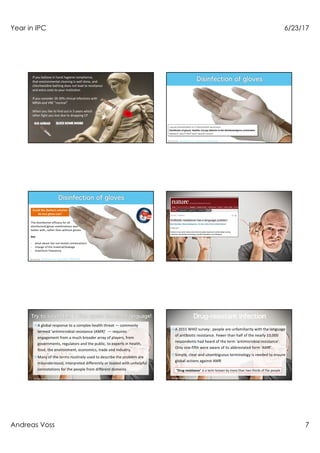
¤ 200	bed	NIH	Clinical Center,	
¤ 400	HCWs with patient contact	/	lab	staff with clinical specimen	contact	versus		400	staff
without	recent	direct	patient contact	as	a	comparator.	
¤ Two perirectal swabs separated by a	few	days
¤ Dataset	was	anonomysed
¤ 4.0%	of	HCWs and 3.2%	of	the control	grew ESBLs,	none	grew VRE,	and one of	the control	
participants grew a	CPE.	
¤ No	significant	risk	factors	were associated with ESBL	carriage
For	more	comments	have	a	look	at	ReflectionsIPC
Thus,	the box	stays shut,	but	should be looked at	again
Year in IPC 6/23/17
Andreas Voss 6
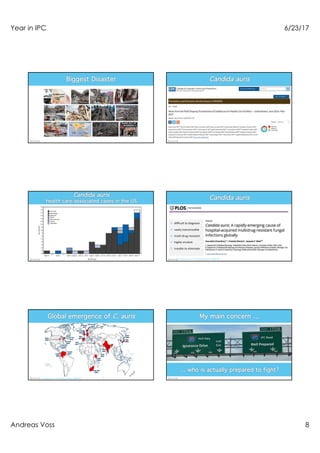
¤Whole-genome sequencing identified
common blaNDM-positive E.	coli shared	
among farms,	flies,	dogs and farmers,	
providing direct	evidence of	carbapenem-
resistant E.	coli transmission	and
environmental contamination.
Wang	et	al.		Nature	Microbiology 2017
“Softly” Killing
Infection Control …
… studies not all of us were waiting for
Hygiea
Infect	Control	Hosp	Epidemiol. 2016	Nov;37(11):1323-1330.	Epub 2016	Jul 26
Discontinuing	routine	contact	precautions	(CP)	for	endemic
MRSA	and	VRE	did	not	result	in	increased	rates	of	MRSA	or	
VRE	after	1	year.	With	cost	savings	on	materials,	decreased	
healthcare	worker	time,	and	no	concomitant	increase	in	
possible	infections,	elimination	of	routine	CP	may	add	
substantial	value	to	inpatient	care	delivery.
Clinically significant	
VRE	outcomes
remain rare.	
Cessation of	all
control	measures for
VRE	had	no	
significant	
attributable adverse	
clinical impact.
¤ Overall,	a	reasonably firm
conclusion can be reached that
routine	contact	isolation for
endemic MRSA	and VRE	is	
unnecessary (and may be
harmful)	when there is	active
maintenance	of	hand	hygiene,	
environmental cleaning,	and
chlorhexidine bathing
Hillary	Humphreys			ISCH	April	2017
Some	centers	would	be	wise	to	continue	with	
active	screening	to	monitor	trends	and	to	
target	additional	measures
We	should	be	reluctant	to	discontinue	even	
selective	screening	and	contact	precautions
Year in IPC 6/23/17
Andreas Voss 7
If	you	believe	in	hand	hygiene	compliance,	
that	environmental	cleaning	is	well	done,	and	
chlorhexidine	bathing	does	not	lead	to	resistance
and	extra	costs	to	your	institution
If	you	consider	20-30%	clinical	infections	with
MRSA	and	VRE	“normal”
When	you	like	to	find	out	in	5	years	which	
other	fight	you	lost	doe	to	dropping	CP
Scheithauer et	al.		J	Hosp Infect		2016;94:268
The	disinfection	efficacy	for	all	
disinfectant/glove	combinations	was
better	with,	rather	than	without	gloves
but
- what	about	the	not	tested	combinations
- change	of	the	material/leakage
- maximum	frequency
Could the (better)	solution	
be less glove-use?
Mendelson et	al.	Nature	2017
¤A	global response	to a	complex	health	threat — commonly
termed 'antimicrobial resistance (AMR)’		— requires
engagement	from a	much broader array	of	players,	from
governments,	regulators	and the public,	to experts	in	health,	
food,	the environment,	economics,	trade and industry.
¤Many of	the terms routinely used to describe the problem are	
misunderstood,	interpreted differently or	loaded with unhelpful
connotations for the people from different	domeins
Mendelson et	al.	Nature	2017
¤A	2015	WHO	survey:		people are	unfamiliarity with the language
of	antibiotic resistance.	Fewer than half	of	the nearly 10,000	
respondents had	heard of	the term	'antimicrobial resistance'.	
Only one-fifth were aware of	its abbreviated form	'AMR'.
¤Simple,	clear and unambiguous terminology is	needed to ensure
global actions	against AMR	
Mendelson et	al.	Nature	2017
”Drug	resistance”	is	a	term	known	by	more	than	two-thirds	of	the	people
Year in IPC 6/23/17
Andreas Voss 8
Candida	auris
Chowdhary et	al.		PLoS Pathog 13(5):	e1006290	
¤ difficult	to	diagnose
¤ vastly	transmissible
¤ multi-drug-resistant
¤ highly	virulent	
¤ trouble	to	eliminate	
Chowdhary et	al.		PLoS Pathog 13(5):	e1006290
Year in IPC 6/23/17
Andreas Voss 9
Ross	&	Witzke Infection 01	February 2017
• Can Bibles in	patient's rooms	act	as	a	vehicle	for the spread	of	nosocomial
infections
• Samples	from 50	Bibles in	various general wards of	the hospital and 99	
hymnals from the hospital chapel
• Results:	mainly apathogenic organisms plus	Aspergillus spp.
• Bibles showed pathogen bacteria in	a	low	number.	
• No	invasive infections with those pathogens could be documented during the
investigation period
• Results do	not support	Bibles as	a	possible source	of	nosocomial infections
Faith	stays	a	good	thing	….	but
• Just	a	pilot	study
• Not	in	isolation	rooms
• We	don’t	know	if	Bibles	
were	actually	used
Year in IPC 6/23/17
Andreas Voss 10
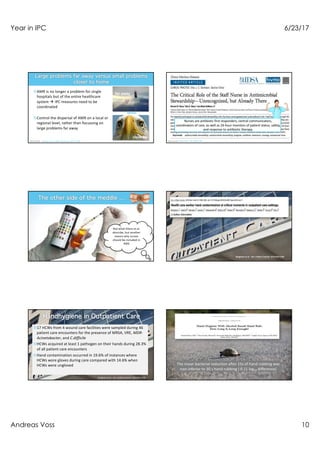
¤AMR	is	no	longer a	problem for single	
hospitals but	of	the entire healthcare
system	à IPC	measures need to	be
coordinated
¤Control	the dispersal of	AMR	on	a	local or	
regional level,	rather than focussing on	
large	problems far	away
far	away
close	by
versus
Donker	et	al.		BMC	Medicine 2017;15:86 Olans et	al.		CID		206;62:84
Nurses	are	antibiotic first	responders,	central communicators,	
coordinators of	care,	as	well	as	24-hour	monitors	of	patient status,	safety,	
and response	to	antibiotic therapy.	
Not	what	Olans et	al.	
describe,	but	another	
reason	why	nurses	
should	be	included	in	
AMS
Bingham et	al.		Am	J	Infect	Control		2016;44:1198
¤17	HCWs from 4	wound care	facilities were sampled during 46	
patient care	encounters for the presence of	MRSA,	VRE,	MDR-
Acinetobacter,	and C.difficile
¤HCWs acquired at	least 1	pathogen on	their hands	during 28.3%	
of	all patient care	encounters
¤Hand	contamination occurred in	19.6%	of	instances where
HCWs wore gloves during care	compared with 14.6%	when
HCWs were ungloved
Bingham et	al.		Am	J	Infect	Control		2016;44:1198
The	mean	bacterial	reduction	after	15s	of	hand	rubbing	was
non-inferior	to	30	s	hand	rubbing	(	0.11	log10 difference)
Year in IPC 6/23/17
Andreas Voss 11
LÜBBEKE	et	al.	Acta	Orthopaedica 2016;	87	(2):	132–138
• PJI	with BMI	35–39.9	(adjusted HR	=	
2.1)	
• PJI	with BMI	≥		40	(adjusted HR	=	4.2).	
Weight	≥		100	kg	was	identified	as	
threshold	for	a	significant	increase	in	
infection	(adjusted	HR	=	2.1).
Albrecht et	al.		JAMDA	2017;18:158-161
Direct	care	staff reported using gowns and gloves primarily as	self-protection against contact	
with bodily fluids:	not to prevent MRSA	transmission.	
Glove use was	described as	common	and more	acceptable to staff and residents than gown
use.	
Administrators were surprised that MRSA	transmission	to health	care	worker hands	and
clothing occurred during activities when direct	care	staff perceives no	contact	with bodily
fluids.	
Staff and administrators expressed willingness to use gowns and gloves for high-risk	care	
activities,	particularly if use is	targeted toward specific types	of	residents such as	those with
pressure ulcers.	
There was	a	knowledge deficit	about MRSA	transmission	and infection among direct	care	
staff and residents
Albrecht et	al.		JAMDA	2017;18:158-161 Albrecht et	al.		JAMDA	2017;18:158-161
Nursing home	residents expressed negative impressions of	
gown use until they learned that gowns could help	prevent
MRSA	transmission,	suggesting that education on	MRSA	may
dispel misconceptions.
Bartek et	al.		CID	2017
*	don’t try this in	your hospital
If	you	do	it,	do	
it	right	!
Year in IPC 6/23/17
Andreas Voss 12
article	previously	presented	by	Bob	Weinstein
Slightly	less	
controversial,	
but	far	more	
sweaty
Infection Control
Not	sure	if	I	would	go	to	the	next	surgical	meeting

Year in Infection Control

  • 1.
    Year in IPC6/23/17 Andreas Voss 1 Elaine Larson, RN, PhD, FAAN, CIC Anna C. Maxwell Professor of Nursing Research Associate Dean for Research Columbia University School of Nursing Andreas Voss, MD, PhD, FSHEA, FESCMID Professor of Infection Control, Radboudumc Clinical Microbiologist, CWZ, Nijmegen, NL both speakers declare no conflict of interest Storr et al. Antimicrob Resist Infect Control (2017) 6:6 Boyce ARIC (2016) 5:10 Do you think to know all that is needed about (nosocomial) virus infections Not me! Chow & Mermel, Open Forum Infectious Diseases 2017, DOI: 10.1093/o d/ofx006
  • 2.
    Year in IPC6/23/17 Andreas Voss 2 Imagine that you are in charge of cleanining the rest-rooms of a large fasility Your problem: Males that can’t aim and the consequent “spillage” How to use human factors engineering for help? Give them an aim à 80% less spillage Bateson et al. Biol. Lett. (2006) 2, 412–414 doi:10.1098/rsbl.2006.0509 Bateson et al. Biol. Lett. (2006) 2, 412–414 doi:10.1098/rsbl.2006.0509 We examined the effect of an image of a pair of eyes on contributions to an honesty box used to collect money for drinks in a university coffee room. Bateson et al. Biol. Lett. (2006) 2, 412–414 doi:10.1098/rsbl.2006.0509 This finding provides the first evidence from a naturalistic setting of the importance of cues of being watched, and hence reputational concerns, on human cooperative behaviour. … leave your money at the back doors King et al. Health Psychol. 2016 Jan;35(1):96-101.
  • 3.
    Year in IPC6/23/17 Andreas Voss 3 King et al. Health Psychol. 2016 Jan;35(1):96-101. Visitors to the ICU were exposed to an olfactory prime (“clean” citrus smell) using an aroma dispenser and “eyes” Choice smell determined in earlier study (“cleanest & freshest”) King et al. Health Psychol. 2016 Jan;35(1):96-101. olfactory > eyes male > female eyes Priming works (47% vs. 15%) If you don’t cite yourself, who will? Bob Weinstein Tartari et al. Antimicrob Reistance Infect Control 2017;6:45 Tartari et al. Antimicrob Reistance Infect Control 2017;6:45 De Geyter et al. ARIC (2017) 6:24
  • 4.
    Year in IPC6/23/17 Andreas Voss 4 De Geyter et al. ARIC (2017) 6:24 To control the outbreak, the sinks and their plumbings were replaced by new ones with another structure drains screens water Hopman et al ARIC 2017;6:59 ¤ The aim of this study was to evaluate the effect of removal of sinks from the Intensive Care Unit (ICU) patient rooms and the introduction of ‘water-free’ patient care on gram-negative bacilli colonization rates. ¤ 2-year pre/post quasi-experimental study that compared monthly gram- negative bacilli colonization rates pre- and post-intervention using segmented regression analysis of interrupted time series data ¤ Five ICUs of a tertiary care medical center ¤ Outconme: monthly colonization rate with gram-negative bacilli (GNB) Hopman et al ARIC 2017;6:59 Hopman et al ARIC 2017;6:59 Hopman et al ARIC 2017;6:59 Monthly gram-negative bacilli (GNB) colonization rates. Hopman et al ARIC 2017;6:59 Monthly gram-negative bacilli (GNB) colonization rates.
  • 5.
    Year in IPC6/23/17 Andreas Voss 5 ¤This study shows that removal of the sinks from all patient rooms and the introduction of ‘water-free’ patient care is associated with a statistically significant lower number of ICU patients that become colonized with GNB, including MDR-GNB, especially among patients with a longer length of stay at the ICU. Hopman et al ARIC 2017;6:59 Decker et al Clin Mirobiol Infect 2017 ¤ 200 bed NIH Clinical Center, ¤ 400 HCWs with patient contact / lab staff with clinical specimen contact versus 400 staff without recent direct patient contact as a comparator. ¤ Two perirectal swabs separated by a few days ¤ Dataset was anonomysed ¤ 4.0% of HCWs and 3.2% of the control grew ESBLs, none grew VRE, and one of the control participants grew a CPE. ¤ No significant risk factors were associated with ESBL carriage For more comments have a look at ReflectionsIPC Thus, the box stays shut, but should be looked at again
  • 6.
    Year in IPC6/23/17 Andreas Voss 6 ¤Whole-genome sequencing identified common blaNDM-positive E. coli shared among farms, flies, dogs and farmers, providing direct evidence of carbapenem- resistant E. coli transmission and environmental contamination. Wang et al. Nature Microbiology 2017 “Softly” Killing Infection Control … … studies not all of us were waiting for Hygiea Infect Control Hosp Epidemiol. 2016 Nov;37(11):1323-1330. Epub 2016 Jul 26 Discontinuing routine contact precautions (CP) for endemic MRSA and VRE did not result in increased rates of MRSA or VRE after 1 year. With cost savings on materials, decreased healthcare worker time, and no concomitant increase in possible infections, elimination of routine CP may add substantial value to inpatient care delivery. Clinically significant VRE outcomes remain rare. Cessation of all control measures for VRE had no significant attributable adverse clinical impact. ¤ Overall, a reasonably firm conclusion can be reached that routine contact isolation for endemic MRSA and VRE is unnecessary (and may be harmful) when there is active maintenance of hand hygiene, environmental cleaning, and chlorhexidine bathing Hillary Humphreys ISCH April 2017 Some centers would be wise to continue with active screening to monitor trends and to target additional measures We should be reluctant to discontinue even selective screening and contact precautions
  • 7.
    Year in IPC6/23/17 Andreas Voss 7 If you believe in hand hygiene compliance, that environmental cleaning is well done, and chlorhexidine bathing does not lead to resistance and extra costs to your institution If you consider 20-30% clinical infections with MRSA and VRE “normal” When you like to find out in 5 years which other fight you lost doe to dropping CP Scheithauer et al. J Hosp Infect 2016;94:268 Scheithauer et al. J Hosp Infect 2016;94:268 The disinfection efficacy for all disinfectant/glove combinations was better with, rather than without gloves but - what about the not tested combinations - change of the material/leakage - maximum frequency Could the (better) solution be less glove-use? Mendelson et al. Nature 2017 ¤A global response to a complex health threat — commonly termed 'antimicrobial resistance (AMR)’ — requires engagement from a much broader array of players, from governments, regulators and the public, to experts in health, food, the environment, economics, trade and industry. ¤Many of the terms routinely used to describe the problem are misunderstood, interpreted differently or loaded with unhelpful connotations for the people from different domeins Mendelson et al. Nature 2017 ¤A 2015 WHO survey: people are unfamiliarity with the language of antibiotic resistance. Fewer than half of the nearly 10,000 respondents had heard of the term 'antimicrobial resistance'. Only one-fifth were aware of its abbreviated form 'AMR'. ¤Simple, clear and unambiguous terminology is needed to ensure global actions against AMR Mendelson et al. Nature 2017 ”Drug resistance” is a term known by more than two-thirds of the people
  • 8.
    Year in IPC6/23/17 Andreas Voss 8 Candida auris Chowdhary et al. PLoS Pathog 13(5): e1006290 ¤ difficult to diagnose ¤ vastly transmissible ¤ multi-drug-resistant ¤ highly virulent ¤ trouble to eliminate Chowdhary et al. PLoS Pathog 13(5): e1006290
  • 9.
    Year in IPC6/23/17 Andreas Voss 9 Ross & Witzke Infection 01 February 2017 • Can Bibles in patient's rooms act as a vehicle for the spread of nosocomial infections • Samples from 50 Bibles in various general wards of the hospital and 99 hymnals from the hospital chapel • Results: mainly apathogenic organisms plus Aspergillus spp. • Bibles showed pathogen bacteria in a low number. • No invasive infections with those pathogens could be documented during the investigation period • Results do not support Bibles as a possible source of nosocomial infections Faith stays a good thing …. but • Just a pilot study • Not in isolation rooms • We don’t know if Bibles were actually used
  • 10.
    Year in IPC6/23/17 Andreas Voss 10 ¤AMR is no longer a problem for single hospitals but of the entire healthcare system à IPC measures need to be coordinated ¤Control the dispersal of AMR on a local or regional level, rather than focussing on large problems far away far away close by versus Donker et al. BMC Medicine 2017;15:86 Olans et al. CID 206;62:84 Nurses are antibiotic first responders, central communicators, coordinators of care, as well as 24-hour monitors of patient status, safety, and response to antibiotic therapy. Not what Olans et al. describe, but another reason why nurses should be included in AMS Bingham et al. Am J Infect Control 2016;44:1198 ¤17 HCWs from 4 wound care facilities were sampled during 46 patient care encounters for the presence of MRSA, VRE, MDR- Acinetobacter, and C.difficile ¤HCWs acquired at least 1 pathogen on their hands during 28.3% of all patient care encounters ¤Hand contamination occurred in 19.6% of instances where HCWs wore gloves during care compared with 14.6% when HCWs were ungloved Bingham et al. Am J Infect Control 2016;44:1198 The mean bacterial reduction after 15s of hand rubbing was non-inferior to 30 s hand rubbing ( 0.11 log10 difference)
  • 11.
    Year in IPC6/23/17 Andreas Voss 11 LÜBBEKE et al. Acta Orthopaedica 2016; 87 (2): 132–138 • PJI with BMI 35–39.9 (adjusted HR = 2.1) • PJI with BMI ≥ 40 (adjusted HR = 4.2). Weight ≥ 100 kg was identified as threshold for a significant increase in infection (adjusted HR = 2.1). Albrecht et al. JAMDA 2017;18:158-161 Direct care staff reported using gowns and gloves primarily as self-protection against contact with bodily fluids: not to prevent MRSA transmission. Glove use was described as common and more acceptable to staff and residents than gown use. Administrators were surprised that MRSA transmission to health care worker hands and clothing occurred during activities when direct care staff perceives no contact with bodily fluids. Staff and administrators expressed willingness to use gowns and gloves for high-risk care activities, particularly if use is targeted toward specific types of residents such as those with pressure ulcers. There was a knowledge deficit about MRSA transmission and infection among direct care staff and residents Albrecht et al. JAMDA 2017;18:158-161 Albrecht et al. JAMDA 2017;18:158-161 Nursing home residents expressed negative impressions of gown use until they learned that gowns could help prevent MRSA transmission, suggesting that education on MRSA may dispel misconceptions. Bartek et al. CID 2017 * don’t try this in your hospital If you do it, do it right !
  • 12.
    Year in IPC6/23/17 Andreas Voss 12 article previously presented by Bob Weinstein Slightly less controversial, but far more sweaty Infection Control Not sure if I would go to the next surgical meeting