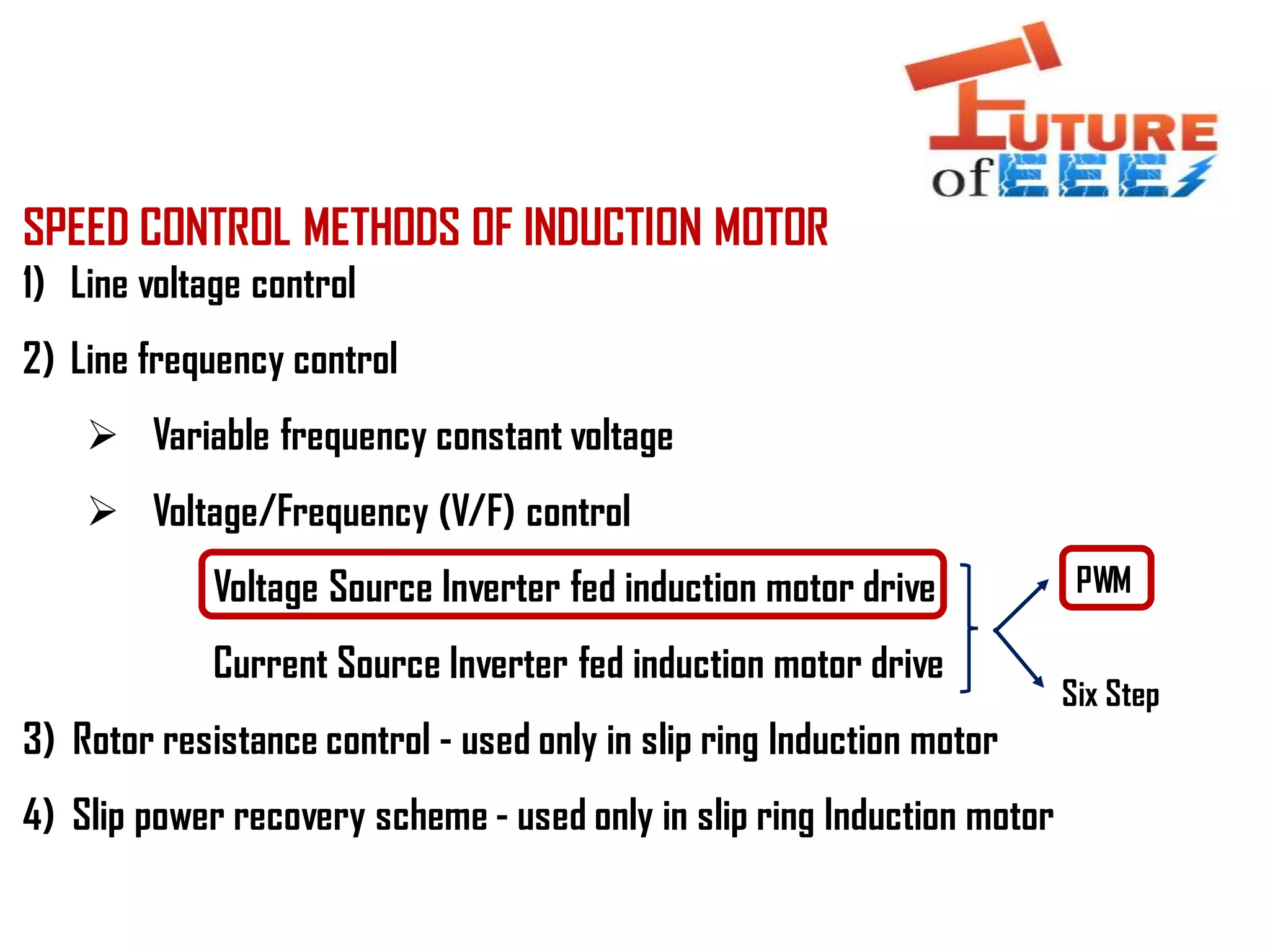
SPEED CONTROL METHODS OF INDUCTION MOTOR
1) Line voltage control
2) Line frequency control
 Variable frequency constant voltage
 Voltage/Frequency (V/F) control
Voltage Source Inverter fed induction motor drive
Current Source Inverter fed induction motor drive
3) Rotor resistance control - used only in slip ring Induction motor
4) Slip power recovery scheme - used only in slip ring Induction motor
Six Step
PWM
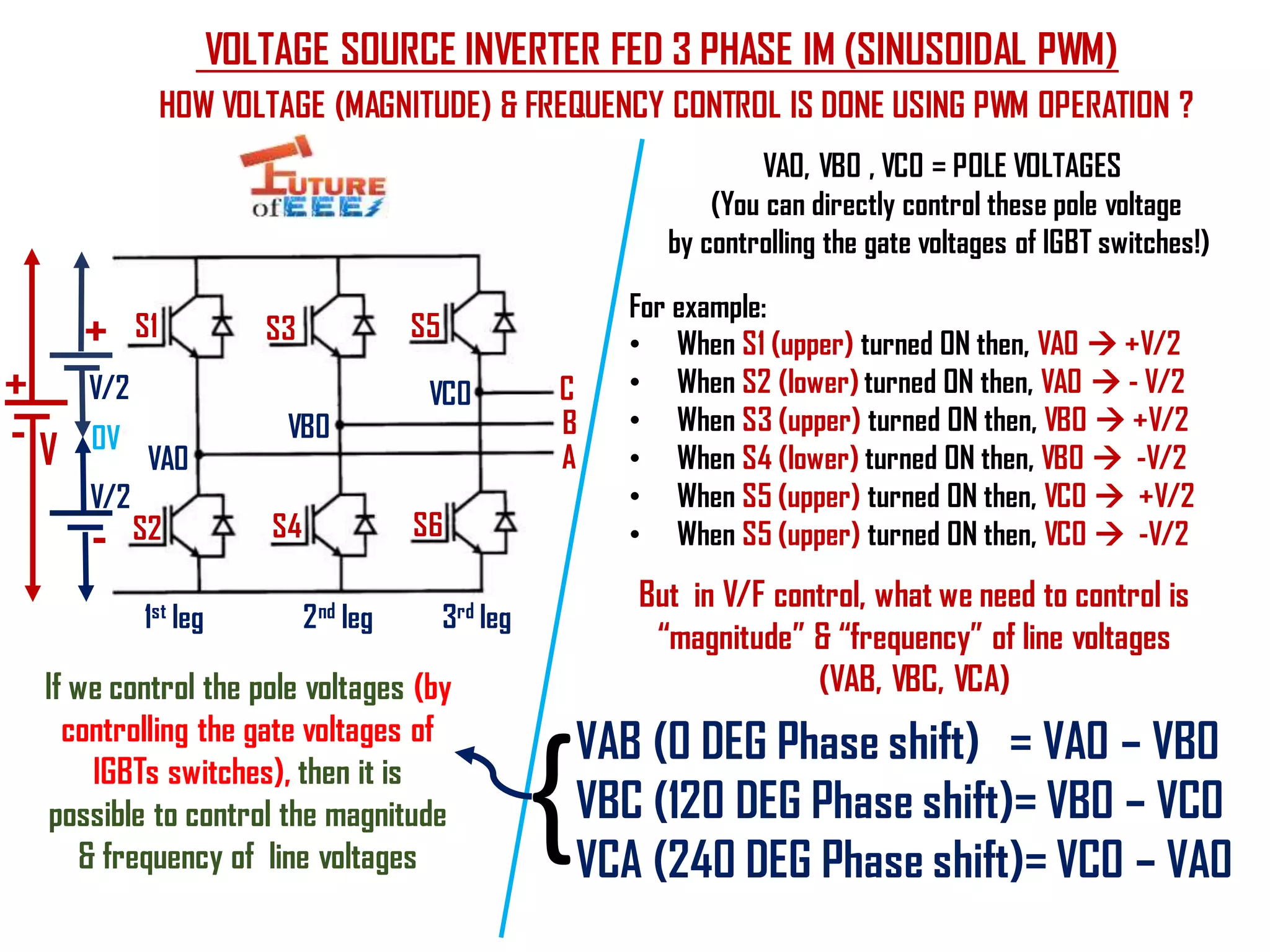
VOLTAGE SOURCE INVERTER FED 3 PHASE IM (SINUSOIDAL PWM)
HOW VOLTAGE (MAGNITUDE) & FREQUENCY CONTROL IS DONE USING PWM OPERATION ?
S1 S3 S5
S2 S4 S6
VA0
VB0
VC0
A
B
C
VA0, VB0 , VC0 = POLE VOLTAGES
(You can directly control these pole voltage
by controlling the gate voltages of IGBT switches!)
For example:
• When S1 (upper) turned ON then, VA0  +V/2
• When S2 (lower) turned ON then, VA0  - V/2
• When S3 (upper) turned ON then, VBO  +V/2
• When S4 (lower) turned ON then, VBO  -V/2
• When S5 (upper) turned ON then, VC0  +V/2
• When S5 (upper) turned ON then, VC0  -V/2
But in V/F control, what we need to control is
“magnitude” & “frequency” of line voltages
(VAB, VBC, VCA)
VAB (0 DEG Phase shift) = VA0 – VB0
VBC (120 DEG Phase shift)= VB0 – VC0
VCA (240 DEG Phase shift)= VC0 – VA0
{
If we control the pole voltages (by
controlling the gate voltages of
IGBTs switches), then it is
possible to control the magnitude
& frequency of line voltages
1st leg 2nd leg 3rd leg
V/2
V/2
V 0V
+
-
+
-
HOW CONTROLLED GATE VOLTAGES ARE GENERATED IN PWM?
Sinusoidal /
Modulating
signal
Triangular/
Carrier
Signal
Comparators
G1 (S1)
[Upper]
G2 (S2)
[Lower]
G3 (S3)
[Upper]
G5 (S5)
[Upper]
G4 (S4)
[Lower]
G6 (S6)
[Lower]
So that both upper & lower transistor
will not turn ON @ the same time – So
Short circuit will not happen!
0 degree
120 degree
240 degree
1st leg
2nd leg
3rd leg
Sin 1 Triang
Sin 2
(120 degree)
Sin 1
(o degree)
Sin 3
(240 degree)
Triang
Comparators
G1 (S1)
G2 (S2)
G3 (S3)
G4 (S4)
G5 (S5)
G6 (S6)
POWER CIRCUIT
PWM CONTROL CIRCUIT
GATE
VOLTAGESG2
(S2)
G1 (S1) G1(S1)
VAO
-V/2 -V/2 -V/2
+ V/2 + V/2
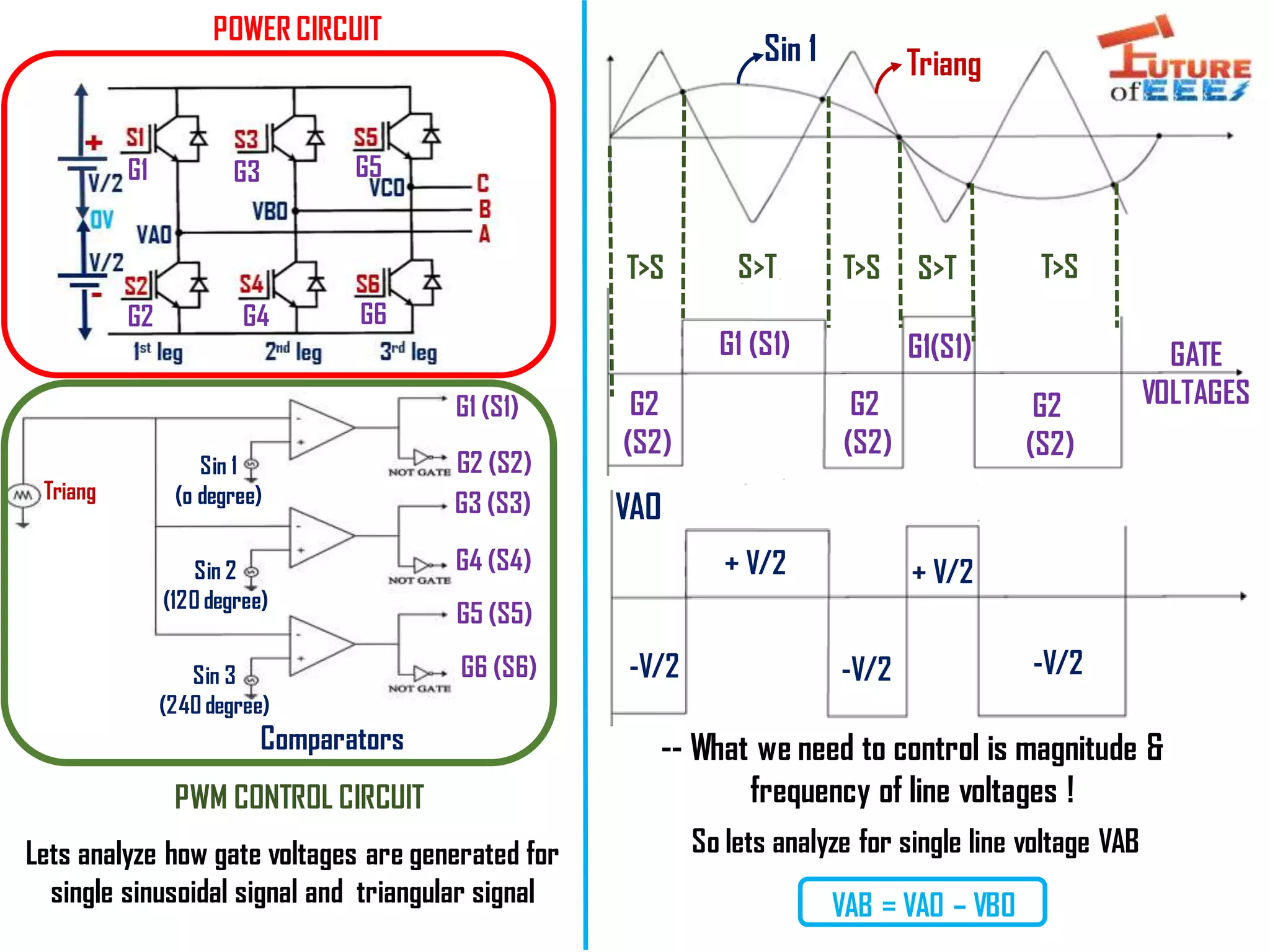
Lets analyze how gate voltages are generated for
single sinusoidal signal and triangular signal
-- What we need to control is magnitude &
frequency of line voltages !
T>S T>S T>SS>T S>T
VAB = VA0 – VB0
G2
(S2)
G2
(S2)
So lets analyze for single line voltage VAB
G1
G2
G3
G4
G5
G6
Sin 1 ( 0 degree) Sin 2 ( 120 degree) Triang
VA0
VB0
VAB
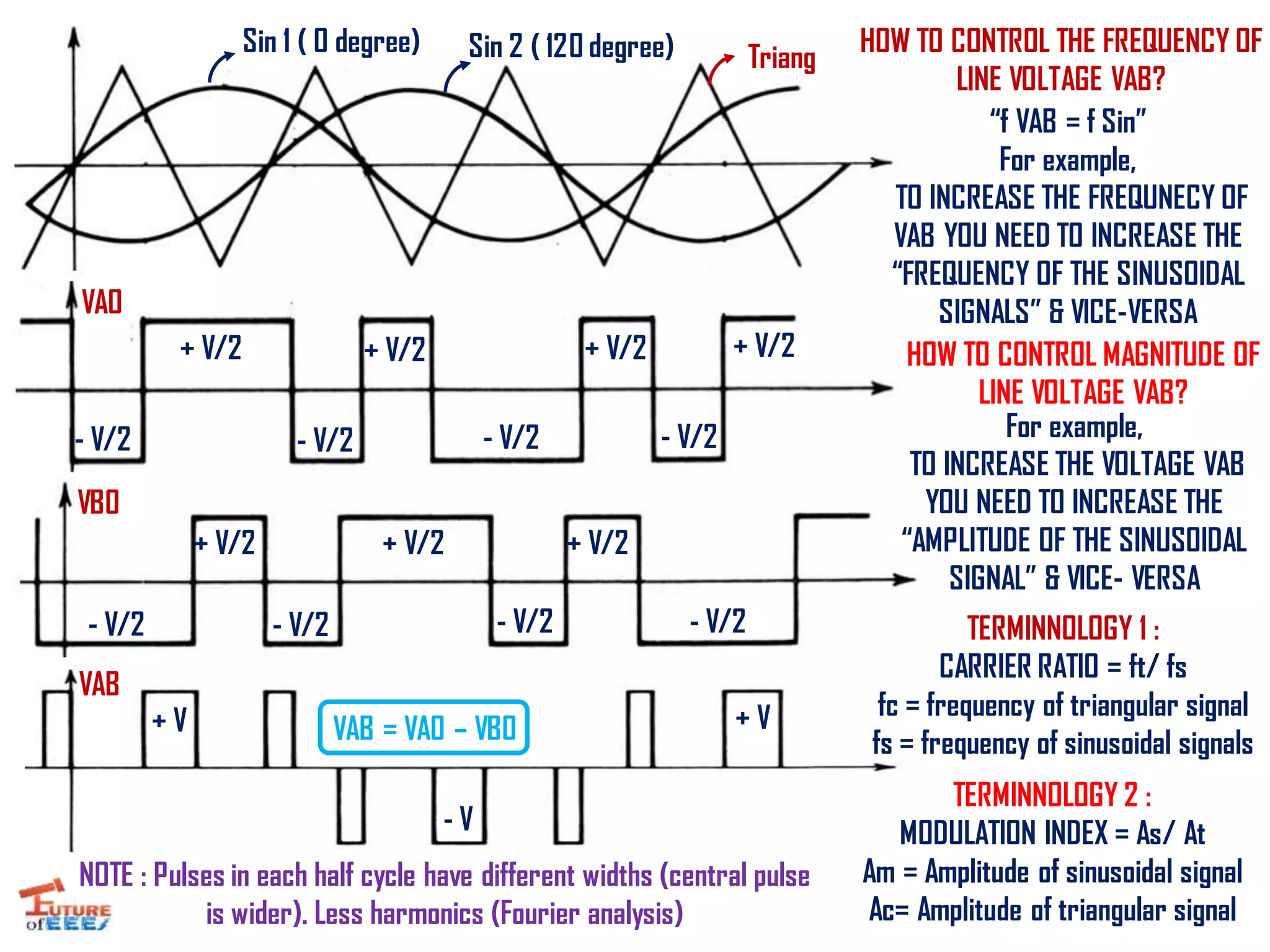
VAB = VA0 – VB0
HOW TO CONTROL MAGNITUDE OF
LINE VOLTAGE VAB?
HOW TO CONTROL THE FREQUENCY OF
LINE VOLTAGE VAB?
“f VAB = f Sin”
For example,
TO INCREASE THE FREQUNECY OF
VAB YOU NEED TO INCREASE THE
“FREQUENCY OF THE SINUSOIDAL
SIGNALS” & VICE-VERSA
TERMINNOLOGY 1 :
CARRIER RATIO = ft/ fs
fc = frequency of triangular signal
fs = frequency of sinusoidal signals
For example,
TO INCREASE THE VOLTAGE VAB
YOU NEED TO INCREASE THE
“AMPLITUDE OF THE SINUSOIDAL
SIGNAL” & VICE- VERSA
TERMINNOLOGY 2 :
MODULATION INDEX = As/ At
Am = Amplitude of sinusoidal signal
Ac= Amplitude of triangular signal
NOTE : Pulses in each half cycle have different widths (central pulse
is wider). Less harmonics (Fourier analysis)
+ V/2 + V/2 + V/2 + V/2
- V/2 - V/2 - V/2 - V/2
+ V/2+ V/2+ V/2
- V/2 - V/2 - V/2 - V/2
+ V + V
- V
VSI
(SIX STEP SWITCHING)
DOWNLOAD
(PPT & PDF)
IN THE DESCRIPTION

Voltage Source Inverter VSI - Pulse Width Modulation (PWM)

  • 1.
    SPEED CONTROL METHODSOF INDUCTION MOTOR 1) Line voltage control 2) Line frequency control  Variable frequency constant voltage  Voltage/Frequency (V/F) control Voltage Source Inverter fed induction motor drive Current Source Inverter fed induction motor drive 3) Rotor resistance control - used only in slip ring Induction motor 4) Slip power recovery scheme - used only in slip ring Induction motor Six Step PWM
  • 2.
    VOLTAGE SOURCE INVERTERFED 3 PHASE IM (SINUSOIDAL PWM) HOW VOLTAGE (MAGNITUDE) & FREQUENCY CONTROL IS DONE USING PWM OPERATION ? S1 S3 S5 S2 S4 S6 VA0 VB0 VC0 A B C VA0, VB0 , VC0 = POLE VOLTAGES (You can directly control these pole voltage by controlling the gate voltages of IGBT switches!) For example: • When S1 (upper) turned ON then, VA0  +V/2 • When S2 (lower) turned ON then, VA0  - V/2 • When S3 (upper) turned ON then, VBO  +V/2 • When S4 (lower) turned ON then, VBO  -V/2 • When S5 (upper) turned ON then, VC0  +V/2 • When S5 (upper) turned ON then, VC0  -V/2 But in V/F control, what we need to control is “magnitude” & “frequency” of line voltages (VAB, VBC, VCA) VAB (0 DEG Phase shift) = VA0 – VB0 VBC (120 DEG Phase shift)= VB0 – VC0 VCA (240 DEG Phase shift)= VC0 – VA0 { If we control the pole voltages (by controlling the gate voltages of IGBTs switches), then it is possible to control the magnitude & frequency of line voltages 1st leg 2nd leg 3rd leg V/2 V/2 V 0V + - + -
  • 3.
    HOW CONTROLLED GATEVOLTAGES ARE GENERATED IN PWM? Sinusoidal / Modulating signal Triangular/ Carrier Signal Comparators G1 (S1) [Upper] G2 (S2) [Lower] G3 (S3) [Upper] G5 (S5) [Upper] G4 (S4) [Lower] G6 (S6) [Lower] So that both upper & lower transistor will not turn ON @ the same time – So Short circuit will not happen! 0 degree 120 degree 240 degree 1st leg 2nd leg 3rd leg
  • 4.
    Sin 1 Triang Sin2 (120 degree) Sin 1 (o degree) Sin 3 (240 degree) Triang Comparators G1 (S1) G2 (S2) G3 (S3) G4 (S4) G5 (S5) G6 (S6) POWER CIRCUIT PWM CONTROL CIRCUIT GATE VOLTAGESG2 (S2) G1 (S1) G1(S1) VAO -V/2 -V/2 -V/2 + V/2 + V/2 Lets analyze how gate voltages are generated for single sinusoidal signal and triangular signal -- What we need to control is magnitude & frequency of line voltages ! T>S T>S T>SS>T S>T VAB = VA0 – VB0 G2 (S2) G2 (S2) So lets analyze for single line voltage VAB G1 G2 G3 G4 G5 G6
  • 5.
    Sin 1 (0 degree) Sin 2 ( 120 degree) Triang VA0 VB0 VAB VAB = VA0 – VB0 HOW TO CONTROL MAGNITUDE OF LINE VOLTAGE VAB? HOW TO CONTROL THE FREQUENCY OF LINE VOLTAGE VAB? “f VAB = f Sin” For example, TO INCREASE THE FREQUNECY OF VAB YOU NEED TO INCREASE THE “FREQUENCY OF THE SINUSOIDAL SIGNALS” & VICE-VERSA TERMINNOLOGY 1 : CARRIER RATIO = ft/ fs fc = frequency of triangular signal fs = frequency of sinusoidal signals For example, TO INCREASE THE VOLTAGE VAB YOU NEED TO INCREASE THE “AMPLITUDE OF THE SINUSOIDAL SIGNAL” & VICE- VERSA TERMINNOLOGY 2 : MODULATION INDEX = As/ At Am = Amplitude of sinusoidal signal Ac= Amplitude of triangular signal NOTE : Pulses in each half cycle have different widths (central pulse is wider). Less harmonics (Fourier analysis) + V/2 + V/2 + V/2 + V/2 - V/2 - V/2 - V/2 - V/2 + V/2+ V/2+ V/2 - V/2 - V/2 - V/2 - V/2 + V + V - V
  • 6.
    VSI (SIX STEP SWITCHING) DOWNLOAD (PPT& PDF) IN THE DESCRIPTION