Submitted by 
Revathy.S.R 
Natural Science 
Reg. No: 13971024
INTRODUCTION 
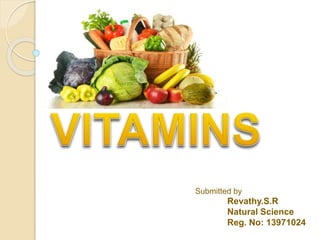
Vitamins are organic molecules required in trace 
amounts for the normal maintenance of life . They are 
not synthesized by the body and hence they must be 
present in the diet . Their importance in the 
physiological well being of an organism was first 
demonstrated by Lunin in 1881 . 
By convention , the term vitamin includes 
neither other essential nutrients , such as dietary 
minerals , essential fatty acids , or essential amino acids 
nor the great number of other nutrients that promote 
health , and are required less often to maintain the 
health of the organism . Thirteen vitamins are 
universally recognized at present . Vitamins have 
diverse biochemical functions . Each vitamin is equally 
important.
CLASSIFICATION OF VITAMINS
WATER SOLUBLE VITAMINS 
1 . VITAMIN C 
 This vitamin is found in fresh fruits and vegetables. 
 It is very easily destroyed by cooking and canning , but 
freezing has no effect on this vitamin . 
 Vitamin C is necessary for the maintenance of normal 
connective tissue . 
 It is required for the formation of collagen , bone 
matrix , tooth dentine and other extra cellular 
materials . 
 It is also needed for the metabolism of many amino 
acids and it acts as an anti oxidant. 
 It is also needed for the metabolism of many amino 
acids and it acts as an anti oxidant .
SOURCES OF VITAMIN C
DEFICIENCY DISEASE
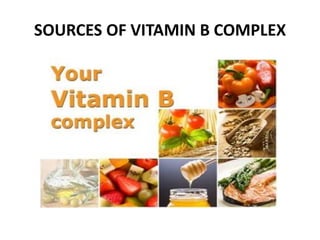
VITAMIN B COMPLEX 
The B complex includes 11 different vitamins. 
They are thiamine , riboflavin , nicotinic acid , 
pyridoxine , pantho thenic acid , folic acid , 
cyanocobalamine , choline , inositol and para-amnobenzoic 
acid . 
In their chemical structure as well as in their effects 
they differ. 
But all of them tend to occur together and hence 
they are all grouped together and hence they are all 
grouped under the B complex
SOURCES OF VITAMIN B COMPLEX
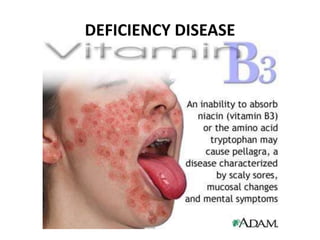
DEFICIENCY DISEASE
FAT SOLUBLE VITAMINS 
1 . VITAMIN A 
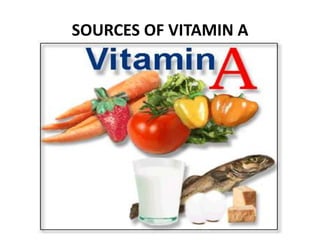
 Vitamin A is also called as retinol . 
 Animal products such as butter , eggs and fish liver oil 
are rich in this vitamin . 
Many vegetable foods contain yellow or red pigment 
called carotene , which in the animal body is converted 
into vitamin A . 
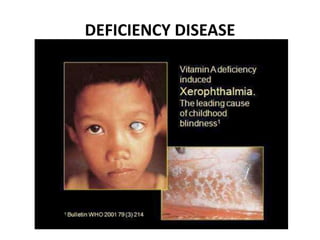
 Deficiency of this vitamin causes night blindness or 
nyctalopia . 
 For the normal health and growth of epithelial tissue 
vitamin A is very essential .
SOURCES OF VITAMIN A
DEFICIENCY DISEASE
2 . VITAMIN D 
 This vitamin occurs in several different forms . 
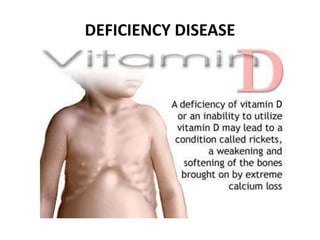
 They are able to cure the disease rickets and hence they 
are called antirachitic factors . 
 One of these factors is ergocalciferol which is produced 
in plants under the influence of sunlight from a 
substance called ergosterol . 
 Cholecalciferol is another form of vitamin D 
 It is synthesized in the skin of higher vertebrates by the 
influence of sunlight from a substance present in the 
skin known as 7- dehydrocholesterol . 
 Vitamin D is necessary for the absorption of calcium 
and phosphorus from the intestine .
SOURCES OF VITAMIN D
DEFICIENCY DISEASE
3 . VITAMIN E 
 This vitamin exists in numerous forms such as alpha , 
beta , gamma and delta tocopherols . 
 Deficiency of this disease causes disturbances in 
reproductive system . 
 In the male degenerative changes occur in the testes 
while in female the ability to complete pregnancy is lost 
. 
 Hence this vitamin has been called the anti-sterility 
vitamin . 
 vegetable and animal oils are good sources of this 
vitamin .
SOURCES OF VITAMIN E
DEFICIENCY DISEASE
4. VITAMIN K 
 This vitamin is widely distributed in foods and quite large 
quantities are manufactured by the bacteria harboured in the 
human intestine . 
 It is absolutely essential for the formation of prothrombin and 
certain plasma factors involved in the coagulation of blood . 
 Hence deficiency of vitamin K will prolong the blood coagulation 
time . 
 In man , vitamin K deficiency generally result from some 
abnormality in its absorption rather than its absence in the diet . 
 Prolonged use of antibiotics may destroy intestinal bacteria and 
this may also result in deficiency of vitamin K . 
 Synthetic vitamin K is known as menadion .
SOURCES OF VITAMIN K
DEFICIENCY DISEASE-ABNORMAL 
BLEEDING
CONCLUSION 
 Vitamin is an organic compound and a vital nutrient 
that an organism require in limited amount. 
 An organic chemical compound is called a vitamin when 
the organism cannot synthesize the compound in 
sufficient amount. 
 Each vitamin is typically used in multiple reactions, and, 
therefore, most have multiple functions
REFERENCE 
 Sumathi.R & Rajagopal.M.V (2012), Fundamentals of 
Food and Nutrients 
 Dr. Vijayakumaran Nair (2004), Animal Physiology 
www.google.com

Vitamins

  • 1.
    Submitted by Revathy.S.R Natural Science Reg. No: 13971024
  • 2.
    INTRODUCTION Vitamins areorganic molecules required in trace amounts for the normal maintenance of life . They are not synthesized by the body and hence they must be present in the diet . Their importance in the physiological well being of an organism was first demonstrated by Lunin in 1881 . By convention , the term vitamin includes neither other essential nutrients , such as dietary minerals , essential fatty acids , or essential amino acids nor the great number of other nutrients that promote health , and are required less often to maintain the health of the organism . Thirteen vitamins are universally recognized at present . Vitamins have diverse biochemical functions . Each vitamin is equally important.
  • 3.
  • 4.
    WATER SOLUBLE VITAMINS 1 . VITAMIN C  This vitamin is found in fresh fruits and vegetables.  It is very easily destroyed by cooking and canning , but freezing has no effect on this vitamin .  Vitamin C is necessary for the maintenance of normal connective tissue .  It is required for the formation of collagen , bone matrix , tooth dentine and other extra cellular materials .  It is also needed for the metabolism of many amino acids and it acts as an anti oxidant.  It is also needed for the metabolism of many amino acids and it acts as an anti oxidant .
  • 5.
  • 6.
  • 7.
    VITAMIN B COMPLEX The B complex includes 11 different vitamins. They are thiamine , riboflavin , nicotinic acid , pyridoxine , pantho thenic acid , folic acid , cyanocobalamine , choline , inositol and para-amnobenzoic acid . In their chemical structure as well as in their effects they differ. But all of them tend to occur together and hence they are all grouped together and hence they are all grouped under the B complex
  • 8.
  • 9.
  • 10.
    FAT SOLUBLE VITAMINS 1 . VITAMIN A  Vitamin A is also called as retinol .  Animal products such as butter , eggs and fish liver oil are rich in this vitamin . Many vegetable foods contain yellow or red pigment called carotene , which in the animal body is converted into vitamin A .  Deficiency of this vitamin causes night blindness or nyctalopia .  For the normal health and growth of epithelial tissue vitamin A is very essential .
  • 11.
  • 12.
  • 13.
    2 . VITAMIND  This vitamin occurs in several different forms .  They are able to cure the disease rickets and hence they are called antirachitic factors .  One of these factors is ergocalciferol which is produced in plants under the influence of sunlight from a substance called ergosterol .  Cholecalciferol is another form of vitamin D  It is synthesized in the skin of higher vertebrates by the influence of sunlight from a substance present in the skin known as 7- dehydrocholesterol .  Vitamin D is necessary for the absorption of calcium and phosphorus from the intestine .
  • 14.
  • 15.
  • 16.
    3 . VITAMINE  This vitamin exists in numerous forms such as alpha , beta , gamma and delta tocopherols .  Deficiency of this disease causes disturbances in reproductive system .  In the male degenerative changes occur in the testes while in female the ability to complete pregnancy is lost .  Hence this vitamin has been called the anti-sterility vitamin .  vegetable and animal oils are good sources of this vitamin .
  • 17.
  • 18.
  • 19.
    4. VITAMIN K  This vitamin is widely distributed in foods and quite large quantities are manufactured by the bacteria harboured in the human intestine .  It is absolutely essential for the formation of prothrombin and certain plasma factors involved in the coagulation of blood .  Hence deficiency of vitamin K will prolong the blood coagulation time .  In man , vitamin K deficiency generally result from some abnormality in its absorption rather than its absence in the diet .  Prolonged use of antibiotics may destroy intestinal bacteria and this may also result in deficiency of vitamin K .  Synthetic vitamin K is known as menadion .
  • 20.
  • 21.
  • 22.
    CONCLUSION  Vitaminis an organic compound and a vital nutrient that an organism require in limited amount.  An organic chemical compound is called a vitamin when the organism cannot synthesize the compound in sufficient amount.  Each vitamin is typically used in multiple reactions, and, therefore, most have multiple functions
  • 23.
    REFERENCE  Sumathi.R& Rajagopal.M.V (2012), Fundamentals of Food and Nutrients  Dr. Vijayakumaran Nair (2004), Animal Physiology www.google.com