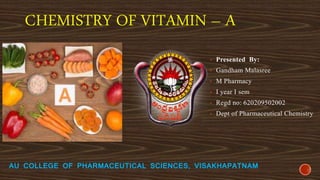
CHEMISTRY OF VITAMIN – A
• Presented By:
• Gandham Malasree
• M Pharmacy
• I year I sem
• Regd no: 620209502002
• Dept of Pharmaceutical Chemistry
AU COLLEGE OF PHARMACEUTICAL SCIENCES, VISAKHAPATNAM
CONTENTS
What are vitamins?
Introduction
Sources
History
Isolation
Chemistry of vitamin A
Structural elucidation of vitamin A
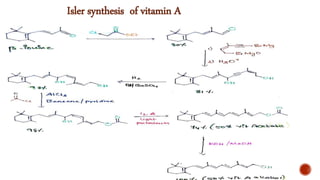
Isler synthesis of vitamin A
Physiological significance of vitamin A
Deficiency of vitamin A
Essential organic compounds that are required in small amounts for normal
growth, maintenance of good health and for the proper utilization of other
nutrients.
Nutrients that our body does not make on its own. Thus we must obtain them
from the foods we eat, or via vitamin supplements.
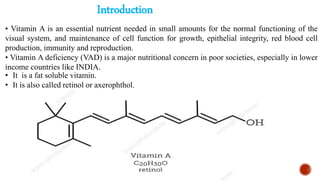
Introduction
• It is a fat soluble vitamin.
• It is also called retinol or axerophthol.
• Vitamin A is an essential nutrient needed in small amounts for the normal functioning of the
visual system, and maintenance of cell function for growth, epithelial integrity, red blood cell
production, immunity and reproduction.
• Vitamin A deficiency (VAD) is a major nutritional concern in poor societies, especially in lower
income countries like INDIA.
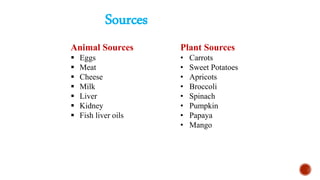
Sources
Animal Sources
 Eggs
 Meat
 Cheese
 Milk
 Liver
 Kidney
 Fish liver oils
Plant Sources
• Carrots
• Sweet Potatoes
• Apricots
• Broccoli
• Spinach
• Pumpkin
• Papaya
• Mango
History Paul karrer
Lafayette mendel
George wald
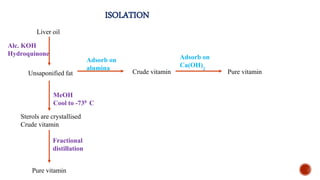
ISOLATION
Liver oil
Unsaponified fat
Sterols are crystallised
Crude vitamin
Pure vitamin
Crude vitamin Pure vitamin
Alc. KOH
Hydroquinone
MeOH
Cool to -730 C
Fractional
distillation
Adsorb on
alumina
Adsorb on
Ca(OH)2
PURE VITAMIN A :
• Pale yellow crystalline solid
• Melting point : 62-640 C
• Thermostable
• Photosensitive to UV rays
• Air oxidizable
 Vitamin A is known for Carr Price reaction
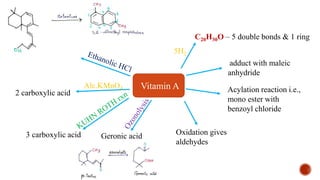
Chemistry of vitamin A
Molecular formula: C20H30O
Beta ionine ring
Two isoprene unit part
Vitamin A
C20H30O – 5 double bonds & 1 ring
adduct with maleic
anhydride
Acylation reaction i.e.,
mono ester with
benzoyl chloride
Oxidation gives
aldehydes
Geronic acid
5H2
3 carboxylic acid
2 carboxylic acid
Alc.KMnO4
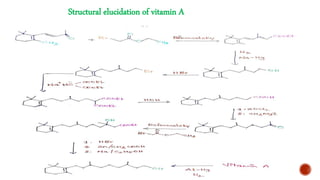
Structural elucidation of vitamin A
Isler synthesis of vitamin A
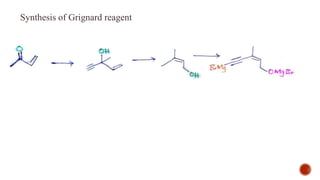
Synthesis of Grignard reagent
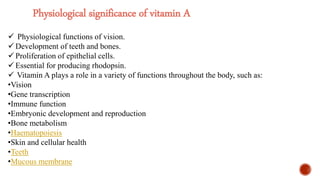
Physiological significance of vitamin A
 Physiological functions of vision.
 Development of teeth and bones.
 Proliferation of epithelial cells.
 Essential for producing rhodopsin.
 Vitamin A plays a role in a variety of functions throughout the body, such as:
•Vision
•Gene transcription
•Immune function
•Embryonic development and reproduction
•Bone metabolism
•Haematopoiesis
•Skin and cellular health
•Teeth
•Mucous membrane
Vitamin A Deficiency and Diseases
 Nyctalopia (night blindness)
 Xerophthalmia
 Bitot’s spots
 Keratomalacia
 Complete blindness (in severe deficiency)
 Corneal ulcers
Vitamin A in overdose can lead to
 Bone disorders
 Gingivitis
 Finally the loss of teeth
Vitamin a

Vitamin a

  • 1.
    CHEMISTRY OF VITAMIN– A • Presented By: • Gandham Malasree • M Pharmacy • I year I sem • Regd no: 620209502002 • Dept of Pharmaceutical Chemistry AU COLLEGE OF PHARMACEUTICAL SCIENCES, VISAKHAPATNAM
  • 2.
    CONTENTS What are vitamins? Introduction Sources History Isolation Chemistryof vitamin A Structural elucidation of vitamin A Isler synthesis of vitamin A Physiological significance of vitamin A Deficiency of vitamin A
  • 3.
    Essential organic compoundsthat are required in small amounts for normal growth, maintenance of good health and for the proper utilization of other nutrients. Nutrients that our body does not make on its own. Thus we must obtain them from the foods we eat, or via vitamin supplements.
  • 4.
    Introduction • It isa fat soluble vitamin. • It is also called retinol or axerophthol. • Vitamin A is an essential nutrient needed in small amounts for the normal functioning of the visual system, and maintenance of cell function for growth, epithelial integrity, red blood cell production, immunity and reproduction. • Vitamin A deficiency (VAD) is a major nutritional concern in poor societies, especially in lower income countries like INDIA.
  • 5.
    Sources Animal Sources  Eggs Meat  Cheese  Milk  Liver  Kidney  Fish liver oils Plant Sources • Carrots • Sweet Potatoes • Apricots • Broccoli • Spinach • Pumpkin • Papaya • Mango
  • 6.
  • 7.
    ISOLATION Liver oil Unsaponified fat Sterolsare crystallised Crude vitamin Pure vitamin Crude vitamin Pure vitamin Alc. KOH Hydroquinone MeOH Cool to -730 C Fractional distillation Adsorb on alumina Adsorb on Ca(OH)2
  • 8.
    PURE VITAMIN A: • Pale yellow crystalline solid • Melting point : 62-640 C • Thermostable • Photosensitive to UV rays • Air oxidizable  Vitamin A is known for Carr Price reaction
  • 9.
    Chemistry of vitaminA Molecular formula: C20H30O Beta ionine ring Two isoprene unit part
  • 10.
    Vitamin A C20H30O –5 double bonds & 1 ring adduct with maleic anhydride Acylation reaction i.e., mono ester with benzoyl chloride Oxidation gives aldehydes Geronic acid 5H2 3 carboxylic acid 2 carboxylic acid Alc.KMnO4
  • 11.
  • 12.
  • 13.
  • 14.
    Physiological significance ofvitamin A  Physiological functions of vision.  Development of teeth and bones.  Proliferation of epithelial cells.  Essential for producing rhodopsin.  Vitamin A plays a role in a variety of functions throughout the body, such as: •Vision •Gene transcription •Immune function •Embryonic development and reproduction •Bone metabolism •Haematopoiesis •Skin and cellular health •Teeth •Mucous membrane
  • 15.
    Vitamin A Deficiencyand Diseases  Nyctalopia (night blindness)  Xerophthalmia  Bitot’s spots  Keratomalacia  Complete blindness (in severe deficiency)  Corneal ulcers
  • 16.
    Vitamin A inoverdose can lead to  Bone disorders  Gingivitis  Finally the loss of teeth