Heterocyclic compound
Imidazole
Introduction
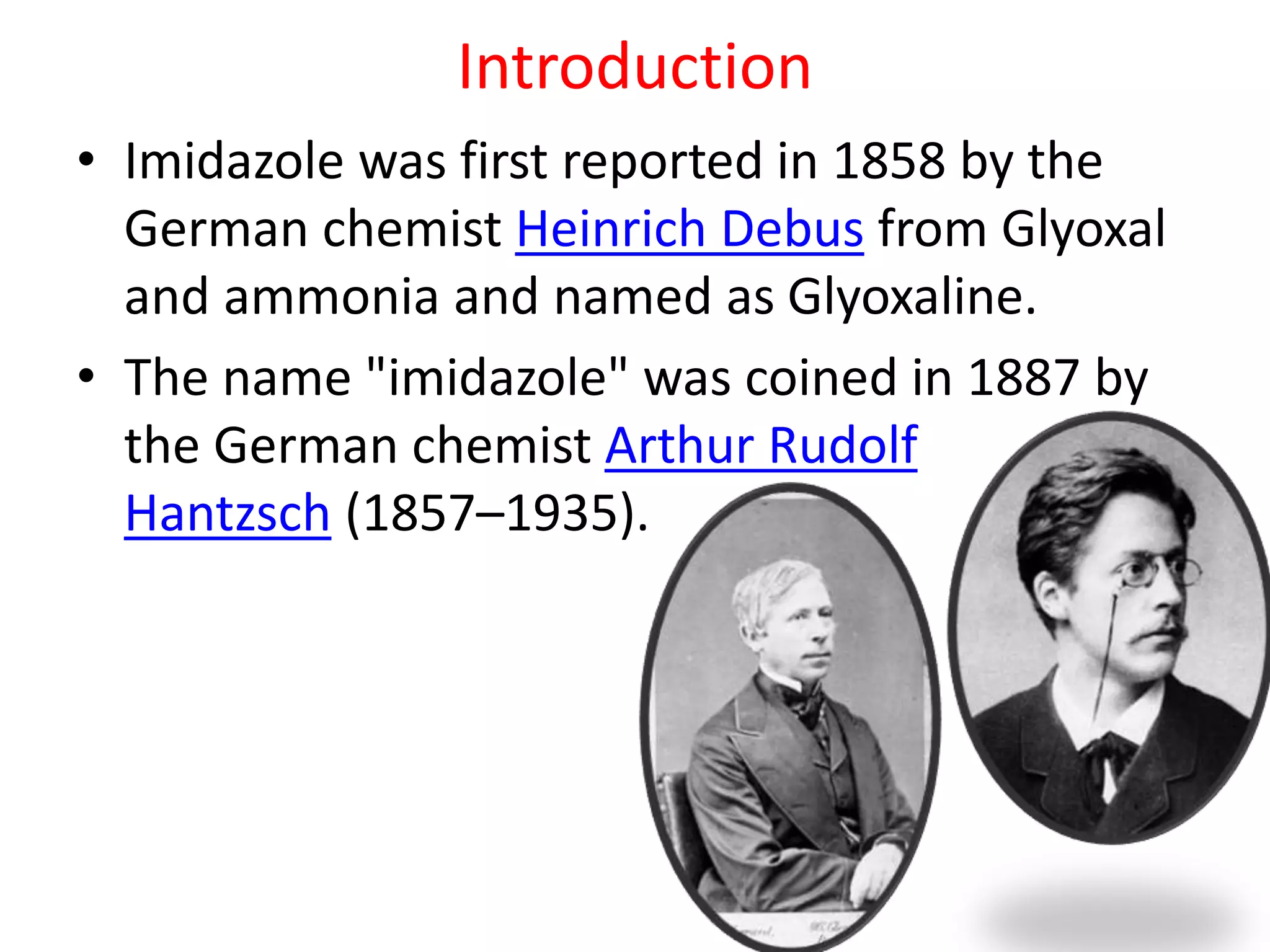
• Imidazole was first reported in 1858 by the
German chemist Heinrich Debus from Glyoxal
and ammonia and named as Glyoxaline.
• The name "imidazole" was coined in 1887 by
the German chemist Arthur Rudolf
Hantzsch (1857–1935).
Imidazole
• Imidazole is an organic compound with the
formula C3H4N2. This aromatic heterocycle is a
diazole and is classified as an alkaloid.
• Imidazole refers to the parent compound,
whereas imidazoles are a class heterocylces
with similar ring structure but varying
substituents.
Biological importance
• This ring system is present in important biological
building blocks, such as histidine and the related
hormone histamine.
• Many drugs contain an imidazole ring, such as
antifungal drugs e.g.clotrimazole, antiulcer drugs,
cimetidine etc. and antimicrobial nitroimidazoles,
e.g. metronidazole, ornidazole etc.
Physical properties
• It is a white or colourless solid that is soluble
in water.
• Melting point : 89 – 91°C
• Boiling point : 256°C
• Density : 1.23 g/cm3
Chemical properties
Amphoterism
• Imidazole is amphoteric. That is,
• It can function as both an acid and as a base.
• As an acid, the pKa of imidazole is 14.5, making it less
acidic than carboxylic acids, phenols, and imides, but
slightly more acidic than alcohols.
• As a base, the pKa of the conjugate acid (cited as
pKBH
+ to avoid confusion between the two) is
approximately 7, making imidazole approximately
sixty times more basic than pyridine.
Synthesis
Conventional method
Tartaric acid
Tartaric acid dinitrate
Imidazole 4,5 dicarboxylic acid
Reactions
Pharmacological activities
• Antifungal and anti-bacterial activity .
• Anti inflammatory activity and analgesic activity .
• Anti tubercular activity .
• Anti depressant activity .
• Anti cancer activity .
• Anti ulcer activity .
• Anti viral activity .
• Anti leishmanial activity
Medicinal uses
Imidazole

Imidazole

  • 1.
  • 2.
    Introduction • Imidazole wasfirst reported in 1858 by the German chemist Heinrich Debus from Glyoxal and ammonia and named as Glyoxaline. • The name "imidazole" was coined in 1887 by the German chemist Arthur Rudolf Hantzsch (1857–1935).
  • 3.
    Imidazole • Imidazole isan organic compound with the formula C3H4N2. This aromatic heterocycle is a diazole and is classified as an alkaloid. • Imidazole refers to the parent compound, whereas imidazoles are a class heterocylces with similar ring structure but varying substituents.
  • 4.
    Biological importance • Thisring system is present in important biological building blocks, such as histidine and the related hormone histamine. • Many drugs contain an imidazole ring, such as antifungal drugs e.g.clotrimazole, antiulcer drugs, cimetidine etc. and antimicrobial nitroimidazoles, e.g. metronidazole, ornidazole etc.
  • 5.
    Physical properties • Itis a white or colourless solid that is soluble in water. • Melting point : 89 – 91°C • Boiling point : 256°C • Density : 1.23 g/cm3
  • 6.
  • 9.
    Amphoterism • Imidazole isamphoteric. That is, • It can function as both an acid and as a base. • As an acid, the pKa of imidazole is 14.5, making it less acidic than carboxylic acids, phenols, and imides, but slightly more acidic than alcohols. • As a base, the pKa of the conjugate acid (cited as pKBH + to avoid confusion between the two) is approximately 7, making imidazole approximately sixty times more basic than pyridine.
  • 10.
  • 11.
    Conventional method Tartaric acid Tartaricacid dinitrate Imidazole 4,5 dicarboxylic acid
  • 14.
  • 21.
    Pharmacological activities • Antifungaland anti-bacterial activity . • Anti inflammatory activity and analgesic activity . • Anti tubercular activity . • Anti depressant activity . • Anti cancer activity . • Anti ulcer activity . • Anti viral activity . • Anti leishmanial activity
  • 22.