Rani T. Bhagat
M . Pharmacy
(Pharmaceutical Chemistry)
1
2
Introduction
Aluminium Isopropoxide
N-Bromo succinimide (NBS)
Diazomethane
N,N Dicyclohexyl Carbodimide (DCC)
Wilkinson’s Catalyst
Witting reagent
3
Synthetic reagents
are those chemical
compounds used as a
catalyst in various
chemical reaction.
A suitable choice
of reagents and
reaction conditions
are essential for
the success of a
reaction for the
desired product.
Reagents have been
found that can
degrade complex
molecule to simple
known molecules
which enabled us to
elucidate the structure
of complex
compounds.
Structure
Properties
4
Molecular formula: C9H21O3Al
Molecular weight: 204.25g
It is white solid.
It is soluble in water.
Uses  Reduction of carbonyl compound,
 Oxidation of alcohol,
 Hydrolysis of oximes,
 Preparation of ether,
 Rearrangement of epoxide to allylic ether.
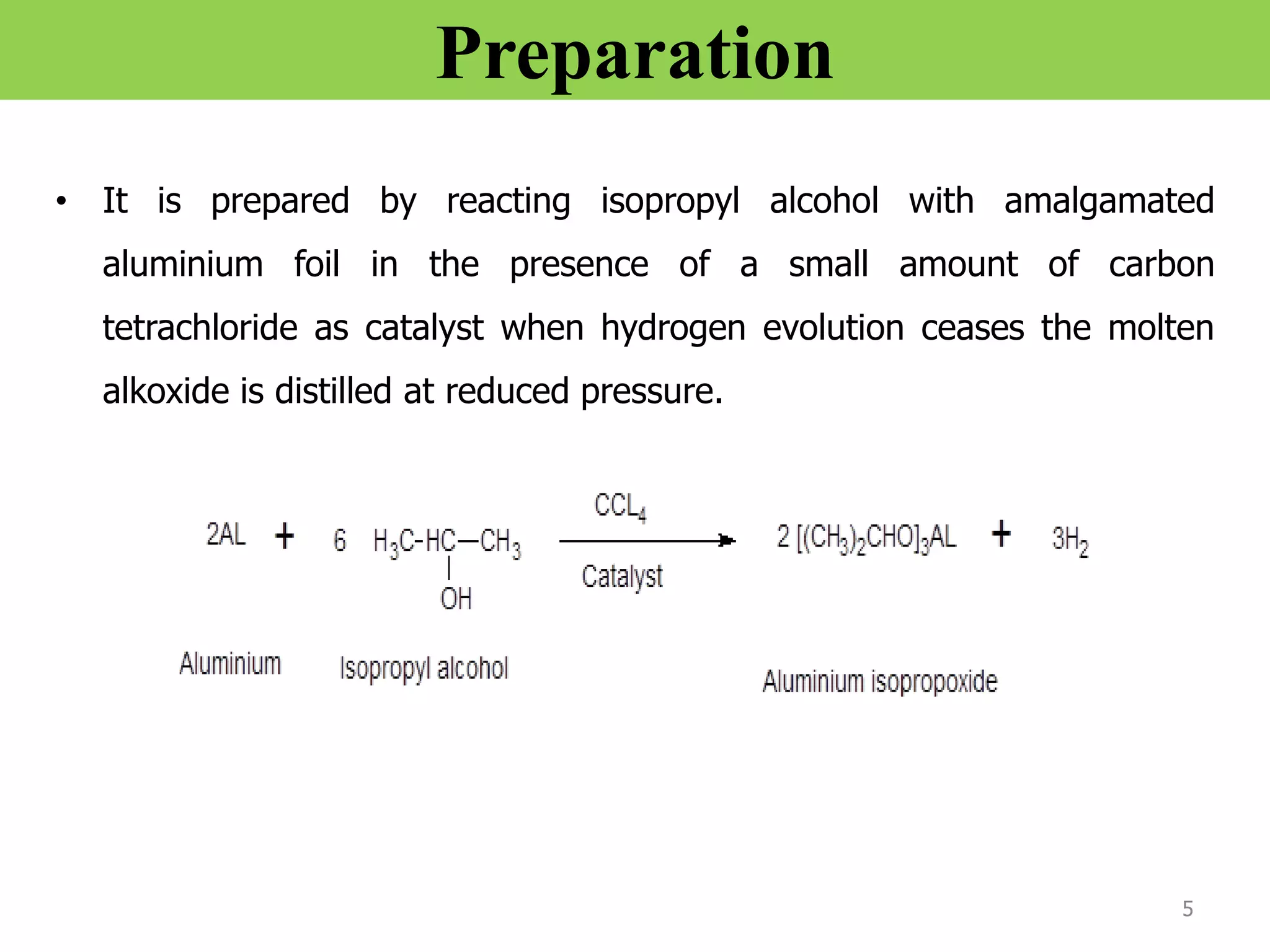
Preparation
• It is prepared by reacting isopropyl alcohol with amalgamated
aluminium foil in the presence of a small amount of carbon
tetrachloride as catalyst when hydrogen evolution ceases the molten
alkoxide is distilled at reduced pressure.
5
Applications
Hydrolysis of oximes-
Oximes can be converted into parent carbonyl compound by aluminium
isopropoxide followed by acid hydrolysis.
6
N
OH
R1 R2
Al(O-
iPr)3
HCl
O
R1 R2
Merrwein Panndorf Verley (MPV) Reduction-:
The reduction of aldehyde and ketones takes place by heating the
carbonyl compound with aluminium isopropoxide in the presence of
excess isopropyl alcohol .the alcohol reduction product is obtained from
the reaction mixtrue after acidification and acetone is generated from
isopropyl alcohol.this is called as Meerwein –ponndrof-verley reduction.
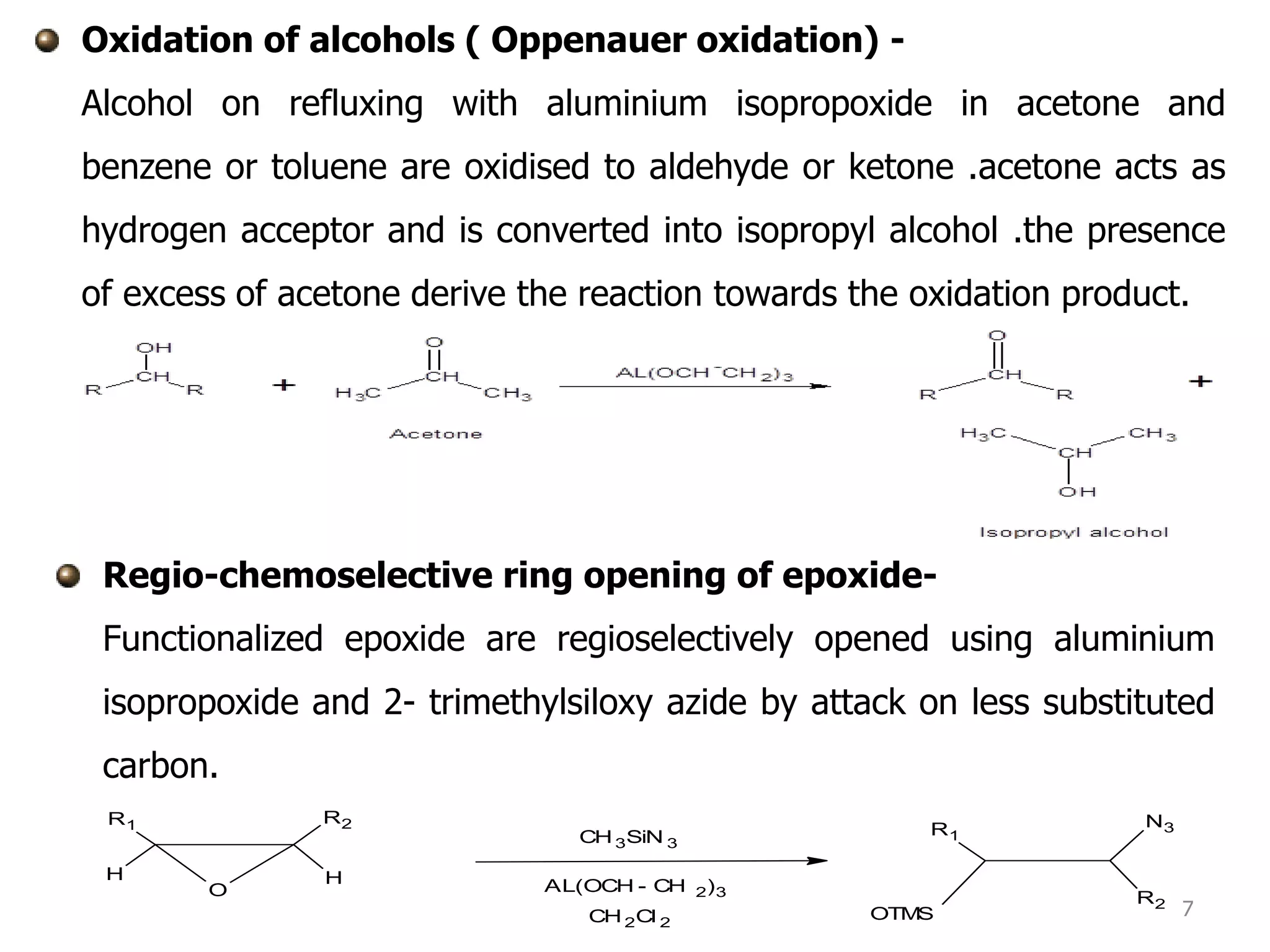
Oxidation of alcohols ( Oppenauer oxidation) -
Alcohol on refluxing with aluminium isopropoxide in acetone and
benzene or toluene are oxidised to aldehyde or ketone .acetone acts as
hydrogen acceptor and is converted into isopropyl alcohol .the presence
of excess of acetone derive the reaction towards the oxidation product.
7
Regio-chemoselective ring opening of epoxide-
Functionalized epoxide are regioselectively opened using aluminium
isopropoxide and 2- trimethylsiloxy azide by attack on less substituted
carbon.
O
R2
HH
R1
R2
N3
OTMS
R1CH3SiN 3
AL(OCH - CH 2)3
CH2Cl 2
Structure
Properties
8
Molecular formula-C4H4BrNO2
 N-Bromosuccinamide or 1-Bromo 2,5-pyrrolidenedione
 Convenient source of bromine for both radicals substitution and
electrophilic addition reaction
Molecular weight-177.98g
Preparation
9
NO O
H
+
Br2 + H Br
NaOH
0
o
C
Succinamide bromine NBS
N OO
Br
• N-Bromosuccinamide can be prepared from succinamide and bromine in
presence of sodium hydroxide solution, the white product obtained is washed
with water or acetic acid.
Applications
• Addition of alkenes –
N-Bromosuccinamide react with alkenes in aqueous solvent to give
bromohydrins.Side reaction include formation of α-bromoketones and
dibromo compound it can be minimised by use of freshly recrystallized
NBS.
10
• Bromination of carbonyl derivatives-
NBS C and α-brominate carbonyl derivative via radical or acid catalyst.
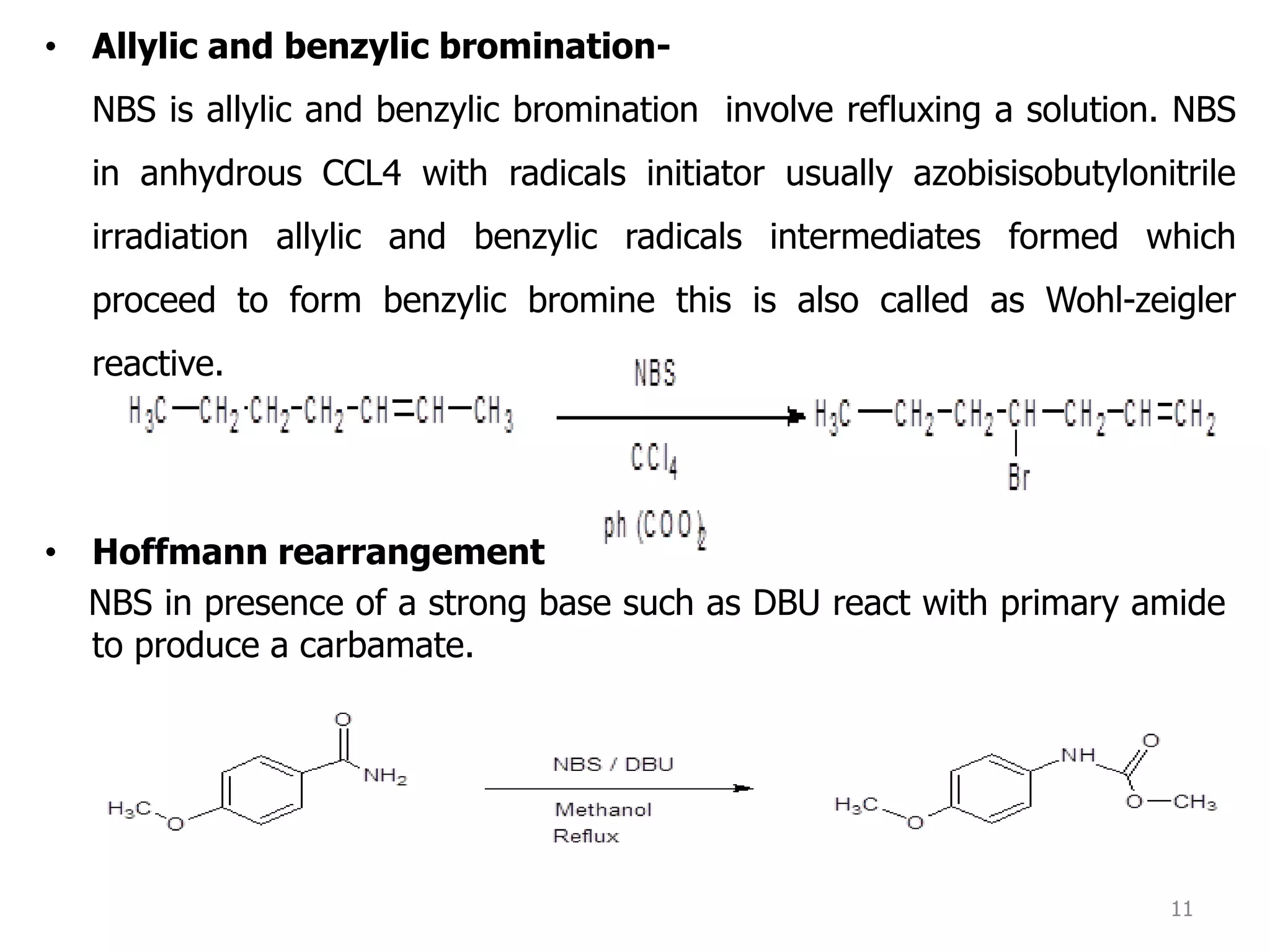
• Hoffmann rearrangement
NBS in presence of a strong base such as DBU react with primary amide
to produce a carbamate.
11
• Allylic and benzylic bromination-
NBS is allylic and benzylic bromination involve refluxing a solution. NBS
in anhydrous CCL4 with radicals initiator usually azobisisobutylonitrile
irradiation allylic and benzylic radicals intermediates formed which
proceed to form benzylic bromine this is also called as Wohl-zeigler
reactive.
Structure
Properties
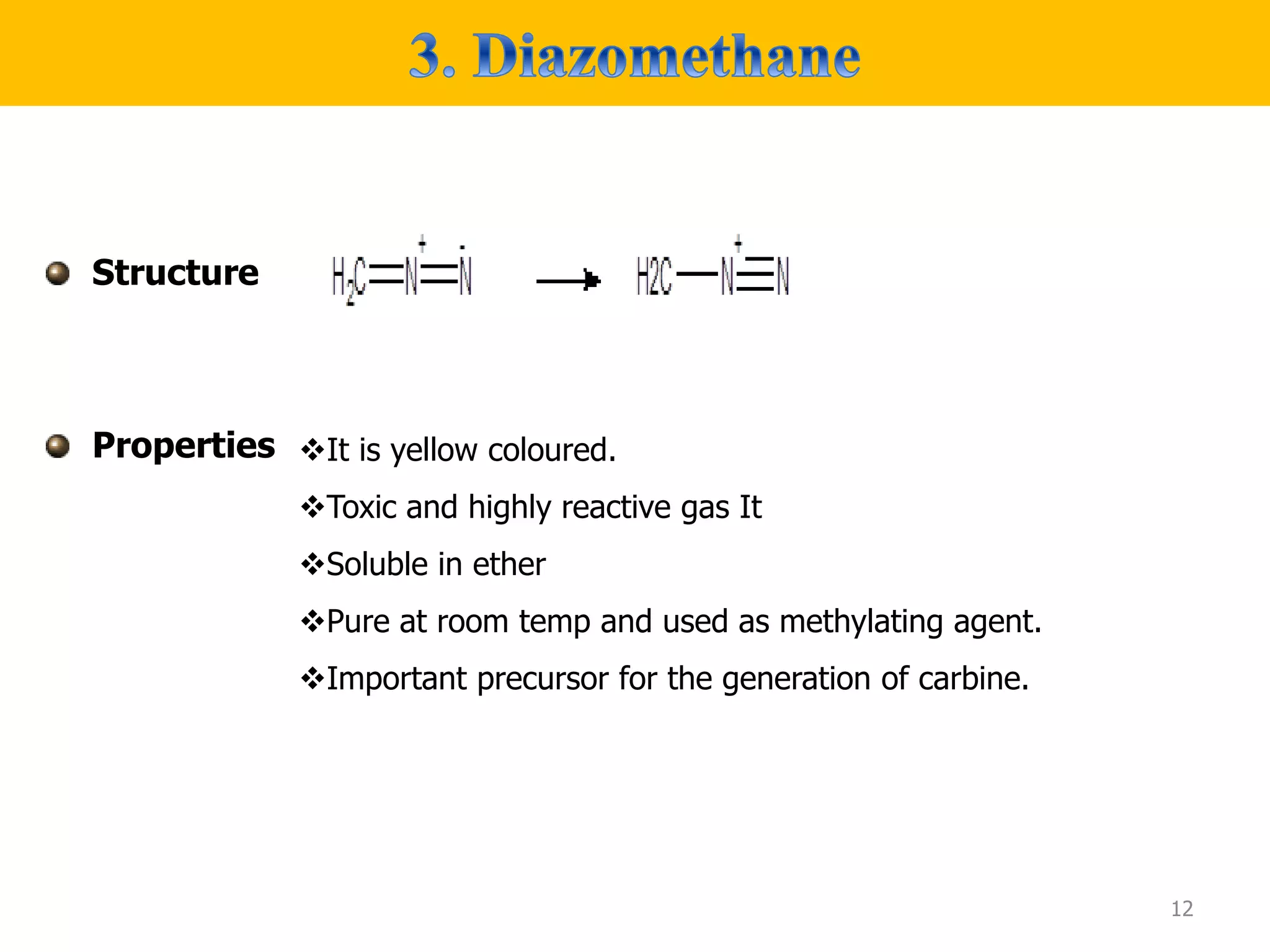
12
It is yellow coloured.
Toxic and highly reactive gas It
Soluble in ether
Pure at room temp and used as methylating agent.
Important precursor for the generation of carbine.
Preparations
 The generally used method for the preparation for the preparation of
diazomethane is by the alkaline hydrolysis of N-nitrosocompound.
 N-methyl-N-nitrourathane an warming with methanolic KOH undergoes
decomposition to give diazomethane .N-methyl-N-nitrosourethane can be
prepared by the reaction of methylamine with ethyl chloroformate, followed
by treatment with HNO2.
13
Applications
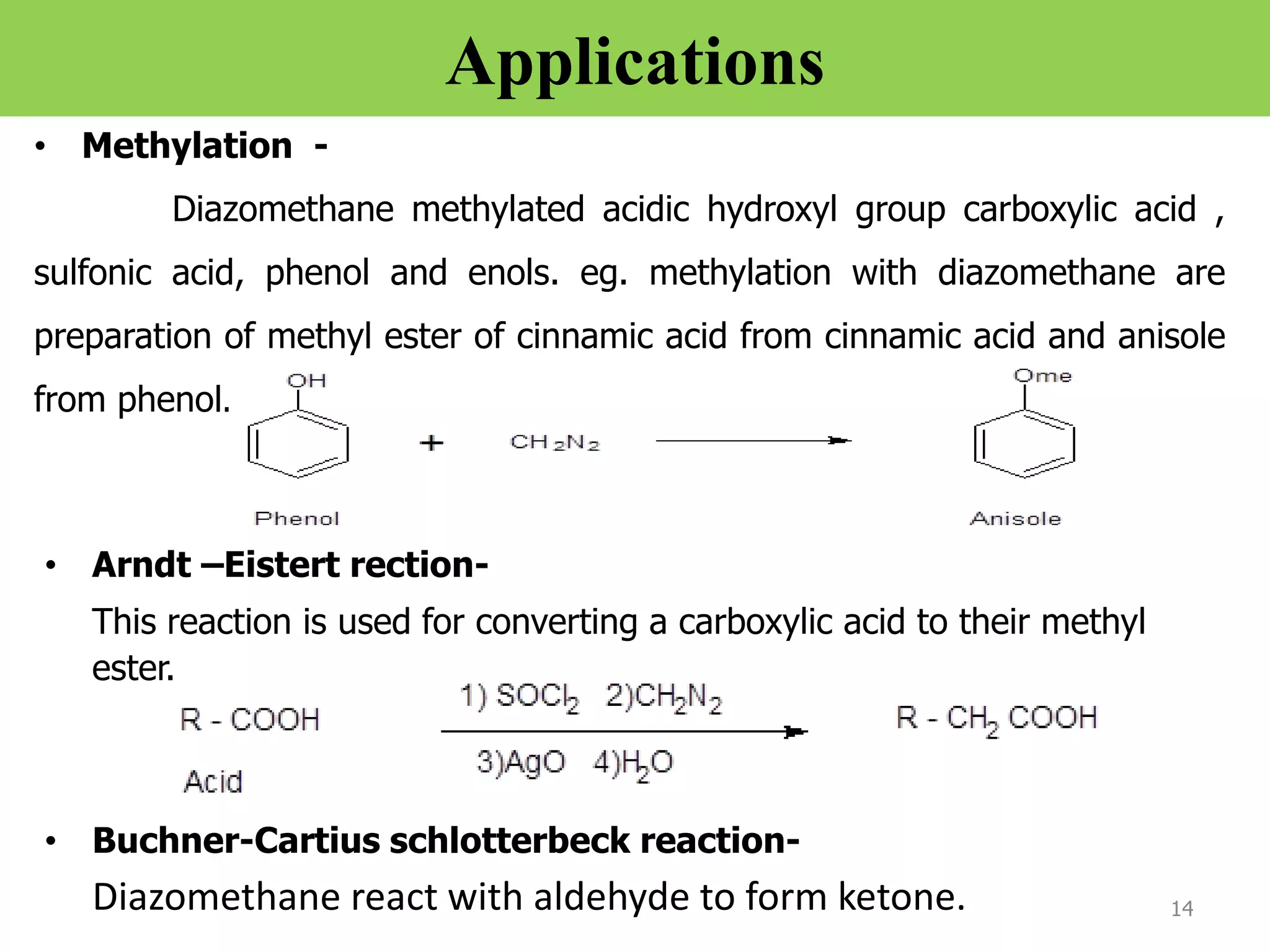
• Methylation -
Diazomethane methylated acidic hydroxyl group carboxylic acid ,
sulfonic acid, phenol and enols. eg. methylation with diazomethane are
preparation of methyl ester of cinnamic acid from cinnamic acid and anisole
from phenol.
14
• Arndt –Eistert rection-
This reaction is used for converting a carboxylic acid to their methyl
ester.
• Buchner-Cartius schlotterbeck reaction-
Diazomethane react with aldehyde to form ketone.
Structure:
Properties:
15
N CH N
N,N Dicyclohexyl carbodiimide or DCC
Molecular formula – C13H22N2
It is white in colour
Sweetish odour , powerful dehydrating agent
It is soluble in tetrahydrofuran , acetonitrile
It is primarily used to couple amino acid during peptide
synthesis
Preparation
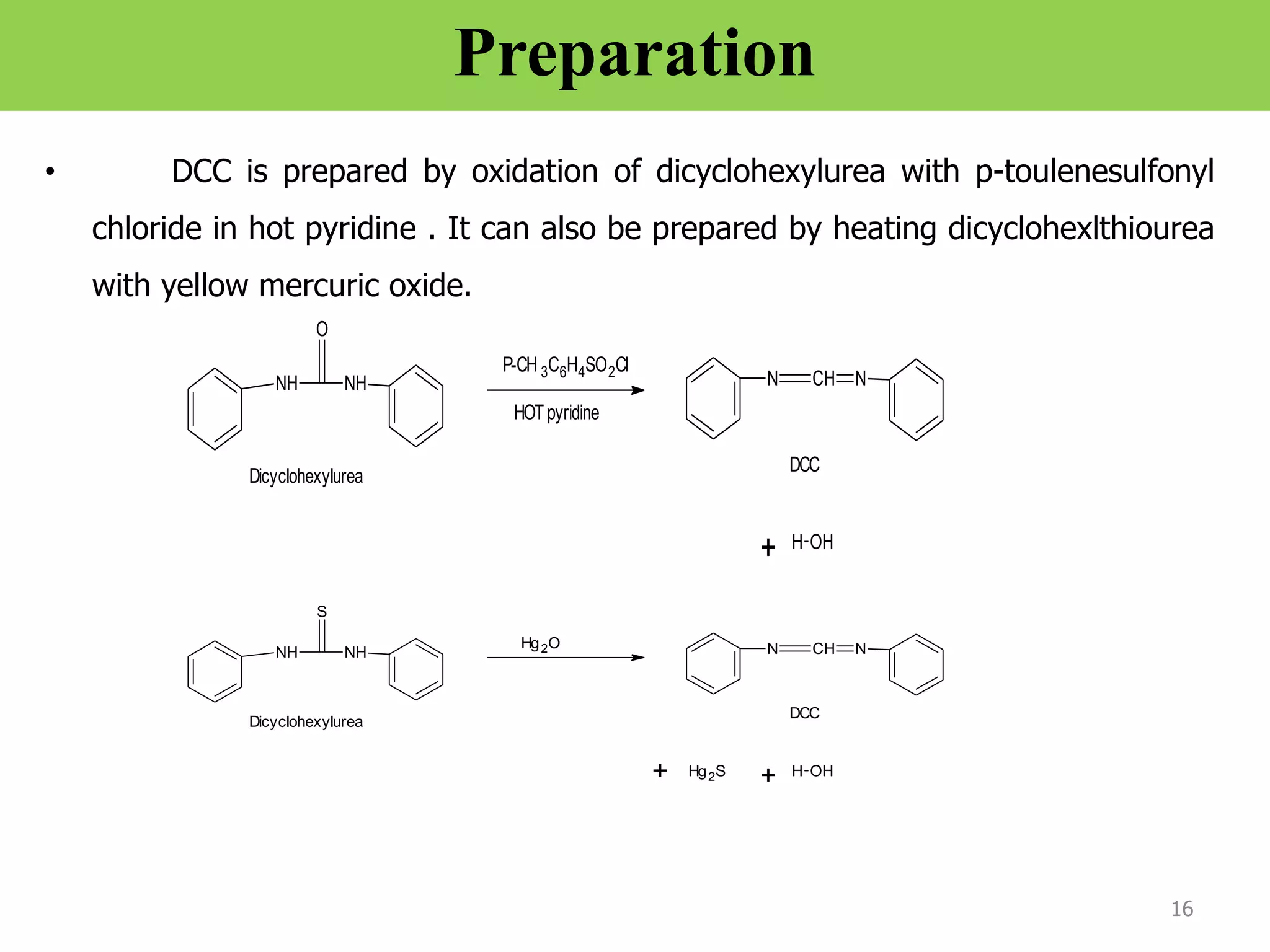
• DCC is prepared by oxidation of dicyclohexylurea with p-toulenesulfonyl
chloride in hot pyridine . It can also be prepared by heating dicyclohexlthiourea
with yellow mercuric oxide.
16
NH
O
NH
Dicyclohexylurea
N CH N
+ H OH
DCC
P-CH 3C6H4SO2Cl
HOTpyridine
NH
S
NH
Dicyclohexylurea
N CH N
+ H OH
DCC
Hg2O
Hg2S+
Application
• Synthesis of amides from carboxylic acids and amine
Activated carboxyl group reacts with the amine to give an amide.used in
synthesis of peptides.
• Synthesis of peroxide
Peroxides can be prepared by reaction of carboxylic acid and hydrogen
peroxide in the presence of DCC.
17
+ (C6H11N2)C + (C6H11NH) 2CO
DCC
R - COOH
O
NRR
2Ar-COOH + H2O2
DCC
Ar
O
O O
O
Ar
Peroxide
• Moffate Oxidation
Oxidation of primary and secondary alcohol to aldehyde and ketone the
oxidant used as DMSO and DCC.
• Dehydration of alcohol
Alcohol can also be dehydrated using DCC to from corresponding alkene.
18
R - OH
DCC
OMSO
R - CHO
R- CH- OH- CH 2 -R + (C6H11N2)C R- CH= CH-R + (C6H11NH) 2CO
AlkeneAlcohol DCC
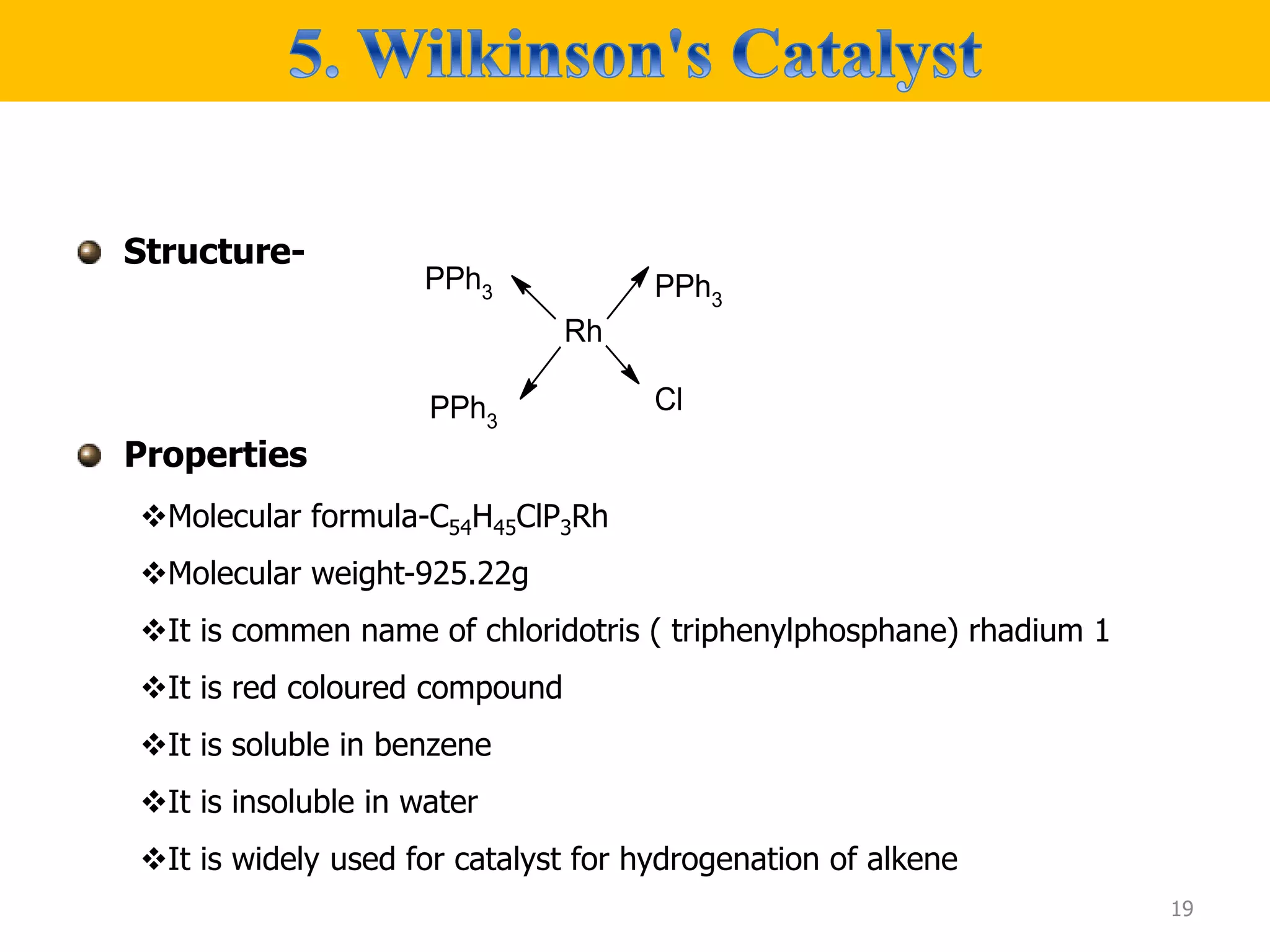
Structure-
Properties
19
Rh
PPh3
PPh3
PPh3
Cl
Molecular formula-C54H45ClP3Rh
Molecular weight-925.22g
It is commen name of chloridotris ( triphenylphosphane) rhadium 1
It is red coloured compound
It is soluble in benzene
It is insoluble in water
It is widely used for catalyst for hydrogenation of alkene
Preparation
• It is obtained by treating rhodium 3 chloride hydrate with an excess of
triphenylphosphin in reflucing ethanol.
20
Rhcl3(H2O)3 + 4PPh3 Rhcl(PPh)3 +OPPh3+2Hcl+2H2O
Applications
• Hydrogenation of olefins
It is also used for hydroxylation, hydroboration of alkenes.
CH2
R
Wilkinson's
catalyst CH3
R
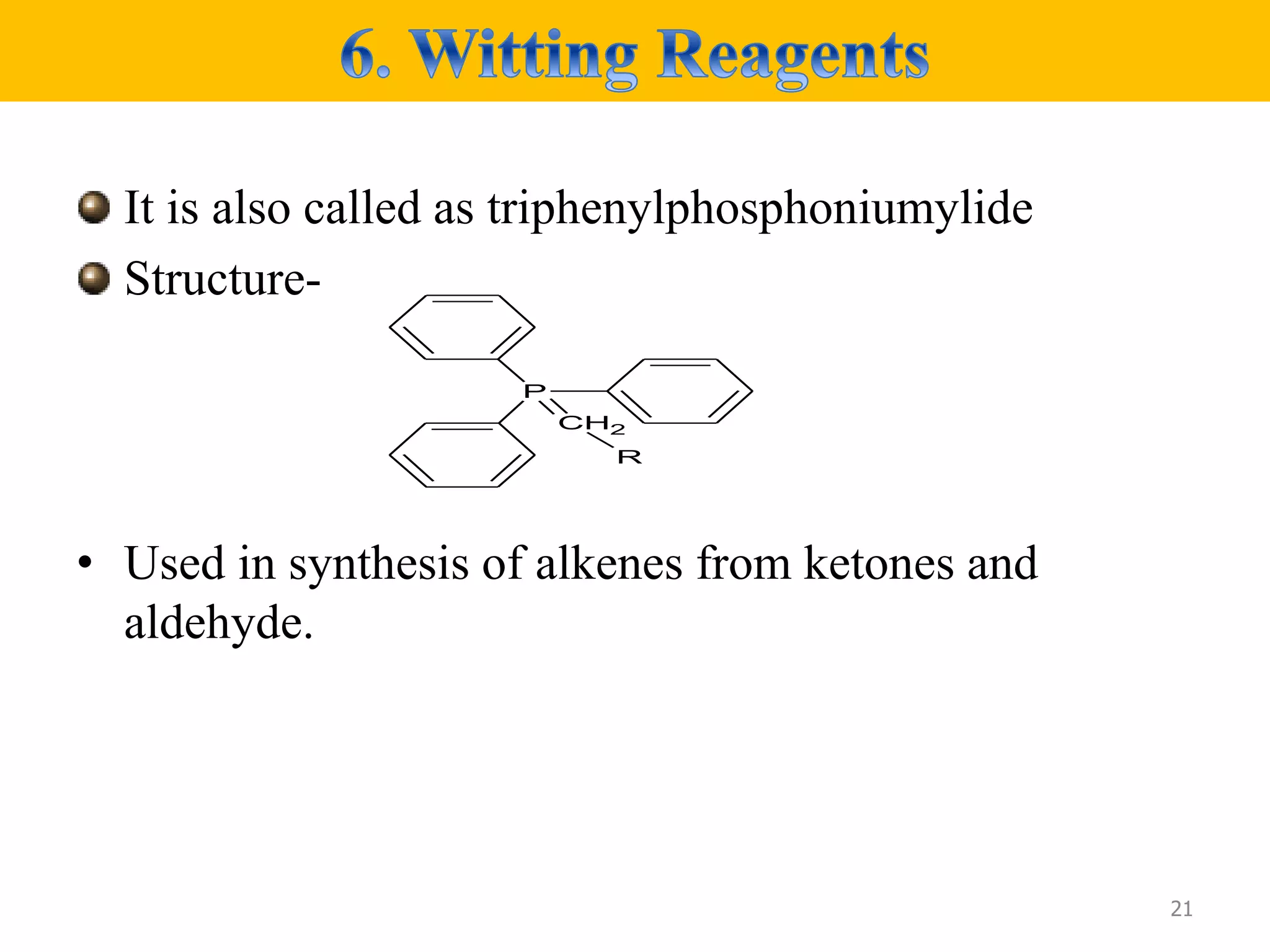
It is also called as triphenylphosphoniumylide
Structure-
• Used in synthesis of alkenes from ketones and
aldehyde.
21
P
CH2
R
Preparation
• Prepared from phosphonium salt which is in turn prepared by
quaternization of triphenylphosphine with an alkyl halide .the alkyl
phosphonium salt is deprotonated.
22
[PPh3CH2R] + C4H9 PPh3=CHR+ C4H10
Application
 Synthesis of leucotrines
 Witting reaction –It involve synthesis of alkenes from ketones
 Prepration of olefins –
Aldehyde or ketones react with witting reagent it gives olefins.
23

Synthetic Reagents and Its Application

  • 1.
    Rani T. Bhagat M. Pharmacy (Pharmaceutical Chemistry) 1
  • 2.
    2 Introduction Aluminium Isopropoxide N-Bromo succinimide(NBS) Diazomethane N,N Dicyclohexyl Carbodimide (DCC) Wilkinson’s Catalyst Witting reagent
  • 3.
    3 Synthetic reagents are thosechemical compounds used as a catalyst in various chemical reaction. A suitable choice of reagents and reaction conditions are essential for the success of a reaction for the desired product. Reagents have been found that can degrade complex molecule to simple known molecules which enabled us to elucidate the structure of complex compounds.
  • 4.
    Structure Properties 4 Molecular formula: C9H21O3Al Molecularweight: 204.25g It is white solid. It is soluble in water. Uses  Reduction of carbonyl compound,  Oxidation of alcohol,  Hydrolysis of oximes,  Preparation of ether,  Rearrangement of epoxide to allylic ether.
  • 5.
    Preparation • It isprepared by reacting isopropyl alcohol with amalgamated aluminium foil in the presence of a small amount of carbon tetrachloride as catalyst when hydrogen evolution ceases the molten alkoxide is distilled at reduced pressure. 5
  • 6.
    Applications Hydrolysis of oximes- Oximescan be converted into parent carbonyl compound by aluminium isopropoxide followed by acid hydrolysis. 6 N OH R1 R2 Al(O- iPr)3 HCl O R1 R2 Merrwein Panndorf Verley (MPV) Reduction-: The reduction of aldehyde and ketones takes place by heating the carbonyl compound with aluminium isopropoxide in the presence of excess isopropyl alcohol .the alcohol reduction product is obtained from the reaction mixtrue after acidification and acetone is generated from isopropyl alcohol.this is called as Meerwein –ponndrof-verley reduction.
  • 7.
    Oxidation of alcohols( Oppenauer oxidation) - Alcohol on refluxing with aluminium isopropoxide in acetone and benzene or toluene are oxidised to aldehyde or ketone .acetone acts as hydrogen acceptor and is converted into isopropyl alcohol .the presence of excess of acetone derive the reaction towards the oxidation product. 7 Regio-chemoselective ring opening of epoxide- Functionalized epoxide are regioselectively opened using aluminium isopropoxide and 2- trimethylsiloxy azide by attack on less substituted carbon. O R2 HH R1 R2 N3 OTMS R1CH3SiN 3 AL(OCH - CH 2)3 CH2Cl 2
  • 8.
    Structure Properties 8 Molecular formula-C4H4BrNO2  N-Bromosuccinamideor 1-Bromo 2,5-pyrrolidenedione  Convenient source of bromine for both radicals substitution and electrophilic addition reaction Molecular weight-177.98g
  • 9.
    Preparation 9 NO O H + Br2 +H Br NaOH 0 o C Succinamide bromine NBS N OO Br • N-Bromosuccinamide can be prepared from succinamide and bromine in presence of sodium hydroxide solution, the white product obtained is washed with water or acetic acid.
  • 10.
    Applications • Addition ofalkenes – N-Bromosuccinamide react with alkenes in aqueous solvent to give bromohydrins.Side reaction include formation of α-bromoketones and dibromo compound it can be minimised by use of freshly recrystallized NBS. 10 • Bromination of carbonyl derivatives- NBS C and α-brominate carbonyl derivative via radical or acid catalyst.
  • 11.
    • Hoffmann rearrangement NBSin presence of a strong base such as DBU react with primary amide to produce a carbamate. 11 • Allylic and benzylic bromination- NBS is allylic and benzylic bromination involve refluxing a solution. NBS in anhydrous CCL4 with radicals initiator usually azobisisobutylonitrile irradiation allylic and benzylic radicals intermediates formed which proceed to form benzylic bromine this is also called as Wohl-zeigler reactive.
  • 12.
    Structure Properties 12 It is yellowcoloured. Toxic and highly reactive gas It Soluble in ether Pure at room temp and used as methylating agent. Important precursor for the generation of carbine.
  • 13.
    Preparations  The generallyused method for the preparation for the preparation of diazomethane is by the alkaline hydrolysis of N-nitrosocompound.  N-methyl-N-nitrourathane an warming with methanolic KOH undergoes decomposition to give diazomethane .N-methyl-N-nitrosourethane can be prepared by the reaction of methylamine with ethyl chloroformate, followed by treatment with HNO2. 13
  • 14.
    Applications • Methylation - Diazomethanemethylated acidic hydroxyl group carboxylic acid , sulfonic acid, phenol and enols. eg. methylation with diazomethane are preparation of methyl ester of cinnamic acid from cinnamic acid and anisole from phenol. 14 • Arndt –Eistert rection- This reaction is used for converting a carboxylic acid to their methyl ester. • Buchner-Cartius schlotterbeck reaction- Diazomethane react with aldehyde to form ketone.
  • 15.
    Structure: Properties: 15 N CH N N,NDicyclohexyl carbodiimide or DCC Molecular formula – C13H22N2 It is white in colour Sweetish odour , powerful dehydrating agent It is soluble in tetrahydrofuran , acetonitrile It is primarily used to couple amino acid during peptide synthesis
  • 16.
    Preparation • DCC isprepared by oxidation of dicyclohexylurea with p-toulenesulfonyl chloride in hot pyridine . It can also be prepared by heating dicyclohexlthiourea with yellow mercuric oxide. 16 NH O NH Dicyclohexylurea N CH N + H OH DCC P-CH 3C6H4SO2Cl HOTpyridine NH S NH Dicyclohexylurea N CH N + H OH DCC Hg2O Hg2S+
  • 17.
    Application • Synthesis ofamides from carboxylic acids and amine Activated carboxyl group reacts with the amine to give an amide.used in synthesis of peptides. • Synthesis of peroxide Peroxides can be prepared by reaction of carboxylic acid and hydrogen peroxide in the presence of DCC. 17 + (C6H11N2)C + (C6H11NH) 2CO DCC R - COOH O NRR 2Ar-COOH + H2O2 DCC Ar O O O O Ar Peroxide
  • 18.
    • Moffate Oxidation Oxidationof primary and secondary alcohol to aldehyde and ketone the oxidant used as DMSO and DCC. • Dehydration of alcohol Alcohol can also be dehydrated using DCC to from corresponding alkene. 18 R - OH DCC OMSO R - CHO R- CH- OH- CH 2 -R + (C6H11N2)C R- CH= CH-R + (C6H11NH) 2CO AlkeneAlcohol DCC
  • 19.
    Structure- Properties 19 Rh PPh3 PPh3 PPh3 Cl Molecular formula-C54H45ClP3Rh Molecular weight-925.22g Itis commen name of chloridotris ( triphenylphosphane) rhadium 1 It is red coloured compound It is soluble in benzene It is insoluble in water It is widely used for catalyst for hydrogenation of alkene
  • 20.
    Preparation • It isobtained by treating rhodium 3 chloride hydrate with an excess of triphenylphosphin in reflucing ethanol. 20 Rhcl3(H2O)3 + 4PPh3 Rhcl(PPh)3 +OPPh3+2Hcl+2H2O Applications • Hydrogenation of olefins It is also used for hydroxylation, hydroboration of alkenes. CH2 R Wilkinson's catalyst CH3 R
  • 21.
    It is alsocalled as triphenylphosphoniumylide Structure- • Used in synthesis of alkenes from ketones and aldehyde. 21 P CH2 R
  • 22.
    Preparation • Prepared fromphosphonium salt which is in turn prepared by quaternization of triphenylphosphine with an alkyl halide .the alkyl phosphonium salt is deprotonated. 22 [PPh3CH2R] + C4H9 PPh3=CHR+ C4H10 Application  Synthesis of leucotrines  Witting reaction –It involve synthesis of alkenes from ketones  Prepration of olefins – Aldehyde or ketones react with witting reagent it gives olefins.
  • 23.