Bouveault – Blanc Reduction
Presented By:
•Gandham Malasree
•M Pharmacy
•Regd no: 620209502002
•Dept of Pharmaceutical Chemistry
AU COLLEGE OF PHARMACEUTICAL SCIENCES, VISAKHAPATNAM
BOUVEAULT – BLANC REDUCTION
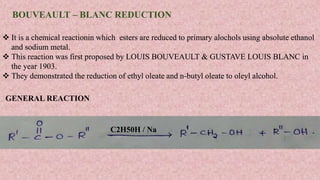
 It is a chemical reactionin which esters are reduced to primary alochols using absolute ethanol
and sodium metal.
 This reaction was first proposed by LOUIS BOUVEAULT & GUSTAVE LOUIS BLANC in
the year 1903.
 They demonstrated the reduction of ethyl oleate and n-butyl oleate to oleyl alcohol.
C2H50H / Na
 It is a chemical reactionin which esters are reduced to primary alochols using absolute ethanol
and sodium metal.
 This reaction was first proposed by LOUIS BOUVEAULT & GUSTAVE LOUIS BLANC in
the year 1903.
 They demonstrated the reduction of ethyl oleate and n-butyl oleate to oleyl alcohol.
GENERAL REACTION
Reagents
1. Sodiun metal (Na + electron)
2. Metal reducing agent is LITHIUM ALUMINIUM HYDRIDE (LiAlH4)
it is used for laboratory scale reactions.
• Solvated electron
• acts as a nucleophile
Solvents
 Ethanol(C2H5OH) • Protonated solvent
 This method is an inexpensive substitute for LAH reductions of esters in industrial
production, and was the only alternative prior to the development of the metal hydride
reducing agents. This dissolving metal reduction is also related to the Birch Reduction.
MECHANISM
It is a single electron transfer mechanism. Sodium serves as single electron reducing agent
and ethyl alcohol is the proton donor. If no proton donor is available, dimerization will take
place, as the acyloin condensation.
1. Electron transfer& radical formation
2. Protonation
3. Second electron transfer & carbanion formation
4. Protonation
5. Removal of one molecule of alcohol
6. Electron transfer
7. Protonation
8. Electron transfer
9. Protonation
Examples
 It involves the encapsulating the alkali metal into a silica gel which has a safety and yield
profile similar to hydride reagents.
 Another modification involves use of sodium dispersion.
Modifications
 This approach to reducing esters was widely used prior to the availability of hydride reducing
agents such as LiAlH4 and related agents.
 It requires vigorous reaction conditions and has a significant risk of fires.
APPLICATIONS
1. It is used to prepare two different types of alcohols.
2. It is used in preparation of alcohols in large amounts.
3. Used in personal care application.
4. Alcohol elevates the extracellular dopamine in brain.
5. Life saving drugs.
Bouveault blanc reduction

Bouveault blanc reduction

  • 1.
    Bouveault – BlancReduction Presented By: •Gandham Malasree •M Pharmacy •Regd no: 620209502002 •Dept of Pharmaceutical Chemistry AU COLLEGE OF PHARMACEUTICAL SCIENCES, VISAKHAPATNAM
  • 2.
    BOUVEAULT – BLANCREDUCTION  It is a chemical reactionin which esters are reduced to primary alochols using absolute ethanol and sodium metal.  This reaction was first proposed by LOUIS BOUVEAULT & GUSTAVE LOUIS BLANC in the year 1903.  They demonstrated the reduction of ethyl oleate and n-butyl oleate to oleyl alcohol. C2H50H / Na  It is a chemical reactionin which esters are reduced to primary alochols using absolute ethanol and sodium metal.  This reaction was first proposed by LOUIS BOUVEAULT & GUSTAVE LOUIS BLANC in the year 1903.  They demonstrated the reduction of ethyl oleate and n-butyl oleate to oleyl alcohol. GENERAL REACTION
  • 3.
    Reagents 1. Sodiun metal(Na + electron) 2. Metal reducing agent is LITHIUM ALUMINIUM HYDRIDE (LiAlH4) it is used for laboratory scale reactions. • Solvated electron • acts as a nucleophile Solvents  Ethanol(C2H5OH) • Protonated solvent  This method is an inexpensive substitute for LAH reductions of esters in industrial production, and was the only alternative prior to the development of the metal hydride reducing agents. This dissolving metal reduction is also related to the Birch Reduction.
  • 4.
    MECHANISM It is asingle electron transfer mechanism. Sodium serves as single electron reducing agent and ethyl alcohol is the proton donor. If no proton donor is available, dimerization will take place, as the acyloin condensation. 1. Electron transfer& radical formation 2. Protonation 3. Second electron transfer & carbanion formation 4. Protonation 5. Removal of one molecule of alcohol 6. Electron transfer 7. Protonation 8. Electron transfer 9. Protonation
  • 6.
  • 7.
     It involvesthe encapsulating the alkali metal into a silica gel which has a safety and yield profile similar to hydride reagents.  Another modification involves use of sodium dispersion. Modifications  This approach to reducing esters was widely used prior to the availability of hydride reducing agents such as LiAlH4 and related agents.  It requires vigorous reaction conditions and has a significant risk of fires.
  • 8.
    APPLICATIONS 1. It isused to prepare two different types of alcohols. 2. It is used in preparation of alcohols in large amounts. 3. Used in personal care application. 4. Alcohol elevates the extracellular dopamine in brain. 5. Life saving drugs.