TYPES
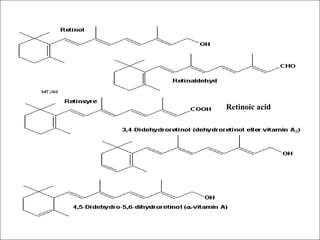
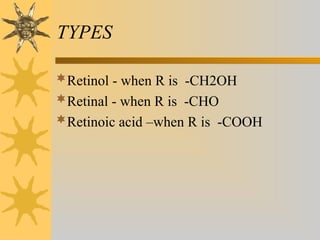
Retinol - whenR is -CH2OH
Retinal - when R is -CHO
Retinoic acid –when R is -COOH
5.
FORMS OF VITAMINA
VITAMIN A1 – found in major species of
animals.
VITAMIN A2- found in fresh water fish.
NEOVITAMIN A- stereoisomer of
vitamin A1
6.
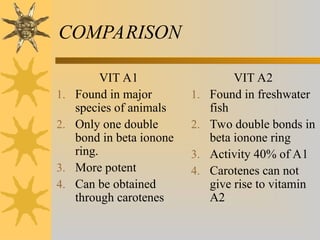
COMPARISON
VIT A1
1. Foundin major
species of animals
2. Only one double
bond in beta ionone
ring.
3. More potent
4. Can be obtained
through carotenes
VIT A2
1. Found in freshwater
fish
2. Two double bonds in
beta ionone ring
3. Activity 40% of A1
4. Carotenes can not
give rise to vitamin
A2
7.
DIETARY SOURCES
Animal sources-liver oil,butter,milk,
cheese,egg- yolk,
Plant sources- tomatoes,carrots,green
yellow vegetables,spinach and fruits like
mangoes,papayas,corn,sweet potatoes
8.
Recommended Daily Allowance
Adultmale- 3000 IU
Adult female- 3000 IU
Recommended daily allowance is 6000IU
1 IU=0.3 micro gms of Retinol
9.
ABSORPTION, STORAGE &
TRANSPORT
ABSORBEDIN SMALL INTESTINE
FREE retinol is absorbed
Retinol is transported in association with a
specific retinol binding protein .
Stored as retinyl ester (normally as retinyl
palmitate)
Retinoic acid is transported in association with a
specific retinoic acid binding protein .
10.
ROLE IN VISION
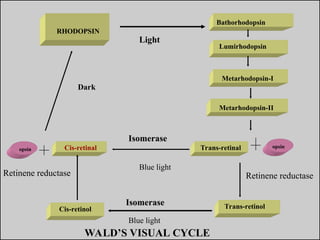
Overallmechanism through which it works
is known as Wald’s visual cycle /rhodopsin
cycle.
Rods contain –photosensitive pigment
called rhodopsin or visual purple.
Visual purple –opsin
retinine/retinal or
retinaldehyde
EPITHELIAIZATON
Epithelial structures showgross structural
changes in deficiency
Skin-dry,rough& scaly
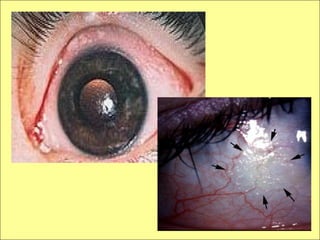
Cornea-epithilium keratinised,opaque
Bitot’s spot
Lacrimal glands-similar changes leading to
dryness of conjunctiva&cornea(xerophthalmia)
Respiratory tract –keratinzation- susceptibility to
infection.
13.
BONE AND TEETH
FORMATION
Deficiencyresults in slowing of
endochondral bone formation and reduced
osteoblastic activity.
Thinning of enamel and deposit of chalky
deposit on the surface of the teeth.
14.
ROLE IN REPRODUCTION
EXPERIMENTSON RATS-
Deficient male-ill developed testes,
immature sperms
Deficient female-unable to carry
pregnancy to full term .
ROLE IN METABOLISM-
• Protein synthesis
• DNA metabolism
15.
Beta-Carotene as anantioxidant
and anticancer
In addition to its antioxidant property,
Beta- Carotene also has been shown to
have anticancer action.
It increases the number of receptors on
WBC for a molecule known as “major
histocompatibility complex I”.
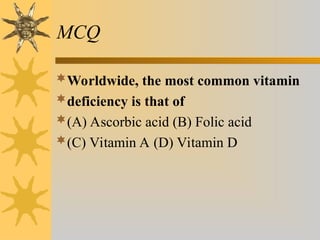
MCQ
Worldwide, the mostcommon vitamin
deficiency is that of
(A) Ascorbic acid (B) Folic acid
(C) Vitamin A (D) Vitamin D
22.
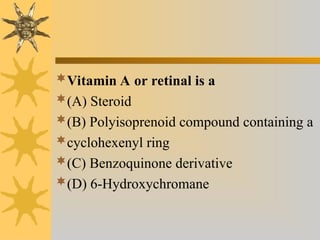
Vitamin A orretinal is a
(A) Steroid
(B) Polyisoprenoid compound containing a
cyclohexenyl ring
(C) Benzoquinone derivative
(D) 6-Hydroxychromane
23.
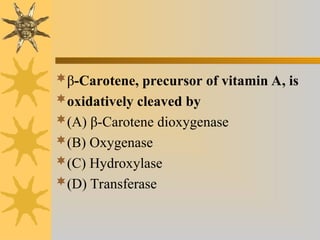
β-Carotene, precursor ofvitamin A, is
oxidatively cleaved by
(A) β-Carotene dioxygenase
(B) Oxygenase
(C) Hydroxylase
(D) Transferase
24.
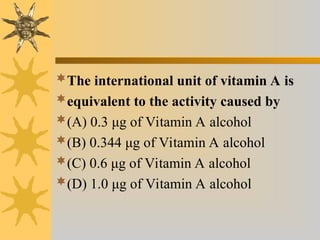
The international unitof vitamin A is
equivalent to the activity caused by
(A) 0.3 μg of Vitamin A alcohol
(B) 0.344 μg of Vitamin A alcohol
(C) 0.6 μg of Vitamin A alcohol
(D) 1.0 μg of Vitamin A alcohol
25.
Retinol is transportedin blood bound to
(A) Aporetinol binding protein
(B) α2-Globulin
(C) β-Globulin
(D) Albumin
Retinal is acomponent of
(A) Iodopsin (B) Rhodopsin
(C) Cardiolipin (D) Glycoproteins
28.
An important functionof vitamin A is
(A) To act as coenzyme for a few enzymes
(B) To play an integral role in protein
synthesis
(C) To prevent hemorrhages
(D) To maintain the integrity of epithelial
tissue