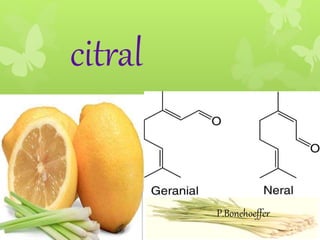
citral
P.Bonehoeffer
what is citral?
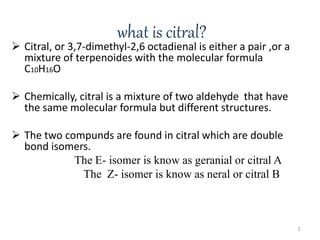
 Citral, or 3,7-dimethyl-2,6 octadienal is either a pair ,or a
mixture of terpenoides with the molecular formula
C10H16O
 Chemically, citral is a mixture of two aldehyde that have
the same molecular formula but different structures.
 The two compunds are found in citral which are double
bond isomers.
The E- isomer is know as geranial or citral A
The Z- isomer is know as neral or citral B
2
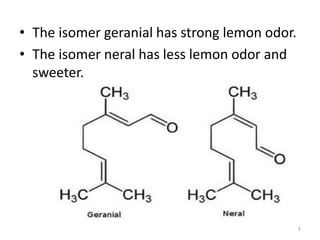
• The isomer geranial has strong lemon odor.
• The isomer neral has less lemon odor and
sweeter.
3
Physical properties of citral
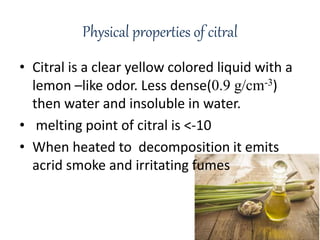
• Citral is a clear yellow colored liquid with a
lemon –like odor. Less dense(0.9 g/cm-3)
then water and insoluble in water.
• melting point of citral is <-10
• When heated to decomposition it emits
acrid smoke and irritating fumes
4
Occurrence
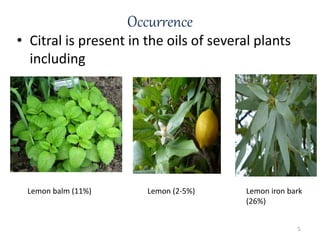
• Citral is present in the oils of several plants
including
Lemon balm (11%) Lemon (2-5%) Lemon iron bark
(26%)
5
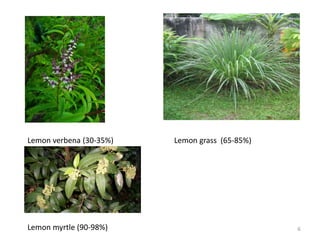
Lemon verbena (30-35%) Lemon grass (65-85%)
Lemon myrtle (90-98%) 6
applications
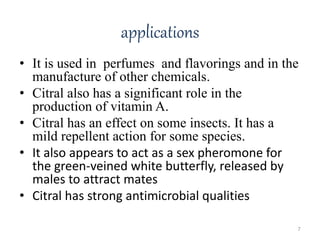
• It is used in perfumes and flavorings and in the
manufacture of other chemicals.
• Citral also has a significant role in the
production of vitamin A.
• Citral has an effect on some insects. It has a
mild repellent action for some species.
• It also appears to act as a sex pheromone for
the green-veined white butterfly, released by
males to attract mates
• Citral has strong antimicrobial qualities
7
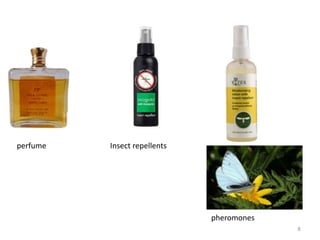
perfume Insect repellents
pheromones
8
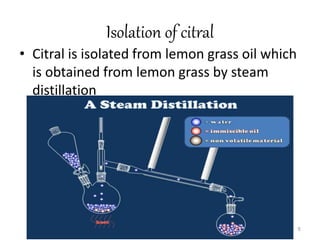
Isolation of citral
• Citral is isolated from lemon grass oil which
is obtained from lemon grass by steam
distillation
9
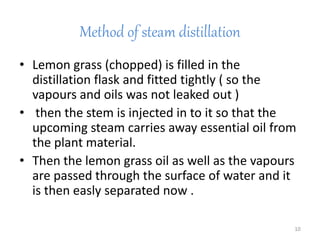
Method of steam distillation
• Lemon grass (chopped) is filled in the
distillation flask and fitted tightly ( so the
vapours and oils was not leaked out )
• then the stem is injected in to it so that the
upcoming steam carries away essential oil from
the plant material.
• Then the lemon grass oil as well as the vapours
are passed through the surface of water and it
is then easly separated now .
10
11
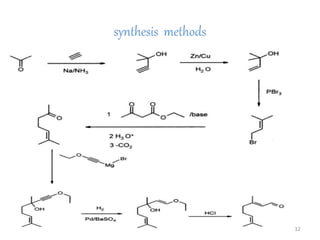
synthesis methods
12
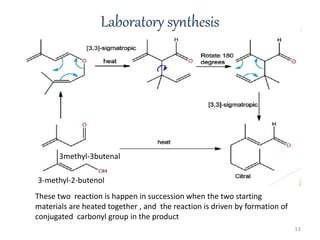
Laboratory synthesis
These two reaction is happen in succession when the two starting
materials are heated together , and the reaction is driven by formation of
conjugated carbonyl group in the product
3methyl-3butenal
3-methyl-2-butenol
13
Structure elucidation of citral
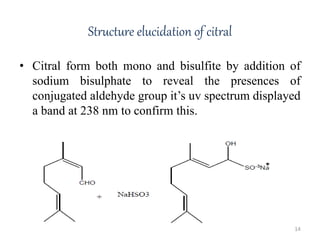
• Citral form both mono and bisulfite by addition of
sodium bisulphate to reveal the presences of
conjugated aldehyde group it’s uv spectrum displayed
a band at 238 nm to confirm this.
14
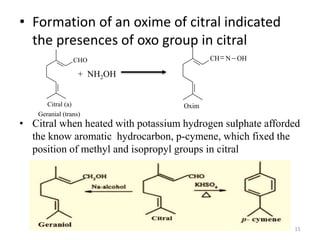
• Formation of an oxime of citral indicated
the presences of oxo group in citral
• Citral when heated with potassium hydrogen sulphate afforded
the know aromatic hydrocarbon, p-cymene, which fixed the
position of methyl and isopropyl groups in citral
CHO
Citral (a)
Geranial (trans)
+ NH2OH
CH N OH
Oxim
15
• Citral on oxidation with alkaline permanganate,
yielded acetone, oxalic and levulenic acid.
• Citral oxidation with silver oxide afforded an acid geranic
acid, C10H16O2 containing the same number of carbon atoms
suggesting that citral had an aldehyde group.
16
CHO
Citral (a)
Geranial (trans)
i) KMnO4
ii) CrO3
+ +
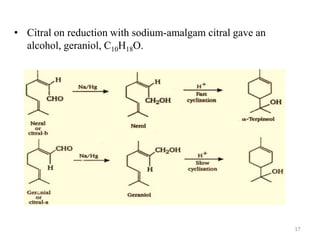
• Citral on reduction with sodium-amalgam citral gave an
alcohol, geraniol, C10H18O.
17
Evidents by Mass spectrum
 molecular mass of
citral is 152
It show a peak at
m/Z 29 due to
hemolytic alpha
cleavage
Peak at m/Z 69 due to
beta cleavage
Peak at m/Z 124 due
to heterolytic alpha
cleavage
18
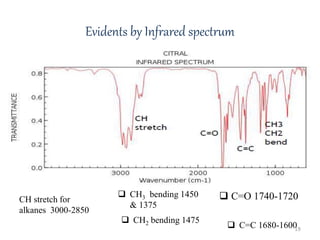
Evidents by Infrared spectrum
 C=O 1740-1720
 CH2 bending 1475
 C=C 1680-1600
 CH3 bending 1450
& 1375
CH stretch for
alkanes 3000-2850
19
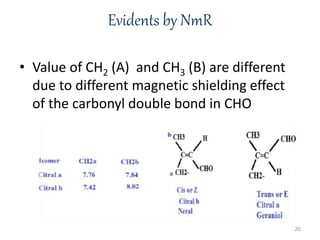
Evidents by NmR
• Value of CH2 (A) and CH3 (B) are different
due to different magnetic shielding effect
of the carbonyl double bond in CHO
20
References
• Journal of antivirals and antiretrovirals ( synthesis of 3,7-
Dimethyl-2,6-Octadienal Acetlals from citral extracted from
lemon grass , Cymbopogon citrates L
• www.chemical book .com / chemical product property E
N_CB8364074.ht
• Online library .wiley.com/ doi/10.1002/hlca.19760590642/pdf
• www.process-nmr.com/citronella_essential_ oil .htm
21
22

Citral

  • 1.
  • 2.
    what is citral? Citral, or 3,7-dimethyl-2,6 octadienal is either a pair ,or a mixture of terpenoides with the molecular formula C10H16O  Chemically, citral is a mixture of two aldehyde that have the same molecular formula but different structures.  The two compunds are found in citral which are double bond isomers. The E- isomer is know as geranial or citral A The Z- isomer is know as neral or citral B 2
  • 3.
    • The isomergeranial has strong lemon odor. • The isomer neral has less lemon odor and sweeter. 3
  • 4.
    Physical properties ofcitral • Citral is a clear yellow colored liquid with a lemon –like odor. Less dense(0.9 g/cm-3) then water and insoluble in water. • melting point of citral is <-10 • When heated to decomposition it emits acrid smoke and irritating fumes 4
  • 5.
    Occurrence • Citral ispresent in the oils of several plants including Lemon balm (11%) Lemon (2-5%) Lemon iron bark (26%) 5
  • 6.
    Lemon verbena (30-35%)Lemon grass (65-85%) Lemon myrtle (90-98%) 6
  • 7.
    applications • It isused in perfumes and flavorings and in the manufacture of other chemicals. • Citral also has a significant role in the production of vitamin A. • Citral has an effect on some insects. It has a mild repellent action for some species. • It also appears to act as a sex pheromone for the green-veined white butterfly, released by males to attract mates • Citral has strong antimicrobial qualities 7
  • 8.
  • 9.
    Isolation of citral •Citral is isolated from lemon grass oil which is obtained from lemon grass by steam distillation 9
  • 10.
    Method of steamdistillation • Lemon grass (chopped) is filled in the distillation flask and fitted tightly ( so the vapours and oils was not leaked out ) • then the stem is injected in to it so that the upcoming steam carries away essential oil from the plant material. • Then the lemon grass oil as well as the vapours are passed through the surface of water and it is then easly separated now . 10
  • 11.
  • 12.
  • 13.
    Laboratory synthesis These tworeaction is happen in succession when the two starting materials are heated together , and the reaction is driven by formation of conjugated carbonyl group in the product 3methyl-3butenal 3-methyl-2-butenol 13
  • 14.
    Structure elucidation ofcitral • Citral form both mono and bisulfite by addition of sodium bisulphate to reveal the presences of conjugated aldehyde group it’s uv spectrum displayed a band at 238 nm to confirm this. 14
  • 15.
    • Formation ofan oxime of citral indicated the presences of oxo group in citral • Citral when heated with potassium hydrogen sulphate afforded the know aromatic hydrocarbon, p-cymene, which fixed the position of methyl and isopropyl groups in citral CHO Citral (a) Geranial (trans) + NH2OH CH N OH Oxim 15
  • 16.
    • Citral onoxidation with alkaline permanganate, yielded acetone, oxalic and levulenic acid. • Citral oxidation with silver oxide afforded an acid geranic acid, C10H16O2 containing the same number of carbon atoms suggesting that citral had an aldehyde group. 16 CHO Citral (a) Geranial (trans) i) KMnO4 ii) CrO3 + +
  • 17.
    • Citral onreduction with sodium-amalgam citral gave an alcohol, geraniol, C10H18O. 17
  • 18.
    Evidents by Massspectrum  molecular mass of citral is 152 It show a peak at m/Z 29 due to hemolytic alpha cleavage Peak at m/Z 69 due to beta cleavage Peak at m/Z 124 due to heterolytic alpha cleavage 18
  • 19.
    Evidents by Infraredspectrum  C=O 1740-1720  CH2 bending 1475  C=C 1680-1600  CH3 bending 1450 & 1375 CH stretch for alkanes 3000-2850 19
  • 20.
    Evidents by NmR •Value of CH2 (A) and CH3 (B) are different due to different magnetic shielding effect of the carbonyl double bond in CHO 20
  • 21.
    References • Journal ofantivirals and antiretrovirals ( synthesis of 3,7- Dimethyl-2,6-Octadienal Acetlals from citral extracted from lemon grass , Cymbopogon citrates L • www.chemical book .com / chemical product property E N_CB8364074.ht • Online library .wiley.com/ doi/10.1002/hlca.19760590642/pdf • www.process-nmr.com/citronella_essential_ oil .htm 21
  • 22.

Editor's Notes

  • #8 The compounds collectively known as vitamin A are essential for human development, the support of a strong immune system and effective vision
  • #13 Yield is decresed when step is incresed