Unit 4
Pyridine
Lecture by
Sowmiya Perinbaraj, M.Pharm
Assistant Professor
Dept of Pharmaceutical Chemistry
SVCP
Pyridine
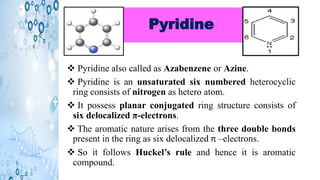
❖ Pyridine also called as Azabenzene or Azine.
❖ Pyridine is an unsaturated six numbered heterocyclic
ring consists of nitrogen as hetero atom.
❖ It possess planar conjugated ring structure consists of
six delocalized π-electrons.
❖ The aromatic nature arises from the three double bonds
present in the ring as six delocalized π –electrons.
❖ So it follows Huckel’s rule and hence it is aromatic
compound.
Pyridine
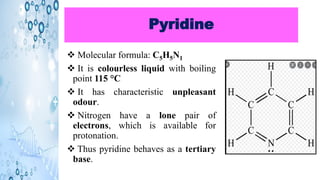
❖ Molecular formula: C5H5N1
❖ It is colourless liquid with boiling
point 115 °C
❖ It has characteristic unpleasant
odour.
❖ Nitrogen have a lone pair of
electrons, which is available for
protonation.
❖ Thus pyridine behaves as a tertiary
base.
Synthesis
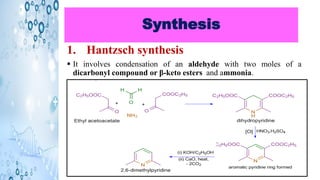
1. Hantzsch synthesis
▪ It involves condensation of an aldehyde with two moles of a
dicarbonyl compound or β-keto esters and ammonia.
Synthesis
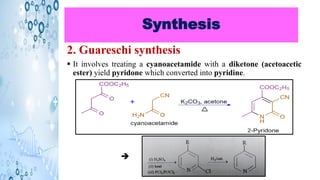
2. Guareschi synthesis
▪ It involves treating a cyanoacetamide with a diketone (acetoacetic
ester) yield pyridone which converted into pyridine.
➔
Synthesis
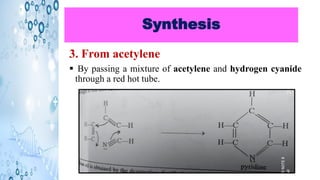
3. From acetylene
▪ By passing a mixture of acetylene and hydrogen cyanide
through a red hot tube.
Synthesis
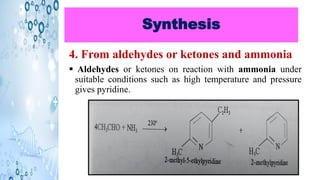
4. From aldehydes or ketones and ammonia
▪ Aldehydes or ketones on reaction with ammonia under
suitable conditions such as high temperature and pressure
gives pyridine.
Synthesis
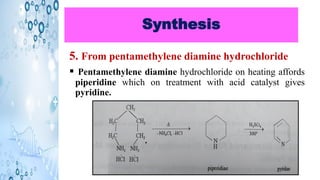
5. From pentamethylene diamine hydrochloride
▪ Pentamethylene diamine hydrochloride on heating affords
piperidine which on treatment with acid catalyst gives
pyridine.
Synthesis
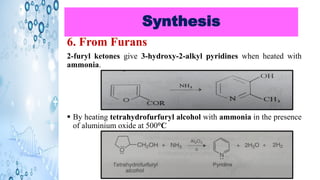
6. From Furans
2-furyl ketones give 3-hydroxy-2-alkyl pyridines when heated with
ammonia.
▪ By heating tetrahydrofurfuryl alcohol with ammonia in the presence
of aluminium oxide at 500°C
Synthesis
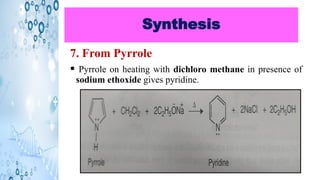
7. From Pyrrole
▪ Pyrrole on heating with dichloro methane in presence of
sodium ethoxide gives pyridine.
Synthesis
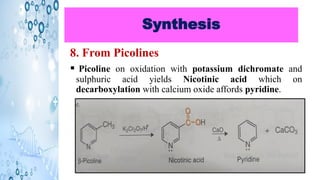
8. From Picolines
▪ Picoline on oxidation with potassium dichromate and
sulphuric acid yields Nicotinic acid which on
decarboxylation with calcium oxide affords pyridine.
Synthesis
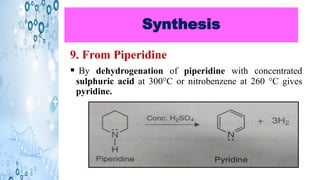
9. From Piperidine
▪ By dehydrogenation of piperidine with concentrated
sulphuric acid at 300°C or nitrobenzene at 260 °C gives
pyridine.
Reactions
1. Electrophilic substitution
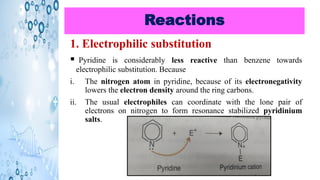
▪ Pyridine is considerably less reactive than benzene towards
electrophilic substitution. Because
i. The nitrogen atom in pyridine, because of its electronegativity
lowers the electron density around the ring carbons.
ii. The usual electrophiles can coordinate with the lone pair of
electrons on nitrogen to form resonance stabilized pyridinium
salts.
Reactions
1. Electrophilic substitution
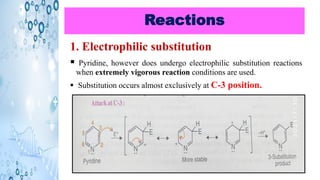
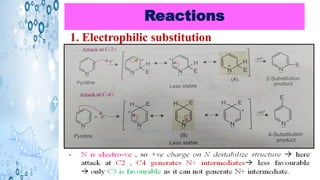
▪ Pyridine, however does undergo electrophilic substitution reactions
when extremely vigorous reaction conditions are used.
▪ Substitution occurs almost exclusively at C-3 position.
Reactions
1. Electrophilic substitution
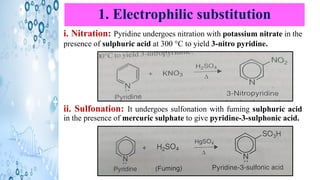
i. Nitration: Pyridine undergoes nitration with potassium nitrate in the
presence of sulphuric acid at 300 °C to yield 3-nitro pyridine.
ii. Sulfonation: It undergoes sulfonation with fuming sulphuric acid
in the presence of mercuric sulphate to give pyridine-3-sulphonic acid.
1. Electrophilic substitution
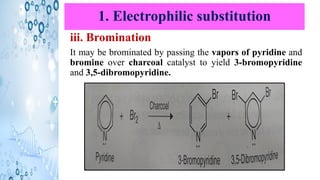
iii. Bromination
It may be brominated by passing the vapors of pyridine and
bromine over charcoal catalyst to yield 3-bromopyridine
and 3,5-dibromopyridine.
2. Nucleophilic substitution
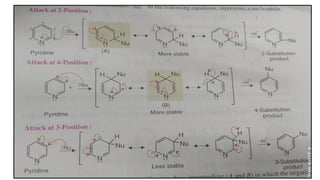
➢ Pyridine undergoes nucleophilic substitution reactions
because the same electronegativity that makes pyridine
unreactive towards electrophilic substitution makes it
highly reactive towards nucleophilic substitution.
➢ Substitution occurs almost exclusively at C-2 or C-4
position if C-2 is blocked.
2. Nucleophilic substitution
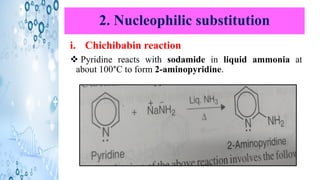
i. Chichibabin reaction
❖ Pyridine reacts with sodamide in liquid ammonia at
about 100°C to form 2-aminopyridine.
2. Nucleophilic substitution
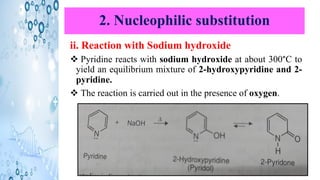
ii. Reaction with Sodium hydroxide
❖ Pyridine reacts with sodium hydroxide at about 300°C to
yield an equilibrium mixture of 2-hydroxypyridine and 2-
pyridine.
❖ The reaction is carried out in the presence of oxygen.
2. Nucleophilic substitution
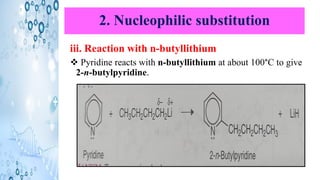
iii. Reaction with n-butyllithium
❖ Pyridine reacts with n-butyllithium at about 100°C to give
2-n-butylpyridine.
Reaction
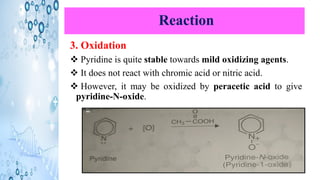
3. Oxidation
❖ Pyridine is quite stable towards mild oxidizing agents.
❖ It does not react with chromic acid or nitric acid.
❖ However, it may be oxidized by peracetic acid to give
pyridine-N-oxide.
Reactions
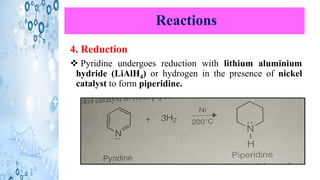
4. Reduction
❖ Pyridine undergoes reduction with lithium aluminium
hydride (LiAlH4) or hydrogen in the presence of nickel
catalyst to form piperidine.
Reaction
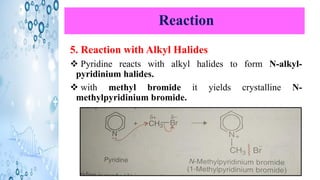
5. Reaction with Alkyl Halides
❖ Pyridine reacts with alkyl halides to form N-alkyl-
pyridinium halides.
❖ with methyl bromide it yields crystalline N-
methylpyridinium bromide.
Basicity of Pyridine
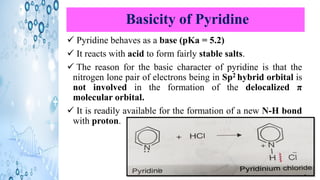
✓ Pyridine behaves as a base (pKa = 5.2)
✓ It reacts with acid to form fairly stable salts.
✓ The reason for the basic character of pyridine is that the
nitrogen lone pair of electrons being in Sp2 hybrid orbital is
not involved in the formation of the delocalized π
molecular orbital.
✓ It is readily available for the formation of a new N-H bond
with proton.
Basicity of Pyridine
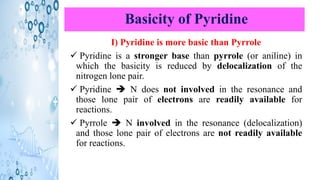
I) Pyridine is more basic than Pyrrole
✓ Pyridine is a stronger base than pyrrole (or aniline) in
which the basicity is reduced by delocalization of the
nitrogen lone pair.
✓ Pyridine ➔ N does not involved in the resonance and
those lone pair of electrons are readily available for
reactions.
✓ Pyrrole ➔ N involved in the resonance (delocalization)
and those lone pair of electrons are not readily available
for reactions.
Basicity of Pyridine
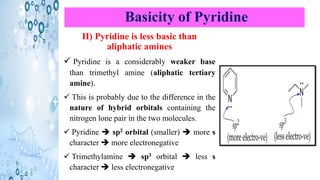
II) Pyridine is less basic than
aliphatic amines
✓ Pyridine is a considerably weaker base
than trimethyl amine (aliphatic tertiary
amine).
✓ This is probably due to the difference in the
nature of hybrid orbitals containing the
nitrogen lone pair in the two molecules.
✓ Pyridine ➔ sp2 orbital (smaller) ➔ more s
character ➔ more electronegative
✓ Trimethylamine ➔ sp3 orbital ➔ less s
character ➔ less electronegative
Basicity of Pyridine
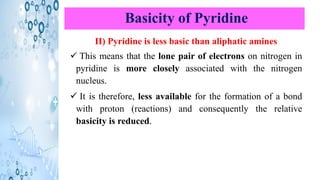
II) Pyridine is less basic than aliphatic amines
✓ This means that the lone pair of electrons on nitrogen in
pyridine is more closely associated with the nitrogen
nucleus.
✓ It is therefore, less available for the formation of a bond
with proton (reactions) and consequently the relative
basicity is reduced.
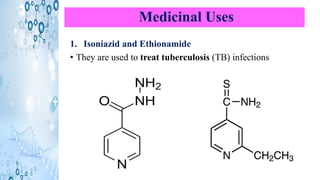
Medicinal Uses
1. Isoniazid and Ethionamide
• They are used to treat tuberculosis (TB) infections
Medicinal Uses
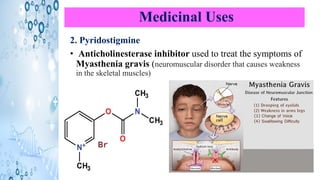
2. Pyridostigmine
• Anticholinesterase inhibitor used to treat the symptoms of
Myasthenia gravis (neuromuscular disorder that causes weakness
in the skeletal muscles)
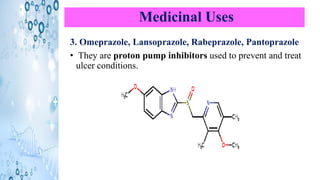
Medicinal Uses
3. Omeprazole, Lansoprazole, Rabeprazole, Pantoprazole
• They are proton pump inhibitors used to prevent and treat
ulcer conditions.
Medicinal Uses
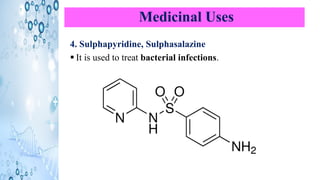
4. Sulphapyridine, Sulphasalazine
▪ It is used to treat bacterial infections.
Medicinal Uses
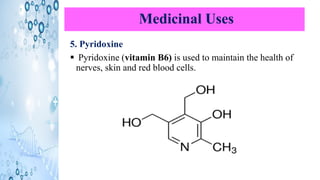
5. Pyridoxine
▪ Pyridoxine (vitamin B6) is used to maintain the health of
nerves, skin and red blood cells.
Unit 4 Pyridine

Unit 4 Pyridine

  • 1.
    Unit 4 Pyridine Lecture by SowmiyaPerinbaraj, M.Pharm Assistant Professor Dept of Pharmaceutical Chemistry SVCP
  • 2.
    Pyridine ❖ Pyridine alsocalled as Azabenzene or Azine. ❖ Pyridine is an unsaturated six numbered heterocyclic ring consists of nitrogen as hetero atom. ❖ It possess planar conjugated ring structure consists of six delocalized π-electrons. ❖ The aromatic nature arises from the three double bonds present in the ring as six delocalized π –electrons. ❖ So it follows Huckel’s rule and hence it is aromatic compound.
  • 3.
    Pyridine ❖ Molecular formula:C5H5N1 ❖ It is colourless liquid with boiling point 115 °C ❖ It has characteristic unpleasant odour. ❖ Nitrogen have a lone pair of electrons, which is available for protonation. ❖ Thus pyridine behaves as a tertiary base.
  • 4.
    Synthesis 1. Hantzsch synthesis ▪It involves condensation of an aldehyde with two moles of a dicarbonyl compound or β-keto esters and ammonia.
  • 5.
    Synthesis 2. Guareschi synthesis ▪It involves treating a cyanoacetamide with a diketone (acetoacetic ester) yield pyridone which converted into pyridine. ➔
  • 6.
    Synthesis 3. From acetylene ▪By passing a mixture of acetylene and hydrogen cyanide through a red hot tube.
  • 7.
    Synthesis 4. From aldehydesor ketones and ammonia ▪ Aldehydes or ketones on reaction with ammonia under suitable conditions such as high temperature and pressure gives pyridine.
  • 8.
    Synthesis 5. From pentamethylenediamine hydrochloride ▪ Pentamethylene diamine hydrochloride on heating affords piperidine which on treatment with acid catalyst gives pyridine.
  • 9.
    Synthesis 6. From Furans 2-furylketones give 3-hydroxy-2-alkyl pyridines when heated with ammonia. ▪ By heating tetrahydrofurfuryl alcohol with ammonia in the presence of aluminium oxide at 500°C
  • 10.
    Synthesis 7. From Pyrrole ▪Pyrrole on heating with dichloro methane in presence of sodium ethoxide gives pyridine.
  • 11.
    Synthesis 8. From Picolines ▪Picoline on oxidation with potassium dichromate and sulphuric acid yields Nicotinic acid which on decarboxylation with calcium oxide affords pyridine.
  • 12.
    Synthesis 9. From Piperidine ▪By dehydrogenation of piperidine with concentrated sulphuric acid at 300°C or nitrobenzene at 260 °C gives pyridine.
  • 13.
    Reactions 1. Electrophilic substitution ▪Pyridine is considerably less reactive than benzene towards electrophilic substitution. Because i. The nitrogen atom in pyridine, because of its electronegativity lowers the electron density around the ring carbons. ii. The usual electrophiles can coordinate with the lone pair of electrons on nitrogen to form resonance stabilized pyridinium salts.
  • 14.
    Reactions 1. Electrophilic substitution ▪Pyridine, however does undergo electrophilic substitution reactions when extremely vigorous reaction conditions are used. ▪ Substitution occurs almost exclusively at C-3 position.
  • 15.
  • 16.
    1. Electrophilic substitution i.Nitration: Pyridine undergoes nitration with potassium nitrate in the presence of sulphuric acid at 300 °C to yield 3-nitro pyridine. ii. Sulfonation: It undergoes sulfonation with fuming sulphuric acid in the presence of mercuric sulphate to give pyridine-3-sulphonic acid.
  • 17.
    1. Electrophilic substitution iii.Bromination It may be brominated by passing the vapors of pyridine and bromine over charcoal catalyst to yield 3-bromopyridine and 3,5-dibromopyridine.
  • 18.
    2. Nucleophilic substitution ➢Pyridine undergoes nucleophilic substitution reactions because the same electronegativity that makes pyridine unreactive towards electrophilic substitution makes it highly reactive towards nucleophilic substitution. ➢ Substitution occurs almost exclusively at C-2 or C-4 position if C-2 is blocked.
  • 20.
    2. Nucleophilic substitution i.Chichibabin reaction ❖ Pyridine reacts with sodamide in liquid ammonia at about 100°C to form 2-aminopyridine.
  • 21.
    2. Nucleophilic substitution ii.Reaction with Sodium hydroxide ❖ Pyridine reacts with sodium hydroxide at about 300°C to yield an equilibrium mixture of 2-hydroxypyridine and 2- pyridine. ❖ The reaction is carried out in the presence of oxygen.
  • 22.
    2. Nucleophilic substitution iii.Reaction with n-butyllithium ❖ Pyridine reacts with n-butyllithium at about 100°C to give 2-n-butylpyridine.
  • 23.
    Reaction 3. Oxidation ❖ Pyridineis quite stable towards mild oxidizing agents. ❖ It does not react with chromic acid or nitric acid. ❖ However, it may be oxidized by peracetic acid to give pyridine-N-oxide.
  • 24.
    Reactions 4. Reduction ❖ Pyridineundergoes reduction with lithium aluminium hydride (LiAlH4) or hydrogen in the presence of nickel catalyst to form piperidine.
  • 25.
    Reaction 5. Reaction withAlkyl Halides ❖ Pyridine reacts with alkyl halides to form N-alkyl- pyridinium halides. ❖ with methyl bromide it yields crystalline N- methylpyridinium bromide.
  • 26.
    Basicity of Pyridine ✓Pyridine behaves as a base (pKa = 5.2) ✓ It reacts with acid to form fairly stable salts. ✓ The reason for the basic character of pyridine is that the nitrogen lone pair of electrons being in Sp2 hybrid orbital is not involved in the formation of the delocalized π molecular orbital. ✓ It is readily available for the formation of a new N-H bond with proton.
  • 27.
    Basicity of Pyridine I)Pyridine is more basic than Pyrrole ✓ Pyridine is a stronger base than pyrrole (or aniline) in which the basicity is reduced by delocalization of the nitrogen lone pair. ✓ Pyridine ➔ N does not involved in the resonance and those lone pair of electrons are readily available for reactions. ✓ Pyrrole ➔ N involved in the resonance (delocalization) and those lone pair of electrons are not readily available for reactions.
  • 28.
    Basicity of Pyridine II)Pyridine is less basic than aliphatic amines ✓ Pyridine is a considerably weaker base than trimethyl amine (aliphatic tertiary amine). ✓ This is probably due to the difference in the nature of hybrid orbitals containing the nitrogen lone pair in the two molecules. ✓ Pyridine ➔ sp2 orbital (smaller) ➔ more s character ➔ more electronegative ✓ Trimethylamine ➔ sp3 orbital ➔ less s character ➔ less electronegative
  • 29.
    Basicity of Pyridine II)Pyridine is less basic than aliphatic amines ✓ This means that the lone pair of electrons on nitrogen in pyridine is more closely associated with the nitrogen nucleus. ✓ It is therefore, less available for the formation of a bond with proton (reactions) and consequently the relative basicity is reduced.
  • 30.
    Medicinal Uses 1. Isoniazidand Ethionamide • They are used to treat tuberculosis (TB) infections
  • 31.
    Medicinal Uses 2. Pyridostigmine •Anticholinesterase inhibitor used to treat the symptoms of Myasthenia gravis (neuromuscular disorder that causes weakness in the skeletal muscles)
  • 32.
    Medicinal Uses 3. Omeprazole,Lansoprazole, Rabeprazole, Pantoprazole • They are proton pump inhibitors used to prevent and treat ulcer conditions.
  • 33.
    Medicinal Uses 4. Sulphapyridine,Sulphasalazine ▪ It is used to treat bacterial infections.
  • 34.
    Medicinal Uses 5. Pyridoxine ▪Pyridoxine (vitamin B6) is used to maintain the health of nerves, skin and red blood cells.