BY:
NOOR MUNIRAH BINTI AWANG ABU BAKAR
P82498
Paediatric Contact Lens
Management
OUTLINES:
Indications for paediatric contact lenses fitting
Various contact lens option for paediatric
Fitting techniques
Challenges that are present with paediatric
CL as Myopia control
WHO is PAEDIATRIC?
Paediatrics : A branch of medical care that deals with
infants, children and adolescents, from birth up to age of 18
(in US up to 21)
The word paediatric is derived from two Greek words (pais =
child and iatros = healer), which means healer of children.
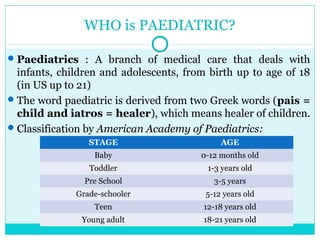
Classification by American Academy of Paediatrics:
STAGE AGE
Baby 0-12 months old
Toddler 1-3 years old
Pre School 3-5 years
Grade-schooler 5-12 years old
Teen 12-18 years old
Young adult 18-21 years old
INDICATIONS
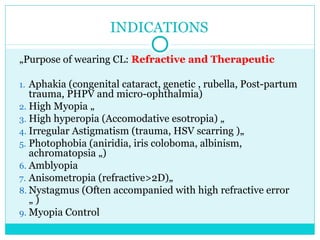
„Purpose of wearing CL: Refractive and Therapeutic
1. Aphakia (congenital cataract, genetic , rubella, Post-partum
trauma, PHPV and micro-ophthalmia)
2. High Myopia „
3. High hyperopia (Accomodative esotropia) „
4. Irregular Astigmatism (trauma, HSV scarring )„
5. Photophobia (aniridia, iris coloboma, albinism,
achromatopsia „)
6. Amblyopia
7. Anisometropia (refractive>2D)„
8. Nystagmus (Often accompanied with high refractive error
„ )
9. Myopia Control
INDICATION cont.
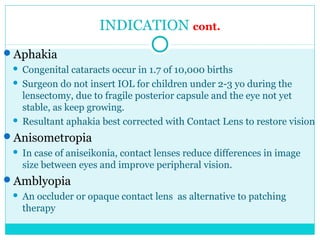
Aphakia
 Congenital cataracts occur in 1.7 of 10,000 births
 Surgeon do not insert IOL for children under 2-3 yo during the
lensectomy, due to fragile posterior capsule and the eye not yet
stable, as keep growing.
 Resultant aphakia best corrected with Contact Lens to restore vision
Anisometropia
 In case of aniseikonia, contact lenses reduce differences in image
size between eyes and improve peripheral vision.
Amblyopia
 An occluder or opaque contact lens as alternative to patching
therapy
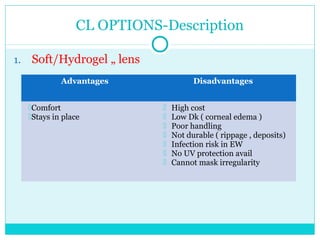
CL OPTIONS-Description
1. Soft/Hydrogel „ lens
Advantages Disadvantages
Comfort
Stays in place
 High cost
 Low Dk ( corneal edema )
 Poor handling
 Not durable ( rippage , deposits)
 Infection risk in EW
 No UV protection avail
 Cannot mask irregularity
CL OPTIONS-Description
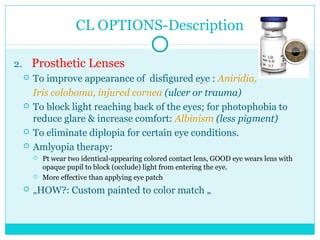
2. Prosthetic Lenses
 To improve appearance of disfigured eye : Aniridia,
Iris coloboma, injured cornea (ulcer or trauma)
 To block light reaching back of the eyes; for photophobia to
reduce glare & increase comfort: Albinism (less pigment)
 To eliminate diplopia for certain eye conditions.
 Amlyopia therapy:
 Pt wear two identical-appearing colored contact lens, GOOD eye wears lens with
opaque pupil to block (occlude) light from entering the eye.
 More effective than applying eye patch
 „HOW?: Custom painted to color match „
CL OPTIONS-Description
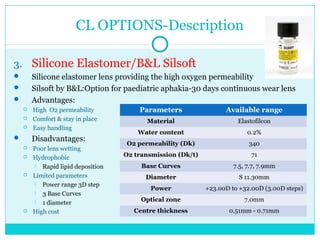
3. Silicone Elastomer/B&L Silsoft
 Silicone elastomer lens providing the high oxygen permeability
 Silsoft by B&L:Option for paediatric aphakia-30 days continuous wear lens
 Advantages:
 High O2 permeability
 Comfort & stay in place
 Easy handling
 Disadvantages:
 Poor lens wetting
 Hydrophobic
 Rapid lipid deposition
 Limited parameters
 Power range 3D step
 3 Base Curves
 1 diameter
 High cost
Parameters Available range
Material Elastofilcon
Water content 0.2%
O2 permeability (Dk) 340
O2 transmission (Dk/t) 71
Base Curves 7.5, 7.7, 7.9mm
Diameter S 11.30mm
Power +23.00D to +32.00D (3.00D steps)
Optical zone 7.0mm
Centre thickness 0.51mm - 0.71mm
CL OPTIONS-Description
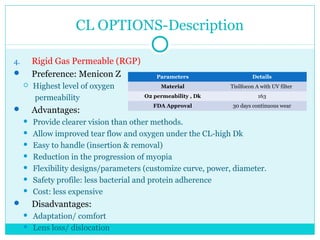
4. Rigid Gas Permeable (RGP)
 Preference: Menicon Z
 Highest level of oxygen
permeability
 Advantages:
 Provide clearer vision than other methods.
 Allow improved tear flow and oxygen under the CL-high Dk
 Easy to handle (insertion & removal)
 Reduction in the progression of myopia
 Flexibility designs/parameters (customize curve, power, diameter.
 Safety profile: less bacterial and protein adherence
 Cost: less expensive
 Disadvantages:
 Adaptation/ comfort
 Lens loss/ dislocation
Parameters Details
Material Tisilfocon A with UV filter
O2 permeability , Dk 163
FDA Approval 30 days continuous wear
CONTACT LENS FITTING
What age appropriate to fit contact lens?
 American Academy of Optometry in 2004 stated :
“ by the age of eight, a child was able to handle contact lenses and assume
some degree of responsibility.”
 However, child's maturity and ability to handle contact lenses responsibly is
more important than age alone.
 Otherwise, optometrist should educate and guide parents on proper
handling of CL.
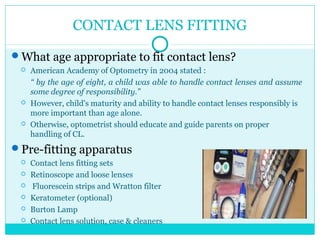
Pre-fitting apparatus
 Contact lens fitting sets
 Retinoscope and loose lenses
 Fluorescein strips and Wratton filter
 Keratometer (optional)
 Burton Lamp
 Contact lens solution, case & cleaners
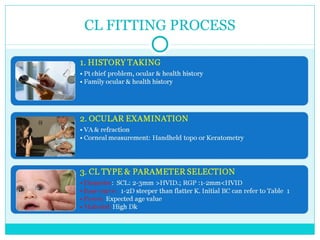
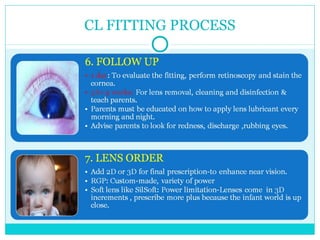
CL FITTING PROCESS
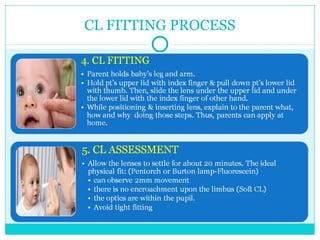
CL FITTING PROCESS
CL FITTING PROCESS
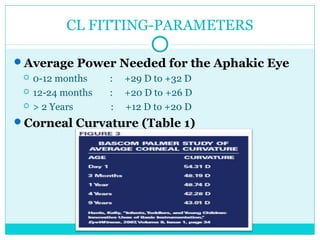
CL FITTING-PARAMETERS
Average Power Needed for the Aphakic Eye
 0-12 months : +29 D to +32 D
 12-24 months : +20 D to +26 D
 > 2 Years : +12 D to +20 D
Corneal Curvature (Table 1)
CL FITTING- CONSIDERATION
Considerations Specific to the Infant
 maximum oxygen permeability
 expanded powers
 steeper base curves
 smaller overall diameters
 ease in handling and durability
 reproducible
 ability to use medication
CHALLENGE IN PAEDIATRIC CL MANAGEMENT
Infant & toddler eye anatomy
 Small palpebral fissure
 Steeper cornea than older patient
 Higher powers than the older pt (due to shorter axial length)
Parent time & motivation
 Time limitation
 Find difficulty on lens insertion and removal process, lens care
Unable to understand instruction (infants)
 Alternative: voice, touch & smell
Anxiety about the procedures (for toddlers)
 Resisting during procedures
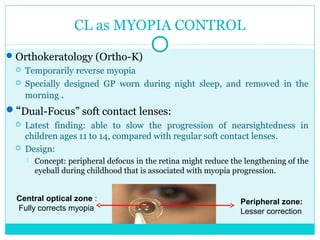
CL as MYOPIA CONTROL
Orthokeratology (Ortho-K)
 Temporarily reverse myopia
 Specially designed GP worn during night sleep, and removed in the
morning .
“Dual-Focus” soft contact lenses:
 Latest finding: able to slow the progression of nearsightedness in
children ages 11 to 14, compared with regular soft contact lenses.
 Design:
 Concept: peripheral defocus in the retina might reduce the lengthening of the
eyeball during childhood that is associated with myopia progression.
Central optical zone :
Fully corrects myopia
Peripheral zone:
Lesser correction
REFERENCES
1. Scalafani, L. August, 4 2002. Kids and Contacts: Pediatric Aphakia Contact Lens
Fitting: Review of Optometry.
2. Edmonds, C.A., October, 23 2003. Fitting Infants and Toddlers with Contact Lenses:
Review of Optometry.
3. Stephenson, M. 2014. Prosthetic Contact Lenses. Allaboutvision.com
4. Walline, J.J. 2000. Fitting Kids with Rigid Gas Permeable Lenses. Contact Lens
Spectrum.
5. Heiting,G. Are Contact Lenses a Good Choice for Kids?. Allaboutvision.com
6. Reeder, R.E.Kattouf, V. November ,1 2010.Succeeding with Kids and Contact Lenses:
Optometric Management.
7. Saltarelli, D.P. 2013. Contact Lenses For Infant Aphakia: Tips For Successful
Management.

Pediatric contact lens

  • 1.
    BY: NOOR MUNIRAH BINTIAWANG ABU BAKAR P82498 Paediatric Contact Lens Management
  • 2.
    OUTLINES: Indications for paediatriccontact lenses fitting Various contact lens option for paediatric Fitting techniques Challenges that are present with paediatric CL as Myopia control
  • 3.
    WHO is PAEDIATRIC? Paediatrics: A branch of medical care that deals with infants, children and adolescents, from birth up to age of 18 (in US up to 21) The word paediatric is derived from two Greek words (pais = child and iatros = healer), which means healer of children. Classification by American Academy of Paediatrics: STAGE AGE Baby 0-12 months old Toddler 1-3 years old Pre School 3-5 years Grade-schooler 5-12 years old Teen 12-18 years old Young adult 18-21 years old
  • 4.
    INDICATIONS „Purpose of wearingCL: Refractive and Therapeutic 1. Aphakia (congenital cataract, genetic , rubella, Post-partum trauma, PHPV and micro-ophthalmia) 2. High Myopia „ 3. High hyperopia (Accomodative esotropia) „ 4. Irregular Astigmatism (trauma, HSV scarring )„ 5. Photophobia (aniridia, iris coloboma, albinism, achromatopsia „) 6. Amblyopia 7. Anisometropia (refractive>2D)„ 8. Nystagmus (Often accompanied with high refractive error „ ) 9. Myopia Control
  • 5.
    INDICATION cont. Aphakia  Congenitalcataracts occur in 1.7 of 10,000 births  Surgeon do not insert IOL for children under 2-3 yo during the lensectomy, due to fragile posterior capsule and the eye not yet stable, as keep growing.  Resultant aphakia best corrected with Contact Lens to restore vision Anisometropia  In case of aniseikonia, contact lenses reduce differences in image size between eyes and improve peripheral vision. Amblyopia  An occluder or opaque contact lens as alternative to patching therapy
  • 6.
    CL OPTIONS-Description 1. Soft/Hydrogel„ lens Advantages Disadvantages Comfort Stays in place  High cost  Low Dk ( corneal edema )  Poor handling  Not durable ( rippage , deposits)  Infection risk in EW  No UV protection avail  Cannot mask irregularity
  • 7.
    CL OPTIONS-Description 2. ProstheticLenses  To improve appearance of disfigured eye : Aniridia, Iris coloboma, injured cornea (ulcer or trauma)  To block light reaching back of the eyes; for photophobia to reduce glare & increase comfort: Albinism (less pigment)  To eliminate diplopia for certain eye conditions.  Amlyopia therapy:  Pt wear two identical-appearing colored contact lens, GOOD eye wears lens with opaque pupil to block (occlude) light from entering the eye.  More effective than applying eye patch  „HOW?: Custom painted to color match „
  • 8.
    CL OPTIONS-Description 3. SiliconeElastomer/B&L Silsoft  Silicone elastomer lens providing the high oxygen permeability  Silsoft by B&L:Option for paediatric aphakia-30 days continuous wear lens  Advantages:  High O2 permeability  Comfort & stay in place  Easy handling  Disadvantages:  Poor lens wetting  Hydrophobic  Rapid lipid deposition  Limited parameters  Power range 3D step  3 Base Curves  1 diameter  High cost Parameters Available range Material Elastofilcon Water content 0.2% O2 permeability (Dk) 340 O2 transmission (Dk/t) 71 Base Curves 7.5, 7.7, 7.9mm Diameter S 11.30mm Power +23.00D to +32.00D (3.00D steps) Optical zone 7.0mm Centre thickness 0.51mm - 0.71mm
  • 9.
    CL OPTIONS-Description 4. RigidGas Permeable (RGP)  Preference: Menicon Z  Highest level of oxygen permeability  Advantages:  Provide clearer vision than other methods.  Allow improved tear flow and oxygen under the CL-high Dk  Easy to handle (insertion & removal)  Reduction in the progression of myopia  Flexibility designs/parameters (customize curve, power, diameter.  Safety profile: less bacterial and protein adherence  Cost: less expensive  Disadvantages:  Adaptation/ comfort  Lens loss/ dislocation Parameters Details Material Tisilfocon A with UV filter O2 permeability , Dk 163 FDA Approval 30 days continuous wear
  • 10.
    CONTACT LENS FITTING Whatage appropriate to fit contact lens?  American Academy of Optometry in 2004 stated : “ by the age of eight, a child was able to handle contact lenses and assume some degree of responsibility.”  However, child's maturity and ability to handle contact lenses responsibly is more important than age alone.  Otherwise, optometrist should educate and guide parents on proper handling of CL. Pre-fitting apparatus  Contact lens fitting sets  Retinoscope and loose lenses  Fluorescein strips and Wratton filter  Keratometer (optional)  Burton Lamp  Contact lens solution, case & cleaners
  • 11.
  • 12.
  • 13.
  • 14.
    CL FITTING-PARAMETERS Average PowerNeeded for the Aphakic Eye  0-12 months : +29 D to +32 D  12-24 months : +20 D to +26 D  > 2 Years : +12 D to +20 D Corneal Curvature (Table 1)
  • 15.
    CL FITTING- CONSIDERATION ConsiderationsSpecific to the Infant  maximum oxygen permeability  expanded powers  steeper base curves  smaller overall diameters  ease in handling and durability  reproducible  ability to use medication
  • 16.
    CHALLENGE IN PAEDIATRICCL MANAGEMENT Infant & toddler eye anatomy  Small palpebral fissure  Steeper cornea than older patient  Higher powers than the older pt (due to shorter axial length) Parent time & motivation  Time limitation  Find difficulty on lens insertion and removal process, lens care Unable to understand instruction (infants)  Alternative: voice, touch & smell Anxiety about the procedures (for toddlers)  Resisting during procedures
  • 17.
    CL as MYOPIACONTROL Orthokeratology (Ortho-K)  Temporarily reverse myopia  Specially designed GP worn during night sleep, and removed in the morning . “Dual-Focus” soft contact lenses:  Latest finding: able to slow the progression of nearsightedness in children ages 11 to 14, compared with regular soft contact lenses.  Design:  Concept: peripheral defocus in the retina might reduce the lengthening of the eyeball during childhood that is associated with myopia progression. Central optical zone : Fully corrects myopia Peripheral zone: Lesser correction
  • 18.
    REFERENCES 1. Scalafani, L.August, 4 2002. Kids and Contacts: Pediatric Aphakia Contact Lens Fitting: Review of Optometry. 2. Edmonds, C.A., October, 23 2003. Fitting Infants and Toddlers with Contact Lenses: Review of Optometry. 3. Stephenson, M. 2014. Prosthetic Contact Lenses. Allaboutvision.com 4. Walline, J.J. 2000. Fitting Kids with Rigid Gas Permeable Lenses. Contact Lens Spectrum. 5. Heiting,G. Are Contact Lenses a Good Choice for Kids?. Allaboutvision.com 6. Reeder, R.E.Kattouf, V. November ,1 2010.Succeeding with Kids and Contact Lenses: Optometric Management. 7. Saltarelli, D.P. 2013. Contact Lenses For Infant Aphakia: Tips For Successful Management.