PEDIATRIC MANAGEMENT
IN CONTACT LENS
NAME: ANG KAI LI
ID NO: P82502
COURSE:NNV6214
LECTURER: PROF MADYA DR HALIZA BINTI ABDUL
MUTALIB
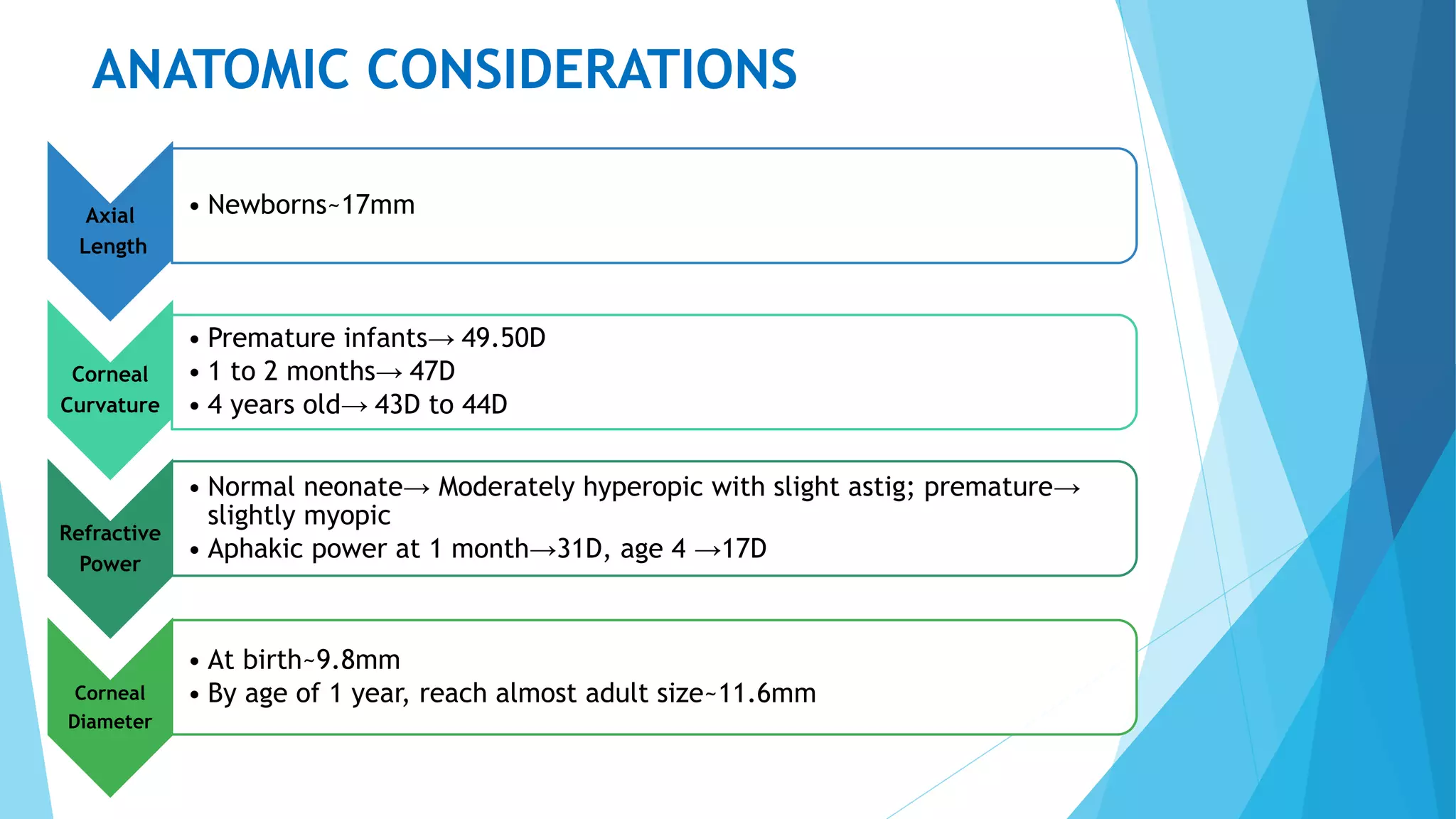
ANATOMIC CONSIDERATIONS
Axial
Length
• Newborns~17mm
Corneal
Curvature
• Premature infants→ 49.50D
• 1 to 2 months→ 47D
• 4 years old→ 43D to 44D
Refractive
Power
• Normal neonate→ Moderately hyperopic with slight astig; premature→
slightly myopic
• Aphakic power at 1 month→31D, age 4 →17D
Corneal
Diameter
• At birth~9.8mm
• By age of 1 year, reach almost adult size~11.6mm
INDICATIONS FOR PEDIATRIC CONTACT
LENS FITTING
INDICATIONS
High
myopia
Aphakia
High hyperopia
• Accommodative
esotropia
Photophobia
• Aniridia
• Iris coloboma
• Achromatopsia
Nystagmus
Anisometropia
Irregular astigmatism
• Trauma
• Scarring
• Penetrating
keratoplasty
PEDIATRIC CONTACT LENS SELECTION
1. SILICONE ELASTOMER
ADVANTAGES DISADVANTAGES
Comfort Very costly
Excellent DK (DK 340); safe for EW Hydrophobic (heavy lipid deposition)
Stays in place (low rate of loss) Limited parameters (3D steps, 3 base
curves)
Great durability and handling Cannot mask astigmatism
No dehydration of material during
wear
No UV protection
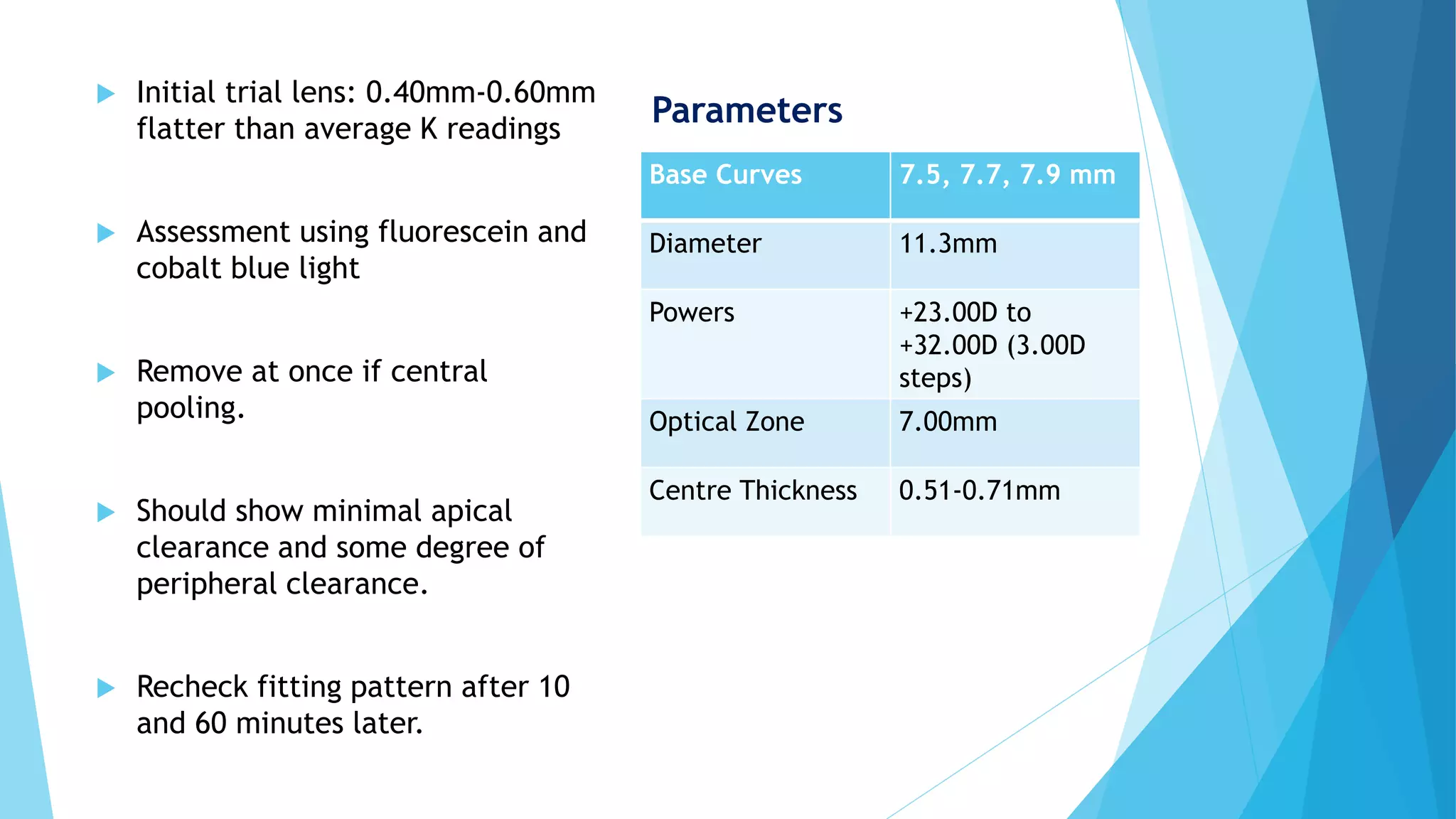
Parameters
Base Curves 7.5, 7.7, 7.9 mm
Diameter 11.3mm
Powers +23.00D to
+32.00D (3.00D
steps)
Optical Zone 7.00mm
Centre Thickness 0.51-0.71mm
 Initial trial lens: 0.40mm-0.60mm
flatter than average K readings
 Assessment using fluorescein and
cobalt blue light
 Remove at once if central
pooling.
 Should show minimal apical
clearance and some degree of
peripheral clearance.
 Recheck fitting pattern after 10
and 60 minutes later.
2. HYDROGEL
ADVANTAGES DISADVANTAGES
Comfort High cost (if custom)
Not easily displaced/dislodged Low DK
DK/t ↓ as power ↑
Wide range of parameters Corneal oedema, Neovascularization:
toric design
Tints Difficulty in handling
3. RGP LENSES
ADVANTAGES DISADVANTAGES
Low cost, longer life span Prolonged adaptation period
Wide range of parameter Risk of dislodgement
High oxygen transmission (Dk up to
150), Low protein adherence
Need greater skill to fit
UV protection, provide best optics
(correct corneal irregularity)
Corneal abrasion from eye rubbing
PEDIATRIC PREFITTING EXAMINATION
 Careful evaluation of patient’s lids, bulbar conjunctiva and cornea
 Using an UV light of the handheld Burton lamp/handheld slit lamp with cobalt filter
illumination, fluorescein dye is applied to the corneal surface.
 Although keratometry is helpful, fitting without this information can proceed. Infants and
toddlers who are aphakic have steep corneal curvatures and high plus refractive errors
 Retinoscopy, with handheld trial lenses, of the pediatric eye before lens fitting (determine
starting contact lens power).
 Selection of initial trial lens base curve is typically based on patient’s age.
Pediatric Contact Lens Selection
(Silsoft)
 Parameters of initial fitting- based on age of the child
 Children < 2 y/o, start lens fitting with 7.5mm base curve, 11.3mm
diameter, +32.00D lens
 As the toddler matures, it is expected that the child’s corneal
curvature will flatten, aperture will enlarge, and the prescription will
require less plus power
 The 7.7mm base curve lens is the starting point for children between 2
and 4 years age, whereas the 7.9 mm base curve is for the child than 4
years of age
Pediatric Contact Lens Fitting
Assessment (Silsoft)
• Insertion → After 15 minutes
of lens equilibrium,
fluorescein dye is instilled in
the child’s eye
• The UV lights and
magnification of the Burton
lamp aid in determining the
Silsoft lens centration,
movement, and thickness of a
post-lens tear film
Ideal fluorescein pattern
• Minimal apical clearance
• Minimal bearing in the
intermediate zone
• Peripheral edge clearance
• Moderate nasal edge lift
• Lens movement of 1-2mm is
expected on a normal blink
Steep fitting
No fluorescein exchange under
lens base curve
Flat fitting
Significant edge lift
Excessive movement
Flat-fitting has the steepest
(7.5mm) base curve,
transition to a hydrogel
(6.8mm) or RGP (5.0 mm) lens
is required
Pediatric Contact Lens Insertion
(Silsoft)
 When inserting , the thumb and forefinger of the dominant hand hold a
partially pinched contact lens.
 The inferior 1/3 of the lens is pinched closed, yet the top 1/3 of the lens is
completely open.
 As the palm of the nondominat hand stabilizes the forehead, the thumb of
this hand is used to retract the upper eyelid allowing for fanned out superior
lens edge to rest on the superior bulbar conjunctiva.
 As the middle finger of the lens-holding hand retracts the lower eyelid, the
inferior lens edge is allowed to unfold onto the inferior cornea
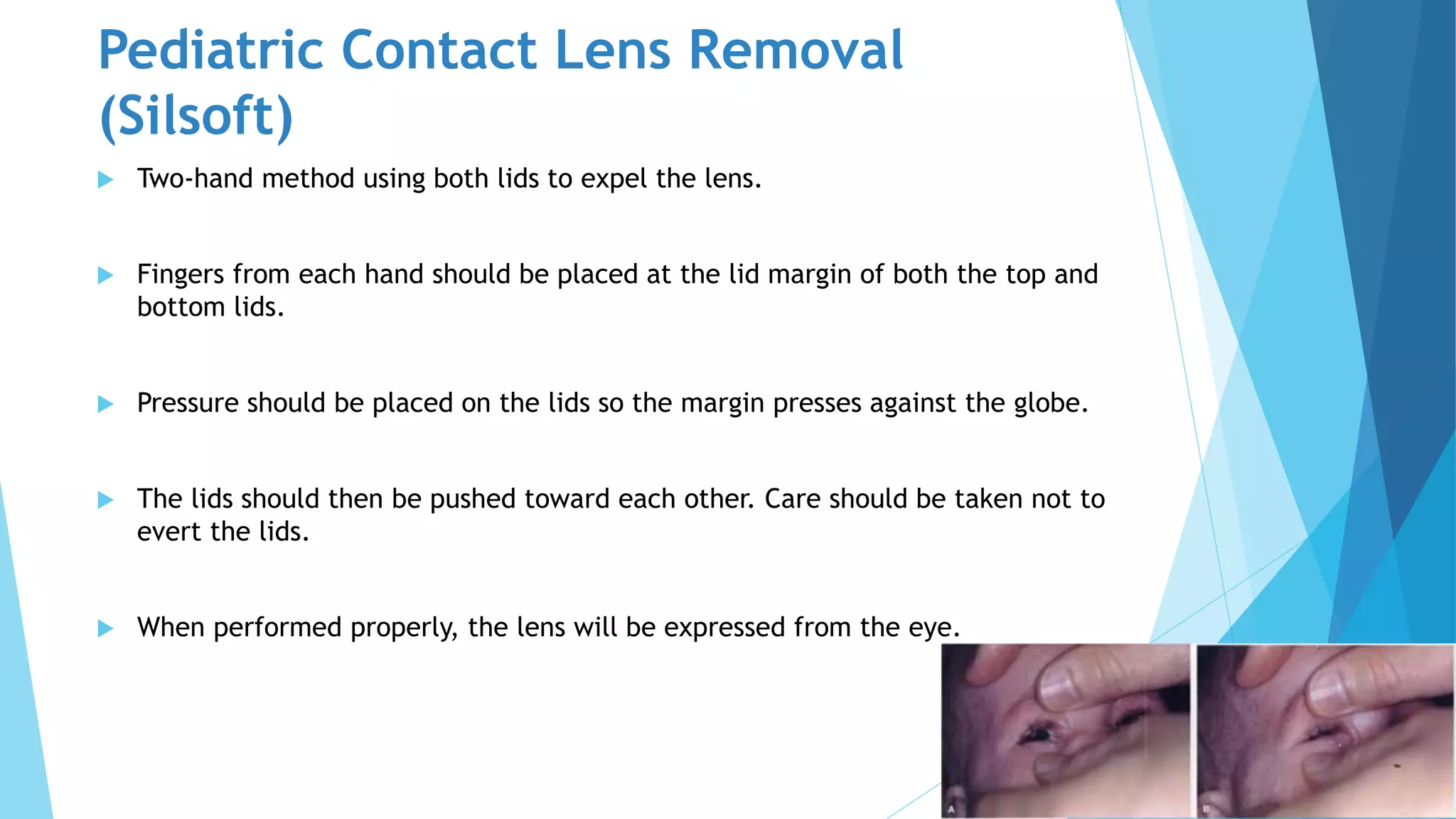
Pediatric Contact Lens Removal
(Silsoft)
 Two-hand method using both lids to expel the lens.
 Fingers from each hand should be placed at the lid margin of both the top and
bottom lids.
 Pressure should be placed on the lids so the margin presses against the globe.
 The lids should then be pushed toward each other. Care should be taken not to
evert the lids.
 When performed properly, the lens will be expressed from the eye.
PROGRESS EVALUATION
 Scheduled according to age of child and complexity of the case
 Infants < 6 months – seen every 2 weeks
 Age: 6-12/18 months – seen monthly
 Age: After 18 months- seen every 3 months
 Maintained at a minimum of 6 months for minors
 Spectacles must be prescribed at all times- to act as a back up during eye
infection, flu or other systemic illness that may affect the eyes
 Remove lenses when swimming, playing with sand and during flight
CASE
4 y/o patient
had a h/o of
congenital
cataract (LE)-
removed in 1st
year of life
Initially fit with
Silsoft CLs, At
age of 3,she
became
intolerant to
Silsoft lenses.
She was
successfully fit
with a hydrogel
lenses (BCR
8.3mm, OAD
13.0mm, RX
+20.00D)
4 mths after
that, patient
began to
experience
discomfort and
lens was
decentered.
Mother
expressed
interest in
trying a
different lens
Solution
Silicone hydrogel trial lenses are to be ordered.
Refraction
OD: pl (20/20)
OS: +15.00 (20/60)
The following lens was ordered for her OS: BCR 8.3mm, Dia:13.0mm,
RX: +20.00D. (The power was chosen to make the patient artificially
myopic to allow clear vision at near-lack of accommodation in
aphakic eye)
At f/u visit, the results of testing were:
VA
OD: 20/20
OS: 20/100 with an over-RX of -4.00/+1.00X180; VA still 20/100
The lenses centered well. To continue patching for amblyopia.
After 3 months of amblyopia treatment, her VA with contact lens was
OS 20/40. Her over-RX was -0.50/+2.00X135 (20/30). A new lens was
ordered with the same parameters, except the power was changed
to +16.00D, The lens centers well and provides good fit.
REFERENCES
 Baldwin, W. R., Adams, A. l. and Flattau, P. (1991) Young adult myopia. In:
Refractive Anomalies: Research and Clinical Applications (T. Grosvenor and M.
C. Flom, eds). Butterworth-Heinemann, pp. 104-120.
 Hom, M. M., Bruce, A. S.(2006). Manual of contact lens prescribing and
fitting. Elsevier Butterworth-Heinemann, pp. 599-601.
 Duckman, R. H. (Ed.). (2006). Visual development, diagnosis, and treatment
of the pediatric patient. Lippincott Williams & Wilkins, pp. 263-265.
 Bennett, E. S., & Henry, V. A. (2013). Clinical manual of contact lenses.
Lippincott Williams & Wilkins, pp. 481-493.
Pediatric management in contact lens-P82502

Pediatric management in contact lens-P82502

  • 1.
    PEDIATRIC MANAGEMENT IN CONTACTLENS NAME: ANG KAI LI ID NO: P82502 COURSE:NNV6214 LECTURER: PROF MADYA DR HALIZA BINTI ABDUL MUTALIB
  • 2.
    ANATOMIC CONSIDERATIONS Axial Length • Newborns~17mm Corneal Curvature •Premature infants→ 49.50D • 1 to 2 months→ 47D • 4 years old→ 43D to 44D Refractive Power • Normal neonate→ Moderately hyperopic with slight astig; premature→ slightly myopic • Aphakic power at 1 month→31D, age 4 →17D Corneal Diameter • At birth~9.8mm • By age of 1 year, reach almost adult size~11.6mm
  • 3.
    INDICATIONS FOR PEDIATRICCONTACT LENS FITTING INDICATIONS High myopia Aphakia High hyperopia • Accommodative esotropia Photophobia • Aniridia • Iris coloboma • Achromatopsia Nystagmus Anisometropia Irregular astigmatism • Trauma • Scarring • Penetrating keratoplasty
  • 4.
    PEDIATRIC CONTACT LENSSELECTION 1. SILICONE ELASTOMER ADVANTAGES DISADVANTAGES Comfort Very costly Excellent DK (DK 340); safe for EW Hydrophobic (heavy lipid deposition) Stays in place (low rate of loss) Limited parameters (3D steps, 3 base curves) Great durability and handling Cannot mask astigmatism No dehydration of material during wear No UV protection
  • 5.
    Parameters Base Curves 7.5,7.7, 7.9 mm Diameter 11.3mm Powers +23.00D to +32.00D (3.00D steps) Optical Zone 7.00mm Centre Thickness 0.51-0.71mm  Initial trial lens: 0.40mm-0.60mm flatter than average K readings  Assessment using fluorescein and cobalt blue light  Remove at once if central pooling.  Should show minimal apical clearance and some degree of peripheral clearance.  Recheck fitting pattern after 10 and 60 minutes later.
  • 6.
    2. HYDROGEL ADVANTAGES DISADVANTAGES ComfortHigh cost (if custom) Not easily displaced/dislodged Low DK DK/t ↓ as power ↑ Wide range of parameters Corneal oedema, Neovascularization: toric design Tints Difficulty in handling
  • 7.
    3. RGP LENSES ADVANTAGESDISADVANTAGES Low cost, longer life span Prolonged adaptation period Wide range of parameter Risk of dislodgement High oxygen transmission (Dk up to 150), Low protein adherence Need greater skill to fit UV protection, provide best optics (correct corneal irregularity) Corneal abrasion from eye rubbing
  • 8.
    PEDIATRIC PREFITTING EXAMINATION Careful evaluation of patient’s lids, bulbar conjunctiva and cornea  Using an UV light of the handheld Burton lamp/handheld slit lamp with cobalt filter illumination, fluorescein dye is applied to the corneal surface.  Although keratometry is helpful, fitting without this information can proceed. Infants and toddlers who are aphakic have steep corneal curvatures and high plus refractive errors  Retinoscopy, with handheld trial lenses, of the pediatric eye before lens fitting (determine starting contact lens power).  Selection of initial trial lens base curve is typically based on patient’s age.
  • 9.
    Pediatric Contact LensSelection (Silsoft)  Parameters of initial fitting- based on age of the child  Children < 2 y/o, start lens fitting with 7.5mm base curve, 11.3mm diameter, +32.00D lens  As the toddler matures, it is expected that the child’s corneal curvature will flatten, aperture will enlarge, and the prescription will require less plus power  The 7.7mm base curve lens is the starting point for children between 2 and 4 years age, whereas the 7.9 mm base curve is for the child than 4 years of age
  • 10.
    Pediatric Contact LensFitting Assessment (Silsoft) • Insertion → After 15 minutes of lens equilibrium, fluorescein dye is instilled in the child’s eye • The UV lights and magnification of the Burton lamp aid in determining the Silsoft lens centration, movement, and thickness of a post-lens tear film Ideal fluorescein pattern • Minimal apical clearance • Minimal bearing in the intermediate zone • Peripheral edge clearance • Moderate nasal edge lift • Lens movement of 1-2mm is expected on a normal blink Steep fitting No fluorescein exchange under lens base curve Flat fitting Significant edge lift Excessive movement Flat-fitting has the steepest (7.5mm) base curve, transition to a hydrogel (6.8mm) or RGP (5.0 mm) lens is required
  • 11.
    Pediatric Contact LensInsertion (Silsoft)  When inserting , the thumb and forefinger of the dominant hand hold a partially pinched contact lens.  The inferior 1/3 of the lens is pinched closed, yet the top 1/3 of the lens is completely open.  As the palm of the nondominat hand stabilizes the forehead, the thumb of this hand is used to retract the upper eyelid allowing for fanned out superior lens edge to rest on the superior bulbar conjunctiva.  As the middle finger of the lens-holding hand retracts the lower eyelid, the inferior lens edge is allowed to unfold onto the inferior cornea
  • 12.
    Pediatric Contact LensRemoval (Silsoft)  Two-hand method using both lids to expel the lens.  Fingers from each hand should be placed at the lid margin of both the top and bottom lids.  Pressure should be placed on the lids so the margin presses against the globe.  The lids should then be pushed toward each other. Care should be taken not to evert the lids.  When performed properly, the lens will be expressed from the eye.
  • 13.
    PROGRESS EVALUATION  Scheduledaccording to age of child and complexity of the case  Infants < 6 months – seen every 2 weeks  Age: 6-12/18 months – seen monthly  Age: After 18 months- seen every 3 months  Maintained at a minimum of 6 months for minors  Spectacles must be prescribed at all times- to act as a back up during eye infection, flu or other systemic illness that may affect the eyes  Remove lenses when swimming, playing with sand and during flight
  • 14.
    CASE 4 y/o patient hada h/o of congenital cataract (LE)- removed in 1st year of life Initially fit with Silsoft CLs, At age of 3,she became intolerant to Silsoft lenses. She was successfully fit with a hydrogel lenses (BCR 8.3mm, OAD 13.0mm, RX +20.00D) 4 mths after that, patient began to experience discomfort and lens was decentered. Mother expressed interest in trying a different lens
  • 15.
    Solution Silicone hydrogel triallenses are to be ordered. Refraction OD: pl (20/20) OS: +15.00 (20/60) The following lens was ordered for her OS: BCR 8.3mm, Dia:13.0mm, RX: +20.00D. (The power was chosen to make the patient artificially myopic to allow clear vision at near-lack of accommodation in aphakic eye) At f/u visit, the results of testing were: VA OD: 20/20 OS: 20/100 with an over-RX of -4.00/+1.00X180; VA still 20/100 The lenses centered well. To continue patching for amblyopia. After 3 months of amblyopia treatment, her VA with contact lens was OS 20/40. Her over-RX was -0.50/+2.00X135 (20/30). A new lens was ordered with the same parameters, except the power was changed to +16.00D, The lens centers well and provides good fit.
  • 16.
    REFERENCES  Baldwin, W.R., Adams, A. l. and Flattau, P. (1991) Young adult myopia. In: Refractive Anomalies: Research and Clinical Applications (T. Grosvenor and M. C. Flom, eds). Butterworth-Heinemann, pp. 104-120.  Hom, M. M., Bruce, A. S.(2006). Manual of contact lens prescribing and fitting. Elsevier Butterworth-Heinemann, pp. 599-601.  Duckman, R. H. (Ed.). (2006). Visual development, diagnosis, and treatment of the pediatric patient. Lippincott Williams & Wilkins, pp. 263-265.  Bennett, E. S., & Henry, V. A. (2013). Clinical manual of contact lenses. Lippincott Williams & Wilkins, pp. 481-493.