BY: Dr NIKITA JAISWAL
Ims & sum hospital
 Introduction
 Pathophysiology
 Classification
 Management
 Amblyopia: (greek word means blunt eye)
Also called as: lazy eye is a disorder of sight.
Results in decreased vision in an eye that
otherwise appears normal.
 As binocular or uniocular decrease in {BCVA}
due to pattern visual deprivation or binocular
interaction during visual immaturity for which
there is no obvious ocular pathology or visual
pathway defect
 Deprivation of form vision:
•No stimulus reaches the fovea.
complete
•When there is presence of a
defocused image it can be U/L
nd B//L
partial
 Single letter acuity is better than linear acuity
seen in strabismic amblyopia
 Phenomenon of crowding
 Because of abnormal contour interaction
 Abnormal eye movement
o Contrast sensitivity :
o In stabismic amblyopia it improves on decreased
illumination.
characteristics strabismic anisometric
Angular VA better
than linear VA
++++ ++
Contrast better on dec.
illuminance
+ -
Better performance in
mesopic conditions
++ +++
Vernier acuity less
affected than
resolution acuity
++++ _
Naso temporal OKN
asymmetry
+++ _
VEP abnormalities ++ ++
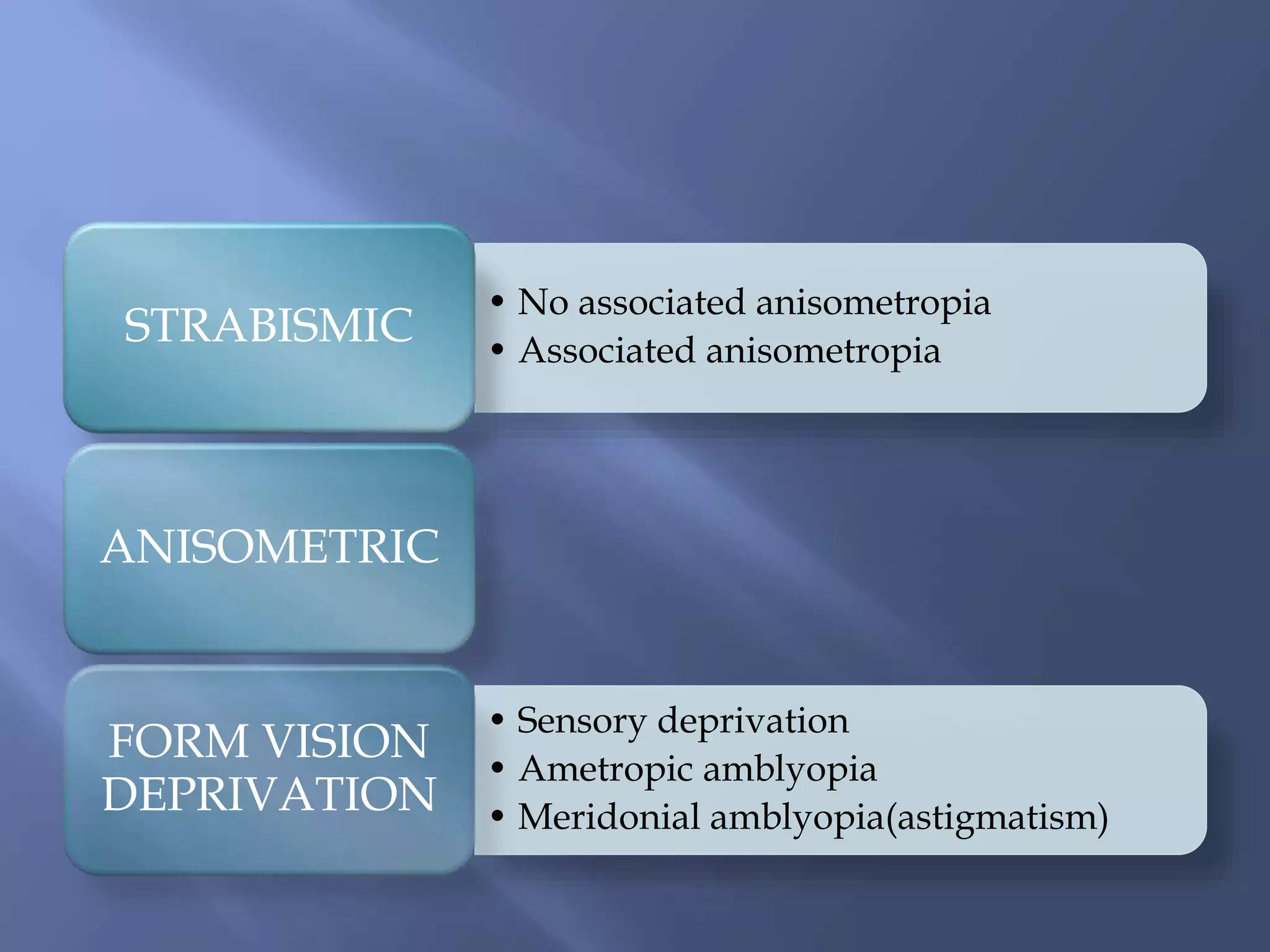
 Strabismic amblyopia
 Anisometric amblyopia
 Form vision deprivation
• No associated anisometropia
• Associated anisometropia
STRABISMIC
ANISOMETRIC
• Sensory deprivation
• Ametropic amblyopia
• Meridonial amblyopia(astigmatism)
FORM VISION
DEPRIVATION
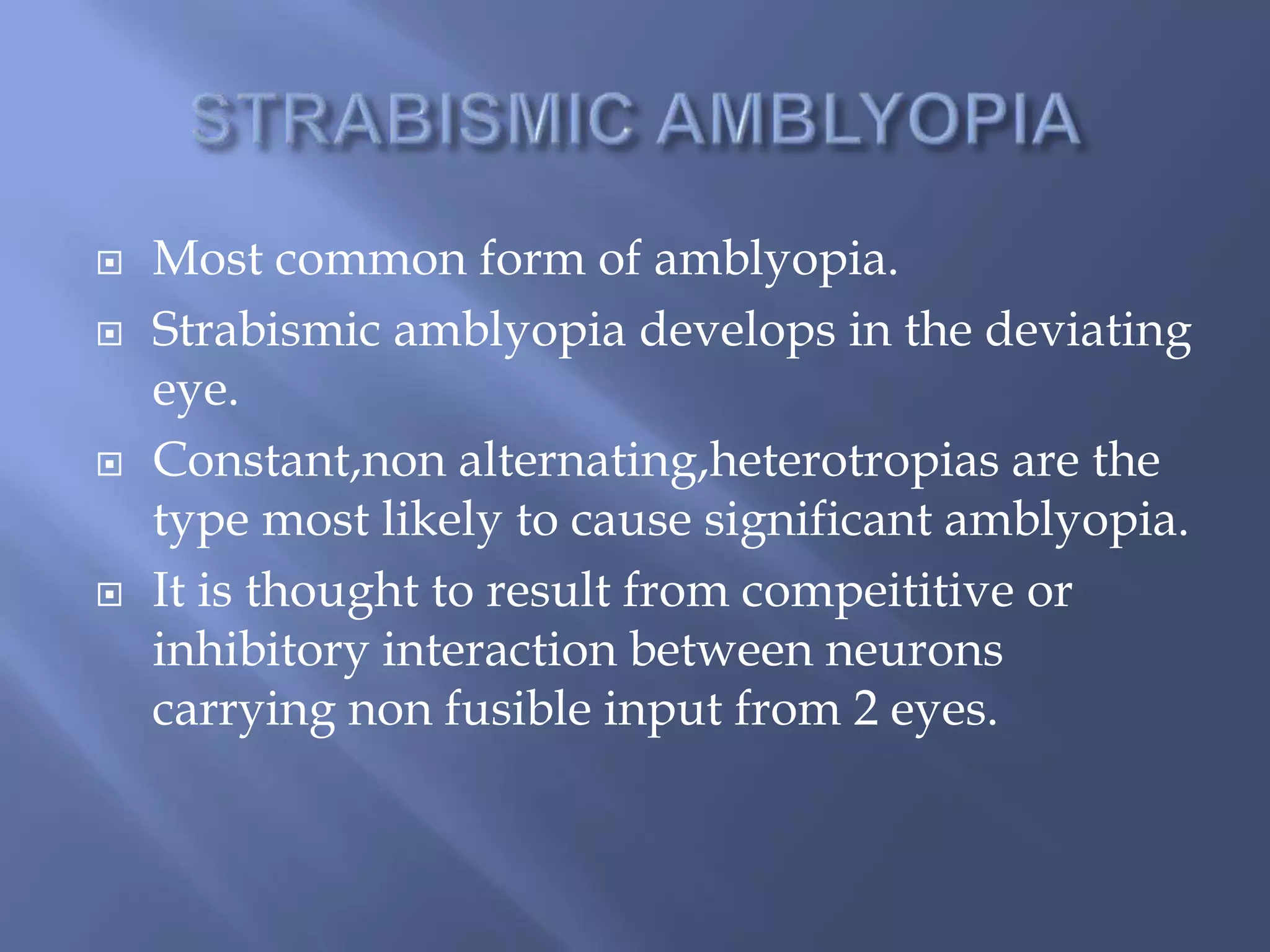
 Most common form of amblyopia.
 Strabismic amblyopia develops in the deviating
eye.
 Constant,non alternating,heterotropias are the
type most likely to cause significant amblyopia.
 It is thought to result from compeititive or
inhibitory interaction between neurons
carrying non fusible input from 2 eyes.
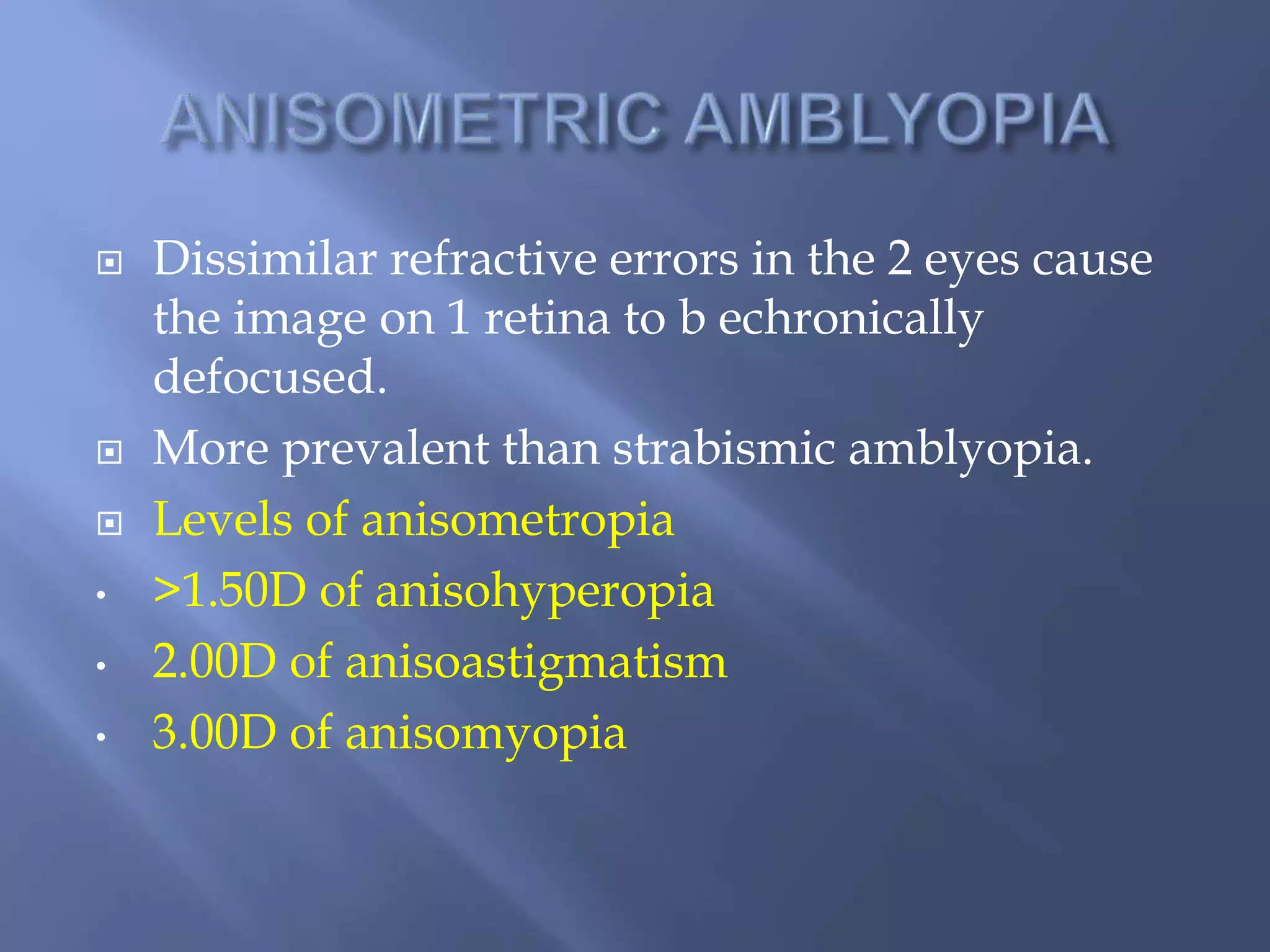
 Dissimilar refractive errors in the 2 eyes cause
the image on 1 retina to b echronically
defocused.
 More prevalent than strabismic amblyopia.
 Levels of anisometropia
• >1.50D of anisohyperopia
• 2.00D of anisoastigmatism
• 3.00D of anisomyopia
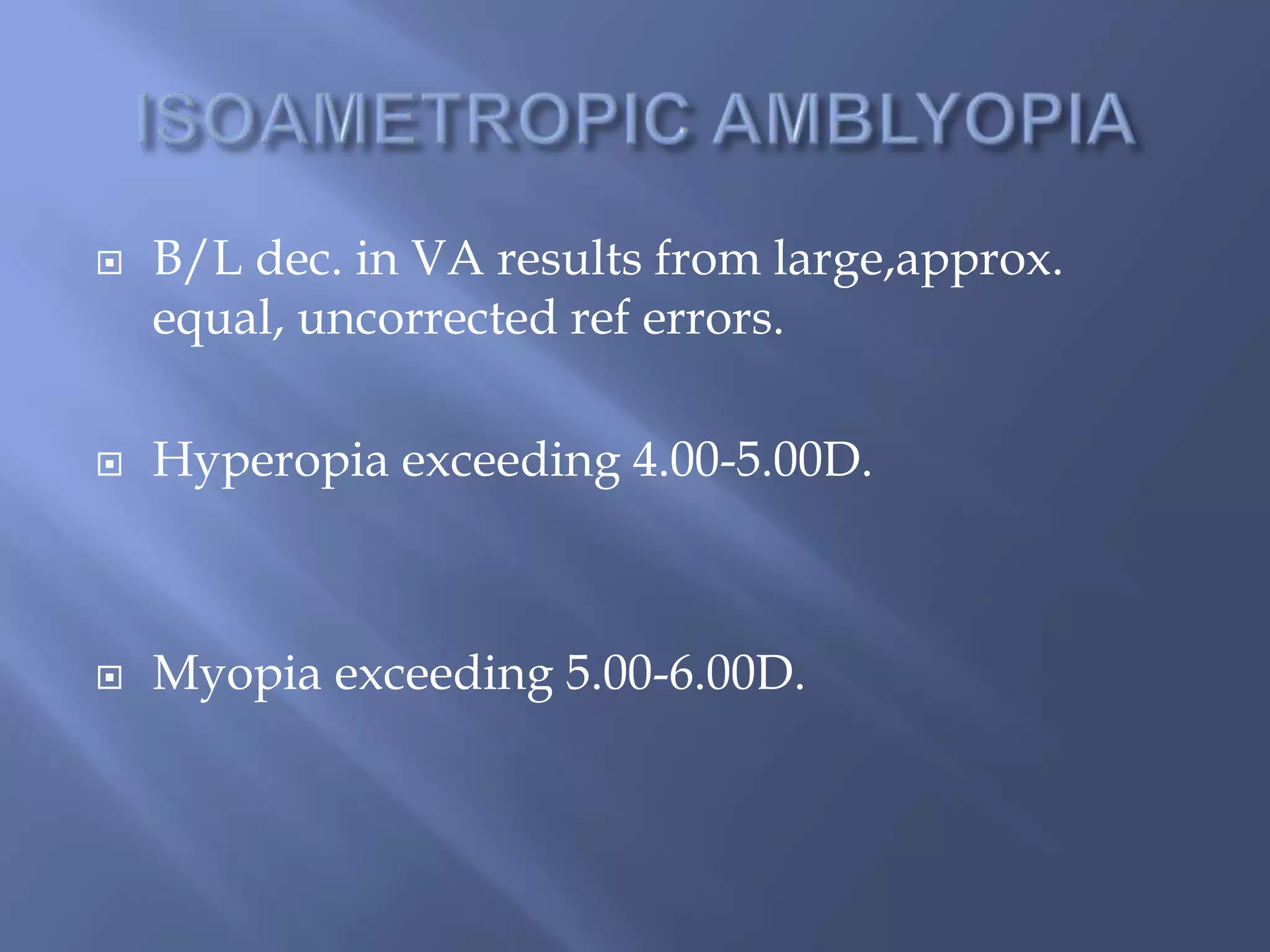
 B/L dec. in VA results from large,approx.
equal, uncorrected ref errors.
 Hyperopia exceeding 4.00-5.00D.
 Myopia exceeding 5.00-6.00D.
 Uncorrected B/L astigmatism in early
childhood may result in loss of resolving ability
limited to the chronically blurred meridians .
 The degree of cylinder is unknown
 Most ophthalmologists recommend correction
when there is > 2.00-3.00 D of cylinder.
 DEPRIVATIONAL AMBLYOPIA
 VISUAL ACUITY
 FIXATION
 FIXATION PATTERN
 ASSESSSMENT OF STRABISMUS
 ASSESSMENT OF BINOCULARITY
 EARLY DETECTION:
 +nce of nystagmus, roving
movement,abnormal head posture
Asymmetrical fundal glow (bruckner’s
reflex)
Observation of delayed visual milestones.
 Correction of refractive errors:
 Removal of any media opacities.
 Providing the worse eye a compeititive
advantage over the better eye by occluding
the better eye.
 Strict vigilance & monitoring of therapy.
Occlusion in moderate
amblyopia in children bet 3-7
yrs
At 5 wks improvement of
2.2 lines,improvement
directly related to no of
hours of patching(lesser
baseline VA)
At 6 months, improvement of
3.1 lines irrespective of hours of
patching in pts with baseline
VA between 20/40 & 20/100
Occlusion vs. Atropine penalization for 6
months in children betw 3-7 yrs
Similar improvement of VA in
both groups of about 3.7 lines
after 2 yrs starting of therapy.
After 2 yrs the amblyopic eye VA remained about 2
lines worse than the VA in the sound eye in both the
groups
2 hrs & 6 hrs occlusion in
moderate amblyopia in 3-7 yrs
Similar improvement of VA in both groups
2 hrs + 1 hr near work equal a 6 hrs
occular regimen
GREATER IMPROVEMENT IN VA IN
CHILDREN WITH SEVERE AMBLYOPIA
WHO PERFORMED NEAR ACTIVITIES
ALONG WITH PATCHING.
NEAR & NON NEAR ACTIVITIES WITH 2 HOURS
PATCHING IN 3-7 YEARS
Evaluation of 2 hours of patching with near
vision activities vs. Spectacles alone for
strabismic & anisometropic amblopia in 3-7 yrs.
Significant difference between
the improvement in VA in the 2
groups at 5 wks.
After a period of refractive adaptation,2
hrs of daily patching with 1 hr of near
visual activities improves VA in mod to
severe amblyopia
Evaluation of spectacles alone as T/T for
anisometropic amblyopia in children between
3 & 7 years
33-50% pts showed resolution of amblyopia: rest
required occlusion after 2 months.
(plateau with spectacles alone)
EVALUATION OF amblyopia between 7-17 yrs
•Optical correction suffices in 25 % cases
•Children bet.7 & 12 yrs improved with patching
irrespective of previous t/t for amblyopia.
•Pts betwn 13& 17 yrs improved with patching only if there
was no h/0 of previous T/T
•Results of long term sustenance of the improvement of VA
in older amblopes require further studies.
 OCCLUSION
 PENALIZATION
 PLEOPTICS
 CAM STIMULATOR
 RED FILTERS
 DRUGS
 A competitive advantage is given to the
worse eye over the better eye.
 Total/partial
 Full time/part time
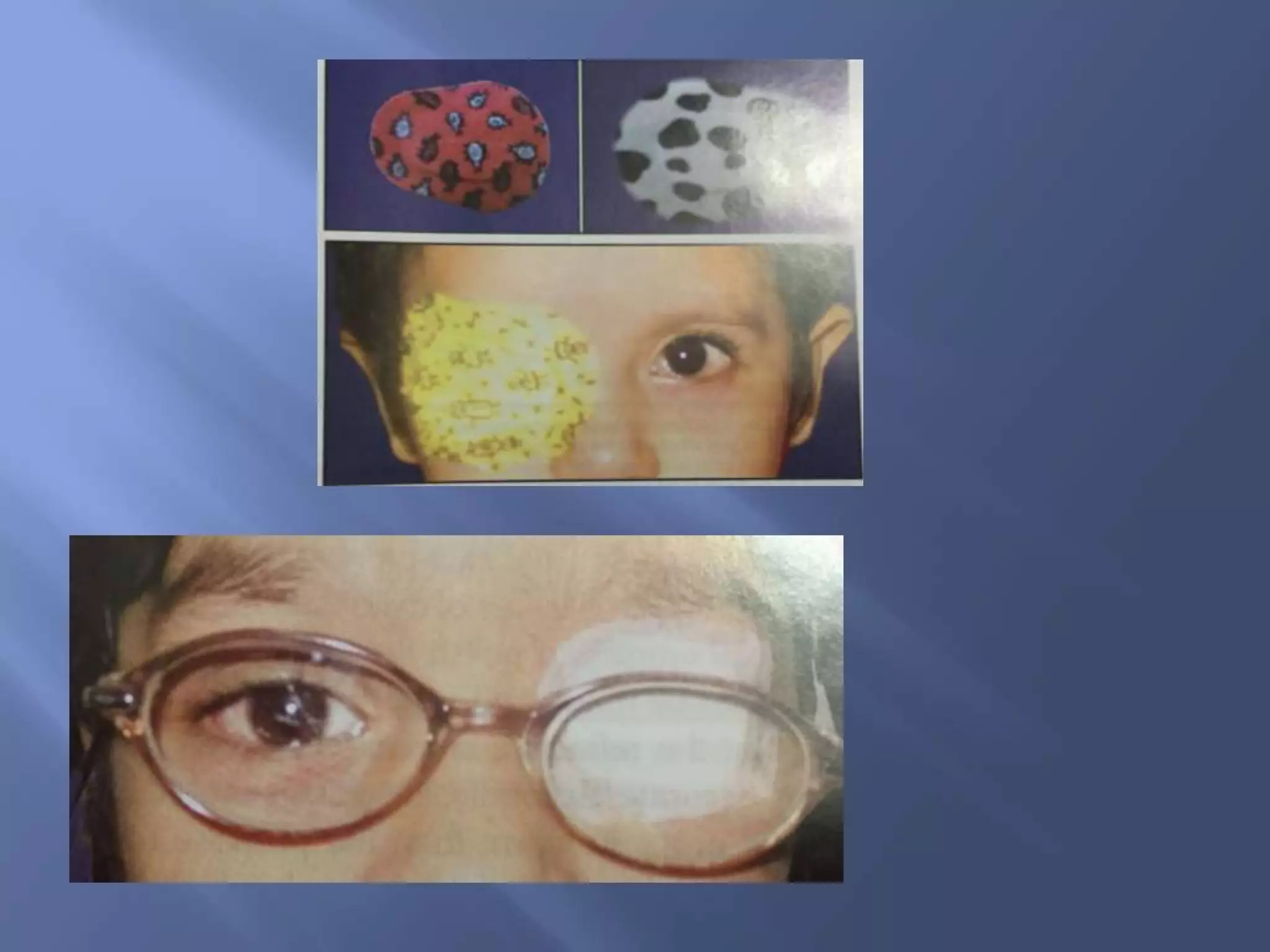
 Direct patch of the skin
 Patch over the back surface of spectacles
 Doyne’s occluder
 Pirate patches
 Occlusive contact lens
DOYNE OCCLUDER
 Refers to partial exclusion of light & form
perception.
 Refractive correction of the glasses that is being
dispensed should be accurate.
 The glasses should be worn properly.
 Selective fogging of the better eye by means of
glasses/cycloplegics.
 Pharmological penalization is more acceptable
cosmetically.
 It can be for distance or near penalization
 Dist: good eye for near & the amblyopic eye for
dist
 Total: fogging for near as well as distance.
 Principle: establish foveal superiority over the
retinal periphery & to bleach out the ecccentric
point of fixation.
 Fovea is re-educated to assume the straight head
position.
 Time taking procedure
 Age : more than 5 yrs children who are intelligent
& coopoerative.
 Not more than 7 yrs
 Principle: visual area of brain respond to a
stimuli of a particular spatial frequency & can
be stimulated to evoke visual function in
amblyopic eye.
 Contains: 7 rotating light & dark coloured disc
which have diff width
 Rotated for 7 mins at the rate of 1rotatn/min
 It is of historical use
 Principle: rod domoninated area is used for
eccentric fixation.
 Red filter is use to motivate the patient to use
fovea.
 Younger the child better the prognosis.
 Deprivation amb. Carries poor prognosis.
 Strabismic amblyopia has best prog.
 Presence of eccentric fixation worsens the prog.
 Occlusion is the better tha other methods.
Amblyopia

Amblyopia

  • 1.
    BY: Dr NIKITAJAISWAL Ims & sum hospital
  • 2.
     Introduction  Pathophysiology Classification  Management
  • 3.
     Amblyopia: (greekword means blunt eye) Also called as: lazy eye is a disorder of sight. Results in decreased vision in an eye that otherwise appears normal.
  • 6.
     As binocularor uniocular decrease in {BCVA} due to pattern visual deprivation or binocular interaction during visual immaturity for which there is no obvious ocular pathology or visual pathway defect
  • 7.
     Deprivation ofform vision: •No stimulus reaches the fovea. complete •When there is presence of a defocused image it can be U/L nd B//L partial
  • 9.
     Single letteracuity is better than linear acuity seen in strabismic amblyopia  Phenomenon of crowding  Because of abnormal contour interaction  Abnormal eye movement o Contrast sensitivity : o In stabismic amblyopia it improves on decreased illumination.
  • 10.
    characteristics strabismic anisometric AngularVA better than linear VA ++++ ++ Contrast better on dec. illuminance + - Better performance in mesopic conditions ++ +++ Vernier acuity less affected than resolution acuity ++++ _ Naso temporal OKN asymmetry +++ _ VEP abnormalities ++ ++
  • 11.
     Strabismic amblyopia Anisometric amblyopia  Form vision deprivation
  • 12.
    • No associatedanisometropia • Associated anisometropia STRABISMIC ANISOMETRIC • Sensory deprivation • Ametropic amblyopia • Meridonial amblyopia(astigmatism) FORM VISION DEPRIVATION
  • 13.
     Most commonform of amblyopia.  Strabismic amblyopia develops in the deviating eye.  Constant,non alternating,heterotropias are the type most likely to cause significant amblyopia.  It is thought to result from compeititive or inhibitory interaction between neurons carrying non fusible input from 2 eyes.
  • 16.
     Dissimilar refractiveerrors in the 2 eyes cause the image on 1 retina to b echronically defocused.  More prevalent than strabismic amblyopia.  Levels of anisometropia • >1.50D of anisohyperopia • 2.00D of anisoastigmatism • 3.00D of anisomyopia
  • 18.
     B/L dec.in VA results from large,approx. equal, uncorrected ref errors.  Hyperopia exceeding 4.00-5.00D.  Myopia exceeding 5.00-6.00D.
  • 19.
     Uncorrected B/Lastigmatism in early childhood may result in loss of resolving ability limited to the chronically blurred meridians .  The degree of cylinder is unknown  Most ophthalmologists recommend correction when there is > 2.00-3.00 D of cylinder.
  • 20.
  • 22.
     VISUAL ACUITY FIXATION  FIXATION PATTERN  ASSESSSMENT OF STRABISMUS  ASSESSMENT OF BINOCULARITY
  • 26.
     EARLY DETECTION: +nce of nystagmus, roving movement,abnormal head posture Asymmetrical fundal glow (bruckner’s reflex) Observation of delayed visual milestones.  Correction of refractive errors:  Removal of any media opacities.  Providing the worse eye a compeititive advantage over the better eye by occluding the better eye.  Strict vigilance & monitoring of therapy.
  • 27.
    Occlusion in moderate amblyopiain children bet 3-7 yrs At 5 wks improvement of 2.2 lines,improvement directly related to no of hours of patching(lesser baseline VA) At 6 months, improvement of 3.1 lines irrespective of hours of patching in pts with baseline VA between 20/40 & 20/100
  • 28.
    Occlusion vs. Atropinepenalization for 6 months in children betw 3-7 yrs Similar improvement of VA in both groups of about 3.7 lines after 2 yrs starting of therapy. After 2 yrs the amblyopic eye VA remained about 2 lines worse than the VA in the sound eye in both the groups
  • 29.
    2 hrs &6 hrs occlusion in moderate amblyopia in 3-7 yrs Similar improvement of VA in both groups 2 hrs + 1 hr near work equal a 6 hrs occular regimen
  • 30.
    GREATER IMPROVEMENT INVA IN CHILDREN WITH SEVERE AMBLYOPIA WHO PERFORMED NEAR ACTIVITIES ALONG WITH PATCHING. NEAR & NON NEAR ACTIVITIES WITH 2 HOURS PATCHING IN 3-7 YEARS
  • 31.
    Evaluation of 2hours of patching with near vision activities vs. Spectacles alone for strabismic & anisometropic amblopia in 3-7 yrs. Significant difference between the improvement in VA in the 2 groups at 5 wks. After a period of refractive adaptation,2 hrs of daily patching with 1 hr of near visual activities improves VA in mod to severe amblyopia
  • 32.
    Evaluation of spectaclesalone as T/T for anisometropic amblyopia in children between 3 & 7 years 33-50% pts showed resolution of amblyopia: rest required occlusion after 2 months. (plateau with spectacles alone)
  • 33.
    EVALUATION OF amblyopiabetween 7-17 yrs •Optical correction suffices in 25 % cases •Children bet.7 & 12 yrs improved with patching irrespective of previous t/t for amblyopia. •Pts betwn 13& 17 yrs improved with patching only if there was no h/0 of previous T/T •Results of long term sustenance of the improvement of VA in older amblopes require further studies.
  • 34.
     OCCLUSION  PENALIZATION PLEOPTICS  CAM STIMULATOR  RED FILTERS  DRUGS
  • 35.
     A competitiveadvantage is given to the worse eye over the better eye.  Total/partial  Full time/part time
  • 36.
     Direct patchof the skin  Patch over the back surface of spectacles  Doyne’s occluder  Pirate patches  Occlusive contact lens
  • 37.
  • 40.
     Refers topartial exclusion of light & form perception.  Refractive correction of the glasses that is being dispensed should be accurate.  The glasses should be worn properly.
  • 42.
     Selective foggingof the better eye by means of glasses/cycloplegics.  Pharmological penalization is more acceptable cosmetically.  It can be for distance or near penalization  Dist: good eye for near & the amblyopic eye for dist  Total: fogging for near as well as distance.
  • 43.
     Principle: establishfoveal superiority over the retinal periphery & to bleach out the ecccentric point of fixation.  Fovea is re-educated to assume the straight head position.  Time taking procedure  Age : more than 5 yrs children who are intelligent & coopoerative.  Not more than 7 yrs
  • 44.
     Principle: visualarea of brain respond to a stimuli of a particular spatial frequency & can be stimulated to evoke visual function in amblyopic eye.  Contains: 7 rotating light & dark coloured disc which have diff width  Rotated for 7 mins at the rate of 1rotatn/min  It is of historical use
  • 45.
     Principle: roddomoninated area is used for eccentric fixation.  Red filter is use to motivate the patient to use fovea.
  • 46.
     Younger thechild better the prognosis.  Deprivation amb. Carries poor prognosis.  Strabismic amblyopia has best prog.  Presence of eccentric fixation worsens the prog.  Occlusion is the better tha other methods.