What is he
writing , why
can’t I see?
VISUAL ACUITY
Presented by : Dr Nikhil Agrawal , 1ST Year DOMS
Moderated by : Dr Pushkar Dhir
DHIR HOSPITAL AND POSTGRADUATE INSTITUTE OF OPTHALMOLOGY
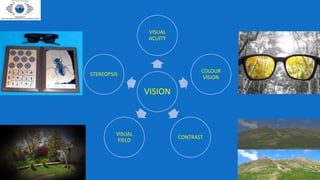
VISION
VISUAL
ACUITY
COLOUR
VISION
CONTRAST
VISUAL
FIELD
STEREOPSIS
VISUAL ACUITY
What is Visual Acuity ?
• Visual acuity is a measure of the ability of the eyes
to distinguish shapes and the details of the object
at a given distance .
• It is measure of spatial resolution of the visual
processing system
• It is quantified by the minimum dimension that an
object must have in order for the observer to be
able to identify, distinguish or simply detect it.
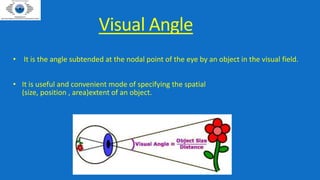
Visual Angle
• It is the angle subtended at the nodal point of the eye by an object in the visual field.
• It is useful and convenient mode of specifying the spatial
(size, position , area)extent of an object.
COMPONENTS
MINIMUM VISIBLE RESOLUTION RECOGNITION
Presence/absence of stimulus Identify the spatial characteristics of
target
Resolution + Cognition
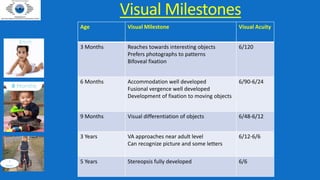
Visual Milestones
Age Visual Milestone Visual Acuity
3 Months Reaches towards interesting objects
Prefers photographs to patterns
Bifoveal fixation
6/120
6 Months Accommodation well developed
Fusional vergence well developed
Development of fixation to moving objects
6/90-6/24
9 Months Visual differentiation of objects 6/48-6/12
3 Years VA approaches near adult level
Can recognize picture and some letters
6/12-6/6
5 Years Stereopsis fully developed 6/6
3
Years
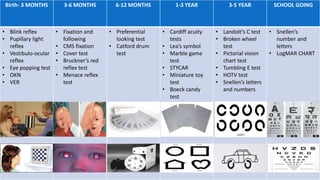
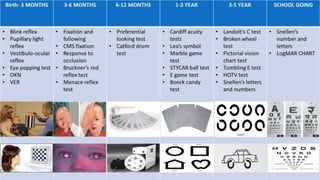
Birth- 3 MONTHS 3-6 MONTHS 6-12 MONTHS 1-3 YEAR 3-5 YEAR SCHOOL GOING
• Blink reflex
• Pupillary light
reflex
• Vestibulo-ocular
reflex
• Eye popping test
• OKN
• VER
• Fixation and
following
• CMS fixation
• Cover test
• Bruckner’s red
reflex test
• Menace reflex
test
• Preferential
looking test
• Catford drum
test
• Cardiff acuity
tests
• Lea’s symbol
• Marble game
test
• STYCAR
• Miniature toy
test
• Boeck candy
test
• Landolt’s C test
• Broken wheel
test
• Pictorial vision
chart test
• Tumbling E test
• HOTV test
• Snellen’s letters
and numbers
• Snellen’s
number and
letters
• LogMAR CHART
VA Assessment in Infants
(Birth – 3 months)
• Blink Reflex Test
• Pupillary Light Reflex Test
• Vestibulo-Ocular Reflex: Dolls eye response
• Eye Popping Test
• OKN Test : Optokinetic Nystagmus
• VER :Visually Evoked Response
OKN TEST :10x8 inches diameter , slow phase 0.2s , fast phase 0.1s VER : Only clinically objective test
3 MONTHS OLD ANAYA
VA ASSESSMENT FROM
3-6 MONTHS
• Fixation Behavior Test: Infant fixates habitually with better
eye , resists its occlusion .
• CSM Method : Central( corneal light reflex )
Steady (eye movements are smooth)
Maintained( alignment is correct when either
eye is covered )
• Bruckner’s Red Reflex Test
• Cover Test
6 MONTHS OLD ANAYA
VA ASSESSMENT IN
6-12 MONTHS
PLT: Preferential Looking Test , Tellers Acuity Card test
Leas Paddles TAC CARDS
12 MONTHS OLD ANANYA
• Child prefers to look at a
patterned background .
• VA determined with PLT ranges
from approximately 6/240 in
newborn to 6/60 at 3 months
and 6/6 at 36 months .
Baby can you see me !!
TELLERS ACUITY CARD TEST
VA ASSESSMENT IN 6-12 MONTHS
Catford Drum Test:
 It is a detection acuity test.
 Oscillating drum with black dots of various size is
observed .
 Rotation of disc at 60cm evokes pendular
movement .
 Unreliable , as it overestimates the VA.
VAASSESSMENTIN
1-3 YEAR OLD
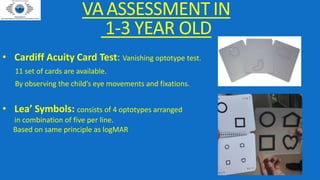
• Cardiff Acuity Card Test: Vanishing optotype test.
11 set of cards are available.
By observing the child’s eye movements and fixations.
• Lea’ Symbols: consists of 4 optotypes arranged
in combination of five per line.
Based on same principle as logMAR
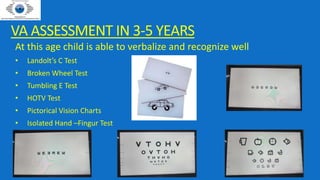
VA ASSESSMENT IN 3-5 YEARS
At this age child is able to verbalize and recognize well
• Landolt’s C Test
• Broken Wheel Test
• Tumbling E Test
• HOTV Test
• Pictorical Vision Charts
• Isolated Hand –Fingur Test
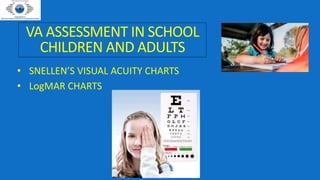
VA ASSESSMENT IN SCHOOL
CHILDREN AND ADULTS
• SNELLEN’S VISUAL ACUITY CHARTS
• LogMAR CHARTS
SNELLEN’S CHART
• Starts with single letter at 6/60 with additional letters on each line progressing
to the 6/4 level.
• Fixed spacing between the lines .
• Nonuniform decrease in size of letters .
• Evenly illuminated
• Measures distance central acuity.
Dr Herman Snellen
SNELLEN’S CHART
LogMAR CHART
• Logarithm of the Minimum Angle of
Resolution
• Each step indicates increase of 25% in letter
size.
• Letter sizes ratio as we move up is a
constant value of 1.26(0.1log unit steps).
• Incorporated 5 letters in every row.
• Spacing b/w 2 adjacent letters = width of 1
letter.
• Spacing b/w 2 horizontal rows = height of
the letter on lower row.
Designed by Ian Bailey and Jan E. Lovie
• Used at a distance of 4 meters .
• 1min of visual angle scores LogMAR of 0 (Log of 1 is
0)
• 2min of visual angle scores LogMAR of 0.3
• As each letter size changes by 0.1logMAR units per
row & there are 5 letters on each row ,therefore
each letter can be assigned value of 0.02.
• LogMAR takes account of every letter that has been
correctly read.
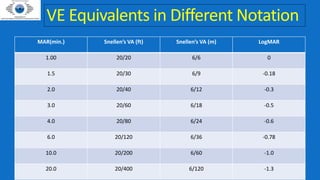
VE Equivalents in Different Notation
MAR(min.) Snellen’s VA (ft) Snellen’s VA (m) LogMAR
1.00 20/20 6/6 0
1.5 20/30 6/9 -0.18
2.0 20/40 6/12 -0.3
3.0 20/60 6/18 -0.5
4.0 20/80 6/24 -0.6
6.0 20/120 6/36 -0.78
10.0 20/200 6/60 -1.0
20.0 20/400 6/120 -1.3
Early Treatment Diabetic
Retinopathy Study (ETDRS) charts
• Randomized clinical trial designed
to evaluate argon laser
photocoagulation and aspirin
treatment in the management of
patients with early proliferative
diabetic retinopathy(Based on
LogMAR).
• ETDRS equipment and testing have
evolved into what is considered the
gold standard of current-day clinical
trials involving vision testing.
Freiburg Visual Acuity Test (FrACT)
• “FrACT” is a visual test battery in
form of a free computer program.
It uses psychometric methods to
provide automated, self-paced
assessment of visual acuity and
contrast sensitivity
• For low vision it can reproducibly
assess CF and even HM.
Procedure
• Ensure good natural light or illumination.
• Explain the procedure to the patient.
• Position the patient, sitting or standing, at a distance of 6 meters or adjust
the optotypes according to the available distance .
• Test the eyes one at a time, at first without any spectacles
• The smallest line read is expressed as a fraction, e.g. 6/18.
• If the patient cannot read the top letter at 6m , move him/her closer, 1m at a
time, until the top letter can be seen – the VA will then be recorded as 5/60
or 4/60, etc.
Procedure
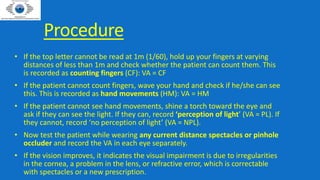
• If the top letter cannot be read at 1m (1/60), hold up your fingers at varying
distances of less than 1m and check whether the patient can count them. This
is recorded as counting fingers (CF): VA = CF
• If the patient cannot count fingers, wave your hand and check if he/she can see
this. This is recorded as hand movements (HM): VA = HM
• If the patient cannot see hand movements, shine a torch toward the eye and
ask if they can see the light. If they can, record ‘perception of light’ (VA = PL). If
they cannot, record ‘no perception of light’ (VA = NPL).
• Now test the patient while wearing any current distance spectacles or pinhole
occluder and record the VA in each eye separately.
• If the vision improves, it indicates the visual impairment is due to irregularities
in the cornea, a problem in the lens, or refractive error, which is correctable
with spectacles or a new prescription.
Having problem reading our discharge
tickets!! You need a near vision
assessment
Near Vision Assessment
• Near vision is tested by asking the pt. to
read a near vision chart kept at a distance of
25cm to 35cm.
• Each eye should be tested separately.
• The near vision is recorded as the smallest
type which the pt. can read comfortably.
Jaeger’s Chart
Prints are marked from 1 to 7 and
accordingly patient’s acuity is labelled as J1-
J7 .
Eduard Jäger von Jaxtthal
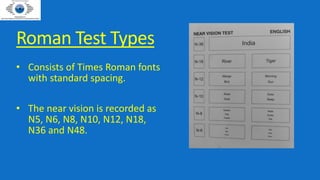
Roman Test Types
• Consists of Times Roman fonts
with standard spacing.
• The near vision is recorded as
N5, N6, N8, N10, N12, N18,
N36 and N48.
Snellen’s Near Vision Test Types
• Constructed on the same principles as of the distant
types.
• The graded thickness of the letters is about 1/17 of the
distant vision chart letter.
• The letter equivalent to 6/6 line subtend an angle of 5
min. at the average reading distance.
References
• https://www.ncbi.nlm.nih.gov/pmc/articles/PMC4069781/#:~:text=Visual%20
acuity%20(VA)%20is%20a,is%20tested%20at%20a%20time.
• https://www.aao.org/eye-health/tips-prevention/eye-chart-facts-history
• https://michaelbach.de/fract
• https://www.precision-vision.com/articles/what-is-etdrs/
• Khurana – Optics and Refraction
That’s how I passed .
visual_acuity_(1) Presentations DHB.pptx

visual_acuity_(1) Presentations DHB.pptx

  • 1.
    What is he writing, why can’t I see?
  • 2.
    VISUAL ACUITY Presented by: Dr Nikhil Agrawal , 1ST Year DOMS Moderated by : Dr Pushkar Dhir DHIR HOSPITAL AND POSTGRADUATE INSTITUTE OF OPTHALMOLOGY
  • 3.
  • 4.
  • 5.
    What is VisualAcuity ? • Visual acuity is a measure of the ability of the eyes to distinguish shapes and the details of the object at a given distance . • It is measure of spatial resolution of the visual processing system • It is quantified by the minimum dimension that an object must have in order for the observer to be able to identify, distinguish or simply detect it.
  • 6.
    Visual Angle • Itis the angle subtended at the nodal point of the eye by an object in the visual field. • It is useful and convenient mode of specifying the spatial (size, position , area)extent of an object.
  • 7.
    COMPONENTS MINIMUM VISIBLE RESOLUTIONRECOGNITION Presence/absence of stimulus Identify the spatial characteristics of target Resolution + Cognition
  • 8.
    Visual Milestones Age VisualMilestone Visual Acuity 3 Months Reaches towards interesting objects Prefers photographs to patterns Bifoveal fixation 6/120 6 Months Accommodation well developed Fusional vergence well developed Development of fixation to moving objects 6/90-6/24 9 Months Visual differentiation of objects 6/48-6/12 3 Years VA approaches near adult level Can recognize picture and some letters 6/12-6/6 5 Years Stereopsis fully developed 6/6 3 Years
  • 9.
    Birth- 3 MONTHS3-6 MONTHS 6-12 MONTHS 1-3 YEAR 3-5 YEAR SCHOOL GOING • Blink reflex • Pupillary light reflex • Vestibulo-ocular reflex • Eye popping test • OKN • VER • Fixation and following • CMS fixation • Cover test • Bruckner’s red reflex test • Menace reflex test • Preferential looking test • Catford drum test • Cardiff acuity tests • Lea’s symbol • Marble game test • STYCAR • Miniature toy test • Boeck candy test • Landolt’s C test • Broken wheel test • Pictorial vision chart test • Tumbling E test • HOTV test • Snellen’s letters and numbers • Snellen’s number and letters • LogMAR CHART
  • 10.
    VA Assessment inInfants (Birth – 3 months) • Blink Reflex Test • Pupillary Light Reflex Test • Vestibulo-Ocular Reflex: Dolls eye response • Eye Popping Test • OKN Test : Optokinetic Nystagmus • VER :Visually Evoked Response OKN TEST :10x8 inches diameter , slow phase 0.2s , fast phase 0.1s VER : Only clinically objective test 3 MONTHS OLD ANAYA
  • 11.
    VA ASSESSMENT FROM 3-6MONTHS • Fixation Behavior Test: Infant fixates habitually with better eye , resists its occlusion . • CSM Method : Central( corneal light reflex ) Steady (eye movements are smooth) Maintained( alignment is correct when either eye is covered ) • Bruckner’s Red Reflex Test • Cover Test 6 MONTHS OLD ANAYA
  • 12.
    VA ASSESSMENT IN 6-12MONTHS PLT: Preferential Looking Test , Tellers Acuity Card test Leas Paddles TAC CARDS 12 MONTHS OLD ANANYA
  • 13.
    • Child prefersto look at a patterned background . • VA determined with PLT ranges from approximately 6/240 in newborn to 6/60 at 3 months and 6/6 at 36 months . Baby can you see me !! TELLERS ACUITY CARD TEST
  • 14.
    VA ASSESSMENT IN6-12 MONTHS Catford Drum Test:  It is a detection acuity test.  Oscillating drum with black dots of various size is observed .  Rotation of disc at 60cm evokes pendular movement .  Unreliable , as it overestimates the VA.
  • 15.
    VAASSESSMENTIN 1-3 YEAR OLD •Cardiff Acuity Card Test: Vanishing optotype test. 11 set of cards are available. By observing the child’s eye movements and fixations. • Lea’ Symbols: consists of 4 optotypes arranged in combination of five per line. Based on same principle as logMAR
  • 16.
    VA ASSESSMENT IN3-5 YEARS At this age child is able to verbalize and recognize well • Landolt’s C Test • Broken Wheel Test • Tumbling E Test • HOTV Test • Pictorical Vision Charts • Isolated Hand –Fingur Test
  • 17.
    VA ASSESSMENT INSCHOOL CHILDREN AND ADULTS • SNELLEN’S VISUAL ACUITY CHARTS • LogMAR CHARTS
  • 19.
    SNELLEN’S CHART • Startswith single letter at 6/60 with additional letters on each line progressing to the 6/4 level. • Fixed spacing between the lines . • Nonuniform decrease in size of letters . • Evenly illuminated • Measures distance central acuity. Dr Herman Snellen
  • 20.
  • 21.
    LogMAR CHART • Logarithmof the Minimum Angle of Resolution • Each step indicates increase of 25% in letter size. • Letter sizes ratio as we move up is a constant value of 1.26(0.1log unit steps). • Incorporated 5 letters in every row. • Spacing b/w 2 adjacent letters = width of 1 letter. • Spacing b/w 2 horizontal rows = height of the letter on lower row. Designed by Ian Bailey and Jan E. Lovie
  • 22.
    • Used ata distance of 4 meters . • 1min of visual angle scores LogMAR of 0 (Log of 1 is 0) • 2min of visual angle scores LogMAR of 0.3 • As each letter size changes by 0.1logMAR units per row & there are 5 letters on each row ,therefore each letter can be assigned value of 0.02. • LogMAR takes account of every letter that has been correctly read.
  • 23.
    VE Equivalents inDifferent Notation MAR(min.) Snellen’s VA (ft) Snellen’s VA (m) LogMAR 1.00 20/20 6/6 0 1.5 20/30 6/9 -0.18 2.0 20/40 6/12 -0.3 3.0 20/60 6/18 -0.5 4.0 20/80 6/24 -0.6 6.0 20/120 6/36 -0.78 10.0 20/200 6/60 -1.0 20.0 20/400 6/120 -1.3
  • 24.
    Early Treatment Diabetic RetinopathyStudy (ETDRS) charts • Randomized clinical trial designed to evaluate argon laser photocoagulation and aspirin treatment in the management of patients with early proliferative diabetic retinopathy(Based on LogMAR). • ETDRS equipment and testing have evolved into what is considered the gold standard of current-day clinical trials involving vision testing.
  • 25.
    Freiburg Visual AcuityTest (FrACT) • “FrACT” is a visual test battery in form of a free computer program. It uses psychometric methods to provide automated, self-paced assessment of visual acuity and contrast sensitivity • For low vision it can reproducibly assess CF and even HM.
  • 26.
    Procedure • Ensure goodnatural light or illumination. • Explain the procedure to the patient. • Position the patient, sitting or standing, at a distance of 6 meters or adjust the optotypes according to the available distance . • Test the eyes one at a time, at first without any spectacles • The smallest line read is expressed as a fraction, e.g. 6/18. • If the patient cannot read the top letter at 6m , move him/her closer, 1m at a time, until the top letter can be seen – the VA will then be recorded as 5/60 or 4/60, etc.
  • 27.
    Procedure • If thetop letter cannot be read at 1m (1/60), hold up your fingers at varying distances of less than 1m and check whether the patient can count them. This is recorded as counting fingers (CF): VA = CF • If the patient cannot count fingers, wave your hand and check if he/she can see this. This is recorded as hand movements (HM): VA = HM • If the patient cannot see hand movements, shine a torch toward the eye and ask if they can see the light. If they can, record ‘perception of light’ (VA = PL). If they cannot, record ‘no perception of light’ (VA = NPL). • Now test the patient while wearing any current distance spectacles or pinhole occluder and record the VA in each eye separately. • If the vision improves, it indicates the visual impairment is due to irregularities in the cornea, a problem in the lens, or refractive error, which is correctable with spectacles or a new prescription.
  • 28.
    Having problem readingour discharge tickets!! You need a near vision assessment
  • 29.
    Near Vision Assessment •Near vision is tested by asking the pt. to read a near vision chart kept at a distance of 25cm to 35cm. • Each eye should be tested separately. • The near vision is recorded as the smallest type which the pt. can read comfortably.
  • 30.
    Jaeger’s Chart Prints aremarked from 1 to 7 and accordingly patient’s acuity is labelled as J1- J7 . Eduard Jäger von Jaxtthal
  • 31.
    Roman Test Types •Consists of Times Roman fonts with standard spacing. • The near vision is recorded as N5, N6, N8, N10, N12, N18, N36 and N48.
  • 32.
    Snellen’s Near VisionTest Types • Constructed on the same principles as of the distant types. • The graded thickness of the letters is about 1/17 of the distant vision chart letter. • The letter equivalent to 6/6 line subtend an angle of 5 min. at the average reading distance.
  • 33.
  • 34.