TRANSPOSITION
OPTOM FASLU MUHAMMED
TRANSPOSITION
 It implies transfer of lens power from one
form to another so as to their meridian values
remain the same in both the forms.
 It means rewrite the expressions of its power
without actually changing them.
TRANSPOSITION
 Simple Transposition
 Toric Transposition
SImPle TRANSPOSITION
Three simple steps
1.SUM :The new spherical surface is given by
adding algebraically the power of the sphere
and cylinder.
2.SIGN :Retain the power of the cylinder but
change the sign.
3.AXIS:Rotate the axis of the cylinder through
90º
SImPle TRANSPOSITION
 +2.00 DS /+1.00 DC 180º
+3.00DS/-1.00DC 90º
 -5.00DS/ -3.00 DC 90º
-8.00DS/+3.00DC 180º
SImPle TRANSPOSITION
 +3.00 DS/-1.50 DC 90º
+1.50 DS /+1.50 DC180º
 -4.00 DS /- 2.25 DC 70º
-6.25 DS /+2.25 DC 160º
SImPle TRANSPOSITION
 +1.00 DS /+0.25 DC 130º
 -2.50 DS /-1.75 DC 40º
 +6.00 DS / -2.75 DC 10º
 -3.00 DC 120º
TORIc TRANSPOSITION
 Toric formula is written as fraction, the
numerator and the denominator comprises
both the base curve and the cylinder necessary
to give the required combination.
 A toric astigmatic lens is made with one
spherical surface and one toric surface .
 The principal meridian of weaker power of the
toric surface is known as the base curve of the
lens.
The sTeps of Toric TransposiTion
1.Transpose the given prescription to one having
a cylinder of the same sign as the base curve
which to be used. (SIMPLE Transposition )
2.The spherical surface is given by subtracting
the base power from the sphere in(1) .This is
written as the numerator of the fraction.
3.Fix the cylindrical base curve with its axis at
right angle to the cylinder in (1)
4. Add to the base curve the cylinder in (1) with
its axis at right angles to that of the base
curve
Toric TransposiTion
 An example
+3.00 DS +1.00 DC 90º BC -6.00
1.Simple Transposition
+4.00 DS /-1.00 DC 180º
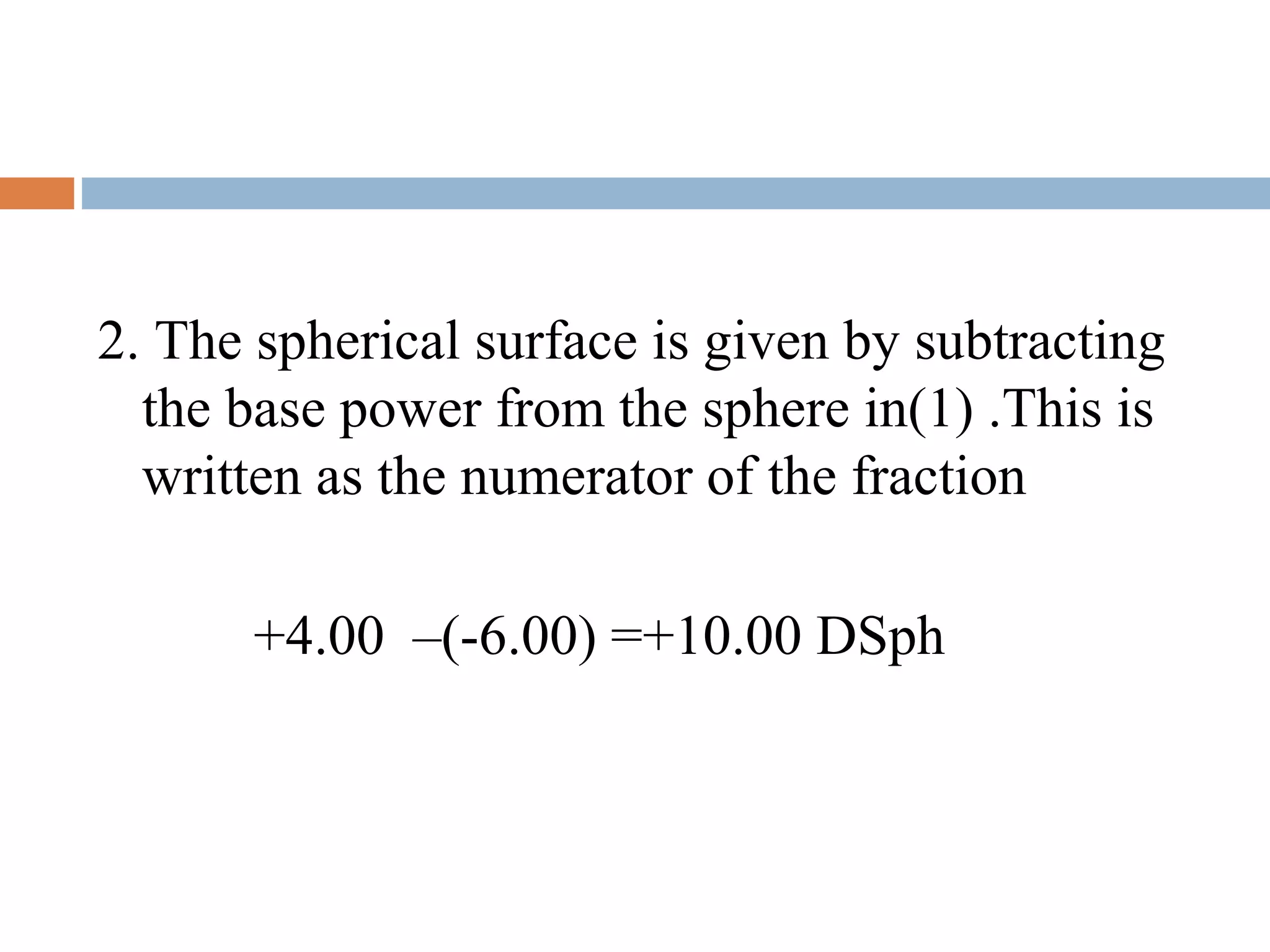
2. The spherical surface is given by subtracting
the base power from the sphere in(1) .This is
written as the numerator of the fraction
+4.00 –(-6.00) =+10.00 DSph
3. Fix the cylindrical base curve with its axis at
right angle to the cylinder in (1)
-6.00 DC 90º
4. Add to the base curve the cylinder in (1) with
its axis at right angles to that of the base curve
-6.00 +(-1.00) =-7.00 DC 180º
+10.00 DSph/ -6.00 DC 90º -7.00 DC
180º
Toric TransposiTion
 +3.00 DS /-1.00 DC 90º BC -6.00
+9.00 DSph / -6.00 DC 180º -7.00 DC 90º
 +3.00 DS /+2.00 DC 90º
-3.00 DSph / +6.00 DC 180 +8.00 DC 90º
Spherical equivalent (S.e)
 A spherocylinder lens will correct for
astigmatism and myopia or hyperopia. If it
was necessary to correct a nearsighted or
farsighted person who also has astigmatism,
but there were no cylinder lenses available,
what would be the best correction using only a
sphere lens?
how to Find the Spherical equivalent ?
1. Take half the value of the cylinder and
2. Add it to the sphere power.
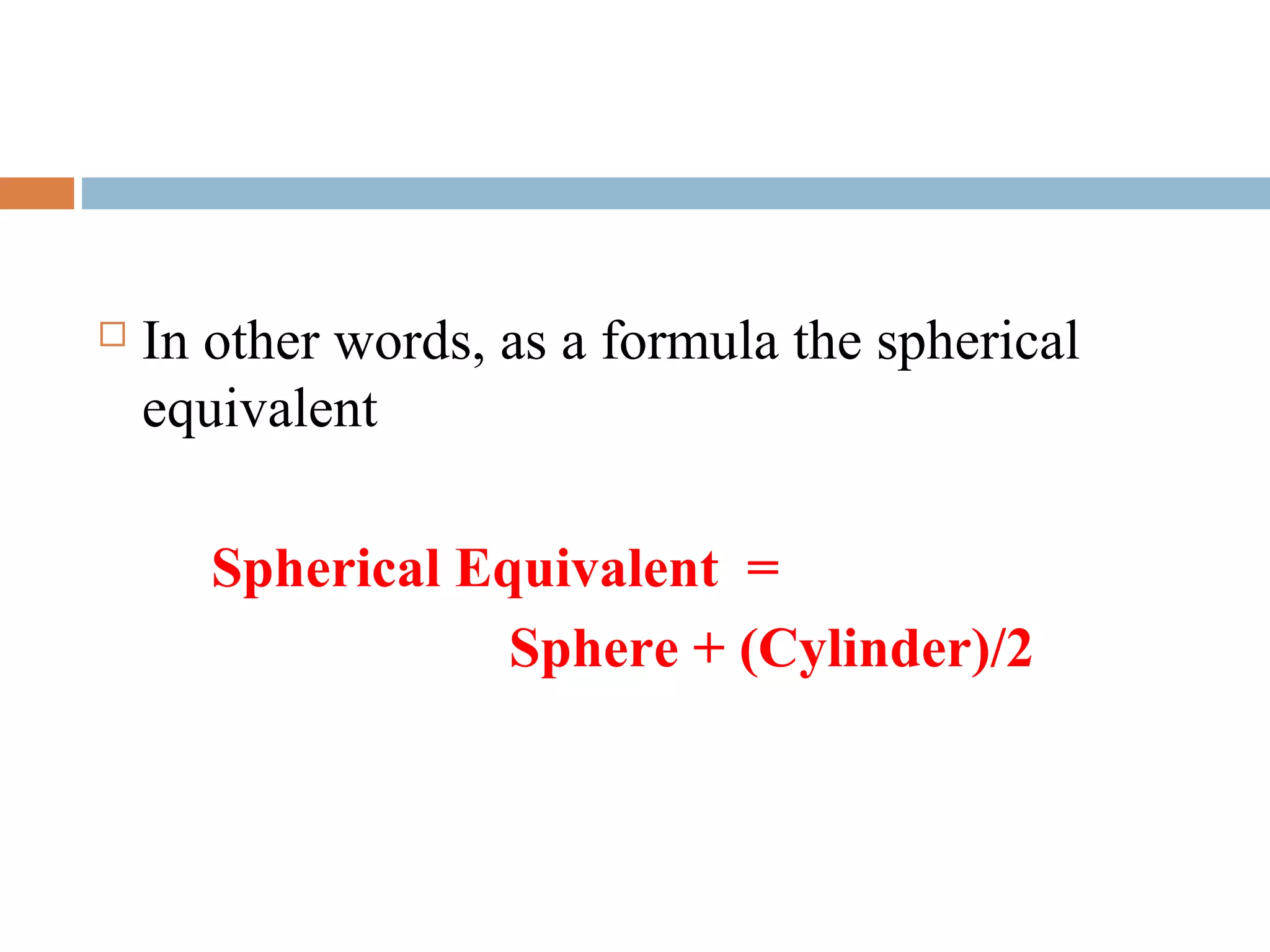
 In other words, as a formula the spherical
equivalent
Spherical Equivalent =
Sphere + (Cylinder)/2
 What is the spherical equivalent for this lens?
+3.00 − 1.00 × 180º
spherical equivalent = +3.00 + (-1.00) /2
= +2.50D
 What is the spherical equivalent for a lens
having a power of −4.25 −1.50 × 135º ?
S.E = -4.25 + (-1.50) /2
= -5.00 D
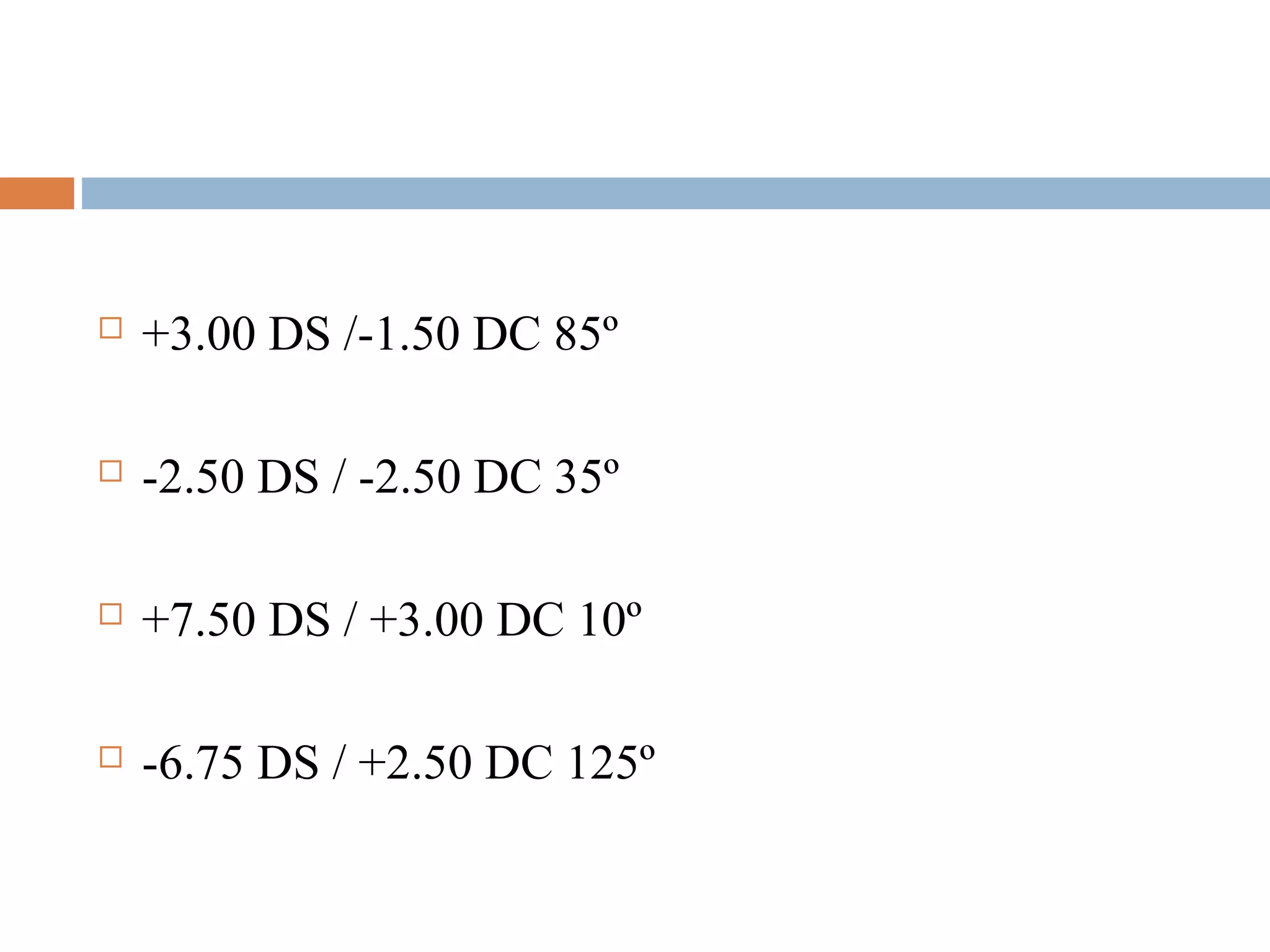
 +3.00 DS /-1.50 DC 85º
 -2.50 DS / -2.50 DC 35º
 +7.50 DS / +3.00 DC 10º
 -6.75 DS / +2.50 DC 125º
Crossed-Cylinder Form
 Another possible abbreviated form of
prescription writing is the crossed-cylinder
form.
 This form is never used to write a prescription
for spectacle lenses. However, an understanding
of this form of prescription writing aids in a
more complete understanding of lenses.
 The crossed-cylinder form of prescription
writing is also the way that keratometer
readings are written when measuring the front
surface power of the cornea for contact lens
purposes.
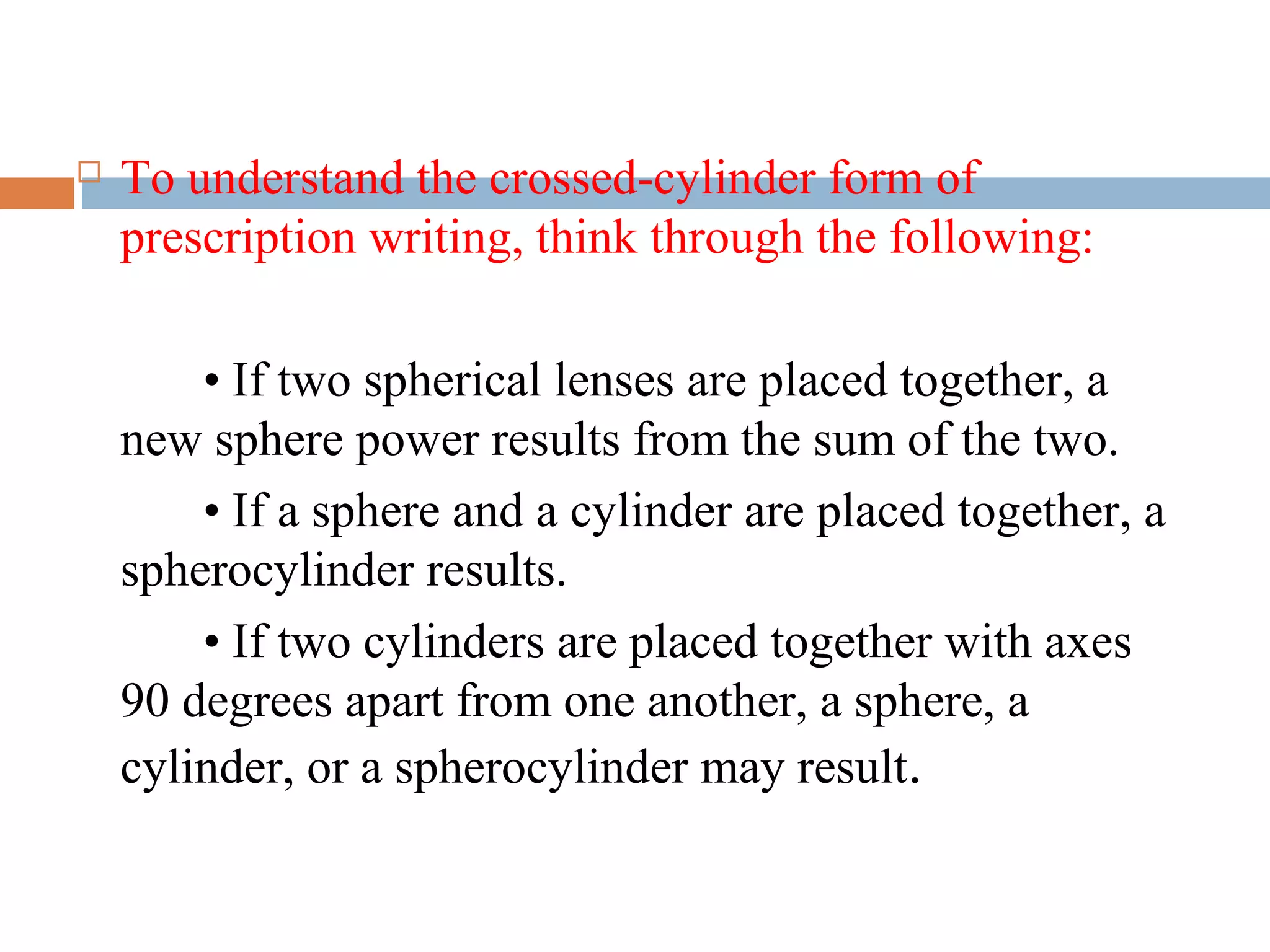
 To understand the crossed-cylinder form of
prescription writing, think through the following:
• If two spherical lenses are placed together, a
new sphere power results from the sum of the two.
• If a sphere and a cylinder are placed together, a
spherocylinder results.
• If two cylinders are placed together with axes
90 degrees apart from one another, a sphere, a
cylinder, or a spherocylinder may result.
An AlternAte Crossed-
Cylinder Form
 The normal way of writing a lens prescription
in crossed cylinder form is done just like
writing a plano cylinder.
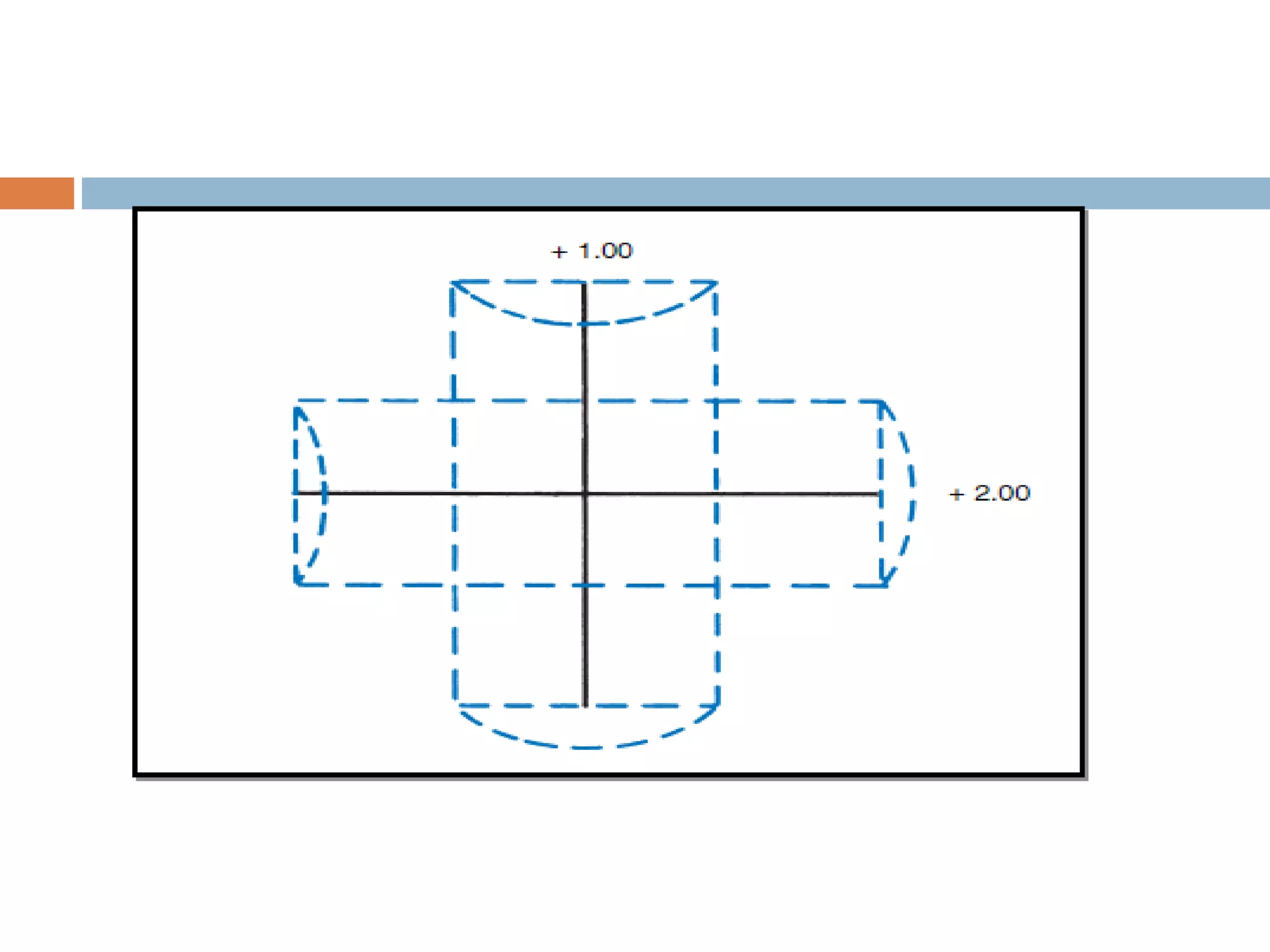
 When the +1.00 × 180 and +2.00 × 90 lenses
were placed together in the example just given,
the crossed-cylinder combination was written
as
+1.00 × 180/+2.00 × 90
 Suppose, for example, +1.00 × 180 and +2.00
× 90 lenses are placed together. These are both
cylinders and their axes are “crossed” in
relationship to one another.
 In abbreviated crossed-cylinder form this
reads
+1.00 × 180( )+2.00 × 90
 This form is seen in contact lens practice when
reading or writing the keratometer reading of
the front surface of the cornea.
 Of course the powers are considerably higher
and might look something like this:
+42.50 @ 90/+43.75 @ 180
Transposition

Transposition

  • 1.
  • 2.
    TRANSPOSITION  It impliestransfer of lens power from one form to another so as to their meridian values remain the same in both the forms.  It means rewrite the expressions of its power without actually changing them.
  • 3.
  • 4.
    SImPle TRANSPOSITION Three simplesteps 1.SUM :The new spherical surface is given by adding algebraically the power of the sphere and cylinder. 2.SIGN :Retain the power of the cylinder but change the sign. 3.AXIS:Rotate the axis of the cylinder through 90º
  • 5.
    SImPle TRANSPOSITION  +2.00DS /+1.00 DC 180º +3.00DS/-1.00DC 90º  -5.00DS/ -3.00 DC 90º -8.00DS/+3.00DC 180º
  • 6.
    SImPle TRANSPOSITION  +3.00DS/-1.50 DC 90º +1.50 DS /+1.50 DC180º  -4.00 DS /- 2.25 DC 70º -6.25 DS /+2.25 DC 160º
  • 7.
    SImPle TRANSPOSITION  +1.00DS /+0.25 DC 130º  -2.50 DS /-1.75 DC 40º  +6.00 DS / -2.75 DC 10º  -3.00 DC 120º
  • 8.
    TORIc TRANSPOSITION  Toricformula is written as fraction, the numerator and the denominator comprises both the base curve and the cylinder necessary to give the required combination.
  • 9.
     A toricastigmatic lens is made with one spherical surface and one toric surface .  The principal meridian of weaker power of the toric surface is known as the base curve of the lens.
  • 10.
    The sTeps ofToric TransposiTion 1.Transpose the given prescription to one having a cylinder of the same sign as the base curve which to be used. (SIMPLE Transposition ) 2.The spherical surface is given by subtracting the base power from the sphere in(1) .This is written as the numerator of the fraction.
  • 11.
    3.Fix the cylindricalbase curve with its axis at right angle to the cylinder in (1) 4. Add to the base curve the cylinder in (1) with its axis at right angles to that of the base curve
  • 12.
    Toric TransposiTion  Anexample +3.00 DS +1.00 DC 90º BC -6.00 1.Simple Transposition +4.00 DS /-1.00 DC 180º
  • 13.
    2. The sphericalsurface is given by subtracting the base power from the sphere in(1) .This is written as the numerator of the fraction +4.00 –(-6.00) =+10.00 DSph
  • 14.
    3. Fix thecylindrical base curve with its axis at right angle to the cylinder in (1) -6.00 DC 90º
  • 15.
    4. Add tothe base curve the cylinder in (1) with its axis at right angles to that of the base curve -6.00 +(-1.00) =-7.00 DC 180º +10.00 DSph/ -6.00 DC 90º -7.00 DC 180º
  • 16.
    Toric TransposiTion  +3.00DS /-1.00 DC 90º BC -6.00 +9.00 DSph / -6.00 DC 180º -7.00 DC 90º
  • 17.
     +3.00 DS/+2.00 DC 90º -3.00 DSph / +6.00 DC 180 +8.00 DC 90º
  • 18.
    Spherical equivalent (S.e) A spherocylinder lens will correct for astigmatism and myopia or hyperopia. If it was necessary to correct a nearsighted or farsighted person who also has astigmatism, but there were no cylinder lenses available, what would be the best correction using only a sphere lens?
  • 19.
    how to Findthe Spherical equivalent ? 1. Take half the value of the cylinder and 2. Add it to the sphere power.
  • 20.
     In otherwords, as a formula the spherical equivalent Spherical Equivalent = Sphere + (Cylinder)/2
  • 21.
     What isthe spherical equivalent for this lens? +3.00 − 1.00 × 180º spherical equivalent = +3.00 + (-1.00) /2 = +2.50D
  • 22.
     What isthe spherical equivalent for a lens having a power of −4.25 −1.50 × 135º ? S.E = -4.25 + (-1.50) /2 = -5.00 D
  • 23.
     +3.00 DS/-1.50 DC 85º  -2.50 DS / -2.50 DC 35º  +7.50 DS / +3.00 DC 10º  -6.75 DS / +2.50 DC 125º
  • 24.
    Crossed-Cylinder Form  Anotherpossible abbreviated form of prescription writing is the crossed-cylinder form.  This form is never used to write a prescription for spectacle lenses. However, an understanding of this form of prescription writing aids in a more complete understanding of lenses.
  • 25.
     The crossed-cylinderform of prescription writing is also the way that keratometer readings are written when measuring the front surface power of the cornea for contact lens purposes.
  • 26.
     To understandthe crossed-cylinder form of prescription writing, think through the following: • If two spherical lenses are placed together, a new sphere power results from the sum of the two. • If a sphere and a cylinder are placed together, a spherocylinder results. • If two cylinders are placed together with axes 90 degrees apart from one another, a sphere, a cylinder, or a spherocylinder may result.
  • 27.
    An AlternAte Crossed- CylinderForm  The normal way of writing a lens prescription in crossed cylinder form is done just like writing a plano cylinder.  When the +1.00 × 180 and +2.00 × 90 lenses were placed together in the example just given, the crossed-cylinder combination was written as +1.00 × 180/+2.00 × 90
  • 29.
     Suppose, forexample, +1.00 × 180 and +2.00 × 90 lenses are placed together. These are both cylinders and their axes are “crossed” in relationship to one another.  In abbreviated crossed-cylinder form this reads +1.00 × 180( )+2.00 × 90
  • 30.
     This formis seen in contact lens practice when reading or writing the keratometer reading of the front surface of the cornea.  Of course the powers are considerably higher and might look something like this: +42.50 @ 90/+43.75 @ 180