Transposition
To avoid falling into the trap of a literal 
translation (an exceedingly strict adherence to 
the source text’s composition and grammatical 
structure), which is justifiable only in some 
isolated cases, we generally use a variety of 
methods. These are almost always done 
automatically, without knowing which 
approach we are using or what it is called. One 
of these strategies, which is quite useful when 
we cannot find the perfect structure to match 
the original, is:
Transposition 
a style of translation 
This is the process where parts of speech change their 
sequence when they are translated. It is in a sense a shift 
of word class. Grammatical structures are often different 
in different languages. Transposition is often used 
between English and Spanish because of the preferred 
position of the verb in the sentence: English often has 
the verb near the beginning of a sentence; Spanish can 
have it closer to the end. This requires that the translator 
knows that it is possible to replace a word category in 
the target language without altering the meaning of the 
source text.
For example: 
In English Hand knitted (noun + 
participle) becomes in Spanish Tejido 
a mano (participle + adverbial phrase). 
"She likes swimming" translates as 
"Le gusta nadar" (not "nadando"). 
“El carro rojo” literally is “the car red” 
as opposed to the correct translation 
“the red car”.
Original in English: After he comes back. 
• Literal Spanish translation: Después de que él 
regrese. 
• Transposed Spanish translation: Después de su 
regreso. 
EQUIVALENCY: using a word whose meaning 
is a synonym of another word in the source.
 Working with you is a pleasure → Trabajar 
contigo… El trabajo contigo … 
 Tras su salida → after he’d gone out 
 There’s a reason for life → Hay una razón para 
vivir 
 with government support → apoyado por el 
gobierno 
 It’s getting dark → comienza a oscurecer
Techniques of transposition 
Transposition 
• Operates at the grammatical level 
• Consists of the replacement of a word class by another word 
class without changing the meaning. 
Within the same language: 
Reconstruction of the city is very important 
Reconstructing the city is very important 
To reconstruct the city is very important 
Tu enojo me tiene sin cuidado 
Que te enojes me tiene sin cuidado 
(Back-translation: I don’t care about your anger. 
I don’t care about your getting angry.) 
Enojo (noun) → enojes (verb)
Public servants should be held accountable for their 
management of public goods. → 
Debe responsabilizarse a los funcionarios públicos por 
el manejo de los bienes públicos. 
Tips 
• The use of the pronominal passive allows a rendition 
that does not indicate the subject of the sentence, like in 
the ST. 
• From a stylistic view point the transposed expression 
does not have the same value, but the meaning is the 
same. 
• Transposed expressions are generally more literary in 
character. 
• It is important to choose the form that best fits the 
context.
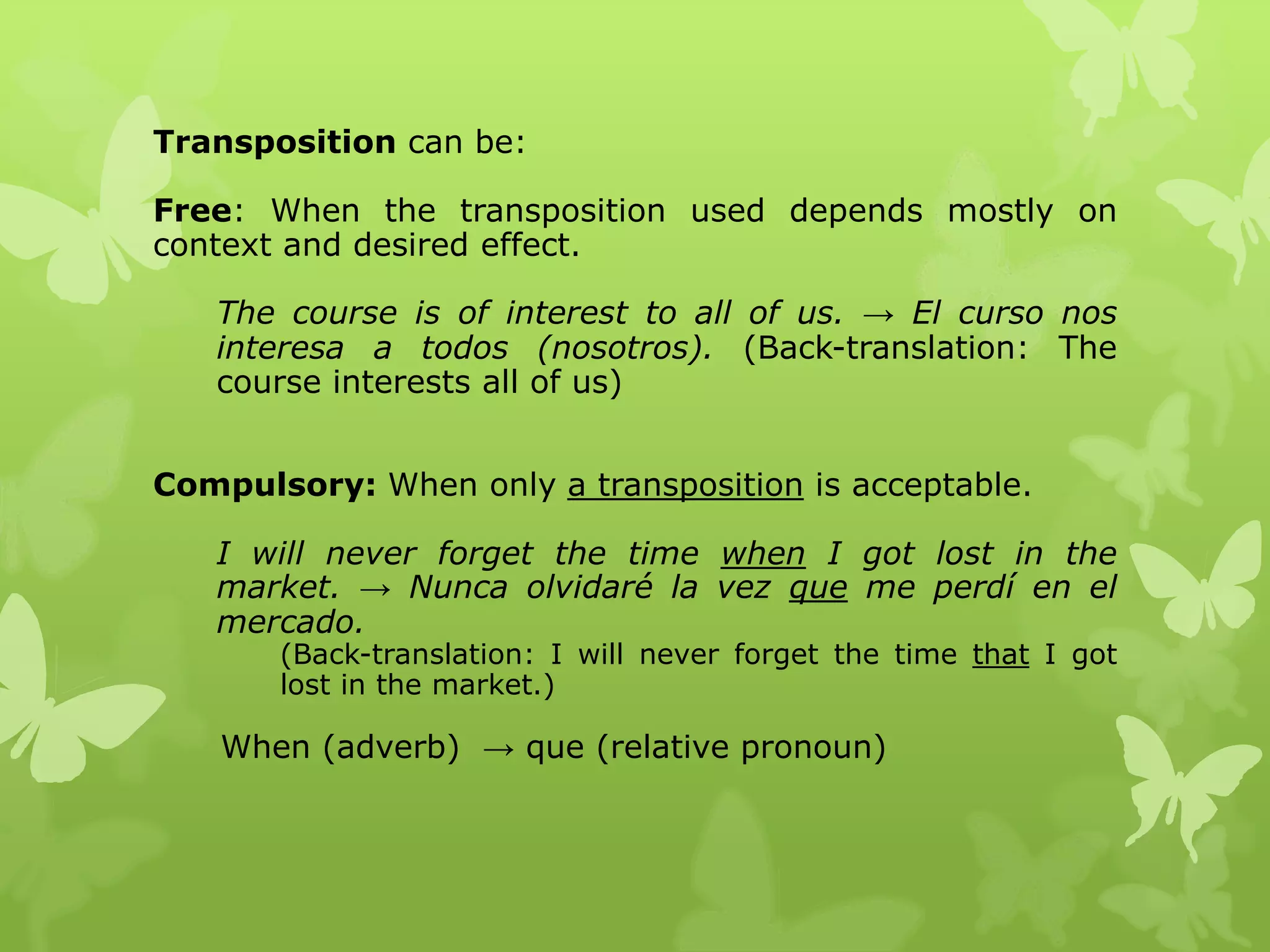
Transposition can be: 
Free: When the transposition used depends mostly on 
context and desired effect. 
The course is of interest to all of us. → El curso nos 
interesa a todos (nosotros). (Back-translation: The 
course interests all of us) 
Compulsory: When only a transposition is acceptable. 
I will never forget the time when I got lost in the 
market. → Nunca olvidaré la vez que me perdí en el 
mercado. 
(Back-translation: I will never forget the time that I got 
lost in the market.) 
When (adverb) → que (relative pronoun)
Types of transposition 
Adverb→ verb 
I only defended myself. → No hice sino defenderme 
(Back-translation → I did nothing but defend 
myself.) 
Adverb→ noun 
I wrote to you early this year. → Le escribí a 
principios de año. 
(Back-translation → I wrote to you at the beginning 
of the year) 
Adverb→ adjective 
He lives precariously → Lleva una vida precaria. 
(Back-translation → He leads a precarious life)
Adjective→ noun 
He found it difficult to arrange for the trip 
Tuvo dificultad en hacer los arreglos para el viaje 
(Back-translation → I had difficulty to make the 
arrangemets for the trip) 
Possessive adjective → definite article 
Your hair is too long→ Tienes el cabello muy largo 
(Back-translation → Your have the hair too long) 
Verb or past participle → noun 
I intended to tell you the whole truth. → Mi intención fue 
(era) decirle toda la verdad. 
(Back-translation → My intention was to tell you the whole 
truth.) 
Adverb → noun 
I wrote to you early this year. → Le escribí a principios de 
año. 
(Back-translation → wrote to you at the beginning of the 
year.)
 It is very important to understand that transposition means 
“replacing one word class with another without 
changing the meaning of the message”. 
 Transposition concerns the changes of grammatical categories 
in translation. This procedure is the most frequent device used by 
translators, since it offers a variety of possibilities that help 
avoiding the problem of untranslatability. 
 Besides, with this type of translation, misunderstanding and 
literary translations can be avoided. In this, the translator can 
interpret the content without changing the main idea from the 
original text; whereby, it is comfortable because of the person 
can use their own style to translate.
Transposition

Transposition

  • 1.
  • 2.
    To avoid fallinginto the trap of a literal translation (an exceedingly strict adherence to the source text’s composition and grammatical structure), which is justifiable only in some isolated cases, we generally use a variety of methods. These are almost always done automatically, without knowing which approach we are using or what it is called. One of these strategies, which is quite useful when we cannot find the perfect structure to match the original, is:
  • 3.
    Transposition a styleof translation This is the process where parts of speech change their sequence when they are translated. It is in a sense a shift of word class. Grammatical structures are often different in different languages. Transposition is often used between English and Spanish because of the preferred position of the verb in the sentence: English often has the verb near the beginning of a sentence; Spanish can have it closer to the end. This requires that the translator knows that it is possible to replace a word category in the target language without altering the meaning of the source text.
  • 4.
    For example: InEnglish Hand knitted (noun + participle) becomes in Spanish Tejido a mano (participle + adverbial phrase). "She likes swimming" translates as "Le gusta nadar" (not "nadando"). “El carro rojo” literally is “the car red” as opposed to the correct translation “the red car”.
  • 5.
    Original in English:After he comes back. • Literal Spanish translation: Después de que él regrese. • Transposed Spanish translation: Después de su regreso. EQUIVALENCY: using a word whose meaning is a synonym of another word in the source.
  • 6.
     Working withyou is a pleasure → Trabajar contigo… El trabajo contigo …  Tras su salida → after he’d gone out  There’s a reason for life → Hay una razón para vivir  with government support → apoyado por el gobierno  It’s getting dark → comienza a oscurecer
  • 7.
    Techniques of transposition Transposition • Operates at the grammatical level • Consists of the replacement of a word class by another word class without changing the meaning. Within the same language: Reconstruction of the city is very important Reconstructing the city is very important To reconstruct the city is very important Tu enojo me tiene sin cuidado Que te enojes me tiene sin cuidado (Back-translation: I don’t care about your anger. I don’t care about your getting angry.) Enojo (noun) → enojes (verb)
  • 8.
    Public servants shouldbe held accountable for their management of public goods. → Debe responsabilizarse a los funcionarios públicos por el manejo de los bienes públicos. Tips • The use of the pronominal passive allows a rendition that does not indicate the subject of the sentence, like in the ST. • From a stylistic view point the transposed expression does not have the same value, but the meaning is the same. • Transposed expressions are generally more literary in character. • It is important to choose the form that best fits the context.
  • 9.
    Transposition can be: Free: When the transposition used depends mostly on context and desired effect. The course is of interest to all of us. → El curso nos interesa a todos (nosotros). (Back-translation: The course interests all of us) Compulsory: When only a transposition is acceptable. I will never forget the time when I got lost in the market. → Nunca olvidaré la vez que me perdí en el mercado. (Back-translation: I will never forget the time that I got lost in the market.) When (adverb) → que (relative pronoun)
  • 10.
    Types of transposition Adverb→ verb I only defended myself. → No hice sino defenderme (Back-translation → I did nothing but defend myself.) Adverb→ noun I wrote to you early this year. → Le escribí a principios de año. (Back-translation → I wrote to you at the beginning of the year) Adverb→ adjective He lives precariously → Lleva una vida precaria. (Back-translation → He leads a precarious life)
  • 11.
    Adjective→ noun Hefound it difficult to arrange for the trip Tuvo dificultad en hacer los arreglos para el viaje (Back-translation → I had difficulty to make the arrangemets for the trip) Possessive adjective → definite article Your hair is too long→ Tienes el cabello muy largo (Back-translation → Your have the hair too long) Verb or past participle → noun I intended to tell you the whole truth. → Mi intención fue (era) decirle toda la verdad. (Back-translation → My intention was to tell you the whole truth.) Adverb → noun I wrote to you early this year. → Le escribí a principios de año. (Back-translation → wrote to you at the beginning of the year.)
  • 12.
     It isvery important to understand that transposition means “replacing one word class with another without changing the meaning of the message”.  Transposition concerns the changes of grammatical categories in translation. This procedure is the most frequent device used by translators, since it offers a variety of possibilities that help avoiding the problem of untranslatability.  Besides, with this type of translation, misunderstanding and literary translations can be avoided. In this, the translator can interpret the content without changing the main idea from the original text; whereby, it is comfortable because of the person can use their own style to translate.