VISUAL ACUITY:
* Visual Acuity is a measurement of the threshold of discrimination of two
spatially- separated targets (a function of the fovea centralis) is termed
visual acuity
* If two objects are so close that two adjacent cones are stimulated,
the patient would appreciate them as a single target.
(Threshold: more specifically, it is the smallest degree of intensity of a stimulus needed to detect that stimulus half of the time)
(In vision, the absolute threshold refers to the smallest level of light that a participant can detect)
Factors Affecting Visual Acuity: Visual acuity can be affected by various factors.
Refractive Errors:- Visual acuity suffers when image quality is degraded by focusing errors sucha as
myopia,hyperopia & astigmatism.
Aberrations:- Chromatic and monochromatic aberrations of the eye also contribute to reduction in visual
acuity.
Pupil size :- image degradation from aberrations increase as pupil size increases. Conversely if pupil
size is small diffraction tendsto reduce visual acuity.
Duration of Stimulus: -The longer the presentation of optotypes greater will be visual acuity.
Areaof RetinaStimulated :
* Due to the densely packed cones at the fovea, visual acuity is the greatest at the centre of fixation.
* At a distance of 5 minutes of arc from the centreof fixation, there is a measurable loss in visual acuity.
* At 10 minutes of arc (1/6 of a degree) from fixation, there is a 25 % loss of visual acuity and so on
Lighting Conditions ofthe Testing Room:-
* Background luminance.
* At high luminance,all cells are active for a high level of visual acuity.
* At low luminance's, only cells sensitive to that level of luminances are active thus low VA
④
COMPONENTS OF VISUAL ACUITY:
1. Minimum Detectable.
2. Minimum Separable
3. Vernier Acuity
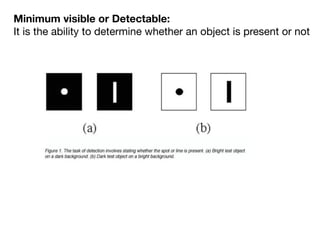
Minimum visible or Detectable:
It is the ability to determine whether an object is present or not
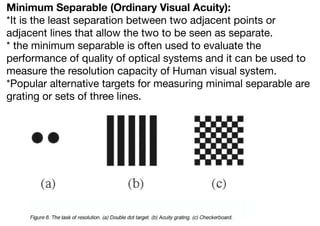
Minimum Separable (Ordinary Visual Acuity):
*It is the least separation between two adjacent points or
adjacent lines that allow the two to be seen as separate.
* the minimum separable is often used to evaluate the
performance of quality of optical systems and it can be used to
measure the resolution capacity of Human visual system.
*Popular alternative targets for measuring minimal separable are
grating or sets of three lines.
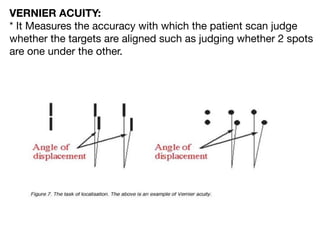
VERNIER ACUITY:
* It Measures the accuracy with which the patient scan judge
whether the targets are aligned such as judging whether 2 spots
are one under the other.
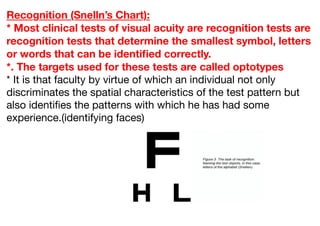
Recognition (Snelln’s Chart):
* Most clinical tests of visual acuity are recognition tests are
recognition tests that determine the smallest symbol, letters
or words that can be identified correctly.
*. The targets used for these tests are called optotypes
* It is that faculty by virtue of which an individual not only
discriminates the spatial characteristics of the test pattern but
also identifies the patterns with which he has had some
experience.(identifying faces)
VISUAL PERCEPTIONS:
Sensations which result from stimulation of the retina by light
are of four kinds
1. The light sense
2. Form sense
3. Sense of contrast
4. Colour sense.
THE LIGHT SENSE:
* It is awareness of the light.
* The minimum brightness required to evoke a sensation of
light is called the light minimum.
* It should be measured when the eye is dark adapted for at
least 20- 30 minutes.
The process of visual adaptation primarily involves.
Dark adaptation (adjustment in dim illumination)
(When one goes from bright sunshine into a dimly-lit room).
Light adaptation (adjustment to bright illumination
(When one passes suddenly from a dim to a brightly lighted
environment).
THE FORM SENSE:
• It is the ability to discriminate between the shapes of the objects.
• Cones play a major role in this faculty.
• Therefore, form sense is most acute at the fovea, where there are maximum
number of cones and decreases very rapidly towards the periphery.
• Visual acuity recorded by Snellen's test chart is a measure of the form sense.
• (Thus, the form sense is not purely a retinal function, as, the perception of its
composite form (e.g.letters) is largely psychological.)
SENSE OF CONTRAST:
* It is the ability of the eye to perceive slight changes in the luminance
between regions which are not separated by definite borders.
* Loss of contrast sensitivity results in mild fogginess of the vision.
COLOUR SENSE:
* It is the ability of the eye to discriminate between
different colours excited by light of different wavelengths.
Why intra Conel Distance?
• Visual acuity is a measure of the spatial resolution of the eye or, in other
words, an estimation of its ability to discriminate between two points.
• If two objects are so close that two adjacent cones are stimulated, the
patient would appreciate them as a single target.
• Therefore, there must be an un-stimulated cone between stimulated
Cones to allow for the resolution of two targets or edges.
• The spacing between cones determines the resolution with which the
retinal image can be sampled.
• Foveal cones are separated by 2 µm , corresponding to a visual angle of
25 seconds of arc.
• The acuity of distant central vision is commonly tested by means of
visual acuity test-types
⑤
± it
1
It 1
( '
±
.
it
5miAC
VISUAL
ACUITY
MEASURMENT
Visual Acuity Notation:
There are several ways in which clinicians record visual acuity. These are
given as the following terms-
Snellen Fraction: in Snellen Notation the number used to indicate the height of the distance at which the letter
height subtends 5 minute of arc. That is 6m letter is one that subtends 5 minute of arc. The Snellen fraction is written
with the test distance as numerator and letter size as denominator.
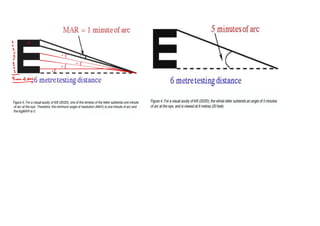
Visual acuity= Test Distance/Distance at which letter subtends 5 minutes of arc.
Visual acuity score of 6/60 means test distance was 6m & smallest letter that could be read would subtend 5 min of
arc with a distance of 60m
Decimal Acuity:-
1.The decimal acuity effectively reduces Snellen fraction to decimalised quantity. Thus 6/6 becomes 1, 6/12
becomes 0.5 so on.
2. Decimal acuity is seldom used clinically; it gives a single number quantify an angle and it does not indicate the
test distance
Minimum angle of Resolution: The MAR Value is typically expressed in minutes of arc and it indicates angular size
of the critical detail within the just resolvable optotype. For a visual acuity of 6/6, the MAR value = 1 min of arc. For
6/6 MAR =10 min of arc
Logarithms of the minimum angle of Resolution:
1. The logarithm of the MAR (logMAR) (Bailey & Lovie, 1976) is the common logarithm of MAR.
2. When visual acuity is 6/6 MAR value is =1 min of arc, so the logMAR =log10(2.0) = 0.30.
3. When the visual acuity is better is better than 6/6, the log MAR value becomes negative.
4. For example for 20/16 (or 6/4.8)m, MAR =0.8min of arc and log10 (0.8) =-0.10
⑤
Clinical Testing of Visual Acuity
Chart illumination:
1. illumination for visual acuity testing as well as for other examination procedures can be
considered in terms of illuminance.
2. It is recommended that illuminance levels of minimum 12-20 (130-215 lux) foot candles.
3. It’s necessary to consider not only luminance of visual acuity charts but also their overall room
illumination.
Testing Distance:
1. Generally calibrated for a viewing distance of six meters, requiring the consulting room to be
designed accordingly.
2. With Projector display the test distance is usually chosen according to spatial constraints of the
examination room.
3. For room shorter than 6 m mirrors are used in both projection and observation paths to achieve
longer testing distance
Testing Procedures:
1.The measurement of visual acuity should be the first test (following the history) administered to all
patients, no matter what the chief complaint is
2. An important reason is that patient may later allege the examination procedures caused the loss of
vision which in fact was preexisting.
3. Another Reason is that some procedures (such as tonometry, Gonioscopy) will involve touching of
cornea and may cause reduction in visual acuity.
4.Moreover, the bright light of ophthalmoscope may dazzle the patient & cause temporary loss of
vision.
④
VISUAL ACUITY:
1. It is a measure of smallest retinal image which can be appreciated.
2.It tests the form sense.
Snellen’s Test Type:
1. Snellen’s chart consists of a series of letters arranged in lines each diminishing in size.
The lines from above downwards should be read at 60, 36, 24, 18, 12, 9, 6, 5 m, respectively.
2. At these distances the letters subtend a visual angle of 5' at the nodal point. It is kept at a
distance of 6 m so that the rays of light are parallel for practical purpose.
3. The minimum illumination of the test type accepted for satisfactory vision should be 15-20 foot
candles.
TESTING OF VISUAL ACUITY:
*. Visual acuity should be tested in all cases, as it may be affected in
numerous ocular disorders.
*. In real sense acuity of vision is a retinal function (to be more precise of the
macular area) concerned with the appreciation of form sense.
*. Distant and near visual acuity should be tested separately.
Recording of Visual Acuity for Distance
1. Each eye is tested separately.
2. A normal person can read all the lines, i.e. up to 6 m line.
3. Thus the normal visual acuity is = 6/6.
4. When the patient can only read the 18 m line, his distant vision is defective = 6/18
5.After that we need to check the PIN HOLE vision for knowing the further vision Improvement of that particular eye.
5. When the patient cannot read the largest letter, he is asked to walk slowly towards the chart.
6. If he can read the top most letter at 5, 4, 3 or 2 meters, his visual acuity = 5/60, 4/60, 3/60, 2/60 respectively.
COUNTING FINGERS:
1. If the patient is unable to see the TOP LETTER when close to it, he is asked to count the Examiners fingers held at 1 m
against a dark background. If he can count the fingers, the visual acuity = 1/60.
2. If he can count fingers only at 50 cm, the visual acuity = counting fingers at 50 cm(CF 50 Cms).
CLOSE TO FACE COUNTING FINGERS:
1. If the patient can count fingers at close to face than the patients vision written as = CFCF
HAND MOVEMENT:
1. If he cannot count fingers, the Examiner hand is moved in front of the eyes if he identified the Hand movement written as
HM+
PERCEPTION OF LIGHT &PROJECTION OF RAYS:
1. If the patient cannot identified Hand movement we need to check light perception.
2. In a dark room, light is concentrated on his eyes.
3. He is asked to say when the light is on the eye or when it is off.
4. If he tells correctly, the visual acuity = PL+ (perception of light).
PROJECTION OF RAYS:
1. If he gives correct indication to the light , than we need to out the direction(Nasal, Temporal, superior and inferior) from
where the light is coming. Writing as: PL+ PR X
NO PERCEPTON OF LIGHT:
If he fails to see the light, Than there is a indication of Blind. Written as = NO PL(no perception of light)
VISUAL ACUITY MEASUREMENT PROCEDURE
Other Test Types
1. Landolt’s chart—‘C’ type—It is used for illiterate persons. 2. E
chart—It is used for illiterate persons.
3. Simple picture chart—It is used for children.
2. Recording of Visual Acuity for Near
The patient reads Snellen’s test type for reading or printer’s types
(N series) at a distance of about 25 cm in good illumination. The
normal vision is recorded as N/6.
Visual Acuity.pdf

Visual Acuity.pdf

  • 3.
    VISUAL ACUITY: * VisualAcuity is a measurement of the threshold of discrimination of two spatially- separated targets (a function of the fovea centralis) is termed visual acuity * If two objects are so close that two adjacent cones are stimulated, the patient would appreciate them as a single target. (Threshold: more specifically, it is the smallest degree of intensity of a stimulus needed to detect that stimulus half of the time) (In vision, the absolute threshold refers to the smallest level of light that a participant can detect)
  • 4.
    Factors Affecting VisualAcuity: Visual acuity can be affected by various factors. Refractive Errors:- Visual acuity suffers when image quality is degraded by focusing errors sucha as myopia,hyperopia & astigmatism. Aberrations:- Chromatic and monochromatic aberrations of the eye also contribute to reduction in visual acuity. Pupil size :- image degradation from aberrations increase as pupil size increases. Conversely if pupil size is small diffraction tendsto reduce visual acuity. Duration of Stimulus: -The longer the presentation of optotypes greater will be visual acuity. Areaof RetinaStimulated : * Due to the densely packed cones at the fovea, visual acuity is the greatest at the centre of fixation. * At a distance of 5 minutes of arc from the centreof fixation, there is a measurable loss in visual acuity. * At 10 minutes of arc (1/6 of a degree) from fixation, there is a 25 % loss of visual acuity and so on Lighting Conditions ofthe Testing Room:- * Background luminance. * At high luminance,all cells are active for a high level of visual acuity. * At low luminance's, only cells sensitive to that level of luminances are active thus low VA ④
  • 5.
    COMPONENTS OF VISUALACUITY: 1. Minimum Detectable. 2. Minimum Separable 3. Vernier Acuity
  • 6.
    Minimum visible orDetectable: It is the ability to determine whether an object is present or not
  • 7.
    Minimum Separable (OrdinaryVisual Acuity): *It is the least separation between two adjacent points or adjacent lines that allow the two to be seen as separate. * the minimum separable is often used to evaluate the performance of quality of optical systems and it can be used to measure the resolution capacity of Human visual system. *Popular alternative targets for measuring minimal separable are grating or sets of three lines.
  • 8.
    VERNIER ACUITY: * ItMeasures the accuracy with which the patient scan judge whether the targets are aligned such as judging whether 2 spots are one under the other.
  • 9.
    Recognition (Snelln’s Chart): *Most clinical tests of visual acuity are recognition tests are recognition tests that determine the smallest symbol, letters or words that can be identified correctly. *. The targets used for these tests are called optotypes * It is that faculty by virtue of which an individual not only discriminates the spatial characteristics of the test pattern but also identifies the patterns with which he has had some experience.(identifying faces)
  • 10.
    VISUAL PERCEPTIONS: Sensations whichresult from stimulation of the retina by light are of four kinds 1. The light sense 2. Form sense 3. Sense of contrast 4. Colour sense.
  • 11.
    THE LIGHT SENSE: *It is awareness of the light. * The minimum brightness required to evoke a sensation of light is called the light minimum. * It should be measured when the eye is dark adapted for at least 20- 30 minutes. The process of visual adaptation primarily involves. Dark adaptation (adjustment in dim illumination) (When one goes from bright sunshine into a dimly-lit room). Light adaptation (adjustment to bright illumination (When one passes suddenly from a dim to a brightly lighted environment).
  • 12.
    THE FORM SENSE: •It is the ability to discriminate between the shapes of the objects. • Cones play a major role in this faculty. • Therefore, form sense is most acute at the fovea, where there are maximum number of cones and decreases very rapidly towards the periphery. • Visual acuity recorded by Snellen's test chart is a measure of the form sense. • (Thus, the form sense is not purely a retinal function, as, the perception of its composite form (e.g.letters) is largely psychological.)
  • 13.
    SENSE OF CONTRAST: *It is the ability of the eye to perceive slight changes in the luminance between regions which are not separated by definite borders. * Loss of contrast sensitivity results in mild fogginess of the vision. COLOUR SENSE: * It is the ability of the eye to discriminate between different colours excited by light of different wavelengths.
  • 14.
    Why intra ConelDistance? • Visual acuity is a measure of the spatial resolution of the eye or, in other words, an estimation of its ability to discriminate between two points. • If two objects are so close that two adjacent cones are stimulated, the patient would appreciate them as a single target. • Therefore, there must be an un-stimulated cone between stimulated Cones to allow for the resolution of two targets or edges. • The spacing between cones determines the resolution with which the retinal image can be sampled. • Foveal cones are separated by 2 µm , corresponding to a visual angle of 25 seconds of arc. • The acuity of distant central vision is commonly tested by means of visual acuity test-types ⑤
  • 15.
    ± it 1 It 1 (' ± . it 5miAC
  • 16.
  • 17.
    Visual Acuity Notation: Thereare several ways in which clinicians record visual acuity. These are given as the following terms- Snellen Fraction: in Snellen Notation the number used to indicate the height of the distance at which the letter height subtends 5 minute of arc. That is 6m letter is one that subtends 5 minute of arc. The Snellen fraction is written with the test distance as numerator and letter size as denominator. Visual acuity= Test Distance/Distance at which letter subtends 5 minutes of arc. Visual acuity score of 6/60 means test distance was 6m & smallest letter that could be read would subtend 5 min of arc with a distance of 60m Decimal Acuity:- 1.The decimal acuity effectively reduces Snellen fraction to decimalised quantity. Thus 6/6 becomes 1, 6/12 becomes 0.5 so on. 2. Decimal acuity is seldom used clinically; it gives a single number quantify an angle and it does not indicate the test distance Minimum angle of Resolution: The MAR Value is typically expressed in minutes of arc and it indicates angular size of the critical detail within the just resolvable optotype. For a visual acuity of 6/6, the MAR value = 1 min of arc. For 6/6 MAR =10 min of arc Logarithms of the minimum angle of Resolution: 1. The logarithm of the MAR (logMAR) (Bailey & Lovie, 1976) is the common logarithm of MAR. 2. When visual acuity is 6/6 MAR value is =1 min of arc, so the logMAR =log10(2.0) = 0.30. 3. When the visual acuity is better is better than 6/6, the log MAR value becomes negative. 4. For example for 20/16 (or 6/4.8)m, MAR =0.8min of arc and log10 (0.8) =-0.10 ⑤
  • 18.
    Clinical Testing ofVisual Acuity Chart illumination: 1. illumination for visual acuity testing as well as for other examination procedures can be considered in terms of illuminance. 2. It is recommended that illuminance levels of minimum 12-20 (130-215 lux) foot candles. 3. It’s necessary to consider not only luminance of visual acuity charts but also their overall room illumination. Testing Distance: 1. Generally calibrated for a viewing distance of six meters, requiring the consulting room to be designed accordingly. 2. With Projector display the test distance is usually chosen according to spatial constraints of the examination room. 3. For room shorter than 6 m mirrors are used in both projection and observation paths to achieve longer testing distance Testing Procedures: 1.The measurement of visual acuity should be the first test (following the history) administered to all patients, no matter what the chief complaint is 2. An important reason is that patient may later allege the examination procedures caused the loss of vision which in fact was preexisting. 3. Another Reason is that some procedures (such as tonometry, Gonioscopy) will involve touching of cornea and may cause reduction in visual acuity. 4.Moreover, the bright light of ophthalmoscope may dazzle the patient & cause temporary loss of vision. ④
  • 19.
    VISUAL ACUITY: 1. Itis a measure of smallest retinal image which can be appreciated. 2.It tests the form sense. Snellen’s Test Type: 1. Snellen’s chart consists of a series of letters arranged in lines each diminishing in size. The lines from above downwards should be read at 60, 36, 24, 18, 12, 9, 6, 5 m, respectively. 2. At these distances the letters subtend a visual angle of 5' at the nodal point. It is kept at a distance of 6 m so that the rays of light are parallel for practical purpose. 3. The minimum illumination of the test type accepted for satisfactory vision should be 15-20 foot candles. TESTING OF VISUAL ACUITY: *. Visual acuity should be tested in all cases, as it may be affected in numerous ocular disorders. *. In real sense acuity of vision is a retinal function (to be more precise of the macular area) concerned with the appreciation of form sense. *. Distant and near visual acuity should be tested separately.
  • 20.
    Recording of VisualAcuity for Distance 1. Each eye is tested separately. 2. A normal person can read all the lines, i.e. up to 6 m line. 3. Thus the normal visual acuity is = 6/6. 4. When the patient can only read the 18 m line, his distant vision is defective = 6/18 5.After that we need to check the PIN HOLE vision for knowing the further vision Improvement of that particular eye. 5. When the patient cannot read the largest letter, he is asked to walk slowly towards the chart. 6. If he can read the top most letter at 5, 4, 3 or 2 meters, his visual acuity = 5/60, 4/60, 3/60, 2/60 respectively. COUNTING FINGERS: 1. If the patient is unable to see the TOP LETTER when close to it, he is asked to count the Examiners fingers held at 1 m against a dark background. If he can count the fingers, the visual acuity = 1/60. 2. If he can count fingers only at 50 cm, the visual acuity = counting fingers at 50 cm(CF 50 Cms). CLOSE TO FACE COUNTING FINGERS: 1. If the patient can count fingers at close to face than the patients vision written as = CFCF HAND MOVEMENT: 1. If he cannot count fingers, the Examiner hand is moved in front of the eyes if he identified the Hand movement written as HM+ PERCEPTION OF LIGHT &PROJECTION OF RAYS: 1. If the patient cannot identified Hand movement we need to check light perception. 2. In a dark room, light is concentrated on his eyes. 3. He is asked to say when the light is on the eye or when it is off. 4. If he tells correctly, the visual acuity = PL+ (perception of light). PROJECTION OF RAYS: 1. If he gives correct indication to the light , than we need to out the direction(Nasal, Temporal, superior and inferior) from where the light is coming. Writing as: PL+ PR X NO PERCEPTON OF LIGHT: If he fails to see the light, Than there is a indication of Blind. Written as = NO PL(no perception of light) VISUAL ACUITY MEASUREMENT PROCEDURE
  • 21.
    Other Test Types 1.Landolt’s chart—‘C’ type—It is used for illiterate persons. 2. E chart—It is used for illiterate persons. 3. Simple picture chart—It is used for children. 2. Recording of Visual Acuity for Near The patient reads Snellen’s test type for reading or printer’s types (N series) at a distance of about 25 cm in good illumination. The normal vision is recorded as N/6.