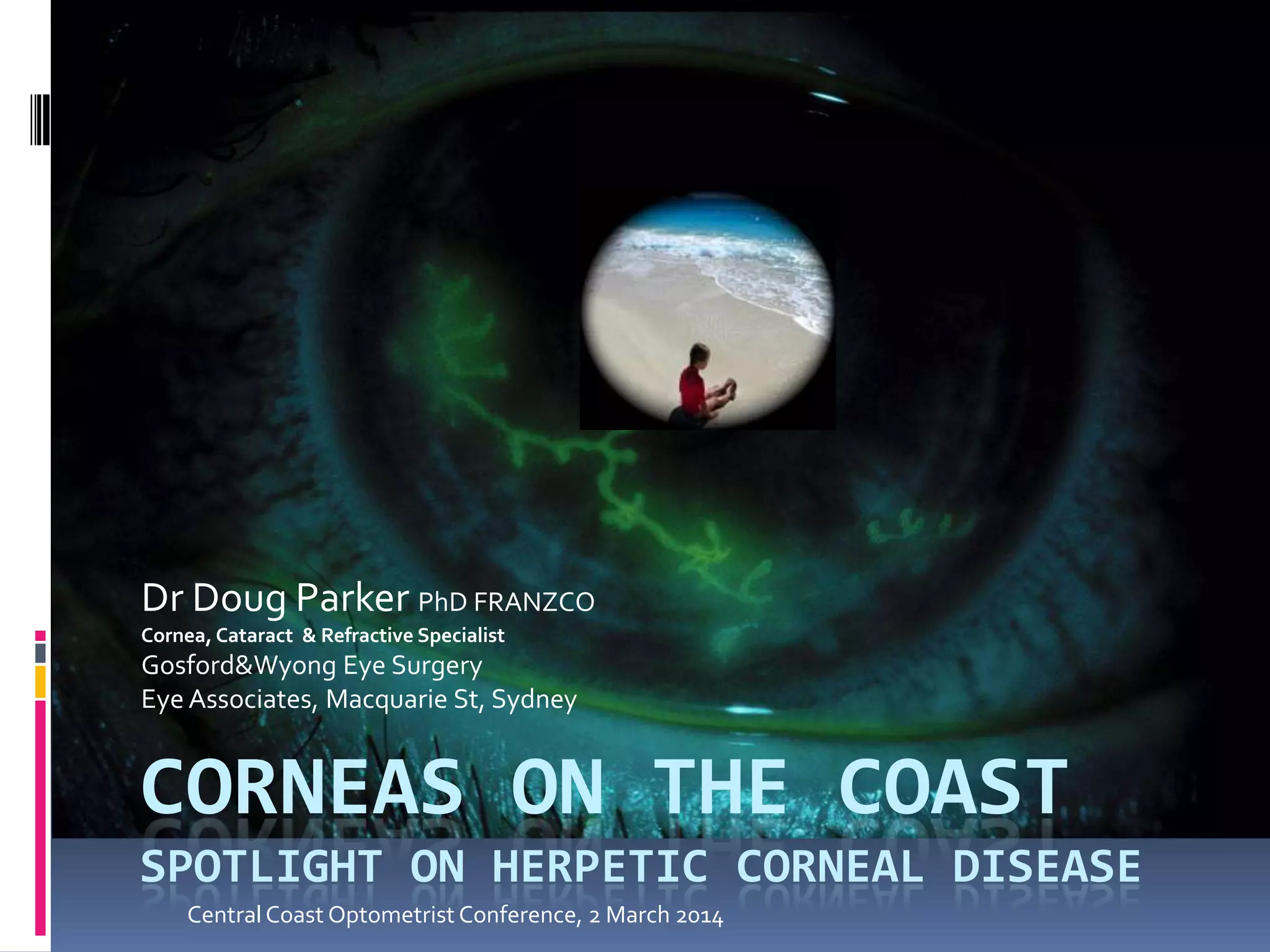
CORNEAS ON THE COAST
SPOTLIGHT ON HERPETIC CORNEAL DISEASE
Dr Doug Parker PhD FRANZCO
Cornea, Cataract & Refractive Specialist
Gosford&Wyong Eye Surgery
Eye Associates, Macquarie St, Sydney
CentralCoast Optometrist Conference, 2 March 2014
Outline
 Herpetic corneal disease
 HSV vVZV
 Diagnosis
 Treatment
 Prophylaxis
 MCQs
 Acknowledgements
 Professor John Dart, Moorfields Eye Hospital, London
 www.aao.org/medialibrary
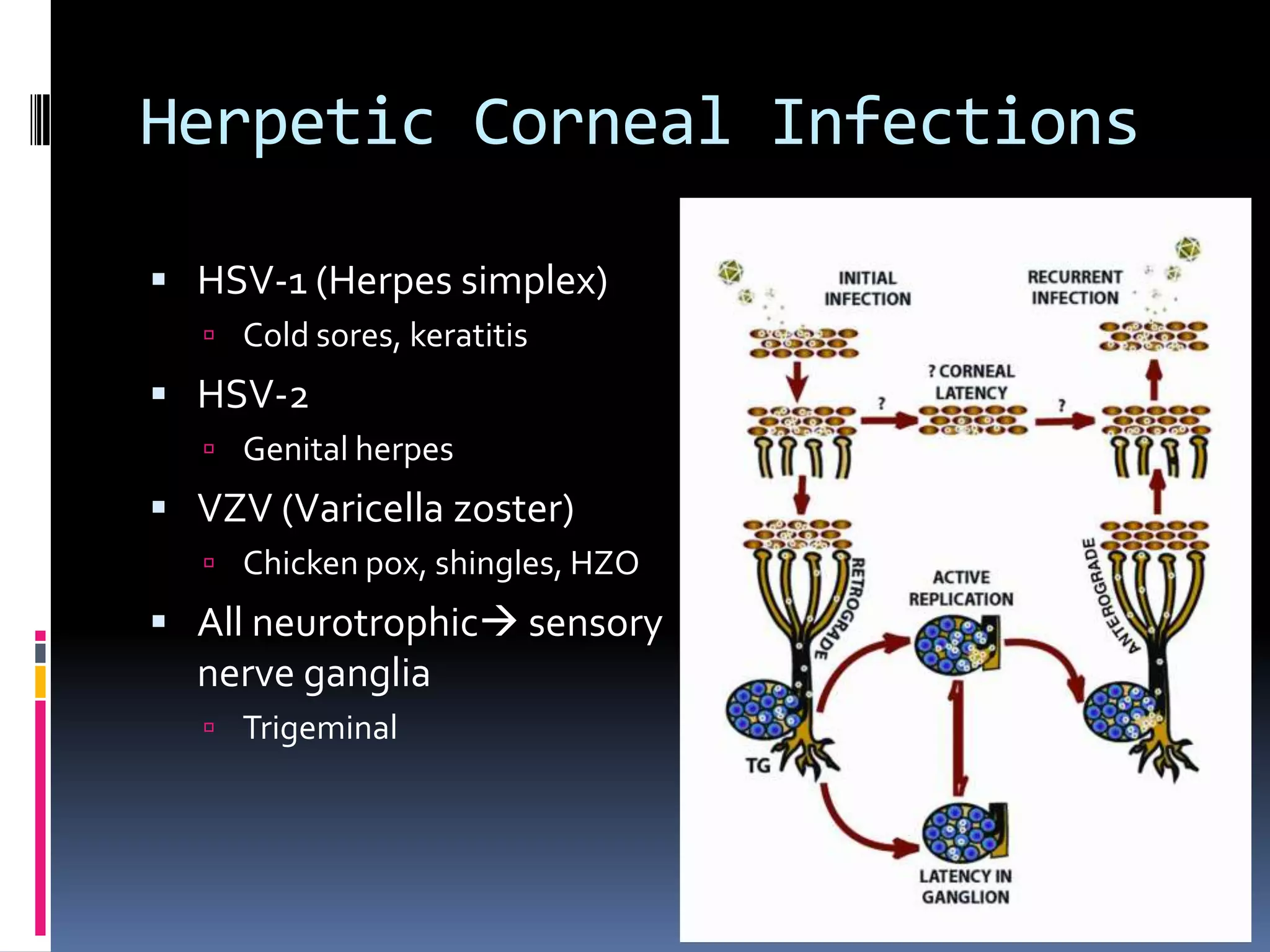
Herpetic Corneal Infections
 HSV-1 (Herpes simplex)
 Cold sores, keratitis
 HSV-2
 Genital herpes
 VZV (Varicella zoster)
 Chicken pox, shingles, HZO
 All neurotrophic sensory
nerve ganglia
 Trigeminal
Herpes Simplex Keratitis
 Primary HSV infection by
direct contact
 May get a
blepharoconjunctivitis
(follicular)
 Latency
 Utilises cellular enzymes for
replication  host cell death
 Loss of ganglion cells 
reduced corneal sensation
 Basic forms:
 Epithelial
 Stromal
 Endothelial
Herpes Simplex Keratitis
 Challenges:
 Making the diagnosis
 Recognising recurrences and judging
activity
 Treatment and prophylaxis
 Epithelial keratitis
 Actively replicating virus
 Dendritic ulcer  may leave a ghost
dendrite
 Geographic ulcer
 Marginal keratitis
 Metaherpetic (trophic) ulcer
Herpes Simplex Keratitis
 Stromal and endothelial keratitis
 Immune-mediated response to non-replicating virus (severe
forms may be live)
 Focal, multifocal or diffuse stromal opacities
 May be associated oedema and AC reaction
 With new vessels  “interstitial keratitis”
 May leak lipid
 Necrotisingkeratitis
 Due to live particles (multiple recurrences, HSV-2)
 Must be distinguished from microbial keratitis
 May cause melting and perforation
 Associated uveitis and trabeculitis glaucoma
 Localised endothelial dysfunction  “disciformkeratitis”
 Pseudoguttae and Descemet’s membrane folds
 Keratouveitis
 Immune-mediated
 Synechiae, cataracts
and glaucoma
Herpes Simplex Keratitis
 Diagnosis
 Clinical
 Lab tests (no use in stromalkeratitis)
 Culture, PCR, serology
 Differential: AK, RCES, healed ED in OSD, HZ
 Long-term complications
 Recurrence  inflammation and scarring
 Reduced sensation
 A sensitive sign of previous HSK
 Poor tear production, decreased growth factors
 Leads to persistent epithelial defects and neurotrophic
ulcers
Triggers for recurrence of HSK
Ophthalmic Systemic
 Contact lens wear
 Eye injury
 Corneal grafting
 Laser eye surgery
 Cataract surgery
 Intravitreal injections
 Topical prostaglandin
analogs
 Stress
 Systemic infection/fever
 Sunlight exposure
 Menstruation
 Genetic factors
Herpes Simplex Keratitis
 Treatment
 Herpetic Eye Disease Study (HEDS)
 Epithelial disease
 Debridement (also use for PCR or culture)
 Monotherapy with topical antiviral (Aciclovir,
Ganciclovir,Trifluridine)
 No added benefit of oral antiviral but may be useful
in kids or allergic patients
 Normal dendrites heal in 1-3 weeks
 If not  think toxicity, resistance or wrong diagnosis!
Herpes Simplex Keratitis
 Treatment
 Stromal disease
 Mainstay is topical steroids
 Shorten duration of disciform and non-necrotisingstromal disease
 Dosing based on severity of inflammation
 Taper to prevent rebound
 Always under antiviral cover
 Simultaneous oral antiviral prophylaxis reduces risk of HSV
reactivation at ganglion level
 Prophylaxis
 Topical antivirals are toxic with prolonged use
 Systemic aciclovir reduces recurrence of stromalkeratitis by 50%
(HEDS-APT)
 Aciclovir 400 mg bd
 Can also useValaciclovir 500 mg bd, or Famciclovir 250 mg bd
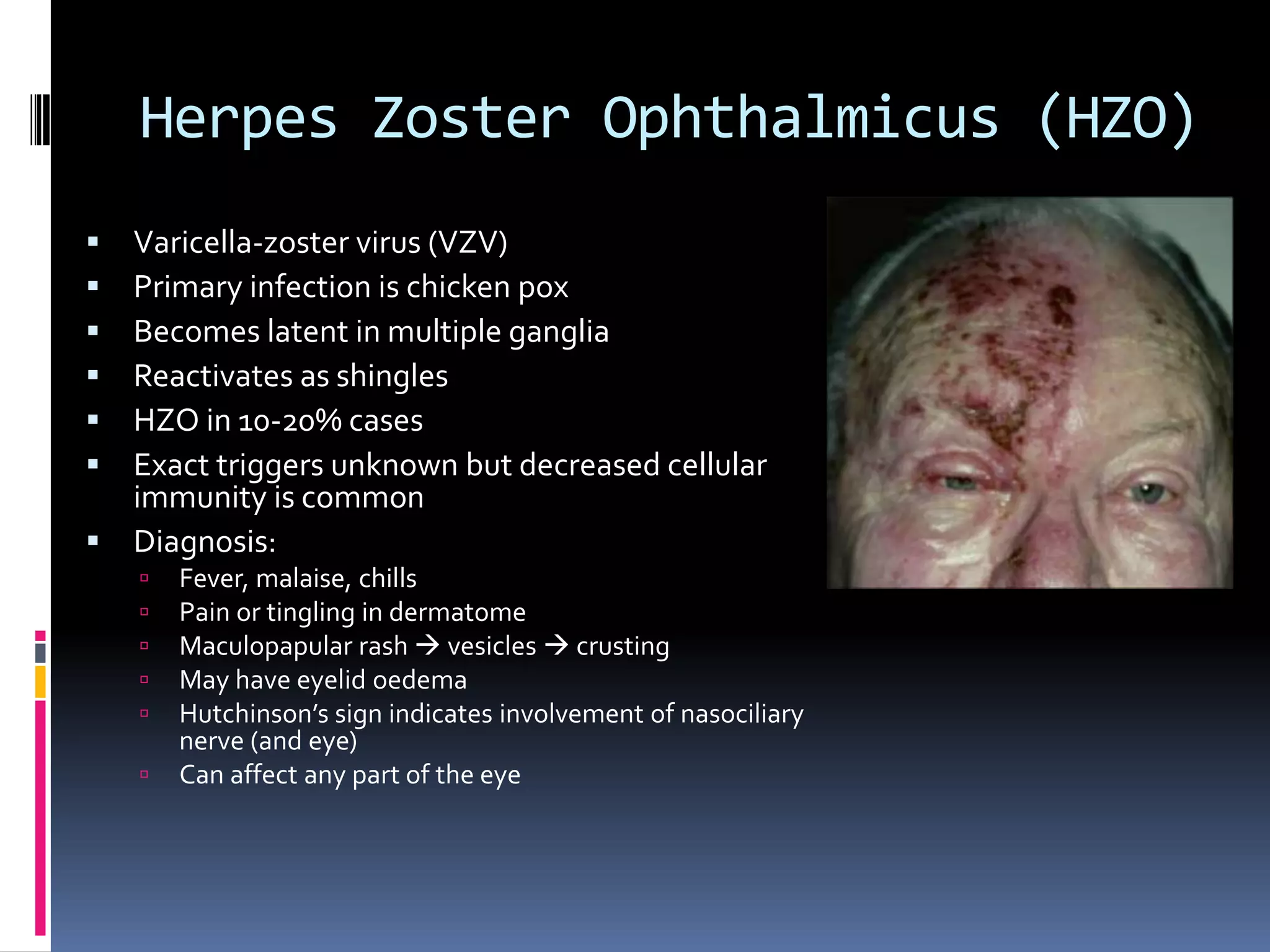
Herpes Zoster Ophthalmicus (HZO)
 Varicella-zoster virus (VZV)
 Primary infection is chicken pox
 Becomes latent in multiple ganglia
 Reactivates as shingles
 HZO in 10-20% cases
 Exact triggers unknown but decreased cellular
immunity is common
 Diagnosis:
 Fever, malaise, chills
 Pain or tingling in dermatome
 Maculopapular rash  vesicles  crusting
 May have eyelid oedema
 Hutchinson’s sign indicates involvement of nasociliary
nerve (and eye)
 Can affect any part of the eye
Herpes Zoster Ophthalmicus
 Acute keratitis
 May occur up to 1 month after rash starts
 Punctatekeratitis and pseudodendrites (lack terminal
bulbs)
 Does not respond to topical antivirals
 Nummular keratitis (coin-shaped lesions) are an
immune-mediated stromal reaction to antigen
 Recurrent keratitis
 Mucous plaques
 Disciformkeratitis (as seen in HSK)
 Interstitial keratitis with lipid exudation
 Long-term complications
 Profound loss of corneal sensation neurotrophic
ulcer
 Smoldering stromalkeratitis (haze, scarring, reduced
vision)
 Neuralgia (PHN)
Herpes Zoster Ophthalmicus
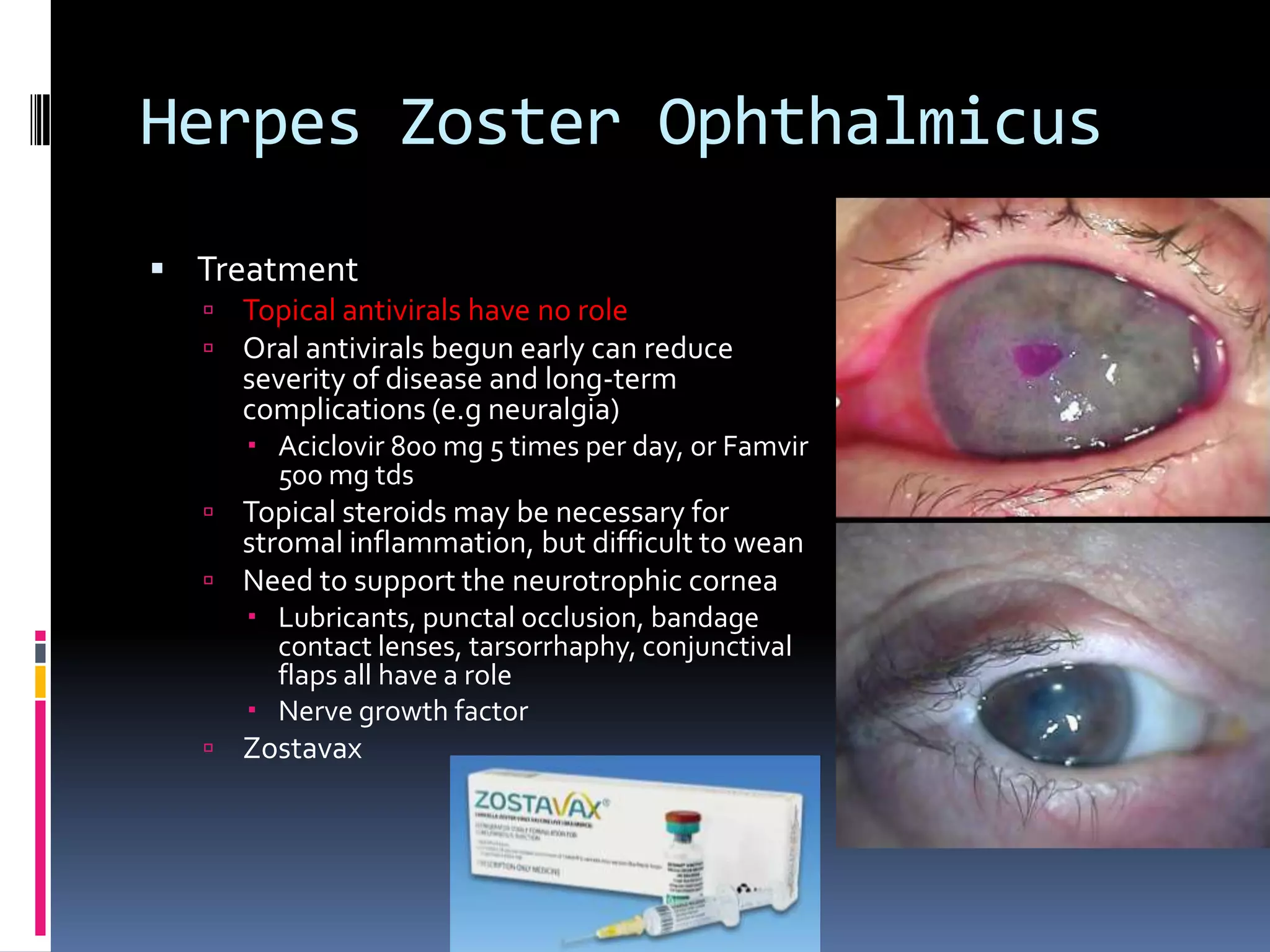
 Treatment
 Topical antivirals have no role
 Oral antivirals begun early can reduce
severity of disease and long-term
complications (e.g neuralgia)
 Aciclovir 800 mg 5 times per day, or Famvir
500 mg tds
 Topical steroids may be necessary for
stromal inflammation, but difficult to wean
 Need to support the neurotrophic cornea
 Lubricants, punctal occlusion, bandage
contact lenses, tarsorrhaphy, conjunctival
flaps all have a role
 Nerve growth factor
 Zostavax
Herpetic corneal disease
 Key points
 HSV andVZV cause distinctive clinical pictures
 Each layer of the cornea may be affected with
different manifestations
 Never start topical steroid in suspected herpes
simplex keratitis without antiviral cover
 Reduced corneal sensation can be a useful sign of
previous disease
 Protect the neurotrophic cornea
MCQ #1
 Which of the following is a sensitive sign of
previous herpetic keratitis?
A. Prominent corneal nerves
B. Descemet’s membrane folds
C. Reduced corneal sensation
D. Corneal vascularisation
MCQ #2
 Herpes simplex keratitis and herpes zoster
ophthalmicus have the following in common,
except:
A. They are both caused by a double-stranded DNA
virus
B. There is a role for topical antiviral treatment in
both cases
C. Both can lead to neurotrophic ulceration
D. There is a role for topical steroid in certain cases
of both conditions
MCQ #3
 Which of the following would be the best first
step in managing a dendritic corneal ulcer in
the absence of any stromal inflammation?
A. Commence a topical antiviral agent alone
B. Commence a topical antiviral agent and a topical
steroid
C. Commence lubricants and review in 1 week
D. Commence a topical steroid alone
MCQ #1
 Which of the following is a sensitive sign of
previous herpetic keratitis?
A. Prominent corneal nerves
B. Descemet’s membrane folds
C. Reduced corneal sensation
D. Corneal vascularisation
MCQ #2
 Herpes simplex keratitis and herpes zoster
ophthalmicus have the following in common,
except:
A. They are both caused by a double-stranded DNA
virus
B. There is a role for topical antiviral treatment in
both cases
C. Both can lead to neurotrophic ulceration
D. There is a role for topical steroid in certain cases
of both conditions
MCQ #3
 Which of the following would be the best first
step in managing a dendritic corneal ulcer in
the absence of any stromal inflammation?
A. Commence a topical antiviral agent alone
B. Commence a topical antiviral agent and a topical
steroid
C. Commence lubricants and review in 1 week
D. Commence a topical steroid alone

Herpetic Corneal Disease

  • 1.
    CORNEAS ON THECOAST SPOTLIGHT ON HERPETIC CORNEAL DISEASE Dr Doug Parker PhD FRANZCO Cornea, Cataract & Refractive Specialist Gosford&Wyong Eye Surgery Eye Associates, Macquarie St, Sydney CentralCoast Optometrist Conference, 2 March 2014
  • 2.
    Outline  Herpetic cornealdisease  HSV vVZV  Diagnosis  Treatment  Prophylaxis  MCQs  Acknowledgements  Professor John Dart, Moorfields Eye Hospital, London  www.aao.org/medialibrary
  • 3.
    Herpetic Corneal Infections HSV-1 (Herpes simplex)  Cold sores, keratitis  HSV-2  Genital herpes  VZV (Varicella zoster)  Chicken pox, shingles, HZO  All neurotrophic sensory nerve ganglia  Trigeminal
  • 4.
    Herpes Simplex Keratitis Primary HSV infection by direct contact  May get a blepharoconjunctivitis (follicular)  Latency  Utilises cellular enzymes for replication  host cell death  Loss of ganglion cells  reduced corneal sensation  Basic forms:  Epithelial  Stromal  Endothelial
  • 5.
    Herpes Simplex Keratitis Challenges:  Making the diagnosis  Recognising recurrences and judging activity  Treatment and prophylaxis  Epithelial keratitis  Actively replicating virus  Dendritic ulcer  may leave a ghost dendrite  Geographic ulcer  Marginal keratitis  Metaherpetic (trophic) ulcer
  • 6.
    Herpes Simplex Keratitis Stromal and endothelial keratitis  Immune-mediated response to non-replicating virus (severe forms may be live)  Focal, multifocal or diffuse stromal opacities  May be associated oedema and AC reaction  With new vessels  “interstitial keratitis”  May leak lipid  Necrotisingkeratitis  Due to live particles (multiple recurrences, HSV-2)  Must be distinguished from microbial keratitis  May cause melting and perforation  Associated uveitis and trabeculitis glaucoma  Localised endothelial dysfunction  “disciformkeratitis”  Pseudoguttae and Descemet’s membrane folds  Keratouveitis  Immune-mediated  Synechiae, cataracts and glaucoma
  • 7.
    Herpes Simplex Keratitis Diagnosis  Clinical  Lab tests (no use in stromalkeratitis)  Culture, PCR, serology  Differential: AK, RCES, healed ED in OSD, HZ  Long-term complications  Recurrence  inflammation and scarring  Reduced sensation  A sensitive sign of previous HSK  Poor tear production, decreased growth factors  Leads to persistent epithelial defects and neurotrophic ulcers
  • 8.
    Triggers for recurrenceof HSK Ophthalmic Systemic  Contact lens wear  Eye injury  Corneal grafting  Laser eye surgery  Cataract surgery  Intravitreal injections  Topical prostaglandin analogs  Stress  Systemic infection/fever  Sunlight exposure  Menstruation  Genetic factors
  • 9.
    Herpes Simplex Keratitis Treatment  Herpetic Eye Disease Study (HEDS)  Epithelial disease  Debridement (also use for PCR or culture)  Monotherapy with topical antiviral (Aciclovir, Ganciclovir,Trifluridine)  No added benefit of oral antiviral but may be useful in kids or allergic patients  Normal dendrites heal in 1-3 weeks  If not  think toxicity, resistance or wrong diagnosis!
  • 10.
    Herpes Simplex Keratitis Treatment  Stromal disease  Mainstay is topical steroids  Shorten duration of disciform and non-necrotisingstromal disease  Dosing based on severity of inflammation  Taper to prevent rebound  Always under antiviral cover  Simultaneous oral antiviral prophylaxis reduces risk of HSV reactivation at ganglion level  Prophylaxis  Topical antivirals are toxic with prolonged use  Systemic aciclovir reduces recurrence of stromalkeratitis by 50% (HEDS-APT)  Aciclovir 400 mg bd  Can also useValaciclovir 500 mg bd, or Famciclovir 250 mg bd
  • 11.
    Herpes Zoster Ophthalmicus(HZO)  Varicella-zoster virus (VZV)  Primary infection is chicken pox  Becomes latent in multiple ganglia  Reactivates as shingles  HZO in 10-20% cases  Exact triggers unknown but decreased cellular immunity is common  Diagnosis:  Fever, malaise, chills  Pain or tingling in dermatome  Maculopapular rash  vesicles  crusting  May have eyelid oedema  Hutchinson’s sign indicates involvement of nasociliary nerve (and eye)  Can affect any part of the eye
  • 12.
    Herpes Zoster Ophthalmicus Acute keratitis  May occur up to 1 month after rash starts  Punctatekeratitis and pseudodendrites (lack terminal bulbs)  Does not respond to topical antivirals  Nummular keratitis (coin-shaped lesions) are an immune-mediated stromal reaction to antigen  Recurrent keratitis  Mucous plaques  Disciformkeratitis (as seen in HSK)  Interstitial keratitis with lipid exudation  Long-term complications  Profound loss of corneal sensation neurotrophic ulcer  Smoldering stromalkeratitis (haze, scarring, reduced vision)  Neuralgia (PHN)
  • 13.
    Herpes Zoster Ophthalmicus Treatment  Topical antivirals have no role  Oral antivirals begun early can reduce severity of disease and long-term complications (e.g neuralgia)  Aciclovir 800 mg 5 times per day, or Famvir 500 mg tds  Topical steroids may be necessary for stromal inflammation, but difficult to wean  Need to support the neurotrophic cornea  Lubricants, punctal occlusion, bandage contact lenses, tarsorrhaphy, conjunctival flaps all have a role  Nerve growth factor  Zostavax
  • 14.
    Herpetic corneal disease Key points  HSV andVZV cause distinctive clinical pictures  Each layer of the cornea may be affected with different manifestations  Never start topical steroid in suspected herpes simplex keratitis without antiviral cover  Reduced corneal sensation can be a useful sign of previous disease  Protect the neurotrophic cornea
  • 15.
    MCQ #1  Whichof the following is a sensitive sign of previous herpetic keratitis? A. Prominent corneal nerves B. Descemet’s membrane folds C. Reduced corneal sensation D. Corneal vascularisation
  • 16.
    MCQ #2  Herpessimplex keratitis and herpes zoster ophthalmicus have the following in common, except: A. They are both caused by a double-stranded DNA virus B. There is a role for topical antiviral treatment in both cases C. Both can lead to neurotrophic ulceration D. There is a role for topical steroid in certain cases of both conditions
  • 17.
    MCQ #3  Whichof the following would be the best first step in managing a dendritic corneal ulcer in the absence of any stromal inflammation? A. Commence a topical antiviral agent alone B. Commence a topical antiviral agent and a topical steroid C. Commence lubricants and review in 1 week D. Commence a topical steroid alone
  • 18.
    MCQ #1  Whichof the following is a sensitive sign of previous herpetic keratitis? A. Prominent corneal nerves B. Descemet’s membrane folds C. Reduced corneal sensation D. Corneal vascularisation
  • 19.
    MCQ #2  Herpessimplex keratitis and herpes zoster ophthalmicus have the following in common, except: A. They are both caused by a double-stranded DNA virus B. There is a role for topical antiviral treatment in both cases C. Both can lead to neurotrophic ulceration D. There is a role for topical steroid in certain cases of both conditions
  • 20.
    MCQ #3  Whichof the following would be the best first step in managing a dendritic corneal ulcer in the absence of any stromal inflammation? A. Commence a topical antiviral agent alone B. Commence a topical antiviral agent and a topical steroid C. Commence lubricants and review in 1 week D. Commence a topical steroid alone