





Green University of
Bangladesh
Department of Textile Engineering
Presentation on
Viscosity Measurement
 Presented by
Golam Sarwar: 120103019
Sifath Abdan:120303003
Mizanur Rahman:120103004
Viscosity
 Viscosity is the measure of the internal friction of a
fluid.
 This friction becomes apparent when a layer of fluid is
made to move in relation to another layer.
 The greater the friction, the greater the amount of force
required to cause this movement, which is called shear.
 Shearing occurs whenever the fluid is physically moved
or distributed, as in pouring, spreading, spraying,
mixing, etc. Highly viscous fluids, therefore, require
more force to move than less viscous materials.
Why should We measure Viscosity?
 From viscosity measurement, we can obtain much useful
behavioral and predictive information for various
products.
 A frequent reason for the measurement of rheological
properties can be found in the area of quality control,
where raw materials must be consistent from batch to
batch.
 For this purpose, flow behavior is an indirect measure of
product consistency and quality.
Types of Viscosity
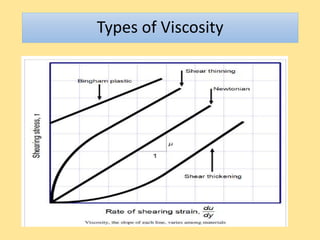
 Increasing viscosity with an increase in shear rate
characterizes the dilatant fluid.
 Although rarer than pseudo plasticity, dilatancy is
frequently observed in fluids containing high levels of
deflocculated solids, such as clay slurries, candy
compounds and sand/water mixtures.
 Dilatancy is also referred to as shear-thickening flow
behavior.
Viscosity coefficients
 Viscosity coefficients can be defined in two ways:
1) Dynamic or Absolute viscosity
2) Kinematic Viscosity
 Viscosity is a tensorial quantity that can be decomposed
in different ways into two independent components.
The most usual decomposition yields the following
viscosity coefficients:
1) Shear Viscosity
2) Extensional Viscosity
Dynamic Viscosity/ Absolute Viscosity
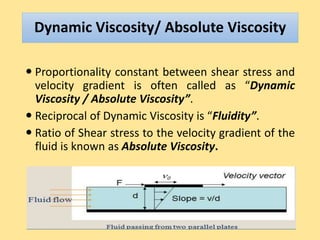
 Proportionality constant between shear stress and
velocity gradient is often called as “Dynamic
Viscosity / Absolute Viscosity”.
 Reciprocal of Dynamic Viscosity is “Fluidity”.
 Ratio of Shear stress to the velocity gradient of the
fluid is known as Absolute Viscosity.
Shear Viscosity
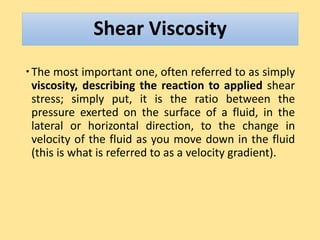
The most important one, often referred to as simply
viscosity, describing the reaction to applied shear
stress; simply put, it is the ratio between the
pressure exerted on the surface of a fluid, in the
lateral or horizontal direction, to the change in
velocity of the fluid as you move down in the fluid
(this is what is referred to as a velocity gradient).
Volume Viscosity or Bulk Viscosity
Bulk viscosity becomes important only for such
effects where fluid compressibility is essential.
Examples would include shock waves and sound
propagation.
It appears in the Stokes' law (sound attenuation)
that describes propagation of sound in Newtonian
liquid.
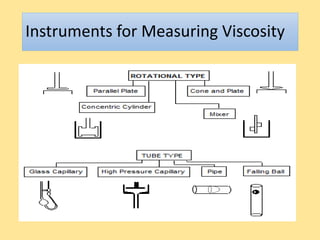
Instruments for Measuring Viscosity
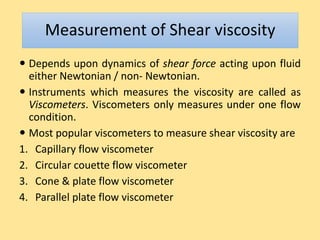
Measurement of Shear viscosity
 Depends upon dynamics of shear force acting upon fluid
either Newtonian / non- Newtonian.
 Instruments which measures the viscosity are called as
Viscometers. Viscometers only measures under one flow
condition.
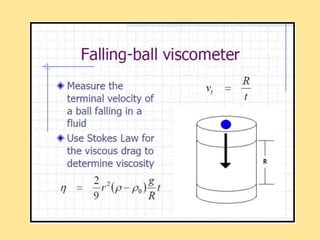
 Most popular viscometers to measure shear viscosity are
1. Capillary flow viscometer
2. Circular couette flow viscometer
3. Cone & plate flow viscometer
4. Parallel plate flow viscometer
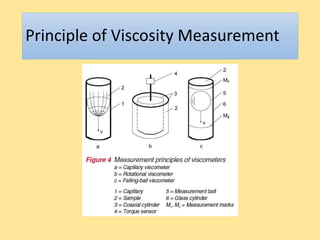
Principle of Viscosity Measurement
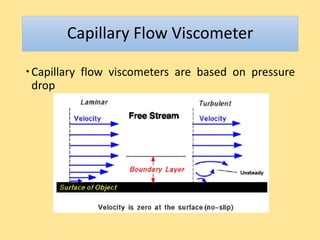
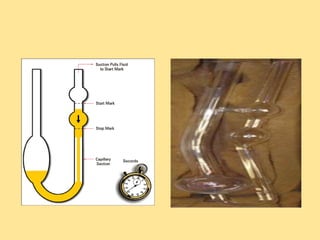
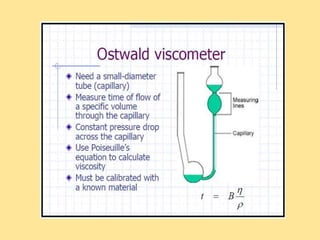
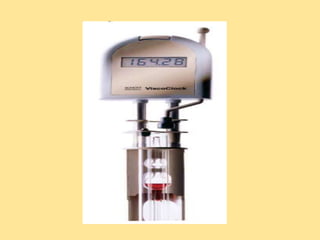
Capillary Flow Viscometer
Capillary flow viscometers are based on pressure
drop
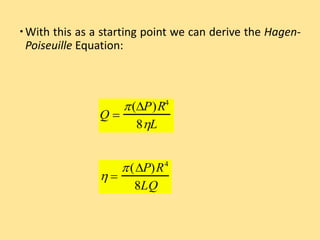
With this as a starting point we can derive the Hagen-
Poiseuille Equation:
Q 
(P)R4
8L
 
(P)R4
8LQ
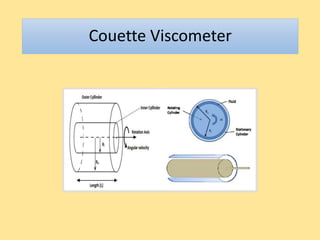
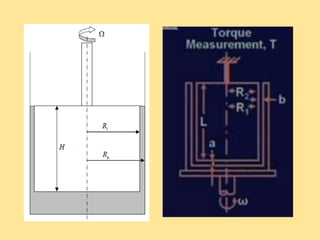
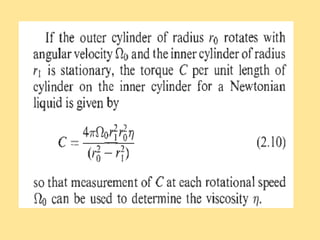
Couette Viscometer
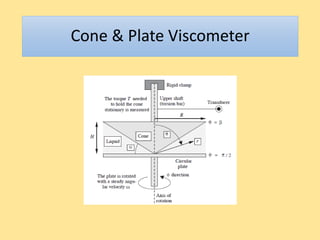
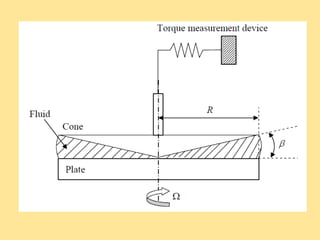
Cone & Plate Viscometer
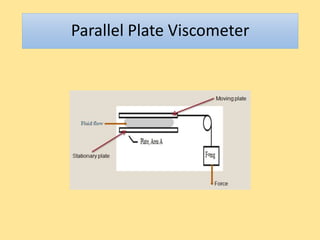
Parallel Plate Viscometer
Shop Floor Viscometers
 Mainly used in Industrial applications to measure
viscosity of mostly Newtonian types of fluid.
 These viscometers consisting simple & convenient
method for viscosity measurement.
 Most popular shop-floor viscometers :
1. Rotational Viscometer
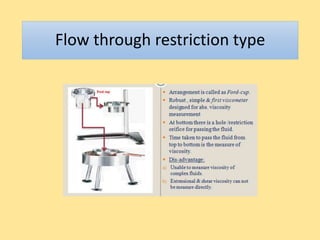
2. Flow through restriction type Viscometer
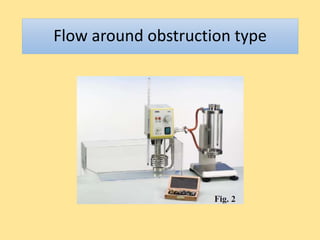
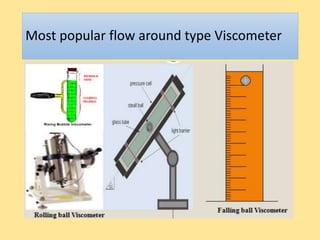
3. Flow around type Viscometer
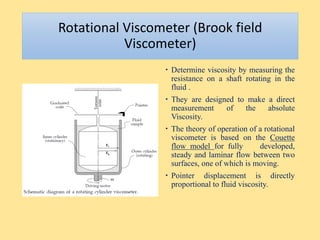
Rotational Viscometer (Brook field
Viscometer)
 Determine viscosity by measuring the
resistance on a shaft rotating in the
fluid .
 They are designed to make a direct
measurement of the absolute
Viscosity.
 The theory of operation of a rotational
viscometer is based on the Couette
flow model for fully developed,
steady and laminar flow between two
surfaces, one of which is moving.
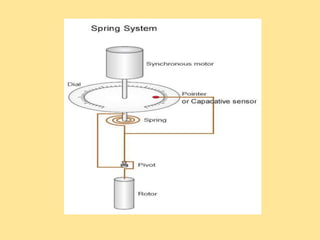
 Pointer displacement is directly
proportional to fluid viscosity.
Flow through restriction type
Flow around obstruction type
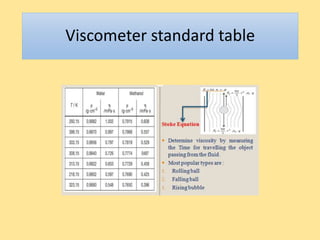
Viscometer standard table
Most popular flow around type Viscometer
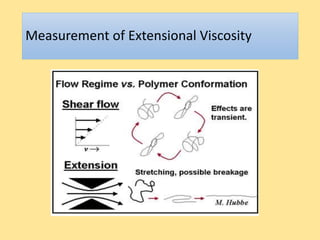
Measurement of Extensional Viscosity
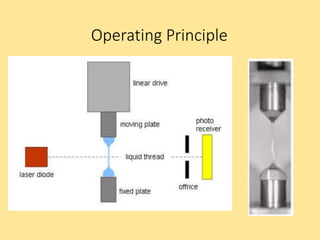
Operating Principle
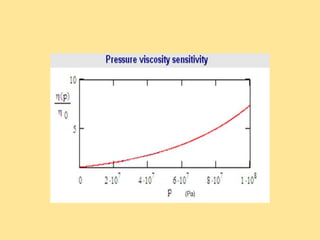
Effect of Temperature
The viscosity of liquids decreases with increase the
temperature.
The viscosity of gases increases with the increase
the temperature.
The lubricant oil viscosity at a specific temperature
can be either calculated from the viscosity -
temperature equation or obtained from the
viscosity-temperature chart.
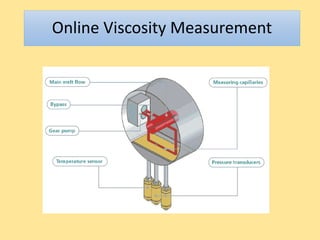
Online Viscosity Measurement
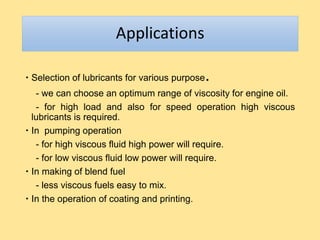
Applications
 Selection of lubricants for various purpose.
- we can choose an optimum range of viscosity for engine oil.
- for high load and also for speed operation high viscous
lubricants is required.
 In pumping operation
- for high viscous fluid high power will require.
- for low viscous fluid low power will require.
 In making of blend fuel
- less viscous fuels easy to mix.
 In the operation of coating and printing.
Thank You All
Any Question
References:
 www.Wikipedia.com
 www.scribd.com
 www.slidehare.com
 www.blogger.com

Viscosity Measurement-

  • 1.
    Green University of Bangladesh Departmentof Textile Engineering Presentation on Viscosity Measurement  Presented by Golam Sarwar: 120103019 Sifath Abdan:120303003 Mizanur Rahman:120103004
  • 2.
    Viscosity  Viscosity isthe measure of the internal friction of a fluid.  This friction becomes apparent when a layer of fluid is made to move in relation to another layer.  The greater the friction, the greater the amount of force required to cause this movement, which is called shear.  Shearing occurs whenever the fluid is physically moved or distributed, as in pouring, spreading, spraying, mixing, etc. Highly viscous fluids, therefore, require more force to move than less viscous materials.
  • 3.
    Why should Wemeasure Viscosity?  From viscosity measurement, we can obtain much useful behavioral and predictive information for various products.  A frequent reason for the measurement of rheological properties can be found in the area of quality control, where raw materials must be consistent from batch to batch.  For this purpose, flow behavior is an indirect measure of product consistency and quality.
  • 4.
  • 5.
     Increasing viscositywith an increase in shear rate characterizes the dilatant fluid.  Although rarer than pseudo plasticity, dilatancy is frequently observed in fluids containing high levels of deflocculated solids, such as clay slurries, candy compounds and sand/water mixtures.  Dilatancy is also referred to as shear-thickening flow behavior.
  • 6.
    Viscosity coefficients  Viscositycoefficients can be defined in two ways: 1) Dynamic or Absolute viscosity 2) Kinematic Viscosity  Viscosity is a tensorial quantity that can be decomposed in different ways into two independent components. The most usual decomposition yields the following viscosity coefficients: 1) Shear Viscosity 2) Extensional Viscosity
  • 7.
    Dynamic Viscosity/ AbsoluteViscosity  Proportionality constant between shear stress and velocity gradient is often called as “Dynamic Viscosity / Absolute Viscosity”.  Reciprocal of Dynamic Viscosity is “Fluidity”.  Ratio of Shear stress to the velocity gradient of the fluid is known as Absolute Viscosity.
  • 8.
    Shear Viscosity The mostimportant one, often referred to as simply viscosity, describing the reaction to applied shear stress; simply put, it is the ratio between the pressure exerted on the surface of a fluid, in the lateral or horizontal direction, to the change in velocity of the fluid as you move down in the fluid (this is what is referred to as a velocity gradient).
  • 9.
    Volume Viscosity orBulk Viscosity Bulk viscosity becomes important only for such effects where fluid compressibility is essential. Examples would include shock waves and sound propagation. It appears in the Stokes' law (sound attenuation) that describes propagation of sound in Newtonian liquid.
  • 10.
  • 11.
    Measurement of Shearviscosity  Depends upon dynamics of shear force acting upon fluid either Newtonian / non- Newtonian.  Instruments which measures the viscosity are called as Viscometers. Viscometers only measures under one flow condition.  Most popular viscometers to measure shear viscosity are 1. Capillary flow viscometer 2. Circular couette flow viscometer 3. Cone & plate flow viscometer 4. Parallel plate flow viscometer
  • 12.
  • 13.
    Capillary Flow Viscometer Capillaryflow viscometers are based on pressure drop
  • 17.
    With this asa starting point we can derive the Hagen- Poiseuille Equation: Q  (P)R4 8L   (P)R4 8LQ
  • 18.
  • 21.
    Cone & PlateViscometer
  • 23.
  • 24.
    Shop Floor Viscometers Mainly used in Industrial applications to measure viscosity of mostly Newtonian types of fluid.  These viscometers consisting simple & convenient method for viscosity measurement.  Most popular shop-floor viscometers : 1. Rotational Viscometer 2. Flow through restriction type Viscometer 3. Flow around type Viscometer
  • 25.
    Rotational Viscometer (Brookfield Viscometer)  Determine viscosity by measuring the resistance on a shaft rotating in the fluid .  They are designed to make a direct measurement of the absolute Viscosity.  The theory of operation of a rotational viscometer is based on the Couette flow model for fully developed, steady and laminar flow between two surfaces, one of which is moving.  Pointer displacement is directly proportional to fluid viscosity.
  • 27.
  • 28.
  • 29.
  • 30.
    Most popular flowaround type Viscometer
  • 32.
  • 33.
  • 34.
    Effect of Temperature Theviscosity of liquids decreases with increase the temperature. The viscosity of gases increases with the increase the temperature. The lubricant oil viscosity at a specific temperature can be either calculated from the viscosity - temperature equation or obtained from the viscosity-temperature chart.
  • 36.
  • 37.
    Applications  Selection oflubricants for various purpose. - we can choose an optimum range of viscosity for engine oil. - for high load and also for speed operation high viscous lubricants is required.  In pumping operation - for high viscous fluid high power will require. - for low viscous fluid low power will require.  In making of blend fuel - less viscous fuels easy to mix.  In the operation of coating and printing.
  • 38.
  • 39.
  • 40.
    References:  www.Wikipedia.com  www.scribd.com www.slidehare.com  www.blogger.com