Distillation


           By
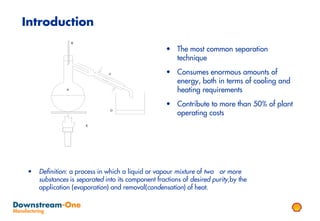
Introduction
                   B

                                                    • The most common separation
                                                      technique

                              C                     • Consumes enormous amounts of
                                                      energy, both in terms of cooling and
               A
                                                      heating requirements
                                                    • Contribute to more than 50% of plant
                                                      operating costs
                               D


                       E


 •   Definition: a process in which a liquid or vapour mixture of two or more
     substances is separated into its component fractions of desired purity,by the
     application (evaporation) and removal(condensation) of heat.
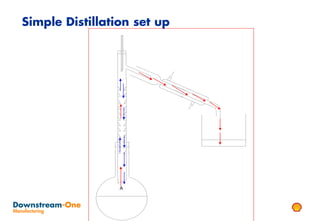
Simple Distillation set up


                 A
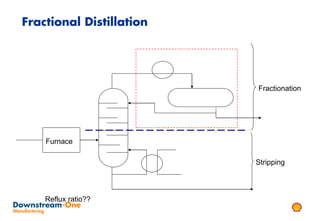
Fractional Distillation


                          Fractionation


    Furnace

                          Stripping


    Reflux ratio??
Influence of Pressure

• Boiling points varies with pressure : keep it constant


• Lower the partial pressure; lower the boiling pt.


• Lighter components difficult to condense at low P; operates at higher P(10-12
  bar)


• Heavier components will have to be heated up to 400 degC for distillation to
  occur, hence HC bonds will start to break.


• For heavier comps, distillation carried under vacuum condition to avoid the
  carbon chain from cracking
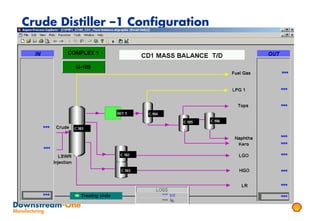
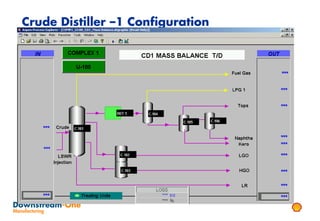
Crude Distiller –1 Configuration
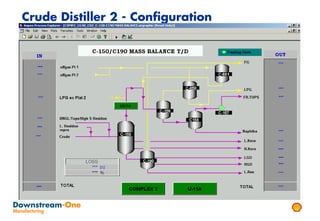
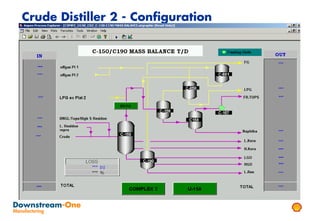
Crude Distiller 2 - Configuration
Separation
• IBP, FBP
• Gap
• Overlap
• Aim for:
    overlap Naphtha < 10 degC < Tops
   no gap & overlap between Naphtha and Kero
   overlap LGO < 10 degC < Kero
   overlap HGO < 10 degC < LGO
Separation efficiency is due to reflux ratio
Column Control For Product Spec

• Control FBP of product by controlling the top temp of the column, higher top
   temp, heavier comps boils over, higher FBP, more product on overheads( at fixed pressure)

• How to change production? for better separation, create more reflux,
• How to  top temp?(1) reduce/increase amount of heat removed from column @ (2)
   reduce/increase amount of heat supplied to column

• Heat removed by reflux flow. reflux, remove more heat, top temperature 
• Heat supplied via (1) feed temperature & (2) bottom reboiler
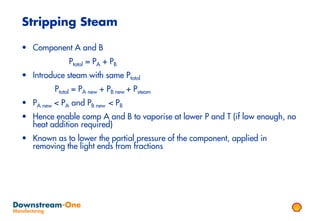
Stripping Steam

• Component A and B
             Ptotal = PA + PB
• Introduce steam with same Ptotal
         Ptotal = PA new + PB new + Psteam
• PA new < PA and PB new < PB
• Hence enable comp A and B to vaporise at lower P and T (if low enough, no
  heat addition required)
• Known as to lower the partial pressure of the component, applied in
  removing the light ends from fractions
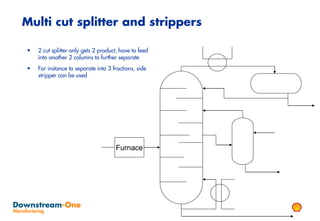
Multi cut splitter and strippers

•   2 cut splitter only gets 2 product, have to feed
    into another 2 columns to further separate
•   For instance to separate into 3 fractions, side
    stripper can be used


                                     Furnace
Crude Distiller –1 Configuration
Crude Distiller 2 - Configuration
Distillation

Distillation

  • 1.
  • 2.
    Introduction B • The most common separation technique C • Consumes enormous amounts of energy, both in terms of cooling and A heating requirements • Contribute to more than 50% of plant operating costs D E • Definition: a process in which a liquid or vapour mixture of two or more substances is separated into its component fractions of desired purity,by the application (evaporation) and removal(condensation) of heat.
  • 3.
  • 4.
    Fractional Distillation Fractionation Furnace Stripping Reflux ratio??
  • 5.
    Influence of Pressure •Boiling points varies with pressure : keep it constant • Lower the partial pressure; lower the boiling pt. • Lighter components difficult to condense at low P; operates at higher P(10-12 bar) • Heavier components will have to be heated up to 400 degC for distillation to occur, hence HC bonds will start to break. • For heavier comps, distillation carried under vacuum condition to avoid the carbon chain from cracking
  • 6.
    Crude Distiller –1Configuration
  • 7.
    Crude Distiller 2- Configuration
  • 8.
    Separation • IBP, FBP •Gap • Overlap • Aim for:  overlap Naphtha < 10 degC < Tops  no gap & overlap between Naphtha and Kero  overlap LGO < 10 degC < Kero  overlap HGO < 10 degC < LGO Separation efficiency is due to reflux ratio
  • 9.
    Column Control ForProduct Spec • Control FBP of product by controlling the top temp of the column, higher top temp, heavier comps boils over, higher FBP, more product on overheads( at fixed pressure) • How to change production? for better separation, create more reflux, • How to  top temp?(1) reduce/increase amount of heat removed from column @ (2) reduce/increase amount of heat supplied to column • Heat removed by reflux flow. reflux, remove more heat, top temperature  • Heat supplied via (1) feed temperature & (2) bottom reboiler
  • 10.
    Stripping Steam • ComponentA and B Ptotal = PA + PB • Introduce steam with same Ptotal Ptotal = PA new + PB new + Psteam • PA new < PA and PB new < PB • Hence enable comp A and B to vaporise at lower P and T (if low enough, no heat addition required) • Known as to lower the partial pressure of the component, applied in removing the light ends from fractions
  • 11.
    Multi cut splitterand strippers • 2 cut splitter only gets 2 product, have to feed into another 2 columns to further separate • For instance to separate into 3 fractions, side stripper can be used Furnace
  • 12.
    Crude Distiller –1Configuration
  • 13.
    Crude Distiller 2- Configuration