Solar water distillation for drinking purposes.
Introduction
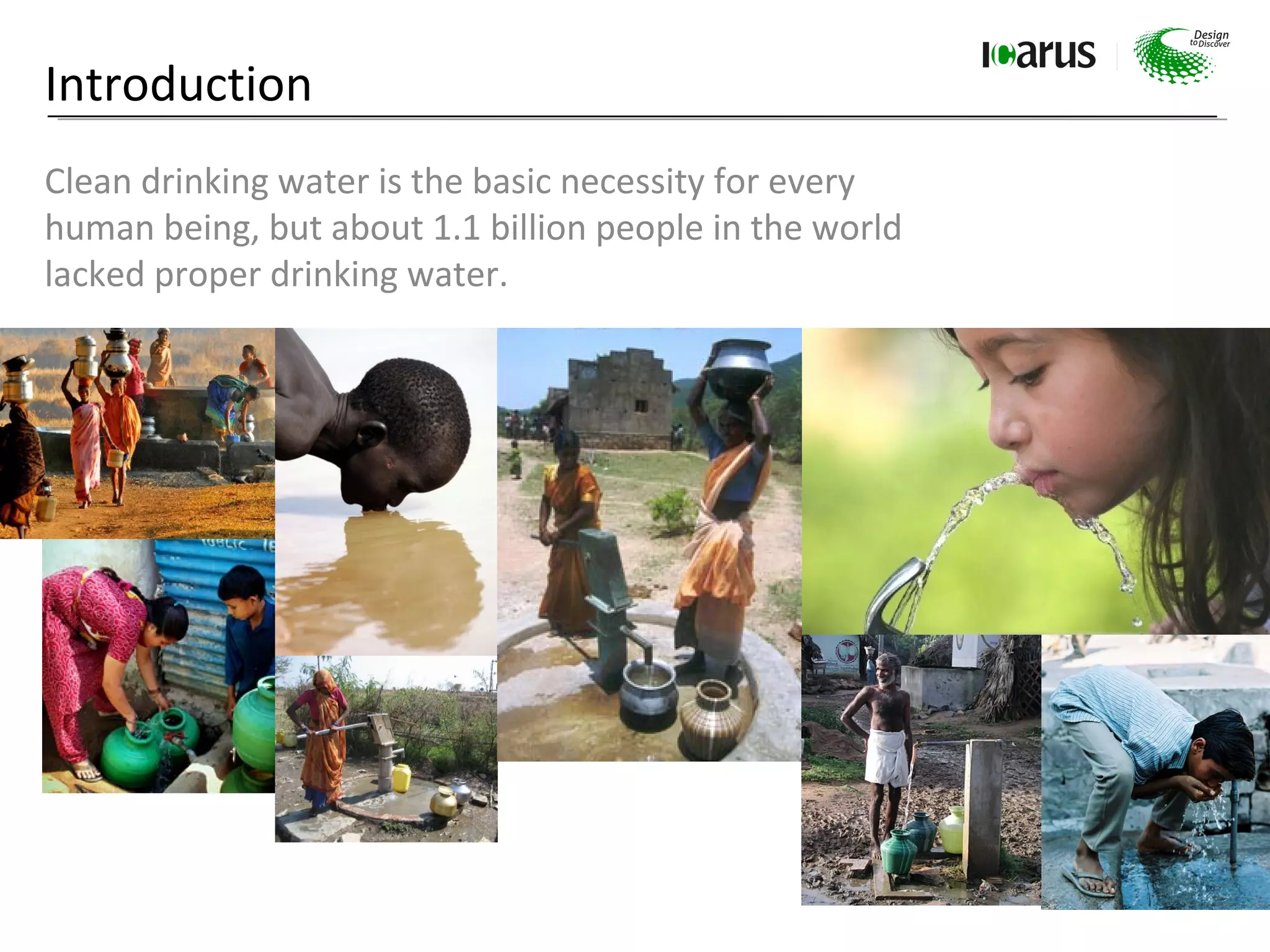
Clean drinking water is the basic necessity for every
human being, but about 1.1 billion people in the world
lacked proper drinking water.
Water purification
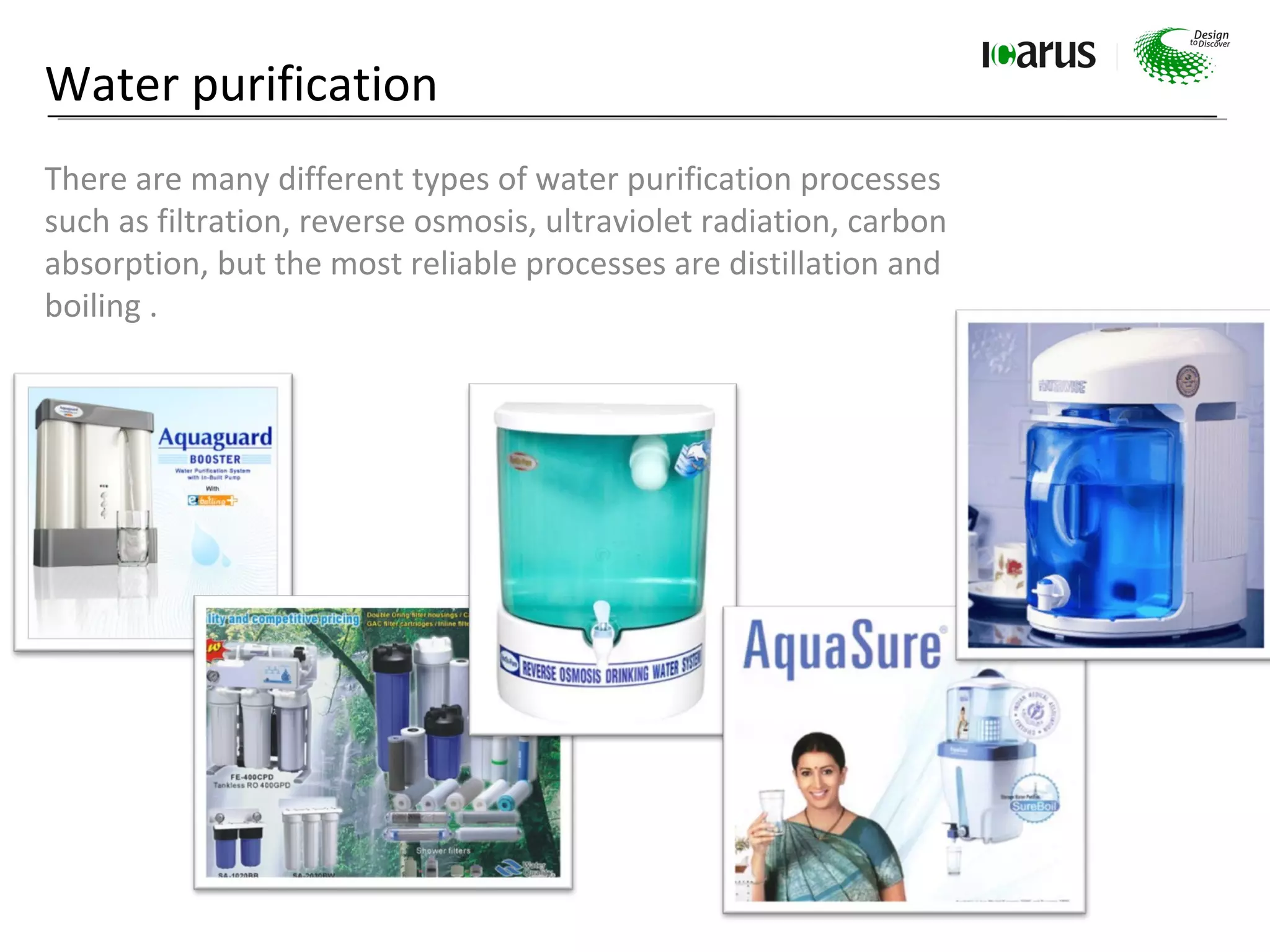
There are many different types of water purification processes
such as filtration, reverse osmosis, ultraviolet radiation, carbon
absorption, but the most reliable processes are distillation and
boiling .
Boiling and distillation
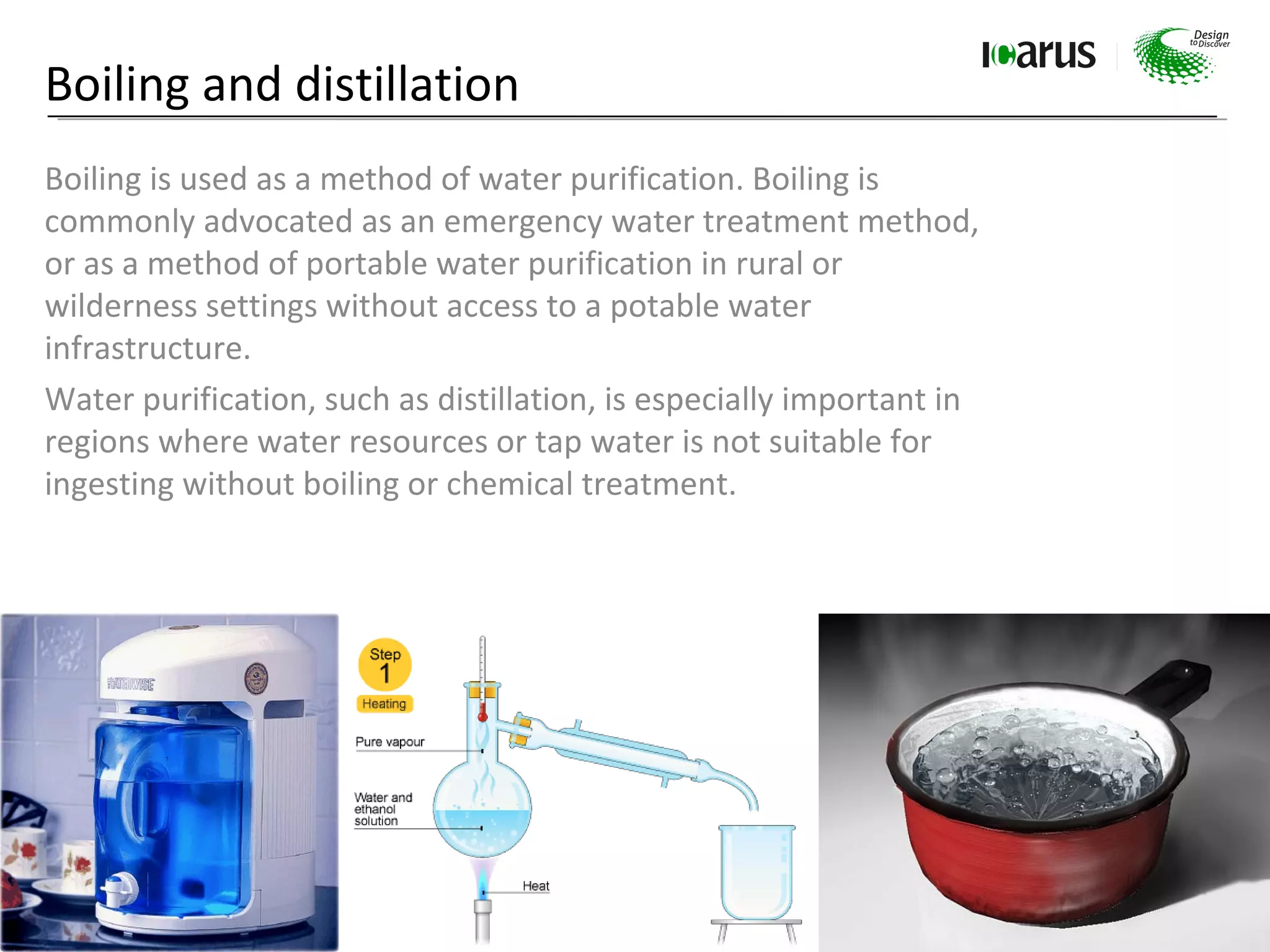
Boiling is used as a method of water purification. Boiling is
commonly advocated as an emergency water treatment method,
or as a method of portable water purification in rural or
wilderness settings without access to a potable water
infrastructure.
Water purification, such as distillation, is especially important in
regions where water resources or tap water is not suitable for
ingesting without boiling or chemical treatment.
Solar water purification
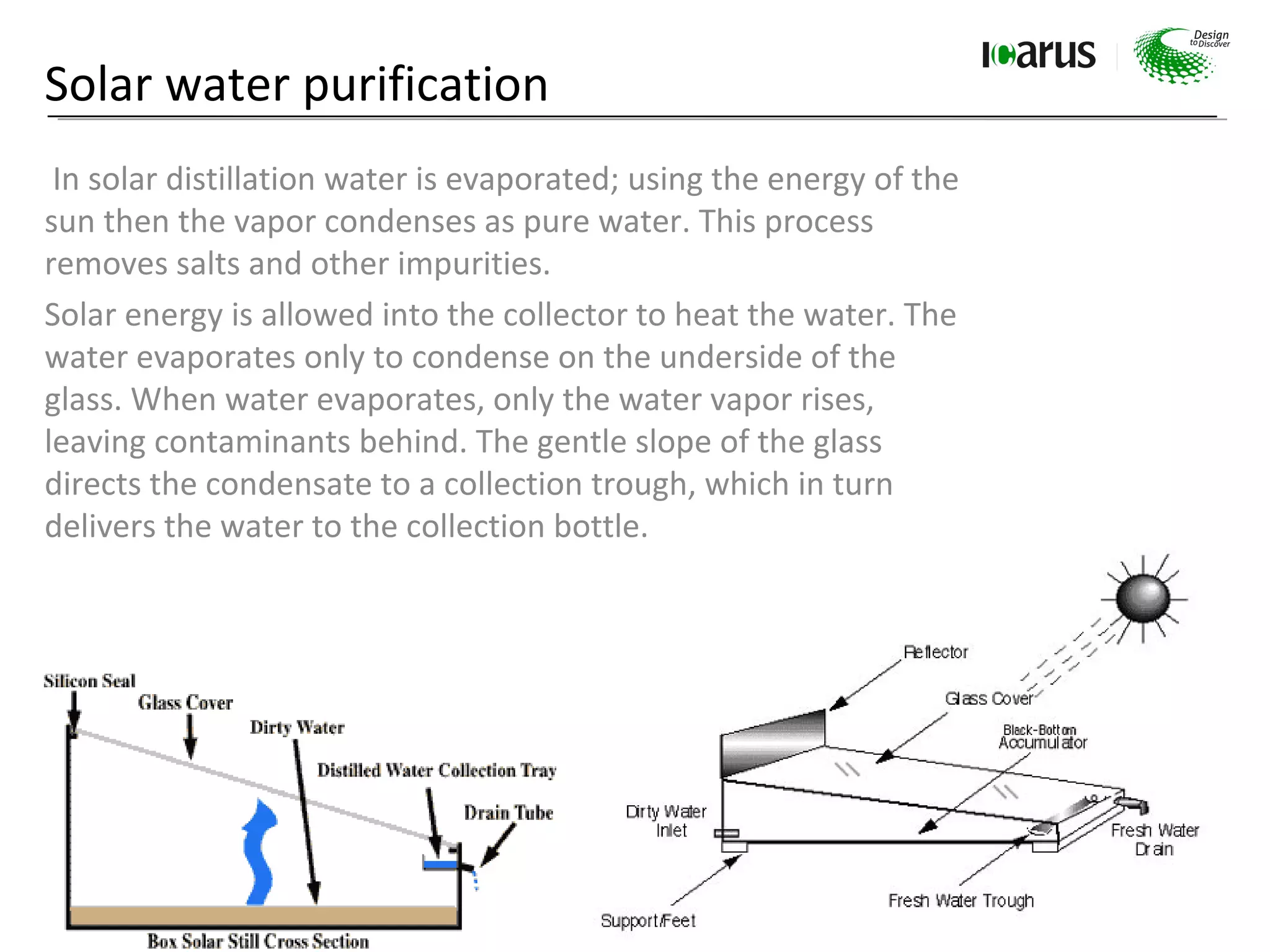
In solar distillation water is evaporated; using the energy of the
sun then the vapor condenses as pure water. This process
removes salts and other impurities.
Solar energy is allowed into the collector to heat the water. The
water evaporates only to condense on the underside of the
glass. When water evaporates, only the water vapor rises,
leaving contaminants behind. The gentle slope of the glass
directs the condensate to a collection trough, which in turn
delivers the water to the collection bottle.
Existing products
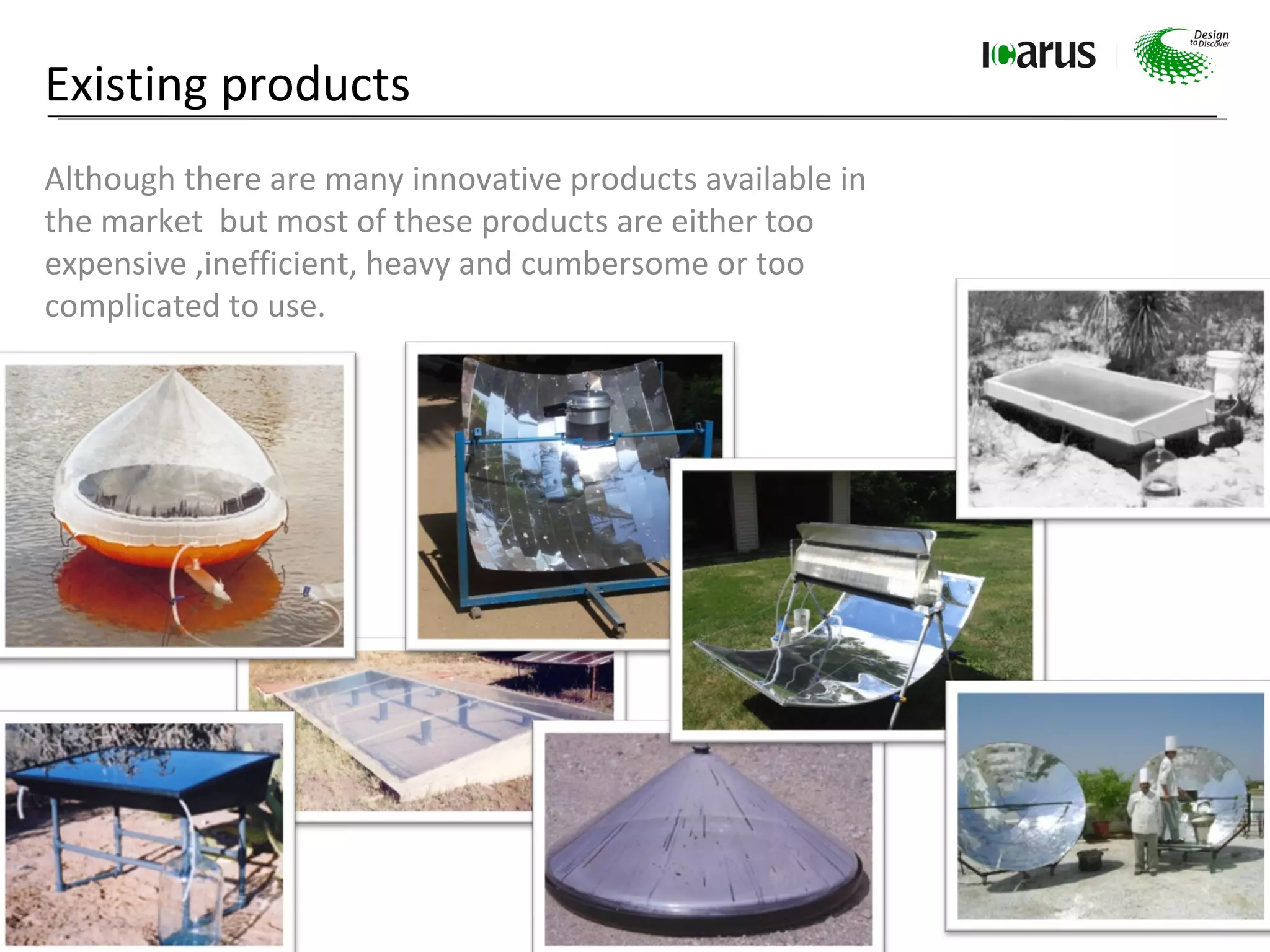
Although there are many innovative products available in
the market but most of these products are either too
expensive ,inefficient, heavy and cumbersome or too
complicated to use.
Abstract
There are many methods and processes of solar distillation
and many solar distillation devices are available in the
market, but these devices are very bulky, expensive or not
very efficient.
There is a requirement for a device which is highly efficient,
economical, simple to manufacture and maintain. This can
be achieved through understanding theory,
experimentation and learning from existing products.
Theory
Energy from the sun per square meter per day = 1000 Watt (1300 Watt accurately)
= 1000 x 3600 joules perhour
= 3600 kilojoules per hour
Heat of vaporization of water = 2257 kilojoules per kg
Specific heat of water = 4.19 kilojoules per kg per Kelvin
Factors effecting evaporation
Concentration of vapor in air
Surface area of water
Pressure of vessel
Temperature of water
Boiling point of water at sea level is 100 degree C.
Boiling point of water may be decreased by decreasing the pressure.
-pressure may be decreased by going "above sea level".
-pressure may be decreased by "applying a low pressure"
Relatively cooler surface for condensation.
High vapor pressure
Low temperature
Solar distill (Icarus experiment)
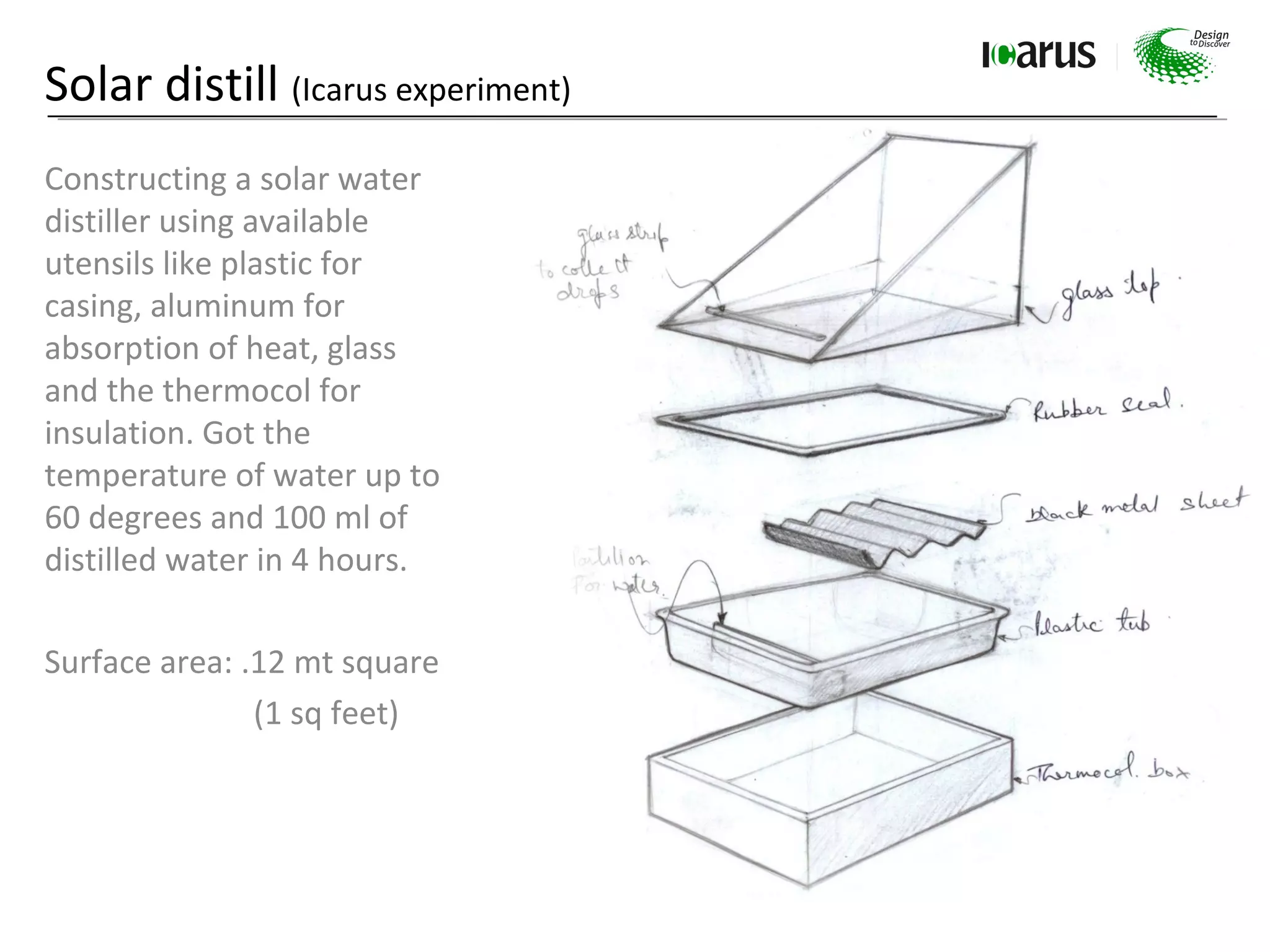
Constructing a solar water
distiller using available
utensils like plastic for
casing, aluminum for
absorption of heat, glass
and the thermocol for
insulation. Got the
temperature of water up to
60 degrees and 100 ml of
distilled water in 4 hours.
Surface area: .12 mt square
(1 sq feet)
Solar distill (Icarus experiment)
Output:
After 4 hours under the sun an output of 150 ml of
pure distilled water.
Drawbacks:
Large number of parts,bulky
Radiator for condensation (Icarus experiment)
Condensation using a car radiator and a
steamer
Results: very efficient
Drawbacks: bulky
Concave mirror (Icarus experiment)
Using an old dish antenna and covering it with
reflective plastic film to obtain concentrated
solar energy.
Wooden sticks burn in 10 seconds with a
temperature of 500 degrees. Heats water to
95 degrees in 45 minutes.
Concave mirror distiller (Icarus experiment)
The concave mirror was then placed under a structure with the focus on a
vessel holding one liter of water .
The vessel is then connected to a plastic bottle kept under the structure
through a flexi pipe.
Surface area: 0.7 sq mt
Results: water boils in 40 minutes
Drawbacks: focus point continuously shifts
Concave mirror distiller (Icarus experiment)
The same experiment is conducted using a metal pipe instead of a flexi pipe.
Results: water condenses faster when
in contact with metal.
Drawbacks: focus point continuously shifts.
Condensation not
efficient
Curved Acrylic reflector (Icarus experiment)
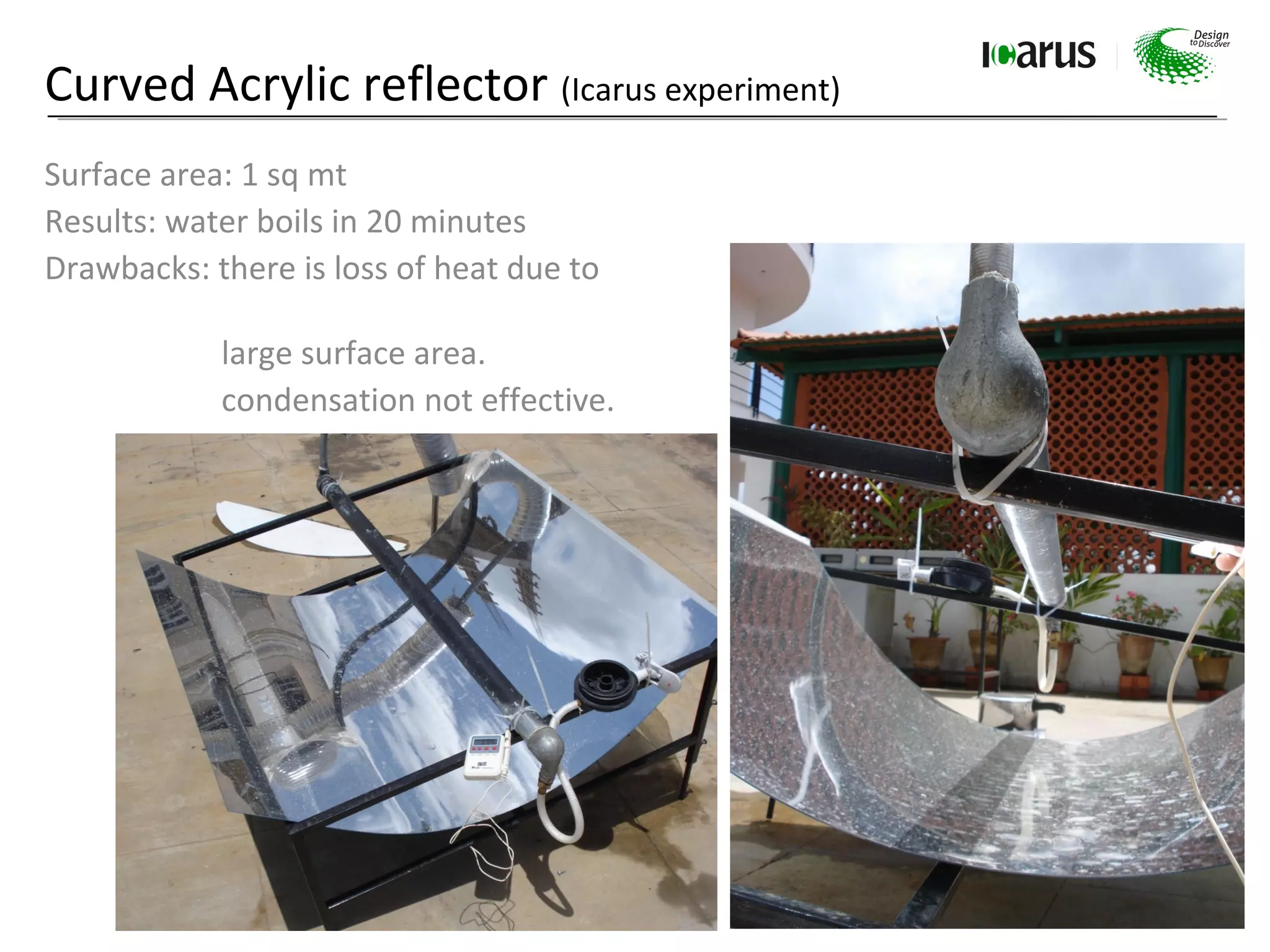
The structure
the structure comprises of a metal
framework on which the curved acrylic will
be mounted.
The focus of the curve which is a straight
thin line will fall on a metal pipe which is
half filled with water to be distilled.
the water level is controlled by a vessel
connected by a flexi pipe.
The heated water then boils to vapors and
is passed through a steel pipe for
condensation.
Curved Acrylic reflector (Icarus experiment)
Surface area: 1 sq mt
Results: water boils in 20 minutes
Drawbacks: there is loss of heat due to
large surface area.
condensation not effective.
Thank you
Research is in progress
Those interested in collaborating please contact.
We have some refinement directions from Aurore….
which we are working on.
www.icarus.co.in
Collaborators
•Icarus Design, Bangalore
•Aurore , Auroville, India
•Kunal Singh, NID, Ahmedabad.

Solar Water Distillation For Drinking Purposes

  • 1.
    Solar water distillationfor drinking purposes.
  • 2.
    Introduction Clean drinking wateris the basic necessity for every human being, but about 1.1 billion people in the world lacked proper drinking water.
  • 3.
    Water purification There aremany different types of water purification processes such as filtration, reverse osmosis, ultraviolet radiation, carbon absorption, but the most reliable processes are distillation and boiling .
  • 4.
    Boiling and distillation Boilingis used as a method of water purification. Boiling is commonly advocated as an emergency water treatment method, or as a method of portable water purification in rural or wilderness settings without access to a potable water infrastructure. Water purification, such as distillation, is especially important in regions where water resources or tap water is not suitable for ingesting without boiling or chemical treatment.
  • 5.
    Solar water purification Insolar distillation water is evaporated; using the energy of the sun then the vapor condenses as pure water. This process removes salts and other impurities. Solar energy is allowed into the collector to heat the water. The water evaporates only to condense on the underside of the glass. When water evaporates, only the water vapor rises, leaving contaminants behind. The gentle slope of the glass directs the condensate to a collection trough, which in turn delivers the water to the collection bottle.
  • 6.
    Existing products Although thereare many innovative products available in the market but most of these products are either too expensive ,inefficient, heavy and cumbersome or too complicated to use.
  • 7.
    Abstract There are manymethods and processes of solar distillation and many solar distillation devices are available in the market, but these devices are very bulky, expensive or not very efficient. There is a requirement for a device which is highly efficient, economical, simple to manufacture and maintain. This can be achieved through understanding theory, experimentation and learning from existing products.
  • 8.
    Theory Energy from thesun per square meter per day = 1000 Watt (1300 Watt accurately) = 1000 x 3600 joules perhour = 3600 kilojoules per hour Heat of vaporization of water = 2257 kilojoules per kg Specific heat of water = 4.19 kilojoules per kg per Kelvin Factors effecting evaporation Concentration of vapor in air Surface area of water Pressure of vessel Temperature of water Boiling point of water at sea level is 100 degree C. Boiling point of water may be decreased by decreasing the pressure. -pressure may be decreased by going "above sea level". -pressure may be decreased by "applying a low pressure" Relatively cooler surface for condensation. High vapor pressure Low temperature
  • 9.
    Solar distill (Icarusexperiment) Constructing a solar water distiller using available utensils like plastic for casing, aluminum for absorption of heat, glass and the thermocol for insulation. Got the temperature of water up to 60 degrees and 100 ml of distilled water in 4 hours. Surface area: .12 mt square (1 sq feet)
  • 10.
    Solar distill (Icarusexperiment) Output: After 4 hours under the sun an output of 150 ml of pure distilled water. Drawbacks: Large number of parts,bulky
  • 11.
    Radiator for condensation(Icarus experiment) Condensation using a car radiator and a steamer Results: very efficient Drawbacks: bulky
  • 12.
    Concave mirror (Icarusexperiment) Using an old dish antenna and covering it with reflective plastic film to obtain concentrated solar energy. Wooden sticks burn in 10 seconds with a temperature of 500 degrees. Heats water to 95 degrees in 45 minutes.
  • 13.
    Concave mirror distiller(Icarus experiment) The concave mirror was then placed under a structure with the focus on a vessel holding one liter of water . The vessel is then connected to a plastic bottle kept under the structure through a flexi pipe. Surface area: 0.7 sq mt Results: water boils in 40 minutes Drawbacks: focus point continuously shifts
  • 14.
    Concave mirror distiller(Icarus experiment) The same experiment is conducted using a metal pipe instead of a flexi pipe. Results: water condenses faster when in contact with metal. Drawbacks: focus point continuously shifts. Condensation not efficient
  • 15.
    Curved Acrylic reflector(Icarus experiment) The structure the structure comprises of a metal framework on which the curved acrylic will be mounted. The focus of the curve which is a straight thin line will fall on a metal pipe which is half filled with water to be distilled. the water level is controlled by a vessel connected by a flexi pipe. The heated water then boils to vapors and is passed through a steel pipe for condensation.
  • 16.
    Curved Acrylic reflector(Icarus experiment) Surface area: 1 sq mt Results: water boils in 20 minutes Drawbacks: there is loss of heat due to large surface area. condensation not effective.
  • 17.
    Thank you Research isin progress Those interested in collaborating please contact. We have some refinement directions from Aurore…. which we are working on. www.icarus.co.in Collaborators •Icarus Design, Bangalore •Aurore , Auroville, India •Kunal Singh, NID, Ahmedabad.