viscosity
Nirmal raj marasine
Cmc
The word "viscosity" derives from the Latin
word "viscum alba" for mistletoe. A viscous
glue called birdlime was made from mistletoe
berries and used for lime-twigs to catch birds.
Defination ;The property of a liquid by virtue
of which it opposes the relative motion
between its different layers is known as
viscosity.
OR
Viscosity is a measure of the resistance of a
fluid which is being deformed by either shear
stress or tensile stress.
Velocity gradient at y1: g = du/dy
• (shear rate)
• Shear Stress: t = F/A
• Shear stress is the force delivered parallel to
an area of fluid surface
• Shear stress and shear rate are related by the
proportionality constant h (known as the
viscosity)
t  h
du
dy
 hÝg
Viscosity unit
• Viscosity has the dimensions of ML-1T-1
• In units
– CGS: poise or centipoise (cp)
– SI : Pa.s = 1000 m Pa.s
– kinematic viscosity in centistokes (cSt)
• Conversions
– 1000 m Pa.s = 1 Pa.s = 1Ns/m2
– 100 cP = 0.1 Pa.s = 100 m Pa.s =1 dyne.s/cm2
Types of viscosity
• Viscosity, the slope of each line, varies among materials
• Newtonian: fluids, such as water and most gases
which have a constant viscosity.
• • Shear thickening: viscosity increases with the
rate of shear.
• • Shear thinning: viscosity decreases with the
rate of shear. Shear thinning liquids are very
commonly, but
• misleadingly, described as thixotropic.
• • Thixotropic: materials which become less
viscous over time when shaken, agitated, or
otherwise stressed.
• Rheopectic: materials which become more viscous
over time when shaken, agitated, or otherwise
stressed.
• • A Bingham plastic is a material that behaves as a
solid at low stresses but flows as a viscous fluid at
high
• stresses.
• • A magnetorheological fluid is a type of "smart fluid"
which, when subjected to a magnetic field, greatly
• increases its apparent viscosity, to the point of
becoming a viscoelastic solid.
Viscosity coefficients
• Dynamic viscosity, also absolute viscosity, the
more usual one (typical units Pa·s, Poise, P);
• • Kinematic viscosity is the dynamic viscosity
divided by the density (typical units m2/s,
strokes ) :
u = h/r
• • Shear viscosity, the most important one,
often referred to as simply viscosity,
describing the reaction to appliedshear
stress; simply put, it is the ratio between the
pressure exerted on the surface of a fluid, in
the lateral orhorizontal direction, to the
change in velocity of the fluid as you move
down in the fluid (this is what is referredto as
a velocity gradient).
• • Volume viscosity (also called bulk viscosity
or second viscosity) becomes important only
for such effects where fluid compressibility is
essential. Examples would include shock
waves and sound propagation. It appears in
the Stokes' law (sound attenuation) that
describes propagation of sound in Newtonian
liquid.
• For liquids, temperature decreases viscosity
• The way in which it varies depends on the fluid
• It is critical to know the temperature at which
viscosity is measured
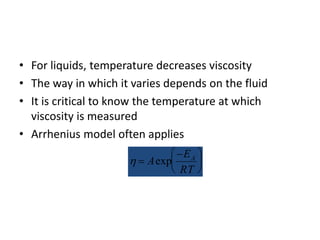
• Arrhenius model often applies

h  Aexp
EA
RT






• Ea is the “activation energy”, that is, the
energy barrier to flow
• As a molecule moves it will experience
minimum and maximum intermolecular forces
with its neighbors. The difference represents
the activation energy
If h is the viscosity of the solution, and
ho the viscosity of only the solvent,
then the following definitions apply
relative viscosity = hrel =
specific viscosity = hsp = hrel - 1
reduced viscosity = hred =
inherent visc osity = hinh =
intrinsic visc osity = hint =
h
h
hsp
C
lnhrel
C
hsp
C C0
• Newtonian Fluids (Newton 1687)
– Simplest model
– Covers most, but not all, ag products
– Velocity behaves linearly w/ distance
– Shear stress is linear function of the shear
rate
– Dynamic viscosity: proportionality constant
for this relationship

Viscosity 2

  • 1.
  • 2.
    The word "viscosity"derives from the Latin word "viscum alba" for mistletoe. A viscous glue called birdlime was made from mistletoe berries and used for lime-twigs to catch birds. Defination ;The property of a liquid by virtue of which it opposes the relative motion between its different layers is known as viscosity. OR
  • 3.
    Viscosity is ameasure of the resistance of a fluid which is being deformed by either shear stress or tensile stress.
  • 5.
    Velocity gradient aty1: g = du/dy • (shear rate) • Shear Stress: t = F/A • Shear stress is the force delivered parallel to an area of fluid surface
  • 6.
    • Shear stressand shear rate are related by the proportionality constant h (known as the viscosity) t  h du dy  hÝg
  • 7.
    Viscosity unit • Viscosityhas the dimensions of ML-1T-1 • In units – CGS: poise or centipoise (cp) – SI : Pa.s = 1000 m Pa.s – kinematic viscosity in centistokes (cSt) • Conversions – 1000 m Pa.s = 1 Pa.s = 1Ns/m2 – 100 cP = 0.1 Pa.s = 100 m Pa.s =1 dyne.s/cm2
  • 8.
    Types of viscosity •Viscosity, the slope of each line, varies among materials
  • 9.
    • Newtonian: fluids,such as water and most gases which have a constant viscosity. • • Shear thickening: viscosity increases with the rate of shear. • • Shear thinning: viscosity decreases with the rate of shear. Shear thinning liquids are very commonly, but • misleadingly, described as thixotropic. • • Thixotropic: materials which become less viscous over time when shaken, agitated, or otherwise stressed.
  • 10.
    • Rheopectic: materialswhich become more viscous over time when shaken, agitated, or otherwise stressed. • • A Bingham plastic is a material that behaves as a solid at low stresses but flows as a viscous fluid at high • stresses. • • A magnetorheological fluid is a type of "smart fluid" which, when subjected to a magnetic field, greatly • increases its apparent viscosity, to the point of becoming a viscoelastic solid.
  • 11.
    Viscosity coefficients • Dynamicviscosity, also absolute viscosity, the more usual one (typical units Pa·s, Poise, P); • • Kinematic viscosity is the dynamic viscosity divided by the density (typical units m2/s, strokes ) : u = h/r
  • 12.
    • • Shearviscosity, the most important one, often referred to as simply viscosity, describing the reaction to appliedshear stress; simply put, it is the ratio between the pressure exerted on the surface of a fluid, in the lateral orhorizontal direction, to the change in velocity of the fluid as you move down in the fluid (this is what is referredto as a velocity gradient).
  • 13.
    • • Volumeviscosity (also called bulk viscosity or second viscosity) becomes important only for such effects where fluid compressibility is essential. Examples would include shock waves and sound propagation. It appears in the Stokes' law (sound attenuation) that describes propagation of sound in Newtonian liquid.
  • 14.
    • For liquids,temperature decreases viscosity • The way in which it varies depends on the fluid • It is critical to know the temperature at which viscosity is measured • Arrhenius model often applies  h  Aexp EA RT      
  • 16.
    • Ea isthe “activation energy”, that is, the energy barrier to flow • As a molecule moves it will experience minimum and maximum intermolecular forces with its neighbors. The difference represents the activation energy
  • 17.
    If h isthe viscosity of the solution, and ho the viscosity of only the solvent, then the following definitions apply relative viscosity = hrel = specific viscosity = hsp = hrel - 1 reduced viscosity = hred = inherent visc osity = hinh = intrinsic visc osity = hint = h h hsp C lnhrel C hsp C C0
  • 18.
    • Newtonian Fluids(Newton 1687) – Simplest model – Covers most, but not all, ag products – Velocity behaves linearly w/ distance – Shear stress is linear function of the shear rate – Dynamic viscosity: proportionality constant for this relationship