Viscosity of Binder at Elevated
Temperature Using Brookfield
Viscometer
Priyansh Singh
16th February 2016
Priyansh Singh | 16th February 2016 0/33
Viscosity of Binder at Elevated Temperature Using Brookfield Viscometer
Priyansh Singh | 16th February 2016 1/33
1 What is viscosity?
Introduction
Use of Viscosity
2 Different Methods
Empirical Methods
Absolute Methods
3 Brookfield Viscometer
Introduction
Working
Testing
What is viscosity? - Introduction
Table of contents
Priyansh Singh | 16th February 2016 2/33
Viscosity
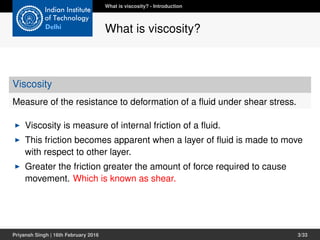
Measure of the resistance to deformation of a fluid under shear stress.
Viscosity is measure of internal friction of a fluid.
This friction becomes apparent when a layer of fluid is made to move
with respect to other layer.
Greater the friction greater the amount of force required to cause
movement. Which is known as shear.
What is viscosity? - Introduction
What is viscosity?
Priyansh Singh | 16th February 2016 3/33
fluid. This friction becomes apparent when a layer of
fluid is made to move in relation to another layer. The
greater the friction, the greater the amount of force re-
quired to cause this movement, which is called “shear.”
Shearing occurs whenever the fluid is physically moved
or distributed, as in pouring, spreading, spraying, mix-
ing, etc. Highly viscous fluids, therefore, require more
force to move than less viscous materials.
A
A
V2
V1
dv
dx
F
Figure 4-1
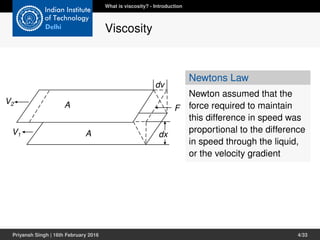
	 Isaac Newton defined viscosity by considering the
model represented in Figure 4-1. Two parallel flat
areas of fluid of the same size “A” are separated by a
distance “dx” and are moving in the same direction at
different velocities “V1” and “V2.” Newton assumed
that the force required to maintain this difference in
speed was proportional to the difference in speed
through the liquid, or the velocity gradient. To express
η = viscosity = =
τ
γ
s
s
.
	 The fundamental unit of viscos
“poise.” A material requiring a s
dyne per square centimeter to p
of one reciprocal second has a vis
or 100 centipoise. You will encou
surements expressed in “Pascal-
“milli-Pascal-seconds” (mPa•s); t
International System and are som
erence to the CGS designations.
is equal to ten poise; one milli-Pas
to one centipoise.
	 Newton assumed that all mater
temperature, a viscosity that is
shear rate. In other words, twice th
the fluid twice as fast.
	 As we shall see, Newton was o
4.3 Newtonian Fluids
	 This type of flow behavior whic
for all fluids is called, not surprisin
is, however, only one of several ty
you may encounter. A Newtonian
graphically in Figure 4-2. Grap
relationship between shear stres
Newtons Law
Newton assumed that the
force required to maintain
this difference in speed was
proportional to the difference
in speed through the liquid,
or the velocity gradient
What is viscosity? - Introduction
Viscosity
Priyansh Singh | 16th February 2016 4/33
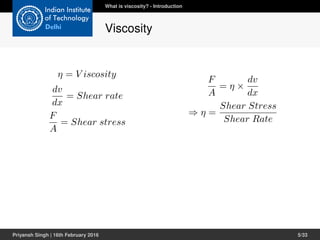
η = V iscosity
dv
dx
= Shear rate
F
A
= Shear stress
F
A
= η ×
dv
dx
⇒ η =
Shear Stress
Shear Rate
What is viscosity? - Introduction
Viscosity
Priyansh Singh | 16th February 2016 5/33
1 What is viscosity?
Introduction
Use of Viscosity
2 Different Methods
Empirical Methods
Absolute Methods
3 Brookfield Viscometer
Introduction
Working
Testing
What is viscosity? - Use of Viscosity
Table of contents
Priyansh Singh | 16th February 2016 6/33
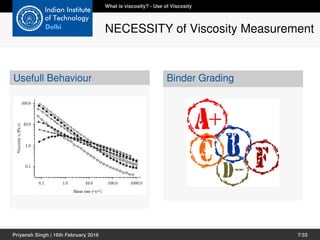
Usefull Behaviour Binder Grading
What is viscosity? - Use of Viscosity
NECESSITY of Viscosity Measurement
Priyansh Singh | 16th February 2016 7/33
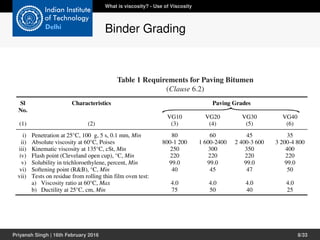
IS 73 : 2013
Table 1 Requirements for Paving Bitumen
(Clause 6.2)
Paving GradesSl
No.
Characteristics
VG10 VG20 VG30 VG40
Me
(1) (2) (3) (4) (5) (6)
i) Penetration at 25°C, 100 g, 5 s, 0.1 mm, Min 80 60 45 35 IS 1
ii) Absolute viscosity at 60°C, Poises 800-1 200 1 600-2400 2 400-3 600 3 200-4 800 IS 1
iii) Kinematic viscosity at 135°C, cSt, Min 250 300 350 400 IS 1
iv) Flash point (Cleveland open cup), °C, Min 220 220 220 220 IS 1
v) Solubility in trichloroethylene, percent, Min 99.0 99.0 99.0 99.0 IS 1
vi) Softening point (R&B), °C, Min 40 45 47 50 IS 1
vii) Tests on residue from rolling thin film oven test:
a) Viscosity ratio at 60°C, Max
b) Ductility at 25°C, cm, Min
4.0
75
4.0
50
4.0
40
4.0
25
IS 1
IS 1
precautions mentioned therein.All these samples from
individual containers shall be stored separately.
7.4 Number of Tests
8 PACKING AND MARKING
8.1 Packing
What is viscosity? - Use of Viscosity
Binder Grading
Priyansh Singh | 16th February 2016 8/33
Effect of Processing
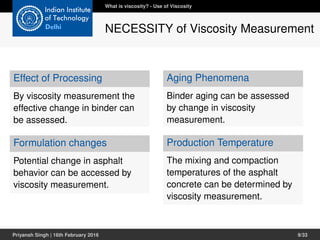
By viscosity measurement the
effective change in binder can
be assessed.
Formulation changes
Potential change in asphalt
behavior can be accessed by
viscosity measurement.
Aging Phenomena
Binder aging can be assessed
by change in viscosity
measurement.
Production Temperature
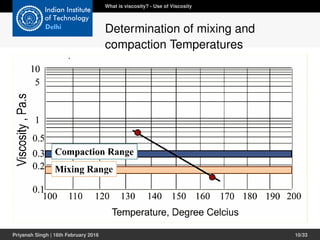
The mixing and compaction
temperatures of the asphalt
concrete can be determined by
viscosity measurement.
What is viscosity? - Use of Viscosity
NECESSITY of Viscosity Measurement
Priyansh Singh | 16th February 2016 9/33
What is viscosity? - Use of Viscosity
Determination of mixing and
compaction Temperatures
Priyansh Singh | 16th February 2016 10/33
1 What is viscosity?
Introduction
Use of Viscosity
2 Different Methods
Empirical Methods
Absolute Methods
3 Brookfield Viscometer
Introduction
Working
Testing
Different Methods - Empirical Methods
Table of contents
Priyansh Singh | 16th February 2016 11/33
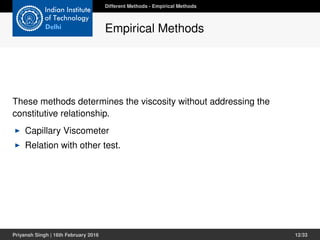
These methods determines the viscosity without addressing the
constitutive relationship.
Capillary Viscometer
Relation with other test.
Different Methods - Empirical Methods
Empirical Methods
Priyansh Singh | 16th February 2016 12/33
1 What is viscosity?
Introduction
Use of Viscosity
2 Different Methods
Empirical Methods
Absolute Methods
3 Brookfield Viscometer
Introduction
Working
Testing
Different Methods - Absolute Methods
Table of contents
Priyansh Singh | 16th February 2016 13/33
These methods uses the basic stress strain relationship to determine
viscosity of material.
Rotational Viscometer.
Shear Rheometer.
Different Methods - Absolute Methods
Absolute Methods
Priyansh Singh | 16th February 2016 14/33
1 What is viscosity?
Introduction
Use of Viscosity
2 Different Methods
Empirical Methods
Absolute Methods
3 Brookfield Viscometer
Introduction
Working
Testing
Brookfield Viscometer - Introduction
Table of contents
Priyansh Singh | 16th February 2016 15/33
Brookfield Viscometer - Introduction
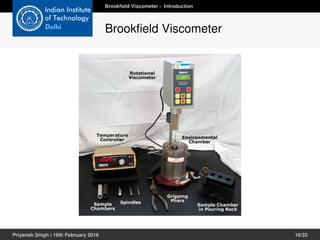
Brookfield Viscometer
Priyansh Singh | 16th February 2016 16/33
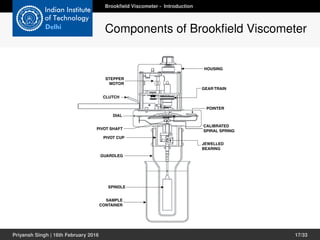
STEPPER
MOTOR
CLUTCH
DIAL
PIVOT SHAFT
PIVOT CUP
GUARDLEG
SPINDLE
SAMPLE
CONTAINER
HOUSING
GEAR TRAIN
POINTER
CALIBRATED
SPIRAL SPRING
JEWELLED
BEARING
Figure 3-1
over 80 years of c
sound foundation f
a starting point from
can be explored.
	 3.4.1 Record Ke
		 We recomm
tion always be
measurement;
cessory), rotatio
sions, sample te
sample prepara
or not the spind
Forms supplied
Viscometer are
	 3.4.2 The Spind
		 Examine ea
corroded or dam
dimensions, a f
Since all spindle
Brookfield Viscometer - Introduction
Components of Brookfield Viscometer
Priyansh Singh | 16th February 2016 17/33
1 What is viscosity?
Introduction
Use of Viscosity
2 Different Methods
Empirical Methods
Absolute Methods
3 Brookfield Viscometer
Introduction
Working
Testing
Brookfield Viscometer - Working
Table of contents
Priyansh Singh | 16th February 2016 18/33
Brookfield Viscometer - Working
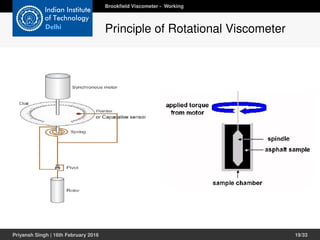
Principle of Rotational Viscometer
Priyansh Singh | 16th February 2016 19/33
It measures the torque required to rotate an immersed element
(Spindle) in a fluid.
Spindle is driven by a motor through a calibrated spring.
Deflection (tension) in spring is indicated by digital display.
For a given viscosity, viscosity drag or resistance to flow is
proportional to spindle speed of rotation.
Brookfield Viscometer - Working
Principle of Rotational Viscometer
Priyansh Singh | 16th February 2016 20/33
instrument (dyne-cm)
L = effective length of
spindle (cm)
(see Appendix A.4)
Rc
Rb
L
ω
Rc
should not exceed 2Rb
for well defined
5.1 Advanced Methods for Rheological Analysis	
	 As mentioned in Chapter 1, those who follow the
Academic school of thought on viscosity measurement
have more complex needs than those who follow the
Pragmatic or “Theoretical” schools. They need viscos-
ity data that are defined in rheological terms. This usu-
ally requires a complete mathematical description of
the Viscometer’s operating parameters and an analysis
of the rheological behavior of the fluid being studied.
	 Previous chapters have described various types of
fluid behavior and their relationship to measurements
made with Brookfield Viscometers/Rheometers and
accessories. The Appendix details the significant
operating parameters of this equipment and presents
simplified formulas for obtaining shear rate and shear
stress values. However, for many this information is
still inadequate to perform the type of analysis they
require. Having identified a particular flow behavior
and defined it mathematically, these people need more
information to understand how the fluid will react in a
certain situation, and how to control that reaction. If
is for these people that this chapter is provided.
	 In it you will find basic formulas from which the
simplified shear rate and shear stress information in
SHEAR STRESS
(dynes/cm2): τ =
M
2 π Rb2L
2 ω Rc2 Rb2
x2 (Rc2 — Rb2)
SHEAR RATE
(sec-1): = (1)
(2)
(3)
VISCOSITY
(poise): η =
τ
⋅γ
Definitions: ω = angular velocity of spindle
(rad/sec)
[ = N], N = RPM
Rc = radius of container (cm)
Rb = radius of spindle (cm)
x = radius at which shear rate
is being calculated (cm)
M = torque input by
instrument (dyne-cm)
L = effective length of
spindle (cm)
(see Appendix A.4)
2 π
60( )
⋅γ
CHAPTER 5: Data Analysis
system. If the dispersed phase has a tendency
to settle, producing a non-homogeneous fluid, the
rheological characteristics of the system will change.
In 	 most cases, this means that the measured
viscosity will decrease. Data acquired during such
conditions will usually be erroneous, necessitating
special precautions to ensure that the dispersed
phase remains in suspension.
Brookfield Viscometer - Working
Principle of Rotational Viscometer
Priyansh Singh | 16th February 2016 21/33
Brookfield Viscometer - Working
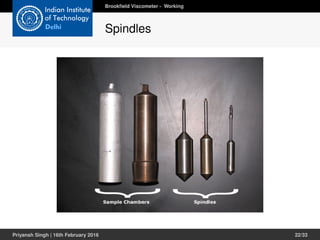
Spindles
Priyansh Singh | 16th February 2016 22/33
SC4 Series Spindle Dimensions
SIDE LENGTH
DIAMETER 	
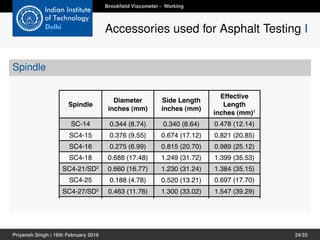
Spindle
Diameter
inches (mm)
Side Length
inches (mm)
Effective
Length
inches (mm)1
SC-14 0.344 (8.74) 0.340 (8.64) 0.478 (12.14)
SC4-15 0.376 (9.55) 0.674 (17.12) 0.821 (20.85)
SC4-16 0.275 (6.99) 0.815 (20.70) 0.989 (25.12)
SC4-18 0.688 (17.48) 1.249 (31.72) 1.399 (35.53)
SC4-21/SD2
0.660 (16.77) 1.230 (31.24) 1.384 (35.15)
SC4-25 0.188 (4.78) 0.520 (13.21) 0.697 (17.70)
SC4-27/SD2
0.463 (11.76) 1.300 (33.02) 1.547 (39.29)
SC4-28 0.370 (9.39) 1.260 (32.00) 1.480 (37.59)
SC4-29 0.300 (7.62) 1.070 (27.18) 1.250 (31.75)
SC4-31 0.463 (11.76) 0.990 (25.15) 1.208 (30.68)
SC4-34 0.370 (9.39) 0.954 (24.23) 1.156 (29.36)
SC4-DIN-82 0.6915 (17.56) 1.0373 (26.35) 1.237 (31.42)
SC4-DIN-83 0.4617 (11.73) 0.6926 (17.59) 0.826 (20.98)
	
	 1.	 Refer to Section 5.2.1.
	 2.	 The “SD” designation indicates that the spindle is also
available in a solid shaft configuration.
	
DIAMETER 	


	 SC4 Series Small Sample Chamber Dimensions
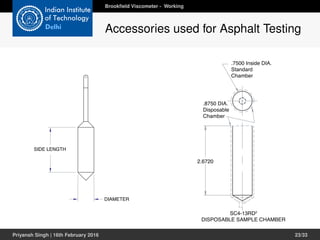
.7500 Inside DIA.
Standard
Chamber
2.6720
SC4-13RD2
DISPOSABLE SAMPLE CHAMBER
.8750 DIA.
Disposable
Chamber
		 1.	 The chamber is available with an optional e
Brookfield Viscometer - Working
Accessories used for Asphalt Testing
Priyansh Singh | 16th February 2016 23/33
Spindle
s
Spindle
Diameter
inches (mm)
Side Length
inches (mm)
Effective
Length
inches (mm)1
SC-14 0.344 (8.74) 0.340 (8.64) 0.478 (12.14)
SC4-15 0.376 (9.55) 0.674 (17.12) 0.821 (20.85)
SC4-16 0.275 (6.99) 0.815 (20.70) 0.989 (25.12)
SC4-18 0.688 (17.48) 1.249 (31.72) 1.399 (35.53)
SC4-21/SD2
0.660 (16.77) 1.230 (31.24) 1.384 (35.15)
SC4-25 0.188 (4.78) 0.520 (13.21) 0.697 (17.70)
SC4-27/SD2
0.463 (11.76) 1.300 (33.02) 1.547 (39.29)
SC4-28 0.370 (9.39) 1.260 (32.00) 1.480 (37.59)
SC4-29 0.300 (7.62) 1.070 (27.18) 1.250 (31.75)
SC4-31 0.463 (11.76) 0.990 (25.15) 1.208 (30.68)
SC4-34 0.370 (9.39) 0.954 (24.23) 1.156 (29.36)
Brookfield Viscometer - Working
Accessories used for Asphalt Testing I
Priyansh Singh | 16th February 2016 24/33
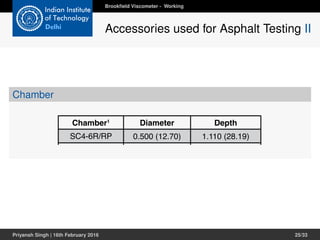
Chamber
er Dimensions
Dimensions are in inches (mm).
Chamber1
Diameter Depth
SC4-6R/RP 0.500 (12.70) 1.110 (28.19)
SC4-7R/RP 0.501 (12.73) 1.745 (44.32)
SC4-8R/RP 0.515 (13.08) 1.584 (40.23)
SC4-13R/RP 0.750 (19.05) 2.550 (64.77)
Brookfield Viscometer - Working
Accessories used for Asphalt Testing II
Priyansh Singh | 16th February 2016 25/33
1 What is viscosity?
Introduction
Use of Viscosity
2 Different Methods
Empirical Methods
Absolute Methods
3 Brookfield Viscometer
Introduction
Working
Testing
Brookfield Viscometer - Testing
Table of contents
Priyansh Singh | 16th February 2016 26/33
Spindle Selection
RPM Selection / Shear Rate /torque
Brookfield Viscometer - Testing
Test Parameters
Priyansh Singh | 16th February 2016 27/33
Single Point Viscosity Test
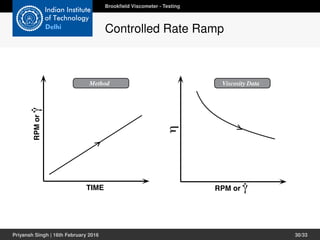
Controlled Rate Ramp
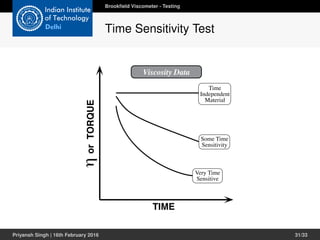
Time Sensitivity Test
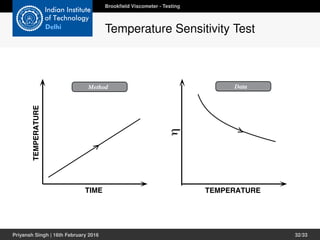
Temperature Sensitivity Test
And lots of more...
Brookfield Viscometer - Testing
Different Types of Test
Priyansh Singh | 16th February 2016 28/33
Choose a spindle.
Select a rotational speed or shear rate.
Control temperature if required.
Specify how long the spindle rotates before making the measurement.
Make sure the torque reading is > 10%
Record the viscosity value in cP or mPa.s.
Record sample temperature.
Brookfield Viscometer - Testing
Single Point Viscosity Test
Priyansh Singh | 16th February 2016 29/33
ing the measurement.
•	 Record data at each speed or shear rate, similar
to the method defined above in “SINGLE POINT”.
•	 Try to keep the torque readings above 10%, if
possible.
Viscosity Data
RPM or γ
.
RPMorγ
.
Method
η
TIME
Figure 6-1
This method shows one example of how viscosity can
.
Thi
fun
6.4
Brookfield Viscometer - Testing
Controlled Rate Ramp
Priyansh Singh | 16th February 2016 30/33
Viscosity Data
ηorTORQUE
TIME
Some Time
Sensitivity
Time
Independent
Material
Very Time
Sensitive
Figure 6-3
Brookfield Viscometer - Testing
Time Sensitivity Test
Priyansh Singh | 16th February 2016 31/33
•	 Choose a starting minimum temperature and an
end point maximum temperature.
•	 Record viscosity values at discrete temperature
setpoints; allow the material time to stabilize at
each temperature setpoint.
Data
TEMPERATURE
η
TEMPERATURE
Method
TIME
Figure 6-4
	 Most materials exhibit decreasing viscosity behavior
	 T
y
f
6.8
	 U
Brookfield Viscometer - Testing
Temperature Sensitivity Test
Priyansh Singh | 16th February 2016 32/33
The system should be leveled before any testing.
Select Spindle and set it in control panel before starting the test.
Take reading when temperature is constant.
The torque should be between 10 to 90 % at the time of observation.
Use of Rheocalc c software is recommended instead of manual
readings.
Whenever possible take readings from higher to lower temperature.
Thanks
Brookfield Viscometer - Testing
Remember...
Priyansh Singh | 16th February 2016 33/33

Viscosity of Binder at Elevated Temperature Using Brookfield Viscometer

  • 1.
    Viscosity of Binderat Elevated Temperature Using Brookfield Viscometer Priyansh Singh 16th February 2016 Priyansh Singh | 16th February 2016 0/33 Viscosity of Binder at Elevated Temperature Using Brookfield Viscometer Priyansh Singh | 16th February 2016 1/33
  • 2.
    1 What isviscosity? Introduction Use of Viscosity 2 Different Methods Empirical Methods Absolute Methods 3 Brookfield Viscometer Introduction Working Testing What is viscosity? - Introduction Table of contents Priyansh Singh | 16th February 2016 2/33
  • 3.
    Viscosity Measure of theresistance to deformation of a fluid under shear stress. Viscosity is measure of internal friction of a fluid. This friction becomes apparent when a layer of fluid is made to move with respect to other layer. Greater the friction greater the amount of force required to cause movement. Which is known as shear. What is viscosity? - Introduction What is viscosity? Priyansh Singh | 16th February 2016 3/33
  • 4.
    fluid. This frictionbecomes apparent when a layer of fluid is made to move in relation to another layer. The greater the friction, the greater the amount of force re- quired to cause this movement, which is called “shear.” Shearing occurs whenever the fluid is physically moved or distributed, as in pouring, spreading, spraying, mix- ing, etc. Highly viscous fluids, therefore, require more force to move than less viscous materials. A A V2 V1 dv dx F Figure 4-1 Isaac Newton defined viscosity by considering the model represented in Figure 4-1. Two parallel flat areas of fluid of the same size “A” are separated by a distance “dx” and are moving in the same direction at different velocities “V1” and “V2.” Newton assumed that the force required to maintain this difference in speed was proportional to the difference in speed through the liquid, or the velocity gradient. To express η = viscosity = = τ γ s s . The fundamental unit of viscos “poise.” A material requiring a s dyne per square centimeter to p of one reciprocal second has a vis or 100 centipoise. You will encou surements expressed in “Pascal- “milli-Pascal-seconds” (mPa•s); t International System and are som erence to the CGS designations. is equal to ten poise; one milli-Pas to one centipoise. Newton assumed that all mater temperature, a viscosity that is shear rate. In other words, twice th the fluid twice as fast. As we shall see, Newton was o 4.3 Newtonian Fluids This type of flow behavior whic for all fluids is called, not surprisin is, however, only one of several ty you may encounter. A Newtonian graphically in Figure 4-2. Grap relationship between shear stres Newtons Law Newton assumed that the force required to maintain this difference in speed was proportional to the difference in speed through the liquid, or the velocity gradient What is viscosity? - Introduction Viscosity Priyansh Singh | 16th February 2016 4/33
  • 5.
    η = Viscosity dv dx = Shear rate F A = Shear stress F A = η × dv dx ⇒ η = Shear Stress Shear Rate What is viscosity? - Introduction Viscosity Priyansh Singh | 16th February 2016 5/33
  • 6.
    1 What isviscosity? Introduction Use of Viscosity 2 Different Methods Empirical Methods Absolute Methods 3 Brookfield Viscometer Introduction Working Testing What is viscosity? - Use of Viscosity Table of contents Priyansh Singh | 16th February 2016 6/33
  • 7.
    Usefull Behaviour BinderGrading What is viscosity? - Use of Viscosity NECESSITY of Viscosity Measurement Priyansh Singh | 16th February 2016 7/33
  • 8.
    IS 73 :2013 Table 1 Requirements for Paving Bitumen (Clause 6.2) Paving GradesSl No. Characteristics VG10 VG20 VG30 VG40 Me (1) (2) (3) (4) (5) (6) i) Penetration at 25°C, 100 g, 5 s, 0.1 mm, Min 80 60 45 35 IS 1 ii) Absolute viscosity at 60°C, Poises 800-1 200 1 600-2400 2 400-3 600 3 200-4 800 IS 1 iii) Kinematic viscosity at 135°C, cSt, Min 250 300 350 400 IS 1 iv) Flash point (Cleveland open cup), °C, Min 220 220 220 220 IS 1 v) Solubility in trichloroethylene, percent, Min 99.0 99.0 99.0 99.0 IS 1 vi) Softening point (R&B), °C, Min 40 45 47 50 IS 1 vii) Tests on residue from rolling thin film oven test: a) Viscosity ratio at 60°C, Max b) Ductility at 25°C, cm, Min 4.0 75 4.0 50 4.0 40 4.0 25 IS 1 IS 1 precautions mentioned therein.All these samples from individual containers shall be stored separately. 7.4 Number of Tests 8 PACKING AND MARKING 8.1 Packing What is viscosity? - Use of Viscosity Binder Grading Priyansh Singh | 16th February 2016 8/33
  • 9.
    Effect of Processing Byviscosity measurement the effective change in binder can be assessed. Formulation changes Potential change in asphalt behavior can be accessed by viscosity measurement. Aging Phenomena Binder aging can be assessed by change in viscosity measurement. Production Temperature The mixing and compaction temperatures of the asphalt concrete can be determined by viscosity measurement. What is viscosity? - Use of Viscosity NECESSITY of Viscosity Measurement Priyansh Singh | 16th February 2016 9/33
  • 10.
    What is viscosity?- Use of Viscosity Determination of mixing and compaction Temperatures Priyansh Singh | 16th February 2016 10/33
  • 11.
    1 What isviscosity? Introduction Use of Viscosity 2 Different Methods Empirical Methods Absolute Methods 3 Brookfield Viscometer Introduction Working Testing Different Methods - Empirical Methods Table of contents Priyansh Singh | 16th February 2016 11/33
  • 12.
    These methods determinesthe viscosity without addressing the constitutive relationship. Capillary Viscometer Relation with other test. Different Methods - Empirical Methods Empirical Methods Priyansh Singh | 16th February 2016 12/33
  • 13.
    1 What isviscosity? Introduction Use of Viscosity 2 Different Methods Empirical Methods Absolute Methods 3 Brookfield Viscometer Introduction Working Testing Different Methods - Absolute Methods Table of contents Priyansh Singh | 16th February 2016 13/33
  • 14.
    These methods usesthe basic stress strain relationship to determine viscosity of material. Rotational Viscometer. Shear Rheometer. Different Methods - Absolute Methods Absolute Methods Priyansh Singh | 16th February 2016 14/33
  • 15.
    1 What isviscosity? Introduction Use of Viscosity 2 Different Methods Empirical Methods Absolute Methods 3 Brookfield Viscometer Introduction Working Testing Brookfield Viscometer - Introduction Table of contents Priyansh Singh | 16th February 2016 15/33
  • 16.
    Brookfield Viscometer -Introduction Brookfield Viscometer Priyansh Singh | 16th February 2016 16/33
  • 17.
    STEPPER MOTOR CLUTCH DIAL PIVOT SHAFT PIVOT CUP GUARDLEG SPINDLE SAMPLE CONTAINER HOUSING GEARTRAIN POINTER CALIBRATED SPIRAL SPRING JEWELLED BEARING Figure 3-1 over 80 years of c sound foundation f a starting point from can be explored. 3.4.1 Record Ke We recomm tion always be measurement; cessory), rotatio sions, sample te sample prepara or not the spind Forms supplied Viscometer are 3.4.2 The Spind Examine ea corroded or dam dimensions, a f Since all spindle Brookfield Viscometer - Introduction Components of Brookfield Viscometer Priyansh Singh | 16th February 2016 17/33
  • 18.
    1 What isviscosity? Introduction Use of Viscosity 2 Different Methods Empirical Methods Absolute Methods 3 Brookfield Viscometer Introduction Working Testing Brookfield Viscometer - Working Table of contents Priyansh Singh | 16th February 2016 18/33
  • 19.
    Brookfield Viscometer -Working Principle of Rotational Viscometer Priyansh Singh | 16th February 2016 19/33
  • 20.
    It measures thetorque required to rotate an immersed element (Spindle) in a fluid. Spindle is driven by a motor through a calibrated spring. Deflection (tension) in spring is indicated by digital display. For a given viscosity, viscosity drag or resistance to flow is proportional to spindle speed of rotation. Brookfield Viscometer - Working Principle of Rotational Viscometer Priyansh Singh | 16th February 2016 20/33
  • 21.
    instrument (dyne-cm) L =effective length of spindle (cm) (see Appendix A.4) Rc Rb L ω Rc should not exceed 2Rb for well defined 5.1 Advanced Methods for Rheological Analysis As mentioned in Chapter 1, those who follow the Academic school of thought on viscosity measurement have more complex needs than those who follow the Pragmatic or “Theoretical” schools. They need viscos- ity data that are defined in rheological terms. This usu- ally requires a complete mathematical description of the Viscometer’s operating parameters and an analysis of the rheological behavior of the fluid being studied. Previous chapters have described various types of fluid behavior and their relationship to measurements made with Brookfield Viscometers/Rheometers and accessories. The Appendix details the significant operating parameters of this equipment and presents simplified formulas for obtaining shear rate and shear stress values. However, for many this information is still inadequate to perform the type of analysis they require. Having identified a particular flow behavior and defined it mathematically, these people need more information to understand how the fluid will react in a certain situation, and how to control that reaction. If is for these people that this chapter is provided. In it you will find basic formulas from which the simplified shear rate and shear stress information in SHEAR STRESS (dynes/cm2): τ = M 2 π Rb2L 2 ω Rc2 Rb2 x2 (Rc2 — Rb2) SHEAR RATE (sec-1): = (1) (2) (3) VISCOSITY (poise): η = τ ⋅γ Definitions: ω = angular velocity of spindle (rad/sec) [ = N], N = RPM Rc = radius of container (cm) Rb = radius of spindle (cm) x = radius at which shear rate is being calculated (cm) M = torque input by instrument (dyne-cm) L = effective length of spindle (cm) (see Appendix A.4) 2 π 60( ) ⋅γ CHAPTER 5: Data Analysis system. If the dispersed phase has a tendency to settle, producing a non-homogeneous fluid, the rheological characteristics of the system will change. In most cases, this means that the measured viscosity will decrease. Data acquired during such conditions will usually be erroneous, necessitating special precautions to ensure that the dispersed phase remains in suspension. Brookfield Viscometer - Working Principle of Rotational Viscometer Priyansh Singh | 16th February 2016 21/33
  • 22.
    Brookfield Viscometer -Working Spindles Priyansh Singh | 16th February 2016 22/33
  • 23.
    SC4 Series SpindleDimensions SIDE LENGTH DIAMETER Spindle Diameter inches (mm) Side Length inches (mm) Effective Length inches (mm)1 SC-14 0.344 (8.74) 0.340 (8.64) 0.478 (12.14) SC4-15 0.376 (9.55) 0.674 (17.12) 0.821 (20.85) SC4-16 0.275 (6.99) 0.815 (20.70) 0.989 (25.12) SC4-18 0.688 (17.48) 1.249 (31.72) 1.399 (35.53) SC4-21/SD2 0.660 (16.77) 1.230 (31.24) 1.384 (35.15) SC4-25 0.188 (4.78) 0.520 (13.21) 0.697 (17.70) SC4-27/SD2 0.463 (11.76) 1.300 (33.02) 1.547 (39.29) SC4-28 0.370 (9.39) 1.260 (32.00) 1.480 (37.59) SC4-29 0.300 (7.62) 1.070 (27.18) 1.250 (31.75) SC4-31 0.463 (11.76) 0.990 (25.15) 1.208 (30.68) SC4-34 0.370 (9.39) 0.954 (24.23) 1.156 (29.36) SC4-DIN-82 0.6915 (17.56) 1.0373 (26.35) 1.237 (31.42) SC4-DIN-83 0.4617 (11.73) 0.6926 (17.59) 0.826 (20.98) 1. Refer to Section 5.2.1. 2. The “SD” designation indicates that the spindle is also available in a solid shaft configuration. DIAMETER SC4 Series Small Sample Chamber Dimensions .7500 Inside DIA. Standard Chamber 2.6720 SC4-13RD2 DISPOSABLE SAMPLE CHAMBER .8750 DIA. Disposable Chamber 1. The chamber is available with an optional e Brookfield Viscometer - Working Accessories used for Asphalt Testing Priyansh Singh | 16th February 2016 23/33
  • 24.
    Spindle s Spindle Diameter inches (mm) Side Length inches(mm) Effective Length inches (mm)1 SC-14 0.344 (8.74) 0.340 (8.64) 0.478 (12.14) SC4-15 0.376 (9.55) 0.674 (17.12) 0.821 (20.85) SC4-16 0.275 (6.99) 0.815 (20.70) 0.989 (25.12) SC4-18 0.688 (17.48) 1.249 (31.72) 1.399 (35.53) SC4-21/SD2 0.660 (16.77) 1.230 (31.24) 1.384 (35.15) SC4-25 0.188 (4.78) 0.520 (13.21) 0.697 (17.70) SC4-27/SD2 0.463 (11.76) 1.300 (33.02) 1.547 (39.29) SC4-28 0.370 (9.39) 1.260 (32.00) 1.480 (37.59) SC4-29 0.300 (7.62) 1.070 (27.18) 1.250 (31.75) SC4-31 0.463 (11.76) 0.990 (25.15) 1.208 (30.68) SC4-34 0.370 (9.39) 0.954 (24.23) 1.156 (29.36) Brookfield Viscometer - Working Accessories used for Asphalt Testing I Priyansh Singh | 16th February 2016 24/33
  • 25.
    Chamber er Dimensions Dimensions arein inches (mm). Chamber1 Diameter Depth SC4-6R/RP 0.500 (12.70) 1.110 (28.19) SC4-7R/RP 0.501 (12.73) 1.745 (44.32) SC4-8R/RP 0.515 (13.08) 1.584 (40.23) SC4-13R/RP 0.750 (19.05) 2.550 (64.77) Brookfield Viscometer - Working Accessories used for Asphalt Testing II Priyansh Singh | 16th February 2016 25/33
  • 26.
    1 What isviscosity? Introduction Use of Viscosity 2 Different Methods Empirical Methods Absolute Methods 3 Brookfield Viscometer Introduction Working Testing Brookfield Viscometer - Testing Table of contents Priyansh Singh | 16th February 2016 26/33
  • 27.
    Spindle Selection RPM Selection/ Shear Rate /torque Brookfield Viscometer - Testing Test Parameters Priyansh Singh | 16th February 2016 27/33
  • 28.
    Single Point ViscosityTest Controlled Rate Ramp Time Sensitivity Test Temperature Sensitivity Test And lots of more... Brookfield Viscometer - Testing Different Types of Test Priyansh Singh | 16th February 2016 28/33
  • 29.
    Choose a spindle. Selecta rotational speed or shear rate. Control temperature if required. Specify how long the spindle rotates before making the measurement. Make sure the torque reading is > 10% Record the viscosity value in cP or mPa.s. Record sample temperature. Brookfield Viscometer - Testing Single Point Viscosity Test Priyansh Singh | 16th February 2016 29/33
  • 30.
    ing the measurement. • Record data at each speed or shear rate, similar to the method defined above in “SINGLE POINT”. • Try to keep the torque readings above 10%, if possible. Viscosity Data RPM or γ . RPMorγ . Method η TIME Figure 6-1 This method shows one example of how viscosity can . Thi fun 6.4 Brookfield Viscometer - Testing Controlled Rate Ramp Priyansh Singh | 16th February 2016 30/33
  • 31.
    Viscosity Data ηorTORQUE TIME Some Time Sensitivity Time Independent Material VeryTime Sensitive Figure 6-3 Brookfield Viscometer - Testing Time Sensitivity Test Priyansh Singh | 16th February 2016 31/33
  • 32.
    • Choose astarting minimum temperature and an end point maximum temperature. • Record viscosity values at discrete temperature setpoints; allow the material time to stabilize at each temperature setpoint. Data TEMPERATURE η TEMPERATURE Method TIME Figure 6-4 Most materials exhibit decreasing viscosity behavior T y f 6.8 U Brookfield Viscometer - Testing Temperature Sensitivity Test Priyansh Singh | 16th February 2016 32/33
  • 33.
    The system shouldbe leveled before any testing. Select Spindle and set it in control panel before starting the test. Take reading when temperature is constant. The torque should be between 10 to 90 % at the time of observation. Use of Rheocalc c software is recommended instead of manual readings. Whenever possible take readings from higher to lower temperature. Thanks Brookfield Viscometer - Testing Remember... Priyansh Singh | 16th February 2016 33/33