DEPARTMENT OF VETERINARY MICROBIOLOGY
DNA VIRUS REPLICATION
Dr Bhagraj Godara
Follow on insta - bishnoi_rj19
INTRODUCTION
 Replication of virus is very complicated process.
 Virus never reproduce by division.
 They are replicated by a process in which all
components of virus are produced separately
and are assembled into intact virion.
 For replication of virus host is necessary.
 Virus are host specific.
 Host may be bacteria, plant ,animal.
PARVOVIRUS SS linear -
PAPOVAVIRUS DS, circular -
ADENOVIRUS DS, linear -
HERPESVIRUS DS, linear +
POXVIRUS DS, linear +
HEPADNAVIRUS DS, circular +
DNA VIRUS GENOME Env
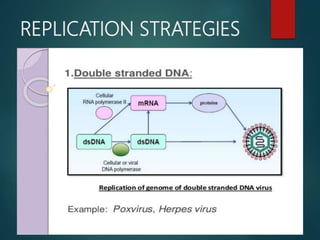
REPLICATION STRATEGIES
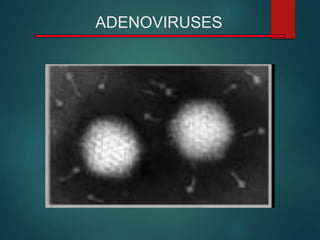
ADENOVIRUSES
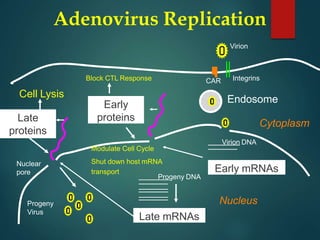
Adenovirus Replication
Endosome
Late mRNAs
Early mRNAs
Early
proteinsLate
proteins
Virion
IntegrinsCAR
Virion DNA
Modulate Cell Cycle
Shut down host mRNA
transport
Progeny DNA
Cell Lysis
Block CTL Response
Progeny
Virus
Nuclear
pore
Nucleus
Cytoplasm
ADENOVIRUS REPLICATION
As a general rule all DNA viruses replicate in the nucleus,
except the Pox viruses which replicate in the cytoplasm
We will use Adenoviruses as a model system for
understanding replication of DNA viruses in general
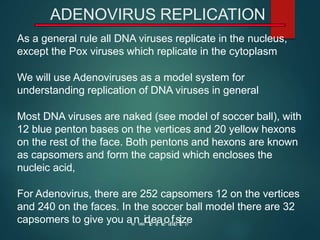
Most DNA viruses are naked (see model of soccer ball), with
12 blue penton bases on the vertices and 20 yellow hexons
on the rest of the face. Both pentons and hexons are known
as capsomers and form the capsid which encloses the
nucleic acid,
For Adenovirus, there are 252 capsomers 12 on the vertices
and 240 on the faces. In the soccer ball model there are 32
capsomers to give you awnwwid.freeelaiveodofctosr.iczoe
In adenovirus, the first step involves attachment of the fiber to
a host cell receptor.
This is called the CAR (coxsackie-adenovirus receptor).
Then after entry the particle moves into an endosomal vesicle
to the nucleus where the DNA is uncoated into the nucleus
through the nuclear pore.
This sets up the general replication scheme: first of enzymes
to help the virus replicate (early stage), then double-stranded
DNA replication (semi-conservative mode) begins (late stage),
followed by translation of structural proteins, such as the
penton and hexon precursors.
STAGES OF ADENO REPLICATION I
STAGES OF ADENO REPLICATION II
After translation the proteins accumulate in the nucleus
and together with newly made (nascent) viral DNA
assembly into virions.
After 2-3 days of accumulation the cells lyse and release
several hundred adenovirus particles in a burst.
HERPESVIRUSES
octor.com
HERPES REPLICATION
They encode their own viral DNA polymerase, as well as other
enzymes, such as thymidine kinase
Due to specificity and differences of these enzymes from that of
the host, this has allowed development of targeted antivirals,
such as acyclovir and ganciclovir
Terminal inverted repeats allow circularization. Replicate as a
rolling circle, producing concatemeric DNA (multiple copies of the
genome covalently linked end-to end)
Concatemers cleaved to yield genome-size pieces and packaged
into an icosahedral nucleocapsid. Genome has long (L) and
short (S) segments, assorted into 4 isomeric forms
(isoschizomers)
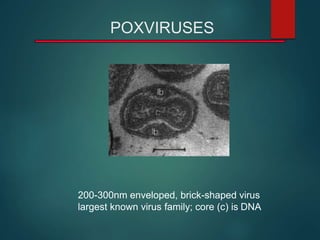
POXVIRUSES
200-300nm enveloped, brick-shaped virus
largest known virus family; core (c) is DNA
Replication of Poxviruses
w edoctor.com
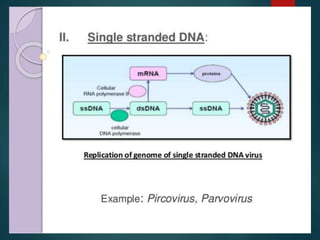
PARVOVIRUSES
Small (22nm) naked single stranded (SS) DNA viruses.There are
two major subgroups: i) autonomous replicating and
ii)dependoviruses.
DNA VIRUS REPLICATION

DNA VIRUS REPLICATION

  • 1.
    DEPARTMENT OF VETERINARYMICROBIOLOGY DNA VIRUS REPLICATION Dr Bhagraj Godara Follow on insta - bishnoi_rj19
  • 2.
    INTRODUCTION  Replication ofvirus is very complicated process.  Virus never reproduce by division.  They are replicated by a process in which all components of virus are produced separately and are assembled into intact virion.  For replication of virus host is necessary.  Virus are host specific.  Host may be bacteria, plant ,animal.
  • 3.
    PARVOVIRUS SS linear- PAPOVAVIRUS DS, circular - ADENOVIRUS DS, linear - HERPESVIRUS DS, linear + POXVIRUS DS, linear + HEPADNAVIRUS DS, circular + DNA VIRUS GENOME Env
  • 4.
  • 6.
  • 7.
    Adenovirus Replication Endosome Late mRNAs EarlymRNAs Early proteinsLate proteins Virion IntegrinsCAR Virion DNA Modulate Cell Cycle Shut down host mRNA transport Progeny DNA Cell Lysis Block CTL Response Progeny Virus Nuclear pore Nucleus Cytoplasm
  • 8.
    ADENOVIRUS REPLICATION As ageneral rule all DNA viruses replicate in the nucleus, except the Pox viruses which replicate in the cytoplasm We will use Adenoviruses as a model system for understanding replication of DNA viruses in general Most DNA viruses are naked (see model of soccer ball), with 12 blue penton bases on the vertices and 20 yellow hexons on the rest of the face. Both pentons and hexons are known as capsomers and form the capsid which encloses the nucleic acid, For Adenovirus, there are 252 capsomers 12 on the vertices and 240 on the faces. In the soccer ball model there are 32 capsomers to give you awnwwid.freeelaiveodofctosr.iczoe
  • 9.
    In adenovirus, thefirst step involves attachment of the fiber to a host cell receptor. This is called the CAR (coxsackie-adenovirus receptor). Then after entry the particle moves into an endosomal vesicle to the nucleus where the DNA is uncoated into the nucleus through the nuclear pore. This sets up the general replication scheme: first of enzymes to help the virus replicate (early stage), then double-stranded DNA replication (semi-conservative mode) begins (late stage), followed by translation of structural proteins, such as the penton and hexon precursors. STAGES OF ADENO REPLICATION I
  • 10.
    STAGES OF ADENOREPLICATION II After translation the proteins accumulate in the nucleus and together with newly made (nascent) viral DNA assembly into virions. After 2-3 days of accumulation the cells lyse and release several hundred adenovirus particles in a burst.
  • 11.
  • 12.
  • 13.
    HERPES REPLICATION They encodetheir own viral DNA polymerase, as well as other enzymes, such as thymidine kinase Due to specificity and differences of these enzymes from that of the host, this has allowed development of targeted antivirals, such as acyclovir and ganciclovir Terminal inverted repeats allow circularization. Replicate as a rolling circle, producing concatemeric DNA (multiple copies of the genome covalently linked end-to end) Concatemers cleaved to yield genome-size pieces and packaged into an icosahedral nucleocapsid. Genome has long (L) and short (S) segments, assorted into 4 isomeric forms (isoschizomers)
  • 14.
    POXVIRUSES 200-300nm enveloped, brick-shapedvirus largest known virus family; core (c) is DNA
  • 15.
  • 16.
    PARVOVIRUSES Small (22nm) nakedsingle stranded (SS) DNA viruses.There are two major subgroups: i) autonomous replicating and ii)dependoviruses.