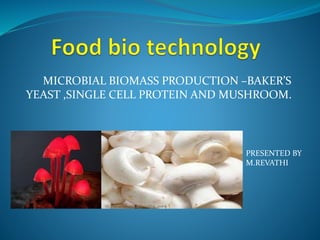
MICROBIAL BIOMASS PRODUCTION –BAKER’S 
YEAST ,SINGLE CELL PROTEIN AND MUSHROOM. 
PRESENTED BY 
M.REVATHI
INTRODUCTION 
 Yeast cells are small in size (5-8m) ,the density of which reaches 
to 1.1g/ml . 
 World production of yeast biomass is of the order of 0.4 million 
metric tonnes per annum including 0.2 million tones baker’s yeast 
alone. 
 Yeasts synthesize amino acids from inorganic acids and sulphur 
supplemented in the form of salts . They get carbon and energy 
sources from the organic wastes ,e .g , molasses , starchy materials , 
milk whey ,fruit pulp , wood pulp and sulphite liquor . 
Yield of yeast biomass is greatly affected by many factors similar 
to bacteria . Like growth nutrients , organic wastes ,temperature , 
culture , oxygen, etc.
FACTORS AFFECTING YIELD OF 
BIOMASS 
 Like bacteria , growth and yield of yeasts are also affected 
by the following factors: 
1 .organic substrate and nitrogen ratio ( optimum c:n ratio 
favouring high protein content should be between 7:1 
and 10:1 . 
2. PH of nutrient medium (PH should be in the range of 
3.5 to 4.5 to minimize growth of bacterial contaminants). 
3. Temperature 
(Differs from organism to organism) 
Most yeasts have specific growth rate in the range of 300c- 
340c 
. Some strains also grow in the range of 40- 450c
4. Oxygen (for growth on carbohydrates ) , o2 required 
should be 1g/g of dried cells , and for growth on n- alkanes 
it should be about 2 g /g dried cells . 
5. Maintenance of sterile condition through out the process 
and , 
6. Suitable strain of yeast. 
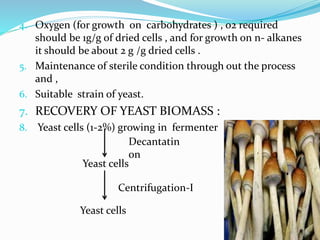
7. RECOVERY OF YEAST BIOMASS : 
8. Yeast cells (1-2%) growing in fermenter 
Decantatin 
on 
Yeast cells 
Centrifugation-I 
Yeast cells
CONT….. 
Centrifugation-II 
Yeast cells 
Centrifugation-III 
Yeast cells 
Washing with water , 
Centrifugation-III 
Yeast cells (2-1% water) 
Vaccum filter 
Dry yeast biomass
BAKER’S YEAST 
 Yeasts are economically the most important group of 
organisms . 
 For e.g saccharomyces and candida have been associated 
with the economic progress . 
 The industrially important products of yeast like ethanol , 
which is used as beverage , solvent , chemical feed stock , 
motor fuel , in feed and pharmaceutical purposes. 
Elucidation of basic biochemical , setabolic and genetic 
processes in living systems . 
 Yeast is not only used as a source of protein , but also as 
Source of enzymes , vitamins , flavourants ,and also as a 
leavening agent.
 A good leavening activity of yeast give good yield in dough 
fermentation. 
(A) Increasing dough volume . 
(B) To develop structure and texture . 
(C) Impart distinctive flavour and , 
(D) To enhance nutritive value in read and other fermented foods 
. 
(E) In the parts of central Europe , and also great Britain and USA 
,there was a great deal of research into the production and 
properties of baker’s yeast with stable characteristics . There 
are three types of baker’ s yeast produced commercially , 
namely :
(1) Wet compressed yeast (WCY). 
(2) Active dry yeast (ADY). 
(3) Instant yeast (ITY). 
The art of making baker’s yeast using grains were made in 
Holland , Germany and Austria during the last country . 
CHARACTERISTICS OF BAKER’S YEAST : 
The baker’s yeast should have good storage stability , high c:n 
ratio , well matured cells , and should impart good spongy 
structure in dough by co2 and also flavour . 
The yeast must be suitable for aerobic cultivation on molasses , 
grow well and give a good yield as high as 0.567g of yeast per g of 
glucose.
 The product should have a light colour and fresh smell. 
The cells should be separate and of even size . 
 They should have a good leavening activity that is not 
rapidly lost on storage . 
 The genetic stability 
 of the strain used must be good and the stock culture must 
be stored so that its original properties remain unchanged 
. 
 The original strain must be stored under conditions , 
where only little growth occurs and must be maintained 
by reselection.
BAKER’S YEAST PRODUCTION 
Diluted and clarified molasses (15% sugars) 
Nutrients( N ,P, K, Mg, vitamins) 
Molasses medium (PH 4.5) 
Fermentation 14 to 16 hrs 
Air 
Yeast inoculum 
Cooling, agitation, pH temperature, 
controls and antifoam device 
Harvesting by yeast seperator
Yeast cream (20% solids) 
CONT.... 
Filtration (Plate and frame 
filter press) 
Yeast cake (25% solids) 
mixing 
Protective agents
CONT.... 
Extrusion 
Yeast )cakes (500 g 
Wrapped in wax paper 
Wet compressed yeast 
Storage at 40 C 
Yeast strands (0.5 to 3.5mm dia) 
Drying to 8% moisture 
Fill in cans under nitrogen atmosphere 
Active dry yeast
Refrigerated transport 
To bakeries 
Storage of ambient/ refrigerated conditions 
To bakeries 
CONT.... 
Flow sheet for production of bakers yeast
SINGLE CELL PROTEINS 
 One approach to produce single cell protein was the use of 
petroleum products. 
 It is also to some extent effected by the safety considerations , 
needing rigorous testing rather emphasis has been shifted 
towards animal feed than developing human food. 
 The alternative sources like cellulosic material , food processing 
waste or other such material for production of single cell 
proteins is being encouraged. 
 Use of techniques like solid state fermentation in production 
of protein enriched foods or the enzyme which could be used 
for bioconversion , has successfully been made.
 Extraction of protein from non- conventional sources like 
wine lees e.g could become a source of protein compared to 
that obtained from conventional sources like fish , oil , seeds 
and leaves . 
 MUSHROOMS AS A SOURCE OF PROTEIN : 
 Mushrooms are fruiting bodies of certain Basidiomycetous 
fungi . 
 Mushrooms with pleasant flavour and high protein content 
are consumed directly as food in the form of soup ,curry 
with meat . 
 Basidiomycetes or mushroom type fungi have the ability to 
degrade lignocellulose material like wood , straws , sawdust 
and rice bran .
 The cultivation of edible mushrooms is one of the examples 
of a microbial culture in which the cultivated organism itself 
is a macroscopic , highly developed umbrella like structure , 
directly utilized as human food . 
 PRODUCTION OF MUSHROOM : 
 The production of mushroom is a fermentation process where 
the lignocellulose material is composted with suitable 
ingredients (like animal manures and other organic nitrogen 
compounds ) over a specific time , the final product is a unique 
substrate utilized by the spores present in the inoculum 
(spawn) to develop into edible mushrooms under certain 
requisite conditions that includes sterilization , addition of 
insecticides,
Maintenance of temperature and humidity , etc. 
The production of mushroom carries several advantages; 
few of them are as follows , 
1. Their process of production is simple and easy . 
2. Low cost substrates are utilized for their production . 
3. Edible mushrooms are rich sources of protein . 
4. During the process of cultivation of mushrooms , the 
plant residues and waste lignins are converted to useful 
edible material . 
5. Mushroom protect the enviornment from lignin derived 
pollutants.
THANK YOU

Single cell protein.

  • 1.
    MICROBIAL BIOMASS PRODUCTION–BAKER’S YEAST ,SINGLE CELL PROTEIN AND MUSHROOM. PRESENTED BY M.REVATHI
  • 2.
    INTRODUCTION  Yeastcells are small in size (5-8m) ,the density of which reaches to 1.1g/ml .  World production of yeast biomass is of the order of 0.4 million metric tonnes per annum including 0.2 million tones baker’s yeast alone.  Yeasts synthesize amino acids from inorganic acids and sulphur supplemented in the form of salts . They get carbon and energy sources from the organic wastes ,e .g , molasses , starchy materials , milk whey ,fruit pulp , wood pulp and sulphite liquor . Yield of yeast biomass is greatly affected by many factors similar to bacteria . Like growth nutrients , organic wastes ,temperature , culture , oxygen, etc.
  • 3.
    FACTORS AFFECTING YIELDOF BIOMASS  Like bacteria , growth and yield of yeasts are also affected by the following factors: 1 .organic substrate and nitrogen ratio ( optimum c:n ratio favouring high protein content should be between 7:1 and 10:1 . 2. PH of nutrient medium (PH should be in the range of 3.5 to 4.5 to minimize growth of bacterial contaminants). 3. Temperature (Differs from organism to organism) Most yeasts have specific growth rate in the range of 300c- 340c . Some strains also grow in the range of 40- 450c
  • 4.
    4. Oxygen (forgrowth on carbohydrates ) , o2 required should be 1g/g of dried cells , and for growth on n- alkanes it should be about 2 g /g dried cells . 5. Maintenance of sterile condition through out the process and , 6. Suitable strain of yeast. 7. RECOVERY OF YEAST BIOMASS : 8. Yeast cells (1-2%) growing in fermenter Decantatin on Yeast cells Centrifugation-I Yeast cells
  • 5.
    CONT….. Centrifugation-II Yeastcells Centrifugation-III Yeast cells Washing with water , Centrifugation-III Yeast cells (2-1% water) Vaccum filter Dry yeast biomass
  • 6.
    BAKER’S YEAST Yeasts are economically the most important group of organisms .  For e.g saccharomyces and candida have been associated with the economic progress .  The industrially important products of yeast like ethanol , which is used as beverage , solvent , chemical feed stock , motor fuel , in feed and pharmaceutical purposes. Elucidation of basic biochemical , setabolic and genetic processes in living systems .  Yeast is not only used as a source of protein , but also as Source of enzymes , vitamins , flavourants ,and also as a leavening agent.
  • 7.
     A goodleavening activity of yeast give good yield in dough fermentation. (A) Increasing dough volume . (B) To develop structure and texture . (C) Impart distinctive flavour and , (D) To enhance nutritive value in read and other fermented foods . (E) In the parts of central Europe , and also great Britain and USA ,there was a great deal of research into the production and properties of baker’s yeast with stable characteristics . There are three types of baker’ s yeast produced commercially , namely :
  • 8.
    (1) Wet compressedyeast (WCY). (2) Active dry yeast (ADY). (3) Instant yeast (ITY). The art of making baker’s yeast using grains were made in Holland , Germany and Austria during the last country . CHARACTERISTICS OF BAKER’S YEAST : The baker’s yeast should have good storage stability , high c:n ratio , well matured cells , and should impart good spongy structure in dough by co2 and also flavour . The yeast must be suitable for aerobic cultivation on molasses , grow well and give a good yield as high as 0.567g of yeast per g of glucose.
  • 9.
     The productshould have a light colour and fresh smell. The cells should be separate and of even size .  They should have a good leavening activity that is not rapidly lost on storage .  The genetic stability  of the strain used must be good and the stock culture must be stored so that its original properties remain unchanged .  The original strain must be stored under conditions , where only little growth occurs and must be maintained by reselection.
  • 10.
    BAKER’S YEAST PRODUCTION Diluted and clarified molasses (15% sugars) Nutrients( N ,P, K, Mg, vitamins) Molasses medium (PH 4.5) Fermentation 14 to 16 hrs Air Yeast inoculum Cooling, agitation, pH temperature, controls and antifoam device Harvesting by yeast seperator
  • 11.
    Yeast cream (20%solids) CONT.... Filtration (Plate and frame filter press) Yeast cake (25% solids) mixing Protective agents
  • 12.
    CONT.... Extrusion Yeast)cakes (500 g Wrapped in wax paper Wet compressed yeast Storage at 40 C Yeast strands (0.5 to 3.5mm dia) Drying to 8% moisture Fill in cans under nitrogen atmosphere Active dry yeast
  • 13.
    Refrigerated transport Tobakeries Storage of ambient/ refrigerated conditions To bakeries CONT.... Flow sheet for production of bakers yeast
  • 14.
    SINGLE CELL PROTEINS  One approach to produce single cell protein was the use of petroleum products.  It is also to some extent effected by the safety considerations , needing rigorous testing rather emphasis has been shifted towards animal feed than developing human food.  The alternative sources like cellulosic material , food processing waste or other such material for production of single cell proteins is being encouraged.  Use of techniques like solid state fermentation in production of protein enriched foods or the enzyme which could be used for bioconversion , has successfully been made.
  • 15.
     Extraction ofprotein from non- conventional sources like wine lees e.g could become a source of protein compared to that obtained from conventional sources like fish , oil , seeds and leaves .  MUSHROOMS AS A SOURCE OF PROTEIN :  Mushrooms are fruiting bodies of certain Basidiomycetous fungi .  Mushrooms with pleasant flavour and high protein content are consumed directly as food in the form of soup ,curry with meat .  Basidiomycetes or mushroom type fungi have the ability to degrade lignocellulose material like wood , straws , sawdust and rice bran .
  • 16.
     The cultivationof edible mushrooms is one of the examples of a microbial culture in which the cultivated organism itself is a macroscopic , highly developed umbrella like structure , directly utilized as human food .  PRODUCTION OF MUSHROOM :  The production of mushroom is a fermentation process where the lignocellulose material is composted with suitable ingredients (like animal manures and other organic nitrogen compounds ) over a specific time , the final product is a unique substrate utilized by the spores present in the inoculum (spawn) to develop into edible mushrooms under certain requisite conditions that includes sterilization , addition of insecticides,
  • 17.
    Maintenance of temperatureand humidity , etc. The production of mushroom carries several advantages; few of them are as follows , 1. Their process of production is simple and easy . 2. Low cost substrates are utilized for their production . 3. Edible mushrooms are rich sources of protein . 4. During the process of cultivation of mushrooms , the plant residues and waste lignins are converted to useful edible material . 5. Mushroom protect the enviornment from lignin derived pollutants.
  • 18.