Mixed Connective
Tissue Disease
SAMIR EL ANSARY
ICU PROFESSOR
AIN SHAMS
CAIRO
Global Critical Care
https://www.facebook.com/groups/1451610115129555/#!/groups/145161011512
9555/
Wellcome in our new group ..... Dr.SAMIR EL ANSARY
“Mixed Connective Tissue
Disease:
Still Crazy After All These
Years”
History
• 1972 Sharp and colleagues
– Identified patients with high levels of antibodies
against a ribonucleic protein (RNP)
– These patients shared several clinical features
including Raynaud’s phenomenom, arthralgias,
mild arthritis, puffy hands, abnormal esophageal
mobility, and myositis
– Additional findings – hypergammaglobulinemia
(80%), anemia and leukopenia (50%); pulmonary,
renal and CNS involvement was “rare”
History
• 1980 Nimelstein and colleagues
– Doubts after reviewing 22/25 original patients
– Many patients evolved into scleroderma
– High mortality rate (8/22)
– Not everyone had antibodies to RNP
– Some patients had antibodies without clear
clinical features of the syndrome
• Then, 20 years of contradictory views
regarding the existence and nature of MCTD
Diagnostic Criteria
• Features of SLE, systemic sclerosis, RA, and
polymyositis
• Four different diagnostic criteria have been proposed
– Sharp
– Kasukawa
– Alarcon-Segovia
– Kahn
• Highest sensitivity (62%) and specificity (86%) with
Alarcon-Segovia and Kahn in 45 patients
Diagnostic Criteria – Sharp
• Major Criteria
– Myositis
– Pulmonary Involvement
– Raynaud phenomenom
or esophageal
dysmobility
– Swollen hands or
sclerodactyly
– High anti-U1-RNP with
negative anti-Sm
• Definite – 4 major plus serology
• Probable – 3 major or 2 major
(1st 3 listed) and 2 minor; and
serology
• Minor Criteria
– Alopecia
– Leukopenia
– Anemia
– Pleuritis
– Pericarditis
– Arthritis
– Trigeminal Neuralgia
– Malar Rash
– Thrombocytopenia
– Mild Myositis
– h/o swollen hands
Diagnostic Criteria
Alarcon-Segovia
–Clinical Criteria 3/5 (must have
synovitis or myositis)
• Edema of the hands
• Synovitis
• Myositis
• Raynaud’s phenomenon
• Acrosclerosis
Serologic: high titers of anti-U1 RNP
Diagnostic Criteria
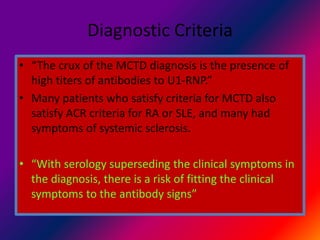
• “The crux of the MCTD diagnosis is the presence of
high titers of antibodies to U1-RNP.”
• Many patients who satisfy criteria for MCTD also
satisfy ACR criteria for RA or SLE, and many had
symptoms of systemic sclerosis.
• “With serology superseding the clinical symptoms in
the diagnosis, there is a risk of fitting the clinical
symptoms to the antibody signs”
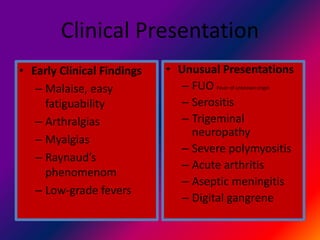
Clinical Presentation
• Early Clinical Findings
– Malaise, easy
fatiguability
– Arthralgias
– Myalgias
– Raynaud’s
phenomenom
– Low-grade fevers
• Unusual Presentations
– FUO Fever of unknown origin
– Serositis
– Trigeminal
neuropathy
– Severe polymyositis
– Acute arthritis
– Aseptic meningitis
– Digital gangrene
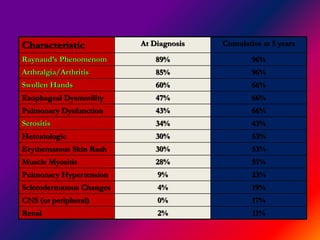
Characteristic At Diagnosis Cumulative at 5 years
Raynaud’s Phenomenom 89% 96%
Arthralgia/Arthritis 85% 96%
Swollen Hands 60% 66%
Esophageal Dysmotility 47% 66%
Pulmonary Dysfunction 43% 66%
Serositis 34% 43%
Hematologic 30% 53%
Erythematous Skin Rash 30% 53%
Muscle Myositis 28% 51%
Pulmonary Hypertension 9% 23%
Sclerodermatous Changes 4% 19%
CNS (or peripheral) 0% 17%
Renal 2% 11%
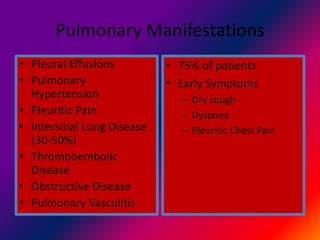
Pulmonary Manifestations
• Pleural Effusions
• Pulmonary
Hypertension
• Pleuritic Pain
• Intersitial Lung Disease
(30-50%)
• Thromboembolic
Disease
• Obstructive Disease
• Pulmonary Vasculitis
• 75% of patients
• Early Symptoms
– Dry cough
– Dyspnea
– Pleuritic Chest Pain
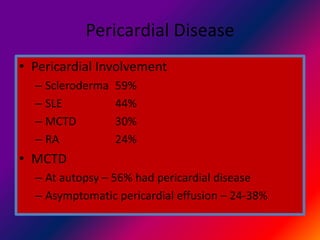
Pericardial Disease
• Pericardial Involvement
– Scleroderma 59%
– SLE 44%
– MCTD 30%
– RA 24%
• MCTD
– At autopsy – 56% had pericardial disease
– Asymptomatic pericardial effusion – 24-38%
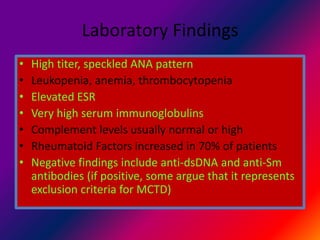
Laboratory Findings
• High titer, speckled ANA pattern
• Leukopenia, anemia, thrombocytopenia
• Elevated ESR
• Very high serum immunoglobulins
• Complement levels usually normal or high
• Rheumatoid Factors increased in 70% of patients
• Negative findings include anti-dsDNA and anti-Sm
antibodies (if positive, some argue that it represents
exclusion criteria for MCTD)
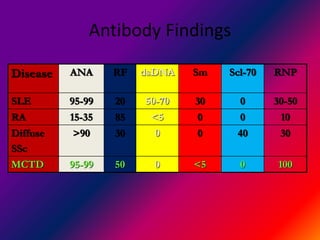
Antibody Findings
Disease ANA RF dsDNA Sm Scl-70 RNP
SLE 95-99 20 50-70 30 0 30-50
RA 15-35 85 <5 0 0 10
Diffuse
SSc
>90 30 0 0 40 30
MCTD 95-99 50 0 <5 0 100
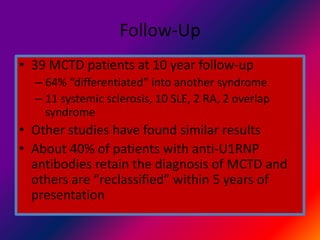
Follow-Up
• 39 MCTD patients at 10 year follow-up
– 64% “differentiated” into another syndrome
– 11 systemic sclerosis, 10 SLE, 2 RA, 2 overlap
syndrome
• Other studies have found similar results
• About 40% of patients with anti-U1RNP
antibodies retain the diagnosis of MCTD and
others are “reclassified” within 5 years of
presentation
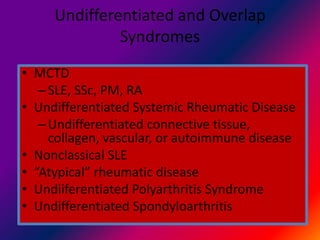
Undifferentiated and Overlap
Syndromes
• MCTD
–SLE, SSc, PM, RA
• Undifferentiated Systemic Rheumatic Disease
–Undifferentiated connective tissue,
collagen, vascular, or autoimmune disease
• Nonclassical SLE
• “Atypical” rheumatic disease
• Undiiferentiated Polyarthritis Syndrome
• Undifferentiated Spondyloarthritis
Undifferentiated and Overlap
Syndromes
Overlap Syndromes
• RA-lupus
– Rhupus
• Scleroderma-PM/DM
• Scleroderma-lupus
• Scleroderma-PBC-Sjogren’s
• Scleroderma-RA  JRA-lupus
 Psoriatic arthritis-lupus
 Psupus
 Sjogren’s overlaps
 PM overlaps
 Raynaud’s phenomenom
overlaps
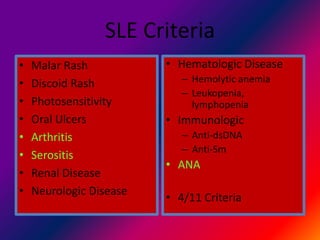
SLE Criteria
• Malar Rash
• Discoid Rash
• Photosensitivity
• Oral Ulcers
• Arthritis
• Serositis
• Renal Disease
• Neurologic Disease
• Hematologic Disease
– Hemolytic anemia
– Leukopenia,
lymphopenia
• Immunologic
– Anti-dsDNA
– Anti-Sm
• ANA
• 4/11 Criteria
Global Critical Care
https://www.facebook.com/groups/1451610115129555/#!/groups/145161011512
9555/
Wellcome in our new group ..... Dr.SAMIR EL ANSARY
GOOD LUCK
SAMIR EL ANSARY
ICU PROFESSOR
AIN SHAMS
CAIRO
elansarysamir@yahoo.com

Mixed connective tissue disease

  • 1.
    Mixed Connective Tissue Disease SAMIREL ANSARY ICU PROFESSOR AIN SHAMS CAIRO
  • 2.
  • 3.
    “Mixed Connective Tissue Disease: StillCrazy After All These Years”
  • 4.
    History • 1972 Sharpand colleagues – Identified patients with high levels of antibodies against a ribonucleic protein (RNP) – These patients shared several clinical features including Raynaud’s phenomenom, arthralgias, mild arthritis, puffy hands, abnormal esophageal mobility, and myositis – Additional findings – hypergammaglobulinemia (80%), anemia and leukopenia (50%); pulmonary, renal and CNS involvement was “rare”
  • 5.
    History • 1980 Nimelsteinand colleagues – Doubts after reviewing 22/25 original patients – Many patients evolved into scleroderma – High mortality rate (8/22) – Not everyone had antibodies to RNP – Some patients had antibodies without clear clinical features of the syndrome • Then, 20 years of contradictory views regarding the existence and nature of MCTD
  • 6.
    Diagnostic Criteria • Featuresof SLE, systemic sclerosis, RA, and polymyositis • Four different diagnostic criteria have been proposed – Sharp – Kasukawa – Alarcon-Segovia – Kahn • Highest sensitivity (62%) and specificity (86%) with Alarcon-Segovia and Kahn in 45 patients
  • 7.
    Diagnostic Criteria –Sharp • Major Criteria – Myositis – Pulmonary Involvement – Raynaud phenomenom or esophageal dysmobility – Swollen hands or sclerodactyly – High anti-U1-RNP with negative anti-Sm • Definite – 4 major plus serology • Probable – 3 major or 2 major (1st 3 listed) and 2 minor; and serology • Minor Criteria – Alopecia – Leukopenia – Anemia – Pleuritis – Pericarditis – Arthritis – Trigeminal Neuralgia – Malar Rash – Thrombocytopenia – Mild Myositis – h/o swollen hands
  • 8.
    Diagnostic Criteria Alarcon-Segovia –Clinical Criteria3/5 (must have synovitis or myositis) • Edema of the hands • Synovitis • Myositis • Raynaud’s phenomenon • Acrosclerosis Serologic: high titers of anti-U1 RNP
  • 9.
    Diagnostic Criteria • “Thecrux of the MCTD diagnosis is the presence of high titers of antibodies to U1-RNP.” • Many patients who satisfy criteria for MCTD also satisfy ACR criteria for RA or SLE, and many had symptoms of systemic sclerosis. • “With serology superseding the clinical symptoms in the diagnosis, there is a risk of fitting the clinical symptoms to the antibody signs”
  • 10.
    Clinical Presentation • EarlyClinical Findings – Malaise, easy fatiguability – Arthralgias – Myalgias – Raynaud’s phenomenom – Low-grade fevers • Unusual Presentations – FUO Fever of unknown origin – Serositis – Trigeminal neuropathy – Severe polymyositis – Acute arthritis – Aseptic meningitis – Digital gangrene
  • 11.
    Characteristic At DiagnosisCumulative at 5 years Raynaud’s Phenomenom 89% 96% Arthralgia/Arthritis 85% 96% Swollen Hands 60% 66% Esophageal Dysmotility 47% 66% Pulmonary Dysfunction 43% 66% Serositis 34% 43% Hematologic 30% 53% Erythematous Skin Rash 30% 53% Muscle Myositis 28% 51% Pulmonary Hypertension 9% 23% Sclerodermatous Changes 4% 19% CNS (or peripheral) 0% 17% Renal 2% 11%
  • 12.
    Pulmonary Manifestations • PleuralEffusions • Pulmonary Hypertension • Pleuritic Pain • Intersitial Lung Disease (30-50%) • Thromboembolic Disease • Obstructive Disease • Pulmonary Vasculitis • 75% of patients • Early Symptoms – Dry cough – Dyspnea – Pleuritic Chest Pain
  • 13.
    Pericardial Disease • PericardialInvolvement – Scleroderma 59% – SLE 44% – MCTD 30% – RA 24% • MCTD – At autopsy – 56% had pericardial disease – Asymptomatic pericardial effusion – 24-38%
  • 14.
    Laboratory Findings • Hightiter, speckled ANA pattern • Leukopenia, anemia, thrombocytopenia • Elevated ESR • Very high serum immunoglobulins • Complement levels usually normal or high • Rheumatoid Factors increased in 70% of patients • Negative findings include anti-dsDNA and anti-Sm antibodies (if positive, some argue that it represents exclusion criteria for MCTD)
  • 15.
    Antibody Findings Disease ANARF dsDNA Sm Scl-70 RNP SLE 95-99 20 50-70 30 0 30-50 RA 15-35 85 <5 0 0 10 Diffuse SSc >90 30 0 0 40 30 MCTD 95-99 50 0 <5 0 100
  • 16.
    Follow-Up • 39 MCTDpatients at 10 year follow-up – 64% “differentiated” into another syndrome – 11 systemic sclerosis, 10 SLE, 2 RA, 2 overlap syndrome • Other studies have found similar results • About 40% of patients with anti-U1RNP antibodies retain the diagnosis of MCTD and others are “reclassified” within 5 years of presentation
  • 17.
    Undifferentiated and Overlap Syndromes •MCTD –SLE, SSc, PM, RA • Undifferentiated Systemic Rheumatic Disease –Undifferentiated connective tissue, collagen, vascular, or autoimmune disease • Nonclassical SLE • “Atypical” rheumatic disease • Undiiferentiated Polyarthritis Syndrome • Undifferentiated Spondyloarthritis
  • 18.
    Undifferentiated and Overlap Syndromes OverlapSyndromes • RA-lupus – Rhupus • Scleroderma-PM/DM • Scleroderma-lupus • Scleroderma-PBC-Sjogren’s • Scleroderma-RA  JRA-lupus  Psoriatic arthritis-lupus  Psupus  Sjogren’s overlaps  PM overlaps  Raynaud’s phenomenom overlaps
  • 19.
    SLE Criteria • MalarRash • Discoid Rash • Photosensitivity • Oral Ulcers • Arthritis • Serositis • Renal Disease • Neurologic Disease • Hematologic Disease – Hemolytic anemia – Leukopenia, lymphopenia • Immunologic – Anti-dsDNA – Anti-Sm • ANA • 4/11 Criteria
  • 20.
  • 21.
    GOOD LUCK SAMIR ELANSARY ICU PROFESSOR AIN SHAMS CAIRO elansarysamir@yahoo.com