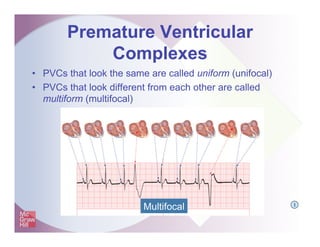
This document defines and describes various types of ventricular dysrhythmias. It notes that ventricular dysrhythmias occur when the atria, AV junction, or both cannot initiate an electrical impulse or there is enhanced excitability of the ventricular myocardium. Key features include wide, bizarre QRS complexes with T waves in the opposite direction of R waves and no P waves. Specific dysrhythmias covered include premature ventricular contractions, ventricular escape rhythms, ventricular tachycardia, ventricular fibrillation, asystole, idioventricular rhythm, and pulseless electrical activity. Characteristics and identifying features of each dysrhythmia are provided.




![Shadechapter08.ppt [read only]](https://cdn.slidesharecdn.com/ss_thumbnails/shadechapter08-150421102734-conversion-gate02-thumbnail.jpg?width=640&height=640&fit=bounds)
![Shadechapter10.ppt [read only]](https://cdn.slidesharecdn.com/ss_thumbnails/shadechapter10-150421103304-conversion-gate02-thumbnail.jpg?width=640&height=640&fit=bounds)
![Shadechapter09.ppt [read only]](https://cdn.slidesharecdn.com/ss_thumbnails/shadechapter09-150421103043-conversion-gate02-thumbnail.jpg?width=640&height=640&fit=bounds)


![Shadechapter16.ppt [read only]](https://cdn.slidesharecdn.com/ss_thumbnails/shadechapter16-150421104734-conversion-gate01-thumbnail.jpg?width=640&height=640&fit=bounds)
![Shadechapter15.ppt [read only]](https://cdn.slidesharecdn.com/ss_thumbnails/shadechapter15-150421104606-conversion-gate01-thumbnail.jpg?width=640&height=640&fit=bounds)
![Shadechapter14.ppt [read only]](https://cdn.slidesharecdn.com/ss_thumbnails/shadechapter14-150421104301-conversion-gate02-thumbnail.jpg?width=640&height=640&fit=bounds)
![Shadechapter13.ppt [read only]](https://cdn.slidesharecdn.com/ss_thumbnails/shadechapter13-150421104054-conversion-gate02-thumbnail.jpg?width=640&height=640&fit=bounds)
![Shadechapter12.ppt [read only]](https://cdn.slidesharecdn.com/ss_thumbnails/shadechapter12-150421103821-conversion-gate02-thumbnail.jpg?width=640&height=640&fit=bounds)
![Shadechapter07.ppt [read only]](https://cdn.slidesharecdn.com/ss_thumbnails/shadechapter07-150421102520-conversion-gate02-thumbnail.jpg?width=640&height=640&fit=bounds)
![Shadechapter05.ppt [read only]](https://cdn.slidesharecdn.com/ss_thumbnails/shadechapter05-150421102328-conversion-gate02-thumbnail.jpg?width=640&height=640&fit=bounds)
![Shadechapter04.ppt [read only]](https://cdn.slidesharecdn.com/ss_thumbnails/shadechapter04-150421102149-conversion-gate02-thumbnail.jpg?width=640&height=640&fit=bounds)
![Shadechapter03.ppt [read only]](https://cdn.slidesharecdn.com/ss_thumbnails/shadechapter03-150421101919-conversion-gate02-thumbnail.jpg?width=640&height=640&fit=bounds)
![Shadechapter02.ppt [read only]](https://cdn.slidesharecdn.com/ss_thumbnails/shadechapter02-150421101545-conversion-gate02-thumbnail.jpg?width=640&height=640&fit=bounds)
![Shadechapter01.ppt [read only]](https://cdn.slidesharecdn.com/ss_thumbnails/shadechapter01-150421101218-conversion-gate01-thumbnail.jpg?width=640&height=640&fit=bounds)


