TI ON
                  C
             N DU
           CO
      NT
    RA
  ER
AB
IK
     BAR
DR
DEFINITION
Alterations in QRS contour of supraventricular beats resulting from
    impulse transmission during periods of physiologic refractoriness
    and/or depressed conductivity
The supraventricular electrical impulse is conducted abnormally
   through the ventricular conducting system
MECHANISMS OF ABERRANCY
Premature arrival of the supraventricular impulse before full recovery
Inadequate or unequal refractoriness of conducting tissue resulting in
   local delay or block of dromotropism
Prolongation of Action Potential (AP) secondary to lengthiness of the
   preceding cycle duration
A reduced take-off potential secondary to diastole depolarization
MECHANISMS OF ABERRANCY
Failure of the refractory period to shorten in response to acceleration
    of the heart rate
Concealed transseptal conduction with delay or block of bundle branch
   conduction
Diffuse depression of Intraventricular conduction including that of
    specialized as well as contractile myocardial
Unsuccessful of restitutions of transmembrane electrolyte
   concentration during relaxation and dilatation of the ventricles
TYPES OF ABERRATION
Type A: It is the common form and due to fascicular refractoriness.
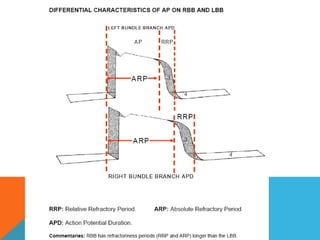
The early impulse reach the RBB when still in refractory period and it
   has been unable to respond and conduct
Type B: It is due to anomalous supraventricular activation
Type C: It is due to paradoxical critical rate
ASHMAN PHENOMENON
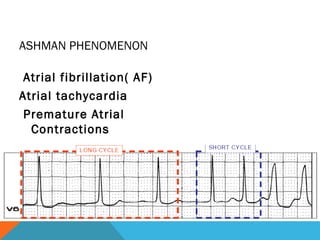
Gouaux-Ashman phenomenon or Ashman phenomenon is an
   intraventricular conduction abnormality restricted to the His-
   Purkinje system, caused by a change in the HR
Modulated by metabolic and electrolyte abnormalities and the effects of
  drugs
Relatively long cycle was followed by a relatively short cycle, the beat
   with a short cycle often has RBBB morphology
ASHMAN PHENOMENON

 Atrial fibrillation( AF)
Atrial tachycardia
 Premature Atrial
  Contractions
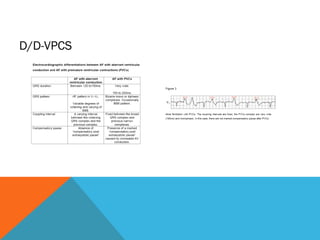
D/D-VPCS
ACCELERATION-DEPENDENT ABERRANCY


TACHYCARDIA-DEPENDENT, IN PHASE 3 ABERRANCY, OR PHASE 3
   ABERRATION
Resulting from the occurrence of impaired intraventricular conduction
   as the heart attains a specific critical rate
The appearance and disappearance often depends on very small
   changes in cycle length
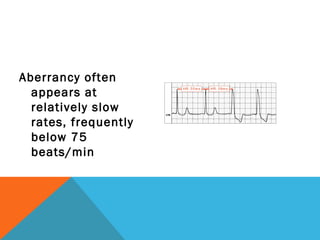
Aberrancy often
  appears at
  relatively slow
  rates, frequently
  below 75
  beats/min
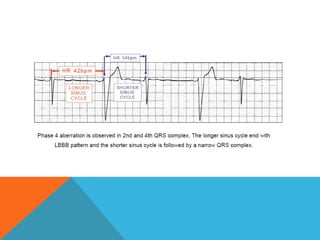
BRADYCARDIA-DEPENDENT, PHASE 4 ABERRANCY


  Occurrence of impaired intraventricular conduction after long pauses or
     slowing of the heart to a critical rate
  Due to a gradual loss transmembrane resting potential during a
     prolonged diastole with excitation from a less negative take-off
     potenial
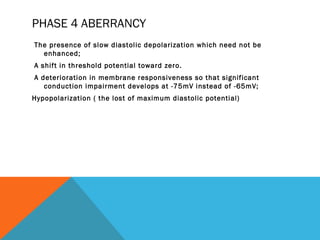
PHASE 4 ABERRANCY
The presence of slow diastolic depolarization which need not be
  enhanced;
A shift in threshold potential toward zero.
A deterioration in membrane responsiveness so that significant
   conduction impairment develops at -75mV instead of -65mV;
Hypopolarization ( the lost of maximum diastolic potential)
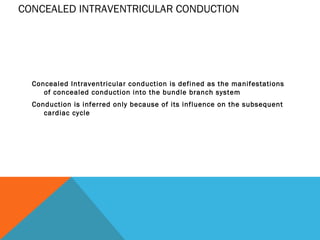
CONCEALED INTRAVENTRICULAR CONDUCTION


  Concealed Intraventricular conduction is defined as the manifestations
     of concealed conduction into the bundle branch system
  Conduction is inferred only because of its influence on the subsequent
     cardiac cycle
CONCEALED INTRAVENTRICULAR CONDUCTION

Trans-septal retrograde concealed intraventricular conduction
Perpetuation of functional BBB initiated by a premature
   supraventricular impulse
Alternation of aberrant ventricular conduction in supraventricular
   bigeminy
Normalization of intraventricular conduction with acceleration or rate
  in bradycardia-dependent BBB
OR ELECTROLYTE DISORDERS


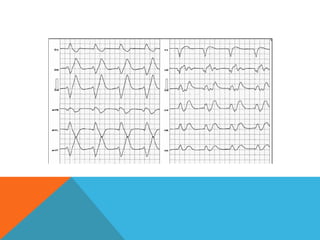
  Hyperkalemia
  Diffuse QRS complexes widening, similar to left or RBBB, associated
      with anterior or posterior fascicular block is seen frequently
  QRS complex widening is differentiated of genuine branch blocks, the
    delay is final or middle, while in hyperkalemia is always global or
    diffuse
POSTEXTRASYSTOLIC ABERRATION

 This variant is caused probably to slow diastolic depolarization, unequal
    recovery of conducting or myocardial tissue, or increased diastolic
    volume
ABERRANCY IN AVRT
When a bundle branch block pattern develops that is ipsilateral to the
  accessory pathway that is participating in the tachycardia during
  ORT
VA conduction time prolongs as a result of the additional time that is
   required for conduction to travel from through the contralateral
   ventricle and septum to reach the accessory pathway
ABERRANCY IN AVRT
Prolongation of the VA interval also results in prolongation of the
   tachycardia cycle length unless there is a compensatory shortening
   of the AV interval
Prolongation oftheVA interval during a bundle branch block is
   diagnostic of ORT, but occurs in only 7% of patients with PSVT
Development of left bundle branch aberration with tachycardia is
   strongly predictive of ORT (92% positive predictive value)
ABERRANCY IN AVRT
Left bundle-branch block facilitates induction of ORT when a left-sided
   accessory pathway is present and most accessory pathways are
   located on the left side
Induction of AV nodal reentry requires significant AV nodal delay, which
   makes the H1-H2 interval longer and makes aberration unlikely

Aberrant conduction

  • 1.
    TI ON C N DU CO NT RA ER AB
  • 2.
    IK BAR DR
  • 3.
    DEFINITION Alterations in QRScontour of supraventricular beats resulting from impulse transmission during periods of physiologic refractoriness and/or depressed conductivity The supraventricular electrical impulse is conducted abnormally through the ventricular conducting system
  • 4.
    MECHANISMS OF ABERRANCY Prematurearrival of the supraventricular impulse before full recovery Inadequate or unequal refractoriness of conducting tissue resulting in local delay or block of dromotropism Prolongation of Action Potential (AP) secondary to lengthiness of the preceding cycle duration A reduced take-off potential secondary to diastole depolarization
  • 5.
    MECHANISMS OF ABERRANCY Failureof the refractory period to shorten in response to acceleration of the heart rate Concealed transseptal conduction with delay or block of bundle branch conduction Diffuse depression of Intraventricular conduction including that of specialized as well as contractile myocardial Unsuccessful of restitutions of transmembrane electrolyte concentration during relaxation and dilatation of the ventricles
  • 6.
    TYPES OF ABERRATION TypeA: It is the common form and due to fascicular refractoriness. The early impulse reach the RBB when still in refractory period and it has been unable to respond and conduct Type B: It is due to anomalous supraventricular activation Type C: It is due to paradoxical critical rate
  • 8.
    ASHMAN PHENOMENON Gouaux-Ashman phenomenonor Ashman phenomenon is an intraventricular conduction abnormality restricted to the His- Purkinje system, caused by a change in the HR Modulated by metabolic and electrolyte abnormalities and the effects of drugs Relatively long cycle was followed by a relatively short cycle, the beat with a short cycle often has RBBB morphology
  • 9.
    ASHMAN PHENOMENON Atrialfibrillation( AF) Atrial tachycardia Premature Atrial Contractions
  • 10.
  • 11.
    ACCELERATION-DEPENDENT ABERRANCY TACHYCARDIA-DEPENDENT, INPHASE 3 ABERRANCY, OR PHASE 3 ABERRATION Resulting from the occurrence of impaired intraventricular conduction as the heart attains a specific critical rate The appearance and disappearance often depends on very small changes in cycle length
  • 12.
    Aberrancy often appears at relatively slow rates, frequently below 75 beats/min
  • 14.
    BRADYCARDIA-DEPENDENT, PHASE 4ABERRANCY Occurrence of impaired intraventricular conduction after long pauses or slowing of the heart to a critical rate Due to a gradual loss transmembrane resting potential during a prolonged diastole with excitation from a less negative take-off potenial
  • 16.
    PHASE 4 ABERRANCY Thepresence of slow diastolic depolarization which need not be enhanced; A shift in threshold potential toward zero. A deterioration in membrane responsiveness so that significant conduction impairment develops at -75mV instead of -65mV; Hypopolarization ( the lost of maximum diastolic potential)
  • 17.
    CONCEALED INTRAVENTRICULAR CONDUCTION Concealed Intraventricular conduction is defined as the manifestations of concealed conduction into the bundle branch system Conduction is inferred only because of its influence on the subsequent cardiac cycle
  • 18.
    CONCEALED INTRAVENTRICULAR CONDUCTION Trans-septalretrograde concealed intraventricular conduction Perpetuation of functional BBB initiated by a premature supraventricular impulse Alternation of aberrant ventricular conduction in supraventricular bigeminy Normalization of intraventricular conduction with acceleration or rate in bradycardia-dependent BBB
  • 19.
    OR ELECTROLYTE DISORDERS Hyperkalemia Diffuse QRS complexes widening, similar to left or RBBB, associated with anterior or posterior fascicular block is seen frequently QRS complex widening is differentiated of genuine branch blocks, the delay is final or middle, while in hyperkalemia is always global or diffuse
  • 21.
    POSTEXTRASYSTOLIC ABERRATION Thisvariant is caused probably to slow diastolic depolarization, unequal recovery of conducting or myocardial tissue, or increased diastolic volume
  • 22.
    ABERRANCY IN AVRT Whena bundle branch block pattern develops that is ipsilateral to the accessory pathway that is participating in the tachycardia during ORT VA conduction time prolongs as a result of the additional time that is required for conduction to travel from through the contralateral ventricle and septum to reach the accessory pathway
  • 23.
    ABERRANCY IN AVRT Prolongationof the VA interval also results in prolongation of the tachycardia cycle length unless there is a compensatory shortening of the AV interval Prolongation oftheVA interval during a bundle branch block is diagnostic of ORT, but occurs in only 7% of patients with PSVT Development of left bundle branch aberration with tachycardia is strongly predictive of ORT (92% positive predictive value)
  • 24.
    ABERRANCY IN AVRT Leftbundle-branch block facilitates induction of ORT when a left-sided accessory pathway is present and most accessory pathways are located on the left side Induction of AV nodal reentry requires significant AV nodal delay, which makes the H1-H2 interval longer and makes aberration unlikely