Venetian Art of the High Renaissance and Mannerism
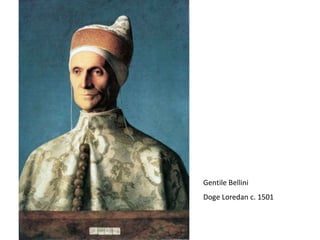
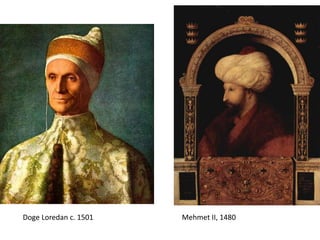
Gentile Bellini  Doge Loredan c. 1501
Mehmet II, 1480  Doge Loredan c. 1501
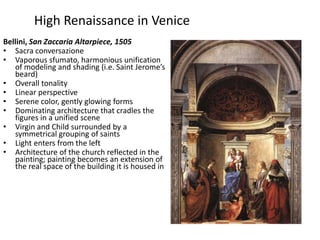
High Renaissance in VeniceBellini, San Zaccaria Altarpiece, 1505Sacra conversazioneVaporous sfumato, harmonious unification of modeling and shading (i.e. Saint Jerome’s beard)Overall tonalityLinear perspectiveSerene color, gently glowing formsDominating architecture that cradles the figures in a unified sceneVirgin and Child surrounded by a symmetrical grouping of saintsLight enters from the leftArchitecture of the church reflected in the painting; painting becomes an extension of the real space of the building it is housed in
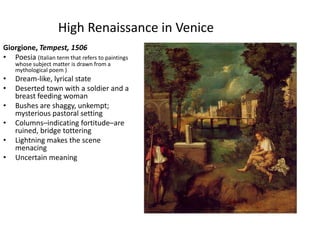
High Renaissance in VeniceGiorgione, Tempest, 1506Poesia (Italian term that refers to paintings whose subject matter is drawn from a mythological poem )Dream-like, lyrical stateDeserted town with a soldier and a breast feeding womanBushes are shaggy, unkempt; mysterious pastoral settingColumns–indicating fortitude–are ruined, bridge totteringLightning makes the scene menacingUncertain meaning
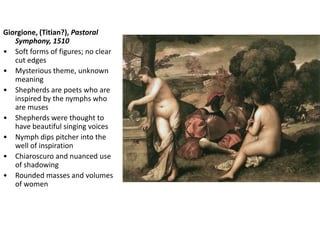
Giorgione, (Titian?), Pastoral Symphony, 1510Soft forms of figures; no clear cut edges
Mysterious theme, unknown meaning
Shepherds are poets who are inspired by the nymphs who are muses
Shepherds were thought to have beautiful singing voices
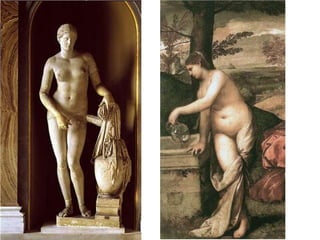
Nymph dips pitcher into the well of inspiration
Chiaroscuro and nuanced use of shadowing
Rounded masses and volumes of women
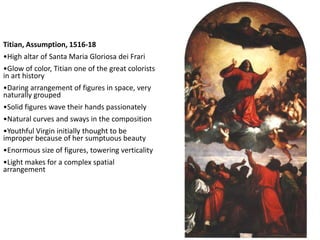
Titian, Assumption, 1516-18High altar of Santa Maria Gloriosa dei Frari
Glow of color, Titian one of the great colorists in art history
Daring arrangement of figures in space, very naturally grouped
Solid figures wave their hands passionately
Natural curves and sways in the composition
Youthful Virgin initially thought to be improper because of her sumptuous beauty
Enormous size of figures, towering verticality
Light makes for a complex spatial arrangementTitian, Madonna of the Pesaro Family , 1519-26
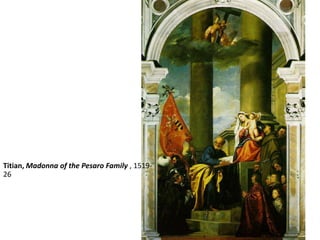
High Renaissance in Venice Titian, Madonna of the Pesaro Family , 15119-26Battle of Santa Maura, 1502, won by Jacopo Pesaro, who kneels at leftRight: five males of patron’s family presented by Saint Francis of AssisiDiagonals and triangles establish a complex asymmetrical spatial relationshipVirgin at the head of a right triangleMultiple oil glazes to increase richnessTurk bowing on the extreme leftSaint Peter in the center, although not central to the compositionVery unusual arrangement not to have Madonna and Child in the center, cf. The Last Supper, San Zaccaria AltarpiecePainterly effect in descriptive passages in the painting (i.e. glistening armor of Saint George)One figure looks out at us, brings us directly into the composition, as is typical in High Renaissance artColumns not part of the original composition: added laterLight comes from above left, from “on high”
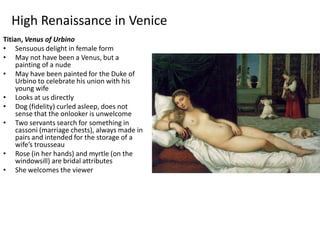
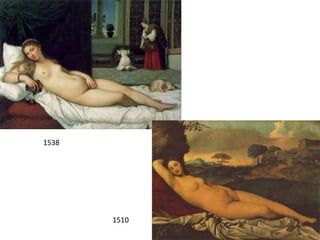
High Renaissance in VeniceTitian, Venus of UrbinoSensuous delight in female formMay not have been a Venus, but a painting of a nudeMay have been painted for the Duke of Urbino to celebrate his union with his young wifeLooks at us directlyDog (fidelity) curled asleep, does not sense that the onlooker is unwelcomeTwo servants search for something in cassoni (marriage chests), always made in pairs and intended for the storage of a wife’s trousseauRose (in her hands) and myrtle (on the windowsill) are bridal attributesShe welcomes the viewer
15381510
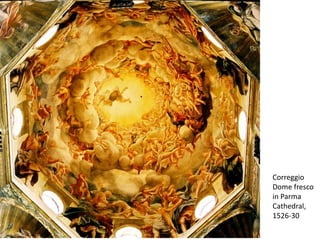
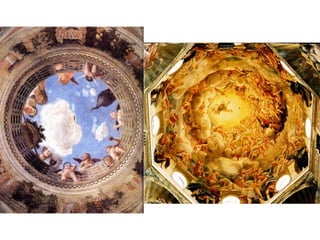
CorreggioDome fresco in Parma Cathedral, 1526-30
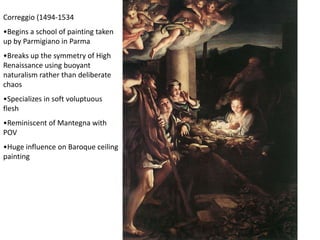
Correggio (1494-1534Begins a school of painting taken up by Parmigiano in Parma
Breaks up the symmetry of High Renaissance using buoyant naturalism rather than deliberate chaos
Specializes in soft voluptuous flesh
Reminiscent of Mantegna with POV
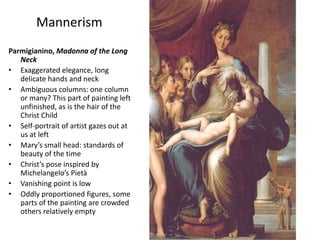
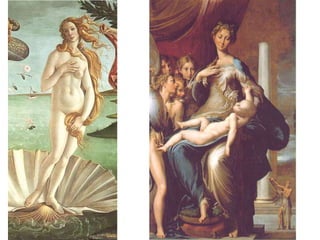
Huge influence on Baroque ceiling paintingMannerismParmigianino, Madonna of the Long NeckExaggerated elegance, long delicate hands and neckAmbiguous columns: one column or many? This part of painting left unfinished, as is the hair of the Christ ChildSelf-portrait of artist gazes out at us at leftMary’s small head: standards of beauty of the timeChrist’s pose inspired by Michelangelo’s PietàVanishing point is lowOddly proportioned figures, some parts of the painting are crowded others relatively empty
Mannerist Paintingemphasized complexity and virtuosity over naturalistic representation. While the formal vocabulary of Mannerism takes much from the later works of Michelangelo (1475–1564) and Raphael (1483–1520) , its adherents generally favored compositional tension and instability rather than the balance and clarity of earlier Renaissance painting. Some characteristics common to many Mannerist works include distortion of the human figure, a flattening of pictorial space, and a cultivated intellectual sophistication
MannerismFigures often seek out toward the frame rather than the center of the compositionHeavy Intertwining of FiguresDistortion and elongation of formsOften a lack of mathematical spaceMany religious and mythological subjects, portraits
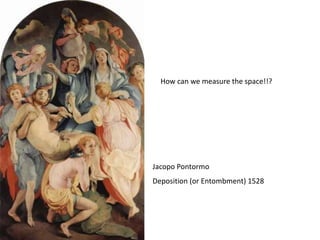
How can we measure the space!!?Jacopo PontormoDeposition (or Entombment) 1528
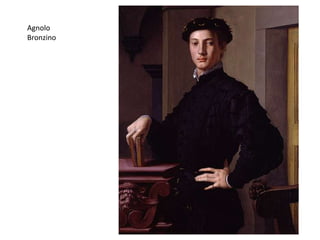
Agnolo Bronzino
Allegory1.(Literary & Literary Critical Terms) (Fine Arts & Visual Arts / Art Terms)            a poem, play, picture, etc., in which the apparent meaning of the characters and events is used to symbolize a deeper moral or spiritual meaninghttp://www.thefreedictionary.com/allegory
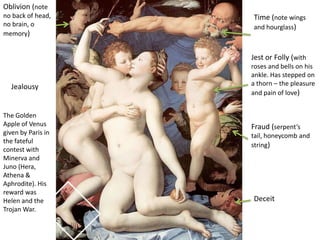
Oblivion (note no back of head, no brain, o memory)Time (note wings and hourglass)Jest or Folly (with roses and bells on his ankle. Has stepped on a thorn – the pleasure and pain of love)JealousyThe Golden Apple of Venus given by Paris in the fateful contest with Minerva and Juno (Hera, Athena & Aphrodite). His reward was Helen and the Trojan War.Fraud (serpent’s tail, honeycomb and string)Deceit
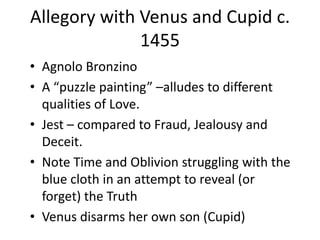
Allegory with Venus and Cupid c. 1455Agnolo BronzinoA “puzzle painting” –alludes to different qualities of Love.Jest – compared to Fraud, Jealousy and Deceit.Note Time and Oblivion struggling with the blue cloth in an attempt to reveal (or forget) the TruthVenus disarms her own son (Cupid)
AllegoriesAn allegory that takes time to unravel and understandGreater effort = greater rewardSome allegories more univeral – David & Goliath. Some more elite. Requires specific education.May have been a gift of Cosimo de’Medici to Francis I. ( a gift of flattery – implies that Francis will1. that Francis will understand all the references2. that Cosimo is inteeligent as well3. caters to the taste of Francis: elegant, refined, erotic
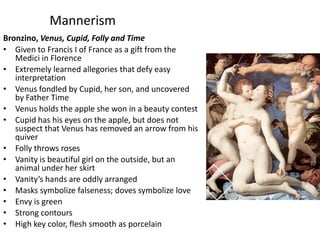
MannerismBronzino, Venus, Cupid, Folly and TimeGiven to Francis I of France as a gift from the Medici in FlorenceExtremely learned allegories that defy easy interpretationVenus fondled by Cupid, her son, and uncovered by Father TimeVenus holds the apple she won in a beauty contestCupid has his eyes on the apple, but does not suspect that Venus has removed an arrow from his quiverFolly throws rosesVanity is beautiful girl on the outside, but an animal under her skirtVanity’s hands are oddly arrangedMasks symbolize falseness; doves symbolize loveEnvy is greenStrong contoursHigh key color, flesh smooth as porcelain
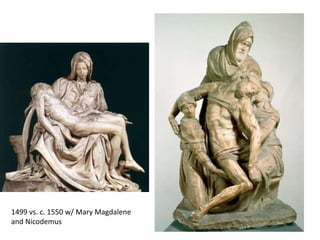
1499 vs. c. 1550 w/ Mary Magdalene and Nicodemus
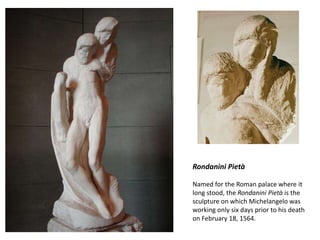
Rondanini PietàNamed for the Roman palace where it long stood, the Rondanini Pietà is the sculpture on which Michelangelo was working only six days prior to his death on February 18, 1564.
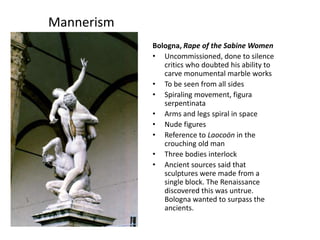
MannerismBologna, Rape of the Sabine WomenUncommissioned, done to silence critics who doubted his ability to carve monumental marble worksTo be seen from all sidesSpiraling movement, figura serpentinataArms and legs spiral in spaceNude figuresReference to Laocoön in the crouching old manThree bodies interlockAncient sources said that sculptures were made from a single block. The Renaissance discovered this was untrue. Bologna wanted to surpass the ancients.
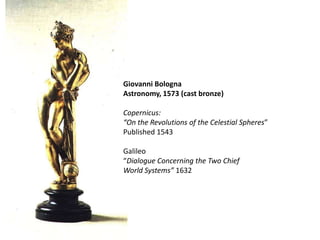
Giovanni BolognaAstronomy, 1573 (cast bronze)Copernicus:“On the Revolutions of the Celestial Spheres”Published 1543Galileo“Dialogue Concerning the Two Chief World Systems” 1632
Women ArtistsWomen’s roles in Florence, Sienna and Venice very limitedMore relaxed guild system outside of these cities

Venetian Artand Mannerism

  • 1.
    Venetian Art ofthe High Renaissance and Mannerism
  • 3.
    Gentile Bellini Doge Loredan c. 1501
  • 4.
    Mehmet II, 1480 Doge Loredan c. 1501
  • 5.
    High Renaissance inVeniceBellini, San Zaccaria Altarpiece, 1505Sacra conversazioneVaporous sfumato, harmonious unification of modeling and shading (i.e. Saint Jerome’s beard)Overall tonalityLinear perspectiveSerene color, gently glowing formsDominating architecture that cradles the figures in a unified sceneVirgin and Child surrounded by a symmetrical grouping of saintsLight enters from the leftArchitecture of the church reflected in the painting; painting becomes an extension of the real space of the building it is housed in
  • 6.
    High Renaissance inVeniceGiorgione, Tempest, 1506Poesia (Italian term that refers to paintings whose subject matter is drawn from a mythological poem )Dream-like, lyrical stateDeserted town with a soldier and a breast feeding womanBushes are shaggy, unkempt; mysterious pastoral settingColumns–indicating fortitude–are ruined, bridge totteringLightning makes the scene menacingUncertain meaning
  • 7.
    Giorgione, (Titian?), PastoralSymphony, 1510Soft forms of figures; no clear cut edges
  • 8.
  • 9.
    Shepherds are poetswho are inspired by the nymphs who are muses
  • 10.
    Shepherds were thoughtto have beautiful singing voices
  • 11.
    Nymph dips pitcherinto the well of inspiration
  • 12.
    Chiaroscuro and nuanceduse of shadowing
  • 13.
    Rounded masses andvolumes of women
  • 14.
    Titian, Assumption, 1516-18Highaltar of Santa Maria Gloriosa dei Frari
  • 15.
    Glow of color,Titian one of the great colorists in art history
  • 16.
    Daring arrangement offigures in space, very naturally grouped
  • 17.
    Solid figures wavetheir hands passionately
  • 18.
    Natural curves andsways in the composition
  • 19.
    Youthful Virgin initiallythought to be improper because of her sumptuous beauty
  • 20.
    Enormous size offigures, towering verticality
  • 21.
    Light makes fora complex spatial arrangementTitian, Madonna of the Pesaro Family , 1519-26
  • 22.
    High Renaissance inVenice Titian, Madonna of the Pesaro Family , 15119-26Battle of Santa Maura, 1502, won by Jacopo Pesaro, who kneels at leftRight: five males of patron’s family presented by Saint Francis of AssisiDiagonals and triangles establish a complex asymmetrical spatial relationshipVirgin at the head of a right triangleMultiple oil glazes to increase richnessTurk bowing on the extreme leftSaint Peter in the center, although not central to the compositionVery unusual arrangement not to have Madonna and Child in the center, cf. The Last Supper, San Zaccaria AltarpiecePainterly effect in descriptive passages in the painting (i.e. glistening armor of Saint George)One figure looks out at us, brings us directly into the composition, as is typical in High Renaissance artColumns not part of the original composition: added laterLight comes from above left, from “on high”
  • 23.
    High Renaissance inVeniceTitian, Venus of UrbinoSensuous delight in female formMay not have been a Venus, but a painting of a nudeMay have been painted for the Duke of Urbino to celebrate his union with his young wifeLooks at us directlyDog (fidelity) curled asleep, does not sense that the onlooker is unwelcomeTwo servants search for something in cassoni (marriage chests), always made in pairs and intended for the storage of a wife’s trousseauRose (in her hands) and myrtle (on the windowsill) are bridal attributesShe welcomes the viewer
  • 24.
  • 25.
    CorreggioDome fresco inParma Cathedral, 1526-30
  • 27.
    Correggio (1494-1534Begins aschool of painting taken up by Parmigiano in Parma
  • 28.
    Breaks up thesymmetry of High Renaissance using buoyant naturalism rather than deliberate chaos
  • 29.
    Specializes in softvoluptuous flesh
  • 30.
  • 31.
    Huge influence onBaroque ceiling paintingMannerismParmigianino, Madonna of the Long NeckExaggerated elegance, long delicate hands and neckAmbiguous columns: one column or many? This part of painting left unfinished, as is the hair of the Christ ChildSelf-portrait of artist gazes out at us at leftMary’s small head: standards of beauty of the timeChrist’s pose inspired by Michelangelo’s PietàVanishing point is lowOddly proportioned figures, some parts of the painting are crowded others relatively empty
  • 33.
    Mannerist Paintingemphasized complexityand virtuosity over naturalistic representation. While the formal vocabulary of Mannerism takes much from the later works of Michelangelo (1475–1564) and Raphael (1483–1520) , its adherents generally favored compositional tension and instability rather than the balance and clarity of earlier Renaissance painting. Some characteristics common to many Mannerist works include distortion of the human figure, a flattening of pictorial space, and a cultivated intellectual sophistication
  • 34.
    MannerismFigures often seekout toward the frame rather than the center of the compositionHeavy Intertwining of FiguresDistortion and elongation of formsOften a lack of mathematical spaceMany religious and mythological subjects, portraits
  • 35.
    How can wemeasure the space!!?Jacopo PontormoDeposition (or Entombment) 1528
  • 36.
  • 37.
    Allegory1.(Literary & LiteraryCritical Terms) (Fine Arts & Visual Arts / Art Terms) a poem, play, picture, etc., in which the apparent meaning of the characters and events is used to symbolize a deeper moral or spiritual meaninghttp://www.thefreedictionary.com/allegory
  • 38.
    Oblivion (note noback of head, no brain, o memory)Time (note wings and hourglass)Jest or Folly (with roses and bells on his ankle. Has stepped on a thorn – the pleasure and pain of love)JealousyThe Golden Apple of Venus given by Paris in the fateful contest with Minerva and Juno (Hera, Athena & Aphrodite). His reward was Helen and the Trojan War.Fraud (serpent’s tail, honeycomb and string)Deceit
  • 39.
    Allegory with Venusand Cupid c. 1455Agnolo BronzinoA “puzzle painting” –alludes to different qualities of Love.Jest – compared to Fraud, Jealousy and Deceit.Note Time and Oblivion struggling with the blue cloth in an attempt to reveal (or forget) the TruthVenus disarms her own son (Cupid)
  • 40.
    AllegoriesAn allegory thattakes time to unravel and understandGreater effort = greater rewardSome allegories more univeral – David & Goliath. Some more elite. Requires specific education.May have been a gift of Cosimo de’Medici to Francis I. ( a gift of flattery – implies that Francis will1. that Francis will understand all the references2. that Cosimo is inteeligent as well3. caters to the taste of Francis: elegant, refined, erotic
  • 41.
    MannerismBronzino, Venus, Cupid,Folly and TimeGiven to Francis I of France as a gift from the Medici in FlorenceExtremely learned allegories that defy easy interpretationVenus fondled by Cupid, her son, and uncovered by Father TimeVenus holds the apple she won in a beauty contestCupid has his eyes on the apple, but does not suspect that Venus has removed an arrow from his quiverFolly throws rosesVanity is beautiful girl on the outside, but an animal under her skirtVanity’s hands are oddly arrangedMasks symbolize falseness; doves symbolize loveEnvy is greenStrong contoursHigh key color, flesh smooth as porcelain
  • 42.
    1499 vs. c.1550 w/ Mary Magdalene and Nicodemus
  • 43.
    Rondanini PietàNamed forthe Roman palace where it long stood, the Rondanini Pietà is the sculpture on which Michelangelo was working only six days prior to his death on February 18, 1564.
  • 44.
    MannerismBologna, Rape ofthe Sabine WomenUncommissioned, done to silence critics who doubted his ability to carve monumental marble worksTo be seen from all sidesSpiraling movement, figura serpentinataArms and legs spiral in spaceNude figuresReference to Laocoön in the crouching old manThree bodies interlockAncient sources said that sculptures were made from a single block. The Renaissance discovered this was untrue. Bologna wanted to surpass the ancients.
  • 45.
    Giovanni BolognaAstronomy, 1573(cast bronze)Copernicus:“On the Revolutions of the Celestial Spheres”Published 1543Galileo“Dialogue Concerning the Two Chief World Systems” 1632
  • 46.
    Women ArtistsWomen’s rolesin Florence, Sienna and Venice very limitedMore relaxed guild system outside of these cities