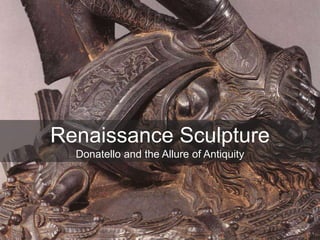
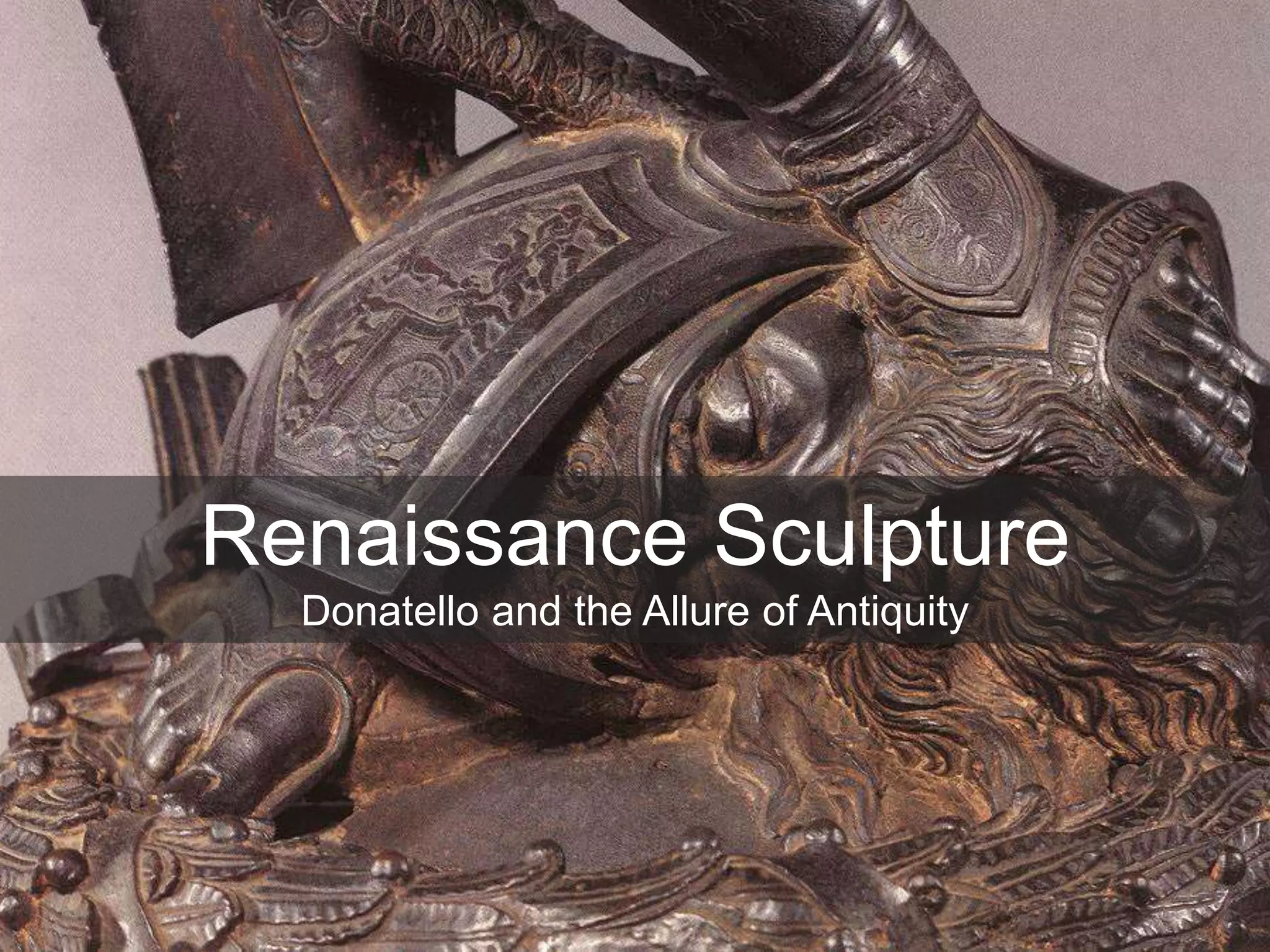


Renaissance Sculpture
Donatello and the Allure of Antiquity
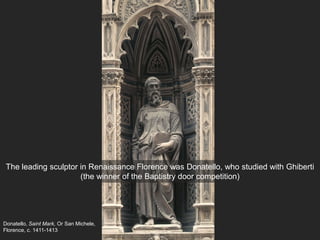
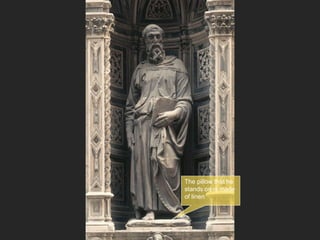
Donatello, Saint Mark, Or San Michele,
Florence, c. 1411-1413
The leading sculptor in Renaissance Florence was Donatello, who studied with Ghiberti
(the winner of the Baptistry door competition)
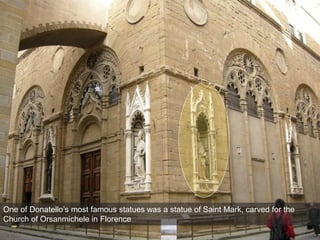
One of Donatello’s most famous statues was a statue of Saint Mark, carved for the
Church of Orsanmichele in Florence
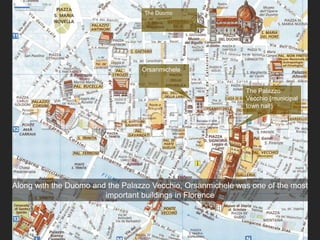
Along with the Duomo and the Palazzo Vecchio, Orsanmichele was one of the most
important buildings in Florence
The Duomo
The Palazzo
Vecchio (municipal
town hall)
Orsanmichele
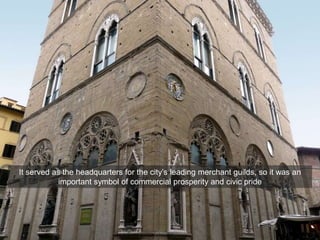
It served as the headquarters for the city’s leading merchant guilds, so it was an
important symbol of commercial prosperity and civic pride
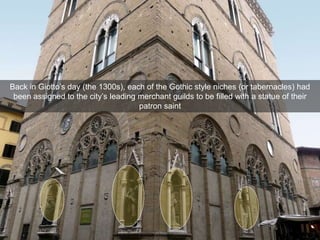
Back in Giotto’s day (the 1300s), each of the Gothic style niches (or tabernacles) had
been assigned to the city’s leading merchant guilds to be filled with a statue of their
patron saint
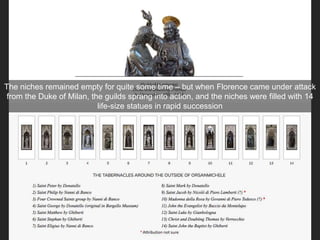
The niches remained empty for quite some time – but when Florence came under attack
from the Duke of Milan, the guilds sprang into action, and the niches were filled with 14
life-size statues in rapid succession
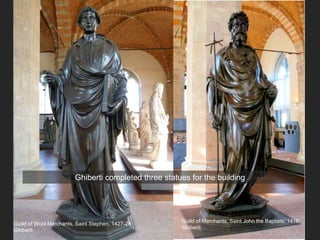
Guild of Wool Merchants, Saint Stephen, 1427-28
Ghiberti
Guild of Merchants, Saint John the Baptists, 1416
Ghiberti
Ghiberti completed three statues for the building
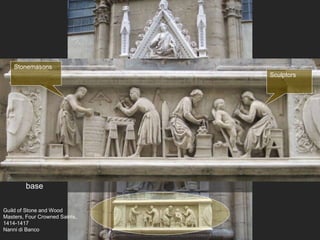
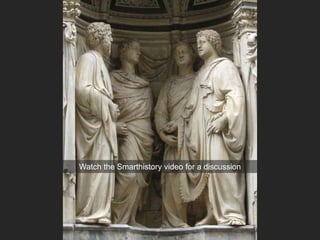
Guild of Stone and Wood
Masters, Four Crowned Saints,
1414-1417
Nanni di Banco
Nanni di Banco completed the Four Crowned Martyrs for the Guild of Stone
and Wood Masters, whose trade is represented in the relief decorating the
base
Stonemasons
Sculptors
Watch the Smarthistory video for a discussion
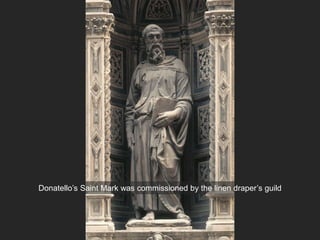
Donatello’s Saint Mark was commissioned by the linen draper’s guild
The pillow that he
stands on is made
of linen
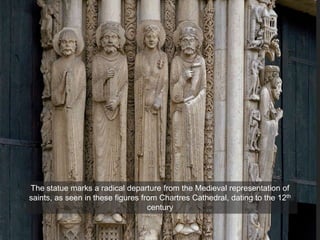
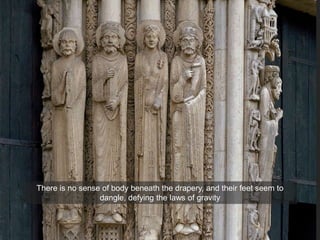
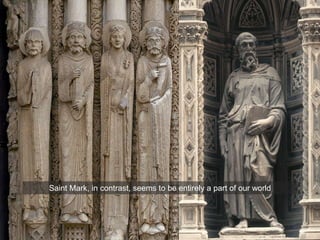
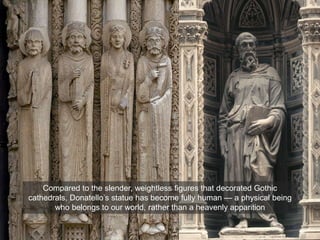
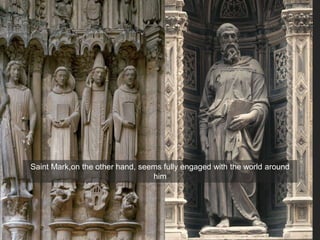
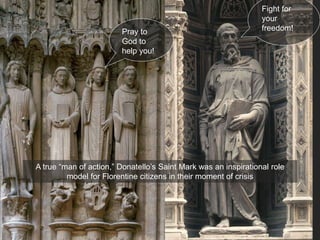
The statue marks a radical departure from the Medieval representation of
saints, as seen in these figures from Chartres Cathedral, dating to the 12th
century
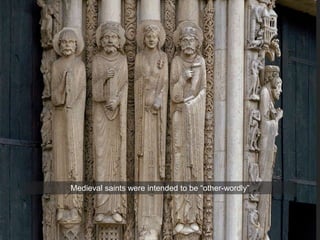
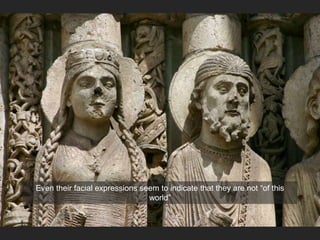
Medieval saints were intended to be “other-wordly”
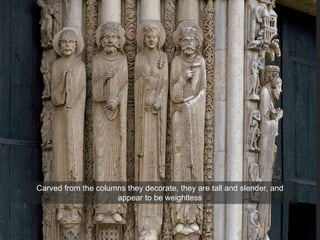
Carved from the columns they decorate, they are tall and slender, and
appear to be weightless
There is no sense of body beneath the drapery, and their feet seem to
dangle, defying the laws of gravity
Even their facial expressions seem to indicate that they are not “of this
world”
Saint Mark, in contrast, seems to be entirely a part of our world
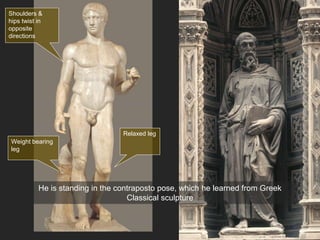
Weight bearing
leg
Relaxed leg
Shoulders &
hips twist in
opposite
directions
He is standing in the contraposto pose, which he learned from Greek
Classical sculpture
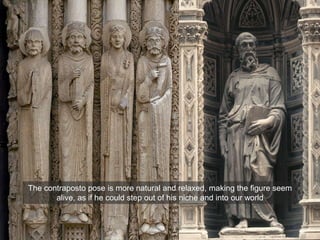
The contraposto pose is more natural and relaxed, making the figure seem
alive, as if he could step out of his niche and into our world
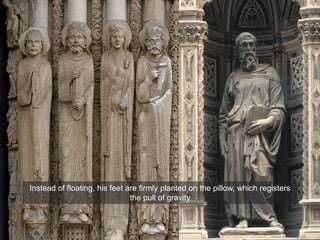
Instead of floating, his feet are firmly planted on the pillow, which registers
the pull of gravity
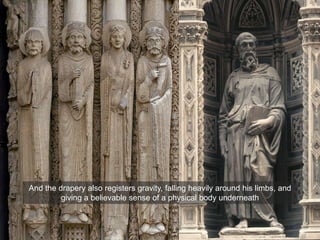
And the drapery also registers gravity, falling heavily around his limbs, and
giving a believable sense of a physical body underneath
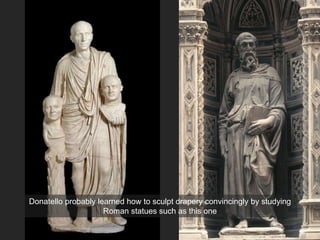
Donatello probably learned how to sculpt drapery convincingly by studying
Roman statues such as this one
Compared to the slender, weightless figures that decorated Gothic
cathedrals, Donatello’s statue has become fully human — a physical being
who belongs to our world, rather than a heavenly apparition
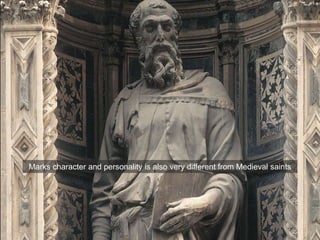
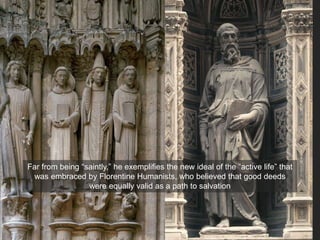
Marks character and personality is also very different from Medieval saints
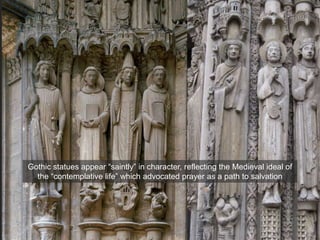
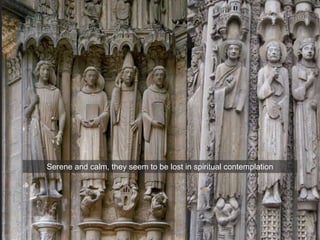
Gothic statues appear “saintly” in character, reflecting the Medieval ideal of
the “contemplative life” which advocated prayer as a path to salvation
Serene and calm, they seem to be lost in spiritual contemplation
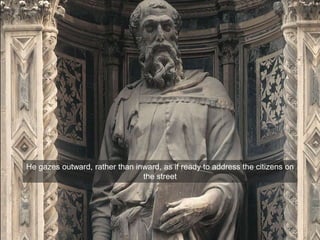
Saint Mark,on the other hand, seems fully engaged with the world around
him
He gazes outward, rather than inward, as if ready to address the citizens on
the street
Far from being “saintly,” he exemplifies the new ideal of the “active life” that
was embraced by Florentine Humanists, who believed that good deeds
were equally valid as a path to salvation
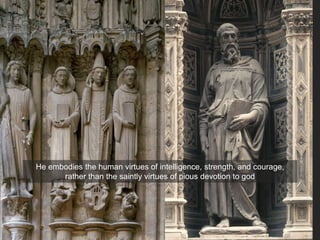
He embodies the human virtues of intelligence, strength, and courage,
rather than the saintly virtues of pious devotion to god
A true “man of action,” Donatello’s Saint Mark was an inspirational role
model for Florentine citizens in their moment of crisis
Pray to
God to
help you!
Fight for
your
freedom!
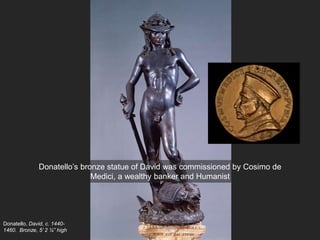
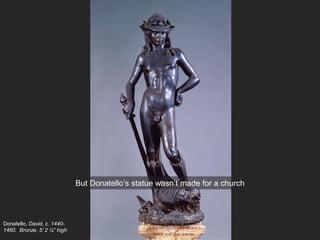
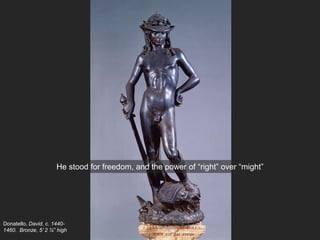
Donatello, David, c. 1440-
1460. Bronze, 5’ 2 ¼” high
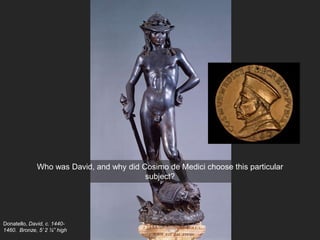
Donatello’s bronze statue of David was commissioned by Cosimo de
Medici, a wealthy banker and Humanist
Donatello, David, c. 1440-
1460. Bronze, 5’ 2 ¼” high
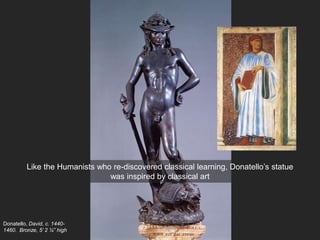
Like the Humanists who re-discovered classical learning, Donatello’s statue
was inspired by classical art
Donatello, David, c. 1440-
1460. Bronze, 5’ 2 ¼” high
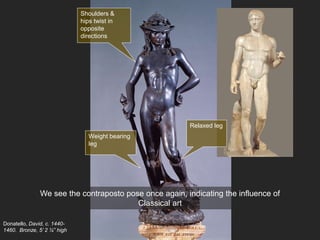
We see the contraposto pose once again, indicating the influence of
Classical art
Weight bearing
leg
Relaxed leg
Shoulders &
hips twist in
opposite
directions
Donatello, David, c. 1440-
1460. Bronze, 5’ 2 ¼” high
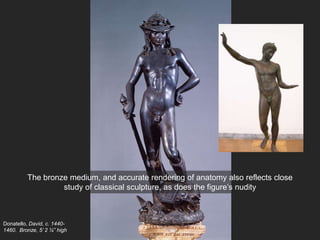
The bronze medium, and accurate rendering of anatomy also reflects close
study of classical sculpture, as does the figure’s nudity
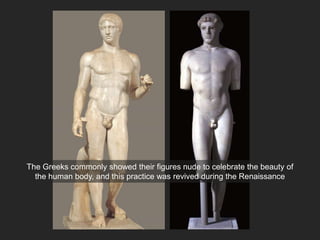
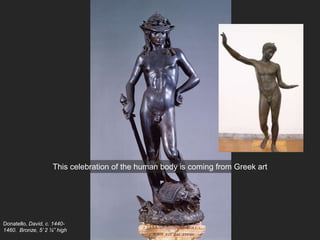
The Greeks commonly showed their figures nude to celebrate the beauty of
the human body, and this practice was revived during the Renaissance
Donatello, David, c. 1440-
1460. Bronze, 5’ 2 ¼” high
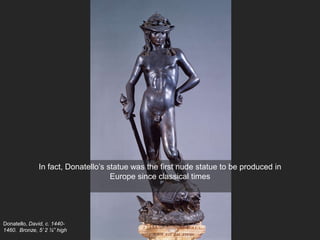
In fact, Donatello’s statue was the first nude statue to be produced in
Europe since classical times
That’s, like,
almost one
thousand
years Why were
there no
nude statues
for such a
long time?
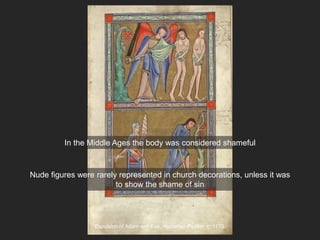
Expulsion of Adam and Eve, Hunterian Psalter, c. 1170
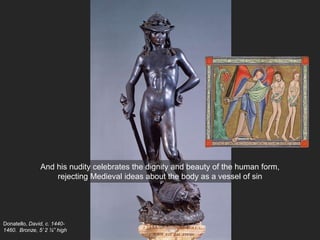
In the Middle Ages the body was considered shameful
Nude figures were rarely represented in church decorations, unless it was
to show the shame of sin
Donatello, David, c. 1440-
1460. Bronze, 5’ 2 ¼” high
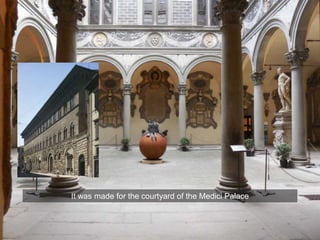
But Donatello’s statue wasn’t made for a church
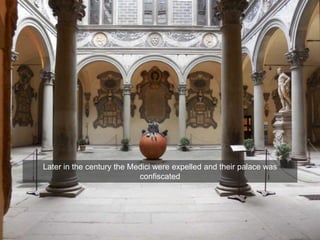
It was made for the courtyard of the Medici Palace
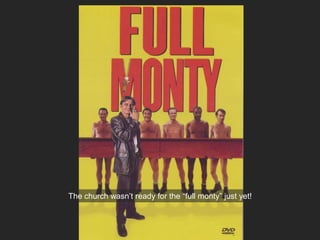
The church wasn’t ready for the “full monty” just yet!
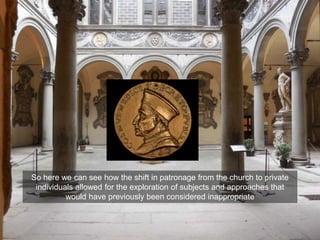
So here we can see how the shift in patronage from the church to private
individuals allowed for the exploration of subjects and approaches that
would have previously been considered inappropriate
Donatello, David, c. 1440-
1460. Bronze, 5’ 2 ¼” high
Who was David, and why did Cosimo de Medici choose this particular
subject?
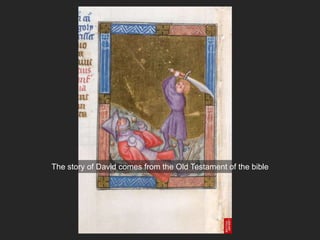
The story of David comes from the Old Testament of the bible
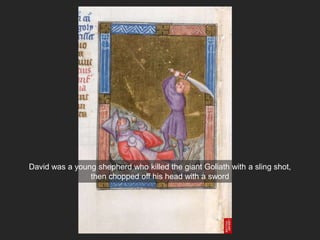
David was a young shepherd who killed the giant Goliath with a sling shot,
then chopped off his head with a sword
Donatello, David, c. 1440-
1460. Bronze, 5’ 2 ¼” high
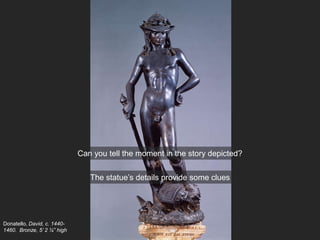
Can you tell the moment in the story depicted?
The statue’s details provide some clues
Donatello, David, c. 1440-
1460. Bronze, 5’ 2 ¼” high
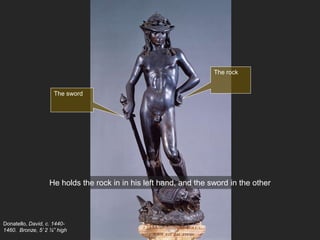
He holds the rock in in his left hand, and the sword in the other
The rock
The sword
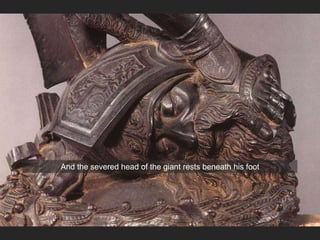
And the severed head of the giant rests beneath his foot
Donatello, David, c. 1440-
1460. Bronze, 5’ 2 ¼” high
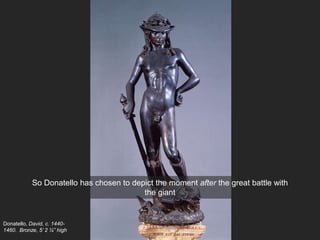
So Donatello has chosen to depict the moment after the great battle with
the giant
It is a moment of calm, where the young boy contemplates the meaning of
his victory
Donatello, David, c. 1440-
1460. Bronze, 5’ 2 ¼” high
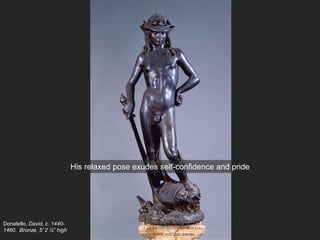
His relaxed pose exudes self-confidence and pride
Donatello, David, c. 1440-
1460. Bronze, 5’ 2 ¼” high
And his nudity celebrates the dignity and beauty of the human form,
rejecting Medieval ideas about the body as a vessel of sin
Donatello, David, c. 1440-
1460. Bronze, 5’ 2 ¼” high
This celebration of the human body is coming from Greek art
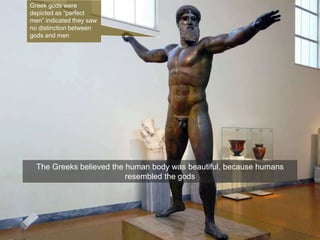
The Greeks believed the human body was beautiful, because humans
resembled the gods
Greek gods were
depicted as “perfect
men” indicated they saw
no distinction between
gods and men
He embodies what Manetti called
“the dignity and excellence of man”
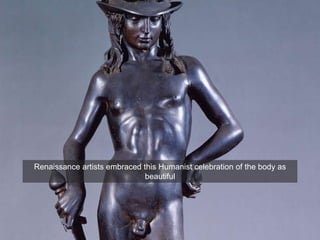
Renaissance artists embraced this Humanist celebration of the body as
beautiful
He embodies what Manetti called
“the dignity and excellence of man”
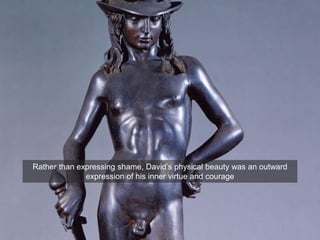
Rather than expressing shame, David’s physical beauty was an outward
expression of his inner virtue and courage
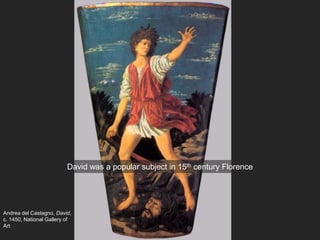
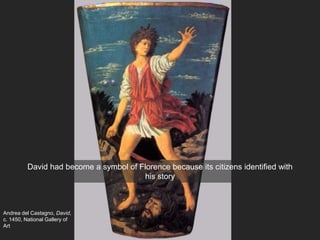
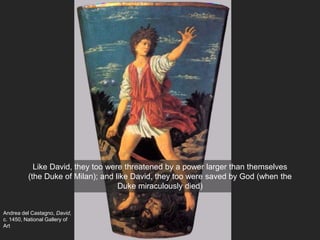
Andrea del Castagno, David,
c. 1450, National Gallery of
Art
David was a popular subject in 15th century Florence
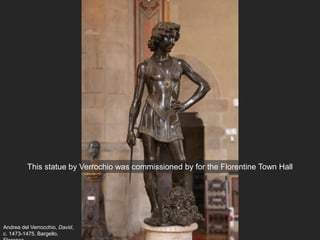
Andrea del Verrocchio, David,
c. 1473-1475, Bargello,
This statue by Verrochio was commissioned by for the Florentine Town Hall
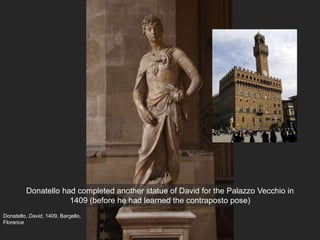
Donatello, David, 1409, Bargello,
Florence
Donatello had completed another statue of David for the Palazzo Vecchio in
1409 (before he had learned the contraposto pose)
Andrea del Castagno, David,
c. 1450, National Gallery of
Art
David had become a symbol of Florence because its citizens identified with
his story
Andrea del Castagno, David,
c. 1450, National Gallery of
Art
Like David, they too were threatened by a power larger than themselves
(the Duke of Milan); and like David, they too were saved by God (when the
Duke miraculously died)
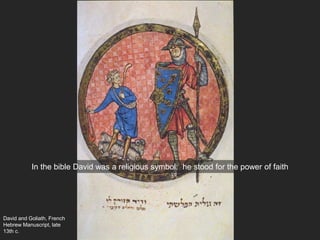
David and Goliath, French
Hebrew Manuscript, late
13th c.
In the bible David was a religious symbol: he stood for the power of faith
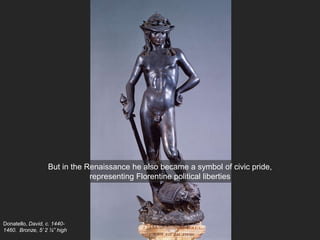
Donatello, David, c. 1440-
1460. Bronze, 5’ 2 ¼” high
But in the Renaissance he also became a symbol of civic pride,
representing Florentine political liberties
Donatello, David, c. 1440-
1460. Bronze, 5’ 2 ¼” high
He stood for freedom, and the power of “right” over “might”
Donatello, David, c. 1440-
1460. Bronze, 5’ 2 ¼” high
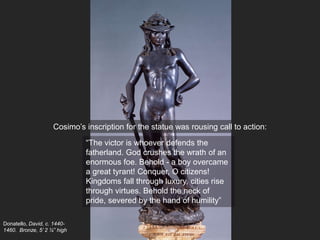
Cosimo’s inscription for the statue was rousing call to action:
“The victor is whoever defends the
fatherland. God crushes the wrath of an
enormous foe. Behold - a boy overcame
a great tyrant! Conquer, O citizens!
Kingdoms fall through luxury, cities rise
through virtues. Behold the neck of
pride, severed by the hand of humility”
Later in the century the Medici were expelled and their palace was
confiscated
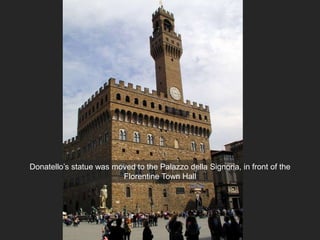
Donatello’s statue was moved to the Palazzo della Signoria, in front of the
Florentine Town Hall
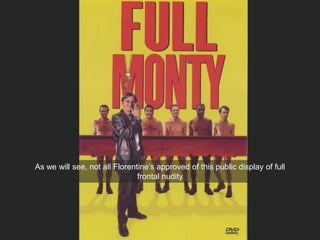
As we will see, not all Florentine’s approved of this public display of full
frontal nudity
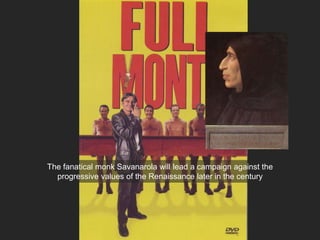
The fanatical monk Savanarola will lead a campaign against the
progressive values of the Renaissance later in the century
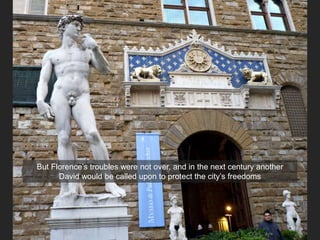
But Florence’s troubles were not over, and in the next century another
David would be called upon to protect the city’s freedoms
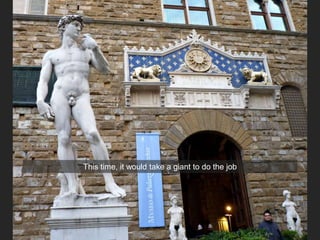
This time, it would take a giant to do the job
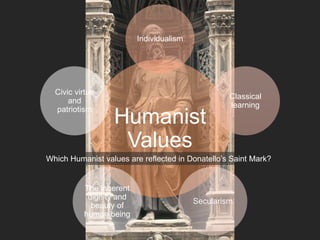
Humanist
Values
Individualism
Classical
learning
Secularism
The inherent
dignity and
beauty of
human being
Civic virtue
and
patriotism
Which Humanist values are reflected in Donatello’s Saint Mark?
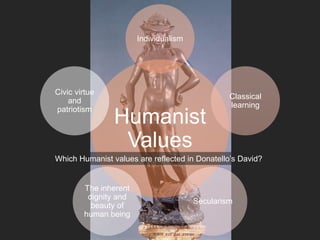
Humanist
Values
Individualism
Classical
learning
Secularism
The inherent
dignity and
beauty of
human being
Civic virtue
and
patriotism
Which Humanist values are reflected in Donatello’s David?

Italisan Renaissance: Donatello

  • 1.
    Renaissance Sculpture Donatello andthe Allure of Antiquity
  • 2.
    Donatello, Saint Mark,Or San Michele, Florence, c. 1411-1413 The leading sculptor in Renaissance Florence was Donatello, who studied with Ghiberti (the winner of the Baptistry door competition)
  • 3.
    One of Donatello’smost famous statues was a statue of Saint Mark, carved for the Church of Orsanmichele in Florence
  • 4.
    Along with theDuomo and the Palazzo Vecchio, Orsanmichele was one of the most important buildings in Florence The Duomo The Palazzo Vecchio (municipal town hall) Orsanmichele
  • 5.
    It served asthe headquarters for the city’s leading merchant guilds, so it was an important symbol of commercial prosperity and civic pride
  • 6.
    Back in Giotto’sday (the 1300s), each of the Gothic style niches (or tabernacles) had been assigned to the city’s leading merchant guilds to be filled with a statue of their patron saint
  • 7.
    The niches remainedempty for quite some time – but when Florence came under attack from the Duke of Milan, the guilds sprang into action, and the niches were filled with 14 life-size statues in rapid succession
  • 8.
    Guild of WoolMerchants, Saint Stephen, 1427-28 Ghiberti Guild of Merchants, Saint John the Baptists, 1416 Ghiberti Ghiberti completed three statues for the building
  • 9.
    Guild of Stoneand Wood Masters, Four Crowned Saints, 1414-1417 Nanni di Banco Nanni di Banco completed the Four Crowned Martyrs for the Guild of Stone and Wood Masters, whose trade is represented in the relief decorating the base Stonemasons Sculptors
  • 10.
    Watch the Smarthistoryvideo for a discussion
  • 11.
    Donatello’s Saint Markwas commissioned by the linen draper’s guild
  • 12.
    The pillow thathe stands on is made of linen
  • 13.
    The statue marksa radical departure from the Medieval representation of saints, as seen in these figures from Chartres Cathedral, dating to the 12th century
  • 14.
    Medieval saints wereintended to be “other-wordly”
  • 15.
    Carved from thecolumns they decorate, they are tall and slender, and appear to be weightless
  • 16.
    There is nosense of body beneath the drapery, and their feet seem to dangle, defying the laws of gravity
  • 17.
    Even their facialexpressions seem to indicate that they are not “of this world”
  • 18.
    Saint Mark, incontrast, seems to be entirely a part of our world
  • 19.
    Weight bearing leg Relaxed leg Shoulders& hips twist in opposite directions He is standing in the contraposto pose, which he learned from Greek Classical sculpture
  • 20.
    The contraposto poseis more natural and relaxed, making the figure seem alive, as if he could step out of his niche and into our world
  • 21.
    Instead of floating,his feet are firmly planted on the pillow, which registers the pull of gravity
  • 22.
    And the draperyalso registers gravity, falling heavily around his limbs, and giving a believable sense of a physical body underneath
  • 23.
    Donatello probably learnedhow to sculpt drapery convincingly by studying Roman statues such as this one
  • 24.
    Compared to theslender, weightless figures that decorated Gothic cathedrals, Donatello’s statue has become fully human — a physical being who belongs to our world, rather than a heavenly apparition
  • 25.
    Marks character andpersonality is also very different from Medieval saints
  • 26.
    Gothic statues appear“saintly” in character, reflecting the Medieval ideal of the “contemplative life” which advocated prayer as a path to salvation
  • 27.
    Serene and calm,they seem to be lost in spiritual contemplation
  • 28.
    Saint Mark,on theother hand, seems fully engaged with the world around him
  • 29.
    He gazes outward,rather than inward, as if ready to address the citizens on the street
  • 30.
    Far from being“saintly,” he exemplifies the new ideal of the “active life” that was embraced by Florentine Humanists, who believed that good deeds were equally valid as a path to salvation
  • 31.
    He embodies thehuman virtues of intelligence, strength, and courage, rather than the saintly virtues of pious devotion to god
  • 32.
    A true “manof action,” Donatello’s Saint Mark was an inspirational role model for Florentine citizens in their moment of crisis Pray to God to help you! Fight for your freedom!
  • 33.
    Donatello, David, c.1440- 1460. Bronze, 5’ 2 ¼” high Donatello’s bronze statue of David was commissioned by Cosimo de Medici, a wealthy banker and Humanist
  • 34.
    Donatello, David, c.1440- 1460. Bronze, 5’ 2 ¼” high Like the Humanists who re-discovered classical learning, Donatello’s statue was inspired by classical art
  • 35.
    Donatello, David, c.1440- 1460. Bronze, 5’ 2 ¼” high We see the contraposto pose once again, indicating the influence of Classical art Weight bearing leg Relaxed leg Shoulders & hips twist in opposite directions
  • 36.
    Donatello, David, c.1440- 1460. Bronze, 5’ 2 ¼” high The bronze medium, and accurate rendering of anatomy also reflects close study of classical sculpture, as does the figure’s nudity
  • 37.
    The Greeks commonlyshowed their figures nude to celebrate the beauty of the human body, and this practice was revived during the Renaissance
  • 38.
    Donatello, David, c.1440- 1460. Bronze, 5’ 2 ¼” high In fact, Donatello’s statue was the first nude statue to be produced in Europe since classical times
  • 39.
    That’s, like, almost one thousand yearsWhy were there no nude statues for such a long time?
  • 40.
    Expulsion of Adamand Eve, Hunterian Psalter, c. 1170 In the Middle Ages the body was considered shameful Nude figures were rarely represented in church decorations, unless it was to show the shame of sin
  • 41.
    Donatello, David, c.1440- 1460. Bronze, 5’ 2 ¼” high But Donatello’s statue wasn’t made for a church
  • 42.
    It was madefor the courtyard of the Medici Palace
  • 43.
    The church wasn’tready for the “full monty” just yet!
  • 44.
    So here wecan see how the shift in patronage from the church to private individuals allowed for the exploration of subjects and approaches that would have previously been considered inappropriate
  • 45.
    Donatello, David, c.1440- 1460. Bronze, 5’ 2 ¼” high Who was David, and why did Cosimo de Medici choose this particular subject?
  • 46.
    The story ofDavid comes from the Old Testament of the bible
  • 47.
    David was ayoung shepherd who killed the giant Goliath with a sling shot, then chopped off his head with a sword
  • 48.
    Donatello, David, c.1440- 1460. Bronze, 5’ 2 ¼” high Can you tell the moment in the story depicted? The statue’s details provide some clues
  • 49.
    Donatello, David, c.1440- 1460. Bronze, 5’ 2 ¼” high He holds the rock in in his left hand, and the sword in the other The rock The sword
  • 50.
    And the severedhead of the giant rests beneath his foot
  • 51.
    Donatello, David, c.1440- 1460. Bronze, 5’ 2 ¼” high So Donatello has chosen to depict the moment after the great battle with the giant
  • 52.
    It is amoment of calm, where the young boy contemplates the meaning of his victory
  • 53.
    Donatello, David, c.1440- 1460. Bronze, 5’ 2 ¼” high His relaxed pose exudes self-confidence and pride
  • 54.
    Donatello, David, c.1440- 1460. Bronze, 5’ 2 ¼” high And his nudity celebrates the dignity and beauty of the human form, rejecting Medieval ideas about the body as a vessel of sin
  • 55.
    Donatello, David, c.1440- 1460. Bronze, 5’ 2 ¼” high This celebration of the human body is coming from Greek art
  • 56.
    The Greeks believedthe human body was beautiful, because humans resembled the gods Greek gods were depicted as “perfect men” indicated they saw no distinction between gods and men
  • 57.
    He embodies whatManetti called “the dignity and excellence of man” Renaissance artists embraced this Humanist celebration of the body as beautiful
  • 58.
    He embodies whatManetti called “the dignity and excellence of man” Rather than expressing shame, David’s physical beauty was an outward expression of his inner virtue and courage
  • 59.
    Andrea del Castagno,David, c. 1450, National Gallery of Art David was a popular subject in 15th century Florence
  • 60.
    Andrea del Verrocchio,David, c. 1473-1475, Bargello, This statue by Verrochio was commissioned by for the Florentine Town Hall
  • 61.
    Donatello, David, 1409,Bargello, Florence Donatello had completed another statue of David for the Palazzo Vecchio in 1409 (before he had learned the contraposto pose)
  • 62.
    Andrea del Castagno,David, c. 1450, National Gallery of Art David had become a symbol of Florence because its citizens identified with his story
  • 63.
    Andrea del Castagno,David, c. 1450, National Gallery of Art Like David, they too were threatened by a power larger than themselves (the Duke of Milan); and like David, they too were saved by God (when the Duke miraculously died)
  • 64.
    David and Goliath,French Hebrew Manuscript, late 13th c. In the bible David was a religious symbol: he stood for the power of faith
  • 65.
    Donatello, David, c.1440- 1460. Bronze, 5’ 2 ¼” high But in the Renaissance he also became a symbol of civic pride, representing Florentine political liberties
  • 66.
    Donatello, David, c.1440- 1460. Bronze, 5’ 2 ¼” high He stood for freedom, and the power of “right” over “might”
  • 67.
    Donatello, David, c.1440- 1460. Bronze, 5’ 2 ¼” high Cosimo’s inscription for the statue was rousing call to action: “The victor is whoever defends the fatherland. God crushes the wrath of an enormous foe. Behold - a boy overcame a great tyrant! Conquer, O citizens! Kingdoms fall through luxury, cities rise through virtues. Behold the neck of pride, severed by the hand of humility”
  • 68.
    Later in thecentury the Medici were expelled and their palace was confiscated
  • 69.
    Donatello’s statue wasmoved to the Palazzo della Signoria, in front of the Florentine Town Hall
  • 70.
    As we willsee, not all Florentine’s approved of this public display of full frontal nudity
  • 71.
    The fanatical monkSavanarola will lead a campaign against the progressive values of the Renaissance later in the century
  • 72.
    But Florence’s troubleswere not over, and in the next century another David would be called upon to protect the city’s freedoms
  • 73.
    This time, itwould take a giant to do the job
  • 74.
    Humanist Values Individualism Classical learning Secularism The inherent dignity and beautyof human being Civic virtue and patriotism Which Humanist values are reflected in Donatello’s Saint Mark?
  • 75.
    Humanist Values Individualism Classical learning Secularism The inherent dignity and beautyof human being Civic virtue and patriotism Which Humanist values are reflected in Donatello’s David?