Italian Quattro Cento
Major Themes of the Era
• Scholars & artists become fascinated with
classical antiquity – its art, literature and
other forms of culture.
• A new interest in the natural world as artists
search for ways to depict what and how we
see – fields of science, medicine and
engineering are of special interest to the
pioneering thinkers of the time.
• Patronage of the church provided financial
support for artwork, and artists portray
humans and their environment in a realistic
manner when visually interpreting biblical
texts.
• Concerns of the era are humanist concerns –
a worldview focused on human beings, their
potential, achievement and subsequent civic
responsibility.
Italian Quattrocento Painting
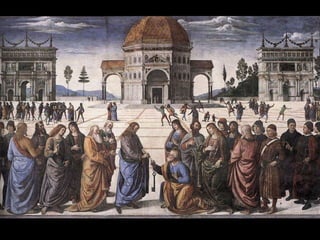
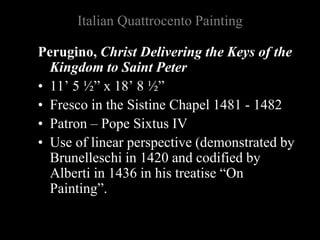
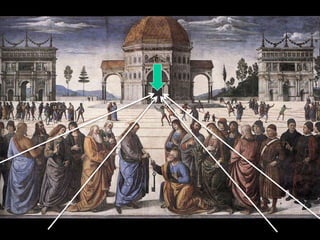
Perugino, Christ Delivering the Keys of the
Kingdom to Saint Peter
• 11’ 5 ½” x 18’ 8 ½”
• Fresco in the Sistine Chapel 1481 - 1482
• Patron – Pope Sixtus IV
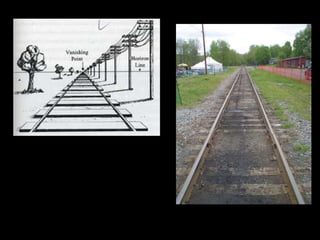
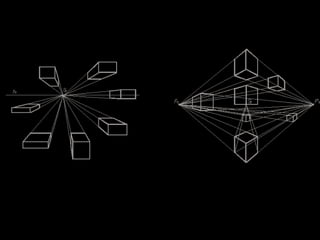
• Use of linear perspective (demonstrated by
Brunelleschi in 1420 and codified by
Alberti in 1436 in his treatise “On
Painting”.
Italian Quattrocento Painting
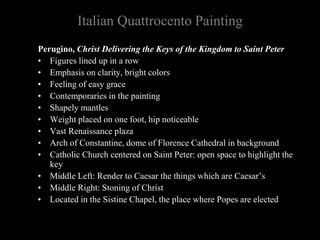
Perugino, Christ Delivering the Keys of the Kingdom to Saint Peter
• Figures lined up in a row
• Emphasis on clarity, bright colors
• Feeling of easy grace
• Contemporaries in the painting
• Shapely mantles
• Weight placed on one foot, hip noticeable
• Vast Renaissance plaza
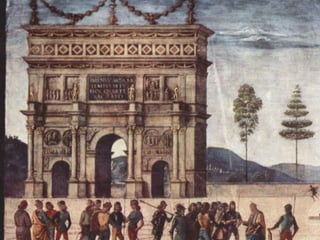
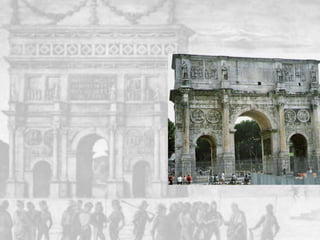
• Arch of Constantine, dome of Florence Cathedral in background
• Catholic Church centered on Saint Peter: open space to highlight the
key
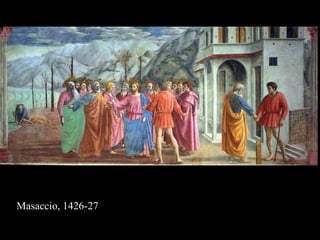
• Middle Left: Render to Caesar the things which are Caesar’s
• Middle Right: Stoning of Christ
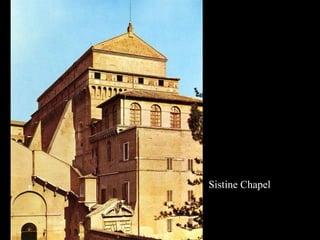
• Located in the Sistine Chapel, the place where Popes are elected
• Architecture ties authority of Constantine,
Christ and St. Peter
• Peter, as first Pope, justifies supremacy of
papacy
Sistine Chapel
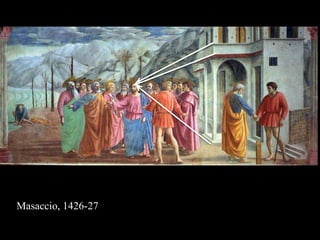
Masaccio, 1426-27
Masaccio, 1426-27
Brancacci Chapel
Italian Quattrocento Painting
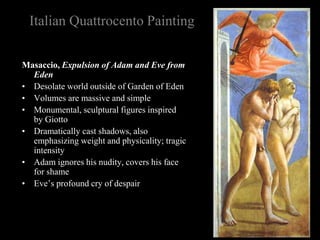
Masaccio, Expulsion of Adam and Eve from
Eden
• Desolate world outside of Garden of Eden
• Volumes are massive and simple
• Monumental, sculptural figures inspired
by Giotto
• Dramatically cast shadows, also
emphasizing weight and physicality; tragic
intensity
• Adam ignores his nudity, covers his face
for shame
• Eve’s profound cry of despair
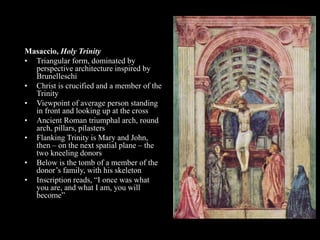
Masaccio, Holy Trinity
• Triangular form, dominated by
perspective architecture inspired by
Brunelleschi
• Christ is crucified and a member of the
Trinity
• Viewpoint of average person standing
in front and looking up at the cross
• Ancient Roman triumphal arch, round
arch, pillars, pilasters
• Flanking Trinity is Mary and John,
then – on the next spatial plane – the
two kneeling donors
• Below is the tomb of a member of the
donor’s family, with his skeleton
• Inscription reads, “I once was what
you are, and what I am, you will
become”
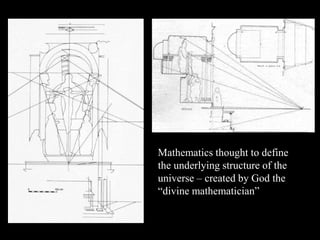
Mathematics thought to define
the underlying structure of the
universe – created by God the
“divine mathematician”
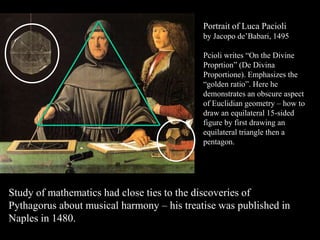
Portrait of Luca Pacioli
by Jacopo de’Babari, 1495
Pcioli writes “On the Divine
Proprtion” (De Divina
Proportione). Emphasizes the
“golden ratio”. Here he
demonstrates an obscure aspect
of Euclidian geometry – how to
draw an equilateral 15-sided
figure by first drawing an
equilateral triangle then a
pentagon.
Study of mathematics had close ties to the discoveries of
Pythagorus about musical harmony – his treatise was published in
Naples in 1480.
Italian Quattrocento Painting
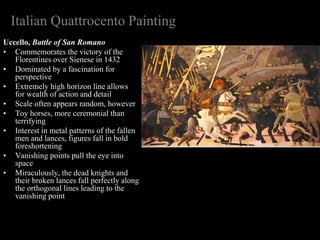
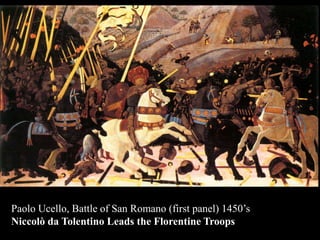
Uccello, Battle of San Romano
• Commemorates the victory of the
Florentines over Sienese in 1432
• Dominated by a fascination for
perspective
• Extremely high horizon line allows
for wealth of action and detail
• Scale often appears random, however
• Toy horses, more ceremonial than
terrifying
• Interest in metal patterns of the fallen
men and lances, figures fall in bold
foreshortening
• Vanishing points pull the eye into
space
• Miraculously, the dead knights and
their broken lances fall perfectly along
the orthogonal lines leading to the
vanishing point
Paolo Ucello, Battle of San Romano (first panel) 1450’s
Niccolò da Tolentino Leads the Florentine Troops
Italian Quattrocento Painting
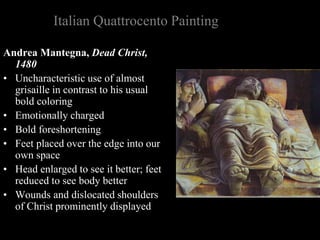
Andrea Mantegna, Dead Christ,
1480
• Uncharacteristic use of almost
grisaille in contrast to his usual
bold coloring
• Emotionally charged
• Bold foreshortening
• Feet placed over the edge into our
own space
• Head enlarged to see it better; feet
reduced to see body better
• Wounds and dislocated shoulders
of Christ prominently displayed
Italian Quattrocento Painting
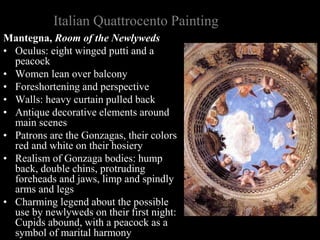
Mantegna, Room of the Newlyweds
• Oculus: eight winged putti and a
peacock
• Women lean over balcony
• Foreshortening and perspective
• Walls: heavy curtain pulled back
• Antique decorative elements around
main scenes
• Patrons are the Gonzagas, their colors
red and white on their hosiery
• Realism of Gonzaga bodies: hump
back, double chins, protruding
foreheads and jaws, limp and spindly
arms and legs
• Charming legend about the possible
use by newlyweds on their first night:
Cupids abound, with a peacock as a
symbol of marital harmony
Italian Quattrocento Painting
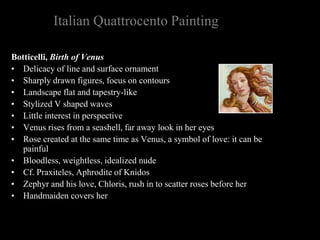
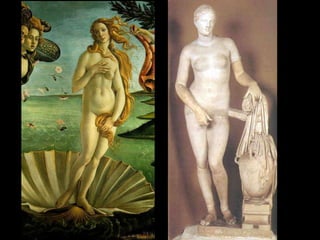
Botticelli, Birth of Venus
• Delicacy of line and surface ornament
• Sharply drawn figures, focus on contours
• Landscape flat and tapestry-like
• Stylized V shaped waves
• Little interest in perspective
• Venus rises from a seashell, far away look in her eyes
• Rose created at the same time as Venus, a symbol of love: it can be
painful
• Bloodless, weightless, idealized nude
• Cf. Praxiteles, Aphrodite of Knidos
• Zephyr and his love, Chloris, rush in to scatter roses before her
• Handmaiden covers her
Using Classical Vocabulary
• Adaptation of classical vocabulary to
contemporary artworks and architectural
structures
• A means to associate with the greatness of
Rome, and to triumph over its pagan past
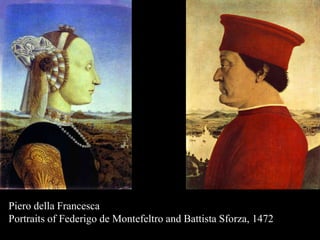
Piero della Francesca
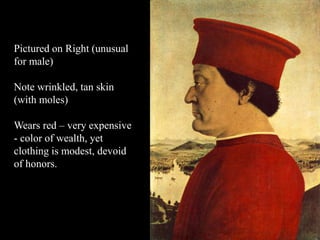
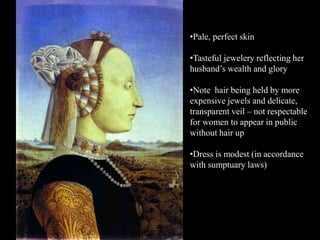
Portraits of Federigo de Montefeltro and Battista Sforza, 1472
Pictured on Right (unusual
for male)
Note wrinkled, tan skin
(with moles)
Wears red – very expensive
- color of wealth, yet
clothing is modest, devoid
of honors.
•Pale, perfect skin
•Tasteful jewelery reflecting her
husband’s wealth and glory
•Note hair being held by more
expensive jewels and delicate,
transparent veil – not respectable
for women to appear in public
without hair up
•Dress is modest (in accordance
with sumptuary laws)
Italian Quattrocento Painting
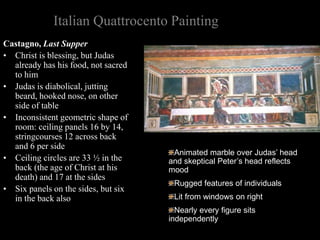
Castagno, Last Supper
• Christ is blessing, but Judas
already has his food, not sacred
to him
• Judas is diabolical, jutting
beard, hooked nose, on other
side of table
• Inconsistent geometric shape of
room: ceiling panels 16 by 14,
stringcourses 12 across back
and 6 per side
• Ceiling circles are 33 ½ in the
back (the age of Christ at his
death) and 17 at the sides
• Six panels on the sides, but six
in the back also
Animated marble over Judas’ head
and skeptical Peter’s head reflects
mood
Rugged features of individuals
Lit from windows on right
Nearly every figure sits
independently
Italian Quattrocento Painting
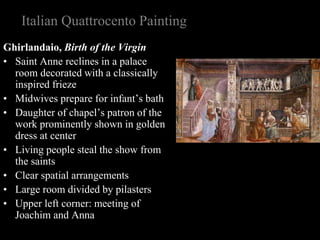
Ghirlandaio, Birth of the Virgin
• Saint Anne reclines in a palace
room decorated with a classically
inspired frieze
• Midwives prepare for infant’s bath
• Daughter of chapel’s patron of the
work prominently shown in golden
dress at center
• Living people steal the show from
the saints
• Clear spatial arrangements
• Large room divided by pilasters
• Upper left corner: meeting of
Joachim and Anna
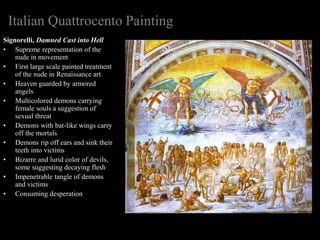
Italian Quattrocento Painting
Signorelli, Damned Cast into Hell
• Supreme representation of the
nude in movement
• First large scale painted treatment
of the nude in Renaissance art
• Heaven guarded by armored
angels
• Multicolored demons carrying
female souls a suggestion of
sexual threat
• Demons with bat-like wings carry
off the mortals
• Demons rip off ears and sink their
teeth into victims
• Bizarre and lurid color of devils,
some suggesting decaying flesh
• Impenetrable tangle of demons
and victims
• Consuming desperation
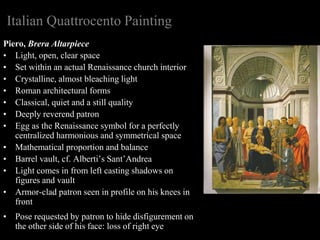
Italian Quattrocento Painting
Piero, Brera Altarpiece
• Light, open, clear space
• Set within an actual Renaissance church interior
• Crystalline, almost bleaching light
• Roman architectural forms
• Classical, quiet and a still quality
• Deeply reverend patron
• Egg as the Renaissance symbol for a perfectly
centralized harmonious and symmetrical space
• Mathematical proportion and balance
• Barrel vault, cf. Alberti’s Sant’Andrea
• Light comes in from left casting shadows on
figures and vault
• Armor-clad patron seen in profile on his knees in
front
• Pose requested by patron to hide disfigurement on
the other side of his face: loss of right eye
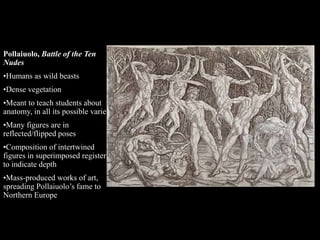
Pollaiuolo, Battle of the Ten
Nudes
•Humans as wild beasts
•Dense vegetation
•Meant to teach students about
anatomy, in all its possible variety
•Many figures are in
reflected/flipped poses
•Composition of intertwined
figures in superimposed registers
to indicate depth
•Mass-produced works of art,
spreading Pollaiuolo’s fame to
Northern Europe
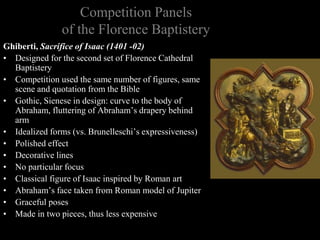
Competition Panels
of the Florence Baptistery
Ghiberti, Sacrifice of Isaac (1401 -02)
• Designed for the second set of Florence Cathedral
Baptistery
• Competition used the same number of figures, same
scene and quotation from the Bible
• Gothic, Sienese in design: curve to the body of
Abraham, fluttering of Abraham’s drapery behind
arm
• Idealized forms (vs. Brunelleschi’s expressiveness)
• Polished effect
• Decorative lines
• No particular focus
• Classical figure of Isaac inspired by Roman art
• Abraham’s face taken from Roman model of Jupiter
• Graceful poses
• Made in two pieces, thus less expensive
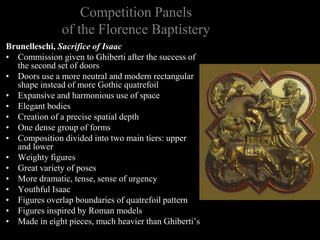
Competition Panels
of the Florence Baptistery
Brunelleschi, Sacrifice of Isaac
• Commission given to Ghiberti after the success of
the second set of doors
• Doors use a more neutral and modern rectangular
shape instead of more Gothic quatrefoil
• Expansive and harmonious use of space
• Elegant bodies
• Creation of a precise spatial depth
• One dense group of forms
• Composition divided into two main tiers: upper
and lower
• Weighty figures
• Great variety of poses
• More dramatic, tense, sense of urgency
• Youthful Isaac
• Figures overlap boundaries of quatrefoil pattern
• Figures inspired by Roman models
• Made in eight pieces, much heavier than Ghiberti’s
Italian Quattrocento Sculpture
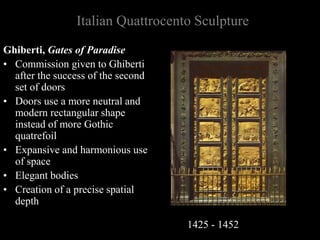
Ghiberti, Gates of Paradise
• Commission given to Ghiberti
after the success of the second
set of doors
• Doors use a more neutral and
modern rectangular shape
instead of more Gothic
quatrefoil
• Expansive and harmonious use
of space
• Elegant bodies
• Creation of a precise spatial
depth
1425 - 1452
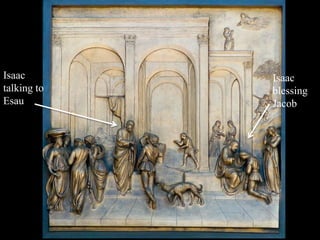
Isaac
talking to
Esau
Isaac
blessing
Jacob
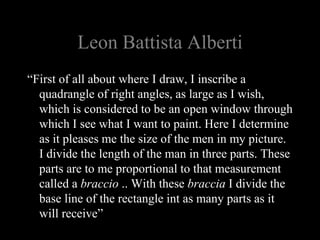
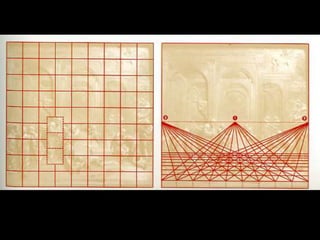
Leon Battista Alberti
“First of all about where I draw, I inscribe a
quadrangle of right angles, as large as I wish,
which is considered to be an open window through
which I see what I want to paint. Here I determine
as it pleases me the size of the men in my picture.
I divide the length of the man in three parts. These
parts are to me proportional to that measurement
called a braccio .. With these braccia I divide the
base line of the rectangle int as many parts as it
will receive”
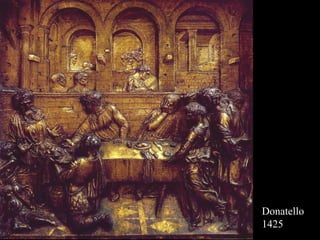
Donatello
1425
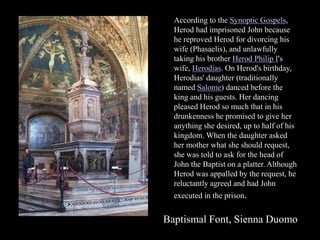
According to the Synoptic Gospels,
Herod had imprisoned John because
he reproved Herod for divorcing his
wife (Phasaelis), and unlawfully
taking his brother Herod Philip I's
wife, Herodias. On Herod's birthday,
Herodias' daughter (traditionally
named Salome) danced before the
king and his guests. Her dancing
pleased Herod so much that in his
drunkenness he promised to give her
anything she desired, up to half of his
kingdom. When the daughter asked
her mother what she should request,
she was told to ask for the head of
John the Baptist on a platter. Although
Herod was appalled by the request, he
reluctantly agreed and had John
executed in the prison.
Baptismal Font, Sienna Duomo
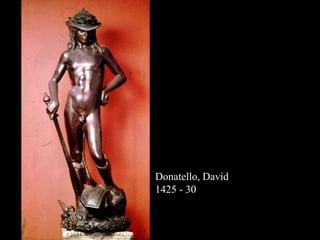
Donatello, David
1425 - 30
Italian Quattrocento Art
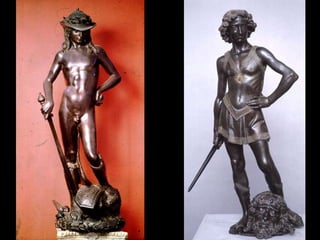
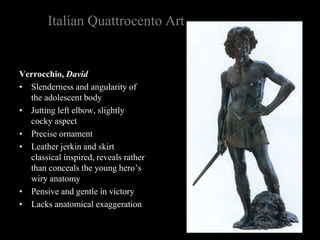
Verrocchio, David
• Slenderness and angularity of
the adolescent body
• Jutting left elbow, slightly
cocky aspect
• Precise ornament
• Leather jerkin and skirt
classical inspired, reveals rather
than conceals the young hero’s
wiry anatomy
• Pensive and gentle in victory
• Lacks anatomical exaggeration
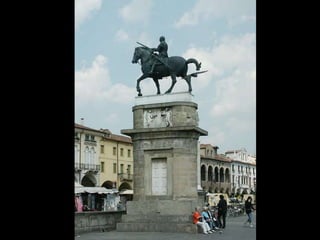
Venetian condottiere, Erasmo da Narni (nicknamed
Gattamelata or "honeyed [or cunning] cat)"
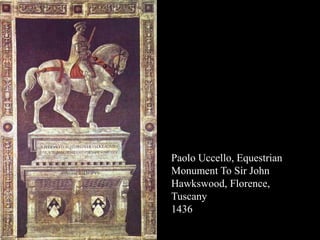
Paolo Uccello, Equestrian
Monument To Sir John
Hawkswood, Florence,
Tuscany
1436
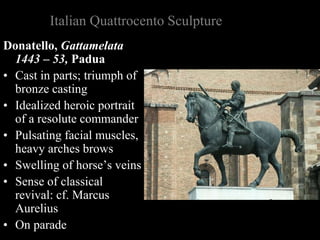
Italian Quattrocento Sculpture
Donatello, Gattamelata
1443 – 53, Padua
• Cast in parts; triumph of
bronze casting
• Idealized heroic portrait
of a resolute commander
• Pulsating facial muscles,
heavy arches brows
• Swelling of horse’s veins
• Sense of classical
revival: cf. Marcus
Aurelius
• On parade
Italian Quattrocento Sculpture
Donatello, Saint Mark
• Commissioned by the Guild of
Linen Weavers and Peddlers,
suggested by pillow at base and
ample drapery
• Although in a Gothic niche, the
statue is free standing
• Contrapposto based on Roman
art
• Drapery falls directly down
• Easy posture
• Face has piercing eyes
• Calculated how the sculpture
would look from street level
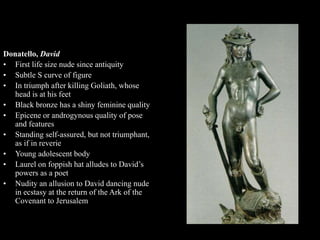
Donatello, David
• First life size nude since antiquity
• Subtle S curve of figure
• In triumph after killing Goliath, whose
head is at his feet
• Black bronze has a shiny feminine quality
• Epicene or androgynous quality of pose
and features
• Standing self-assured, but not triumphant,
as if in reverie
• Young adolescent body
• Laurel on foppish hat alludes to David’s
powers as a poet
• Nudity an allusion to David dancing nude
in ecstasy at the return of the Ark of the
Covenant to Jerusalem
Italian Quattrocento Sculpture
Donatello, Zuccone (Habbakuk)
• Cf. Roman Republican art
• Strong, rustic, not refined, nor idealized
• Heavy drapery sweeps your eye
diagonally to head
• Fiery intensity of expression, meant to be
seen by passersby in the cathedral square
below
• Living out in the wilderness, looks
haggard but divinely inspired
• Bald head carved roughly to enhance
effect
Italian Quattrocento Architecture
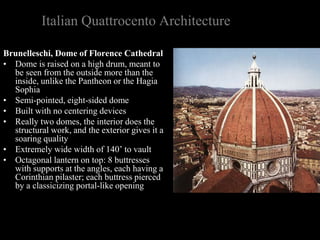
Brunelleschi, Dome of Florence Cathedral
• Dome is raised on a high drum, meant to
be seen from the outside more than the
inside, unlike the Pantheon or the Hagia
Sophia
• Semi-pointed, eight-sided dome
• Built with no centering devices
• Really two domes, the interior does the
structural work, and the exterior gives it a
soaring quality
• Extremely wide width of 140’ to vault
• Octagonal lantern on top: 8 buttresses
with supports at the angles, each having a
Corinthian pilaster; each buttress pierced
by a classicizing portal-like opening
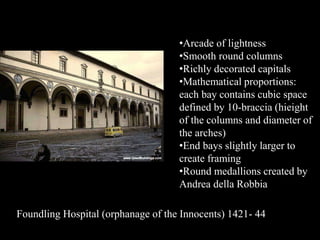
•Arcade of lightness
•Smooth round columns
•Richly decorated capitals
•Mathematical proportions:
each bay contains cubic space
defined by 10-braccia (hieight
of the columns and diameter of
the arches)
•End bays slightly larger to
create framing
•Round medallions created by
Andrea della Robbia
Foundling Hospital (orphanage of the Innocents) 1421- 44
Italian Quattrocento Architecture
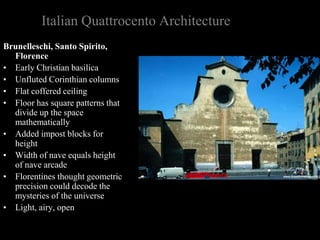
Brunelleschi, Santo Spirito,
Florence
• Early Christian basilica
• Unfluted Corinthian columns
• Flat coffered ceiling
• Floor has square patterns that
divide up the space
mathematically
• Added impost blocks for
height
• Width of nave equals height
of nave arcade
• Florentines thought geometric
precision could decode the
mysteries of the universe
• Light, airy, open
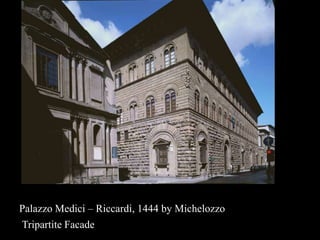
Palazzo Medici – Riccardi, 1444 by Michelozzo
Tripartite Facade
Italian Quattrocento Architecture
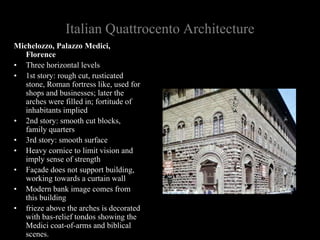
Michelozzo, Palazzo Medici,
Florence
• Three horizontal levels
• 1st story: rough cut, rusticated
stone, Roman fortress like, used for
shops and businesses; later the
arches were filled in; fortitude of
inhabitants implied
• 2nd story: smooth cut blocks,
family quarters
• 3rd story: smooth surface
• Heavy cornice to limit vision and
imply sense of strength
• Façade does not support building,
working towards a curtain wall
• Modern bank image comes from
this building
• frieze above the arches is decorated
with bas-relief tondos showing the
Medici coat-of-arms and biblical
scenes.
Alberti
Palazzo Rucellai, 1455-58
•Façade to unify several pre-
existing houses.
•Based on Palazzo Medici
•Pilasters and architraves
across levels (Doric on bottom,
modified Corinthian,
Corinthian)
•Heavy cornice
•Model of classical elements
and mathematical proportions
Leon Battista Alberti
• The Universal Man
• High interest in the the study and
preservation of ancient architecture
• Studied Vitruvius and wrote his own
treatise on architecture.
• Champion of the concept of virtu – the
capacity of individuals to steer both
personal and public lives by the exercise of
Reason.
• Beauty is a result of measurement and
proportion
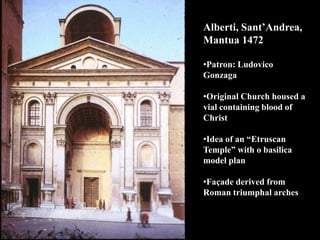
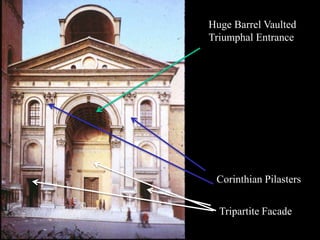
Alberti, Sant’Andrea,
Mantua 1472
•Patron: Ludovico
Gonzaga
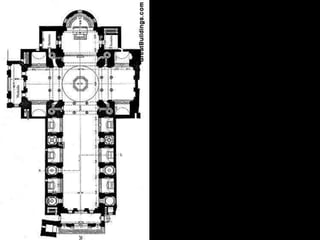
•Original Church housed a
vial containing blood of
Christ
•Idea of an “Etruscan
Temple” with o basilica
model plan
•Façade derived from
Roman triumphal arches
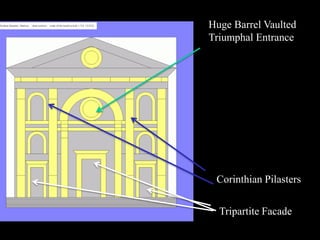
Corinthian Pilasters
Tripartite Facade
Huge Barrel Vaulted
Triumphal Entrance
Corinthian Pilasters
Tripartite Facade
Huge Barrel Vaulted
Triumphal Entrance
•"On the facade, [Alberti]
combined two of his favorite
ancient images—the
pedimented temple front
(pilasters, entablature,
trabeation, and triangular
pediment) and the triadic
triumphal arch (arched
central section and lower
portals on either side)
•The height of the facade
equals its width, but the
barrel vault of the nave
reached well above the apex
of the pediment
"...[The] avowed architectural
aim, to schematize in the spatial
form of the church the
immanent, harmonious order of
the world, found majestic
realization in Alberti's own
church of Sant' Andrea in
Mantua. This was his final
architectural work... and it
carries out these theoretical ideas
with perfect artistic clarity."
— Joan Gadol
Italian Quattrocento Architecture
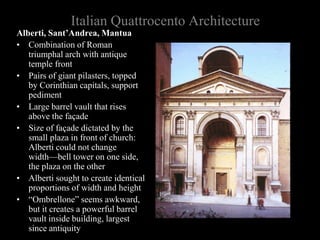
Alberti, Sant’Andrea, Mantua
• Combination of Roman
triumphal arch with antique
temple front
• Pairs of giant pilasters, topped
by Corinthian capitals, support
pediment
• Large barrel vault that rises
above the façade
• Size of façade dictated by the
small plaza in front of church:
Alberti could not change
width—bell tower on one side,
the plaza on the other
• Alberti sought to create identical
proportions of width and height
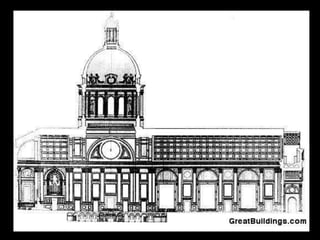
• “Ombrellone” seems awkward,
but it creates a powerful barrel
vault inside building, largest
since antiquity
Patronage
• Artists could work for private patrons (i.e
the Medici)
• Relationships within guilds
• Working for a Court
• Church Commissions
• Commissions could serve many purposes,
but rarely aesthetics
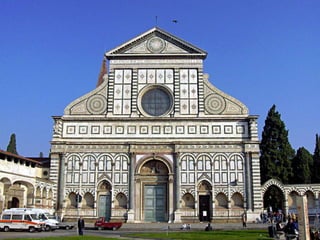
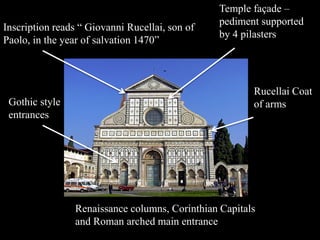
Giovanni Rucellai
• Ordered his commission of Sanat Maria
Novella to serve “the glory of God, the
honour of the city, and the commemoration
of myself”
Renaissance columns, Corinthian Capitals
and Roman arched main entrance
Inscription reads “ Giovanni Rucellai, son of
Paolo, in the year of salvation 1470”
Rucellai Coat
of armsGothic style
entrances
Temple façade –
pediment supported
by 4 pilasters

Italian Quattrocento1

  • 1.
  • 2.
    Major Themes ofthe Era • Scholars & artists become fascinated with classical antiquity – its art, literature and other forms of culture. • A new interest in the natural world as artists search for ways to depict what and how we see – fields of science, medicine and engineering are of special interest to the pioneering thinkers of the time.
  • 3.
    • Patronage ofthe church provided financial support for artwork, and artists portray humans and their environment in a realistic manner when visually interpreting biblical texts. • Concerns of the era are humanist concerns – a worldview focused on human beings, their potential, achievement and subsequent civic responsibility.
  • 5.
    Italian Quattrocento Painting Perugino,Christ Delivering the Keys of the Kingdom to Saint Peter • 11’ 5 ½” x 18’ 8 ½” • Fresco in the Sistine Chapel 1481 - 1482 • Patron – Pope Sixtus IV • Use of linear perspective (demonstrated by Brunelleschi in 1420 and codified by Alberti in 1436 in his treatise “On Painting”.
  • 6.
    Italian Quattrocento Painting Perugino,Christ Delivering the Keys of the Kingdom to Saint Peter • Figures lined up in a row • Emphasis on clarity, bright colors • Feeling of easy grace • Contemporaries in the painting • Shapely mantles • Weight placed on one foot, hip noticeable • Vast Renaissance plaza • Arch of Constantine, dome of Florence Cathedral in background • Catholic Church centered on Saint Peter: open space to highlight the key • Middle Left: Render to Caesar the things which are Caesar’s • Middle Right: Stoning of Christ • Located in the Sistine Chapel, the place where Popes are elected
  • 9.
    • Architecture tiesauthority of Constantine, Christ and St. Peter • Peter, as first Pope, justifies supremacy of papacy
  • 10.
  • 12.
  • 14.
  • 17.
  • 19.
    Italian Quattrocento Painting Masaccio,Expulsion of Adam and Eve from Eden • Desolate world outside of Garden of Eden • Volumes are massive and simple • Monumental, sculptural figures inspired by Giotto • Dramatically cast shadows, also emphasizing weight and physicality; tragic intensity • Adam ignores his nudity, covers his face for shame • Eve’s profound cry of despair
  • 20.
    Masaccio, Holy Trinity •Triangular form, dominated by perspective architecture inspired by Brunelleschi • Christ is crucified and a member of the Trinity • Viewpoint of average person standing in front and looking up at the cross • Ancient Roman triumphal arch, round arch, pillars, pilasters • Flanking Trinity is Mary and John, then – on the next spatial plane – the two kneeling donors • Below is the tomb of a member of the donor’s family, with his skeleton • Inscription reads, “I once was what you are, and what I am, you will become”
  • 21.
    Mathematics thought todefine the underlying structure of the universe – created by God the “divine mathematician”
  • 22.
    Portrait of LucaPacioli by Jacopo de’Babari, 1495 Pcioli writes “On the Divine Proprtion” (De Divina Proportione). Emphasizes the “golden ratio”. Here he demonstrates an obscure aspect of Euclidian geometry – how to draw an equilateral 15-sided figure by first drawing an equilateral triangle then a pentagon. Study of mathematics had close ties to the discoveries of Pythagorus about musical harmony – his treatise was published in Naples in 1480.
  • 23.
    Italian Quattrocento Painting Uccello,Battle of San Romano • Commemorates the victory of the Florentines over Sienese in 1432 • Dominated by a fascination for perspective • Extremely high horizon line allows for wealth of action and detail • Scale often appears random, however • Toy horses, more ceremonial than terrifying • Interest in metal patterns of the fallen men and lances, figures fall in bold foreshortening • Vanishing points pull the eye into space • Miraculously, the dead knights and their broken lances fall perfectly along the orthogonal lines leading to the vanishing point
  • 24.
    Paolo Ucello, Battleof San Romano (first panel) 1450’s Niccolò da Tolentino Leads the Florentine Troops
  • 25.
    Italian Quattrocento Painting AndreaMantegna, Dead Christ, 1480 • Uncharacteristic use of almost grisaille in contrast to his usual bold coloring • Emotionally charged • Bold foreshortening • Feet placed over the edge into our own space • Head enlarged to see it better; feet reduced to see body better • Wounds and dislocated shoulders of Christ prominently displayed
  • 26.
    Italian Quattrocento Painting Mantegna,Room of the Newlyweds • Oculus: eight winged putti and a peacock • Women lean over balcony • Foreshortening and perspective • Walls: heavy curtain pulled back • Antique decorative elements around main scenes • Patrons are the Gonzagas, their colors red and white on their hosiery • Realism of Gonzaga bodies: hump back, double chins, protruding foreheads and jaws, limp and spindly arms and legs • Charming legend about the possible use by newlyweds on their first night: Cupids abound, with a peacock as a symbol of marital harmony
  • 28.
    Italian Quattrocento Painting Botticelli,Birth of Venus • Delicacy of line and surface ornament • Sharply drawn figures, focus on contours • Landscape flat and tapestry-like • Stylized V shaped waves • Little interest in perspective • Venus rises from a seashell, far away look in her eyes • Rose created at the same time as Venus, a symbol of love: it can be painful • Bloodless, weightless, idealized nude • Cf. Praxiteles, Aphrodite of Knidos • Zephyr and his love, Chloris, rush in to scatter roses before her • Handmaiden covers her
  • 30.
    Using Classical Vocabulary •Adaptation of classical vocabulary to contemporary artworks and architectural structures • A means to associate with the greatness of Rome, and to triumph over its pagan past
  • 31.
    Piero della Francesca Portraitsof Federigo de Montefeltro and Battista Sforza, 1472
  • 32.
    Pictured on Right(unusual for male) Note wrinkled, tan skin (with moles) Wears red – very expensive - color of wealth, yet clothing is modest, devoid of honors.
  • 33.
    •Pale, perfect skin •Tastefuljewelery reflecting her husband’s wealth and glory •Note hair being held by more expensive jewels and delicate, transparent veil – not respectable for women to appear in public without hair up •Dress is modest (in accordance with sumptuary laws)
  • 34.
    Italian Quattrocento Painting Castagno,Last Supper • Christ is blessing, but Judas already has his food, not sacred to him • Judas is diabolical, jutting beard, hooked nose, on other side of table • Inconsistent geometric shape of room: ceiling panels 16 by 14, stringcourses 12 across back and 6 per side • Ceiling circles are 33 ½ in the back (the age of Christ at his death) and 17 at the sides • Six panels on the sides, but six in the back also Animated marble over Judas’ head and skeptical Peter’s head reflects mood Rugged features of individuals Lit from windows on right Nearly every figure sits independently
  • 35.
    Italian Quattrocento Painting Ghirlandaio,Birth of the Virgin • Saint Anne reclines in a palace room decorated with a classically inspired frieze • Midwives prepare for infant’s bath • Daughter of chapel’s patron of the work prominently shown in golden dress at center • Living people steal the show from the saints • Clear spatial arrangements • Large room divided by pilasters • Upper left corner: meeting of Joachim and Anna
  • 36.
    Italian Quattrocento Painting Signorelli,Damned Cast into Hell • Supreme representation of the nude in movement • First large scale painted treatment of the nude in Renaissance art • Heaven guarded by armored angels • Multicolored demons carrying female souls a suggestion of sexual threat • Demons with bat-like wings carry off the mortals • Demons rip off ears and sink their teeth into victims • Bizarre and lurid color of devils, some suggesting decaying flesh • Impenetrable tangle of demons and victims • Consuming desperation
  • 37.
    Italian Quattrocento Painting Piero,Brera Altarpiece • Light, open, clear space • Set within an actual Renaissance church interior • Crystalline, almost bleaching light • Roman architectural forms • Classical, quiet and a still quality • Deeply reverend patron • Egg as the Renaissance symbol for a perfectly centralized harmonious and symmetrical space • Mathematical proportion and balance • Barrel vault, cf. Alberti’s Sant’Andrea • Light comes in from left casting shadows on figures and vault • Armor-clad patron seen in profile on his knees in front • Pose requested by patron to hide disfigurement on the other side of his face: loss of right eye
  • 38.
    Pollaiuolo, Battle ofthe Ten Nudes •Humans as wild beasts •Dense vegetation •Meant to teach students about anatomy, in all its possible variety •Many figures are in reflected/flipped poses •Composition of intertwined figures in superimposed registers to indicate depth •Mass-produced works of art, spreading Pollaiuolo’s fame to Northern Europe
  • 39.
    Competition Panels of theFlorence Baptistery Ghiberti, Sacrifice of Isaac (1401 -02) • Designed for the second set of Florence Cathedral Baptistery • Competition used the same number of figures, same scene and quotation from the Bible • Gothic, Sienese in design: curve to the body of Abraham, fluttering of Abraham’s drapery behind arm • Idealized forms (vs. Brunelleschi’s expressiveness) • Polished effect • Decorative lines • No particular focus • Classical figure of Isaac inspired by Roman art • Abraham’s face taken from Roman model of Jupiter • Graceful poses • Made in two pieces, thus less expensive
  • 40.
    Competition Panels of theFlorence Baptistery Brunelleschi, Sacrifice of Isaac • Commission given to Ghiberti after the success of the second set of doors • Doors use a more neutral and modern rectangular shape instead of more Gothic quatrefoil • Expansive and harmonious use of space • Elegant bodies • Creation of a precise spatial depth • One dense group of forms • Composition divided into two main tiers: upper and lower • Weighty figures • Great variety of poses • More dramatic, tense, sense of urgency • Youthful Isaac • Figures overlap boundaries of quatrefoil pattern • Figures inspired by Roman models • Made in eight pieces, much heavier than Ghiberti’s
  • 41.
    Italian Quattrocento Sculpture Ghiberti,Gates of Paradise • Commission given to Ghiberti after the success of the second set of doors • Doors use a more neutral and modern rectangular shape instead of more Gothic quatrefoil • Expansive and harmonious use of space • Elegant bodies • Creation of a precise spatial depth 1425 - 1452
  • 42.
  • 43.
    Leon Battista Alberti “Firstof all about where I draw, I inscribe a quadrangle of right angles, as large as I wish, which is considered to be an open window through which I see what I want to paint. Here I determine as it pleases me the size of the men in my picture. I divide the length of the man in three parts. These parts are to me proportional to that measurement called a braccio .. With these braccia I divide the base line of the rectangle int as many parts as it will receive”
  • 45.
  • 46.
    According to theSynoptic Gospels, Herod had imprisoned John because he reproved Herod for divorcing his wife (Phasaelis), and unlawfully taking his brother Herod Philip I's wife, Herodias. On Herod's birthday, Herodias' daughter (traditionally named Salome) danced before the king and his guests. Her dancing pleased Herod so much that in his drunkenness he promised to give her anything she desired, up to half of his kingdom. When the daughter asked her mother what she should request, she was told to ask for the head of John the Baptist on a platter. Although Herod was appalled by the request, he reluctantly agreed and had John executed in the prison. Baptismal Font, Sienna Duomo
  • 47.
  • 49.
    Italian Quattrocento Art Verrocchio,David • Slenderness and angularity of the adolescent body • Jutting left elbow, slightly cocky aspect • Precise ornament • Leather jerkin and skirt classical inspired, reveals rather than conceals the young hero’s wiry anatomy • Pensive and gentle in victory • Lacks anatomical exaggeration
  • 50.
    Venetian condottiere, Erasmoda Narni (nicknamed Gattamelata or "honeyed [or cunning] cat)"
  • 52.
    Paolo Uccello, Equestrian MonumentTo Sir John Hawkswood, Florence, Tuscany 1436
  • 53.
    Italian Quattrocento Sculpture Donatello,Gattamelata 1443 – 53, Padua • Cast in parts; triumph of bronze casting • Idealized heroic portrait of a resolute commander • Pulsating facial muscles, heavy arches brows • Swelling of horse’s veins • Sense of classical revival: cf. Marcus Aurelius • On parade
  • 54.
    Italian Quattrocento Sculpture Donatello,Saint Mark • Commissioned by the Guild of Linen Weavers and Peddlers, suggested by pillow at base and ample drapery • Although in a Gothic niche, the statue is free standing • Contrapposto based on Roman art • Drapery falls directly down • Easy posture • Face has piercing eyes • Calculated how the sculpture would look from street level
  • 55.
    Donatello, David • Firstlife size nude since antiquity • Subtle S curve of figure • In triumph after killing Goliath, whose head is at his feet • Black bronze has a shiny feminine quality • Epicene or androgynous quality of pose and features • Standing self-assured, but not triumphant, as if in reverie • Young adolescent body • Laurel on foppish hat alludes to David’s powers as a poet • Nudity an allusion to David dancing nude in ecstasy at the return of the Ark of the Covenant to Jerusalem
  • 56.
    Italian Quattrocento Sculpture Donatello,Zuccone (Habbakuk) • Cf. Roman Republican art • Strong, rustic, not refined, nor idealized • Heavy drapery sweeps your eye diagonally to head • Fiery intensity of expression, meant to be seen by passersby in the cathedral square below • Living out in the wilderness, looks haggard but divinely inspired • Bald head carved roughly to enhance effect
  • 57.
    Italian Quattrocento Architecture Brunelleschi,Dome of Florence Cathedral • Dome is raised on a high drum, meant to be seen from the outside more than the inside, unlike the Pantheon or the Hagia Sophia • Semi-pointed, eight-sided dome • Built with no centering devices • Really two domes, the interior does the structural work, and the exterior gives it a soaring quality • Extremely wide width of 140’ to vault • Octagonal lantern on top: 8 buttresses with supports at the angles, each having a Corinthian pilaster; each buttress pierced by a classicizing portal-like opening
  • 58.
    •Arcade of lightness •Smoothround columns •Richly decorated capitals •Mathematical proportions: each bay contains cubic space defined by 10-braccia (hieight of the columns and diameter of the arches) •End bays slightly larger to create framing •Round medallions created by Andrea della Robbia Foundling Hospital (orphanage of the Innocents) 1421- 44
  • 59.
    Italian Quattrocento Architecture Brunelleschi,Santo Spirito, Florence • Early Christian basilica • Unfluted Corinthian columns • Flat coffered ceiling • Floor has square patterns that divide up the space mathematically • Added impost blocks for height • Width of nave equals height of nave arcade • Florentines thought geometric precision could decode the mysteries of the universe • Light, airy, open
  • 60.
    Palazzo Medici –Riccardi, 1444 by Michelozzo Tripartite Facade
  • 61.
    Italian Quattrocento Architecture Michelozzo,Palazzo Medici, Florence • Three horizontal levels • 1st story: rough cut, rusticated stone, Roman fortress like, used for shops and businesses; later the arches were filled in; fortitude of inhabitants implied • 2nd story: smooth cut blocks, family quarters • 3rd story: smooth surface • Heavy cornice to limit vision and imply sense of strength • Façade does not support building, working towards a curtain wall • Modern bank image comes from this building • frieze above the arches is decorated with bas-relief tondos showing the Medici coat-of-arms and biblical scenes.
  • 62.
    Alberti Palazzo Rucellai, 1455-58 •Façadeto unify several pre- existing houses. •Based on Palazzo Medici •Pilasters and architraves across levels (Doric on bottom, modified Corinthian, Corinthian) •Heavy cornice •Model of classical elements and mathematical proportions
  • 63.
    Leon Battista Alberti •The Universal Man • High interest in the the study and preservation of ancient architecture • Studied Vitruvius and wrote his own treatise on architecture. • Champion of the concept of virtu – the capacity of individuals to steer both personal and public lives by the exercise of Reason. • Beauty is a result of measurement and proportion
  • 64.
    Alberti, Sant’Andrea, Mantua 1472 •Patron:Ludovico Gonzaga •Original Church housed a vial containing blood of Christ •Idea of an “Etruscan Temple” with o basilica model plan •Façade derived from Roman triumphal arches
  • 65.
    Corinthian Pilasters Tripartite Facade HugeBarrel Vaulted Triumphal Entrance
  • 66.
    Corinthian Pilasters Tripartite Facade HugeBarrel Vaulted Triumphal Entrance
  • 67.
    •"On the facade,[Alberti] combined two of his favorite ancient images—the pedimented temple front (pilasters, entablature, trabeation, and triangular pediment) and the triadic triumphal arch (arched central section and lower portals on either side) •The height of the facade equals its width, but the barrel vault of the nave reached well above the apex of the pediment
  • 70.
    "...[The] avowed architectural aim,to schematize in the spatial form of the church the immanent, harmonious order of the world, found majestic realization in Alberti's own church of Sant' Andrea in Mantua. This was his final architectural work... and it carries out these theoretical ideas with perfect artistic clarity." — Joan Gadol
  • 71.
    Italian Quattrocento Architecture Alberti,Sant’Andrea, Mantua • Combination of Roman triumphal arch with antique temple front • Pairs of giant pilasters, topped by Corinthian capitals, support pediment • Large barrel vault that rises above the façade • Size of façade dictated by the small plaza in front of church: Alberti could not change width—bell tower on one side, the plaza on the other • Alberti sought to create identical proportions of width and height • “Ombrellone” seems awkward, but it creates a powerful barrel vault inside building, largest since antiquity
  • 72.
    Patronage • Artists couldwork for private patrons (i.e the Medici) • Relationships within guilds • Working for a Court • Church Commissions • Commissions could serve many purposes, but rarely aesthetics
  • 73.
    Giovanni Rucellai • Orderedhis commission of Sanat Maria Novella to serve “the glory of God, the honour of the city, and the commemoration of myself”
  • 75.
    Renaissance columns, CorinthianCapitals and Roman arched main entrance Inscription reads “ Giovanni Rucellai, son of Paolo, in the year of salvation 1470” Rucellai Coat of armsGothic style entrances Temple façade – pediment supported by 4 pilasters