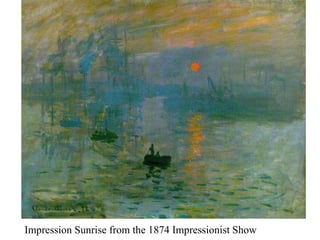
Impression Sunrise from the 1874 Impressionist Show
Introduction to Photography
Pre-Photographic Inventions             Early Photographs
Camera obscura                          Daguerreotype
• A box (in earlier times a room)       • A unique item of very high clarity
   with a hole and a lens at one end    • Has a mirror surface
• An image is projected onto the        • Three-dimensional effects are
   opposite end                            striking
• The image is traceable with pen       • Highly vulnerable to physical
   and paper                               damage and scratching
Photogram                               • Placed in an individualized frame
• A flat object is placed on photo-        with a top
   sensitive paper                      • Very expensive procedure
• The paper is exposed to light and a   • No negatives
   silhouette is rendered               Calotype
                                        • Makes a positive and a negative
                                           image
                                        • Negatives were not clear
                                        • Has a grainy texture
Questions
        about the Nature of Photography
• Photography has become accepted as a fact. How can we
  question the facts that photographs present?
• How can the vantage point change our impression of a
  subject in a photograph?
• How is time the subject of all photographs?
• Is photography a mirror of the world, or a window onto the
  world?
Photography

  From 1826
Louis Daguerre
• 1787 – 1851
• Produced his first photo in 1939
• Inventor of the Daguerreotype
•   This used a copper plate with a finely polished silver layer on its surface. It was made
    light-sensitive by reaction with iodine (and later bromine) vapour which produced a
    coating of silver iodide. Following an exposure - perhaps 10 minutes using a camera in
    bright sunlight - the almost invisible image was made visible by suspending the plate
    above a heated mercury bath. The mercury did not alter the silver iodide, but where an
    image had been formed this consisted of small particles of silver. This combined with
    the mercury to form a light gray silver amalgam in the lighter parts of the image. The
    darker parts of the scene were unchanged silver iodide and this was dissolved using a
    strong salt (sodium chloride) solution, revealing the polished silver surface. Later hypo
    (sodium thiosulphate) was found to be better for this 'fixing' process.
Early Photography

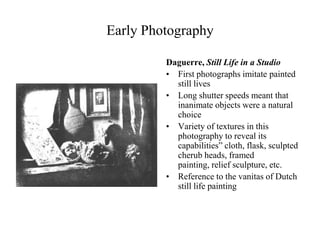
         Daguerre, Still Life in a Studio
         • First photographs imitate painted
           still lives
         • Long shutter speeds meant that
           inanimate objects were a natural
           choice
         • Variety of textures in this
           photography to reveal its
           capabilities” cloth, flask, sculpted
           cherub heads, framed
           painting, relief sculpture, etc.
         • Reference to the vanitas of Dutch
           still life painting
Atelier of the Artist, 1837
Henry Fox Talbot
• 1800 –1877
• Invented the Calotype
Henry Fox Talbot, 1844
3 daughters, c. 1846
Ever open to new ideas and discoveries, Nadar was
the first in France to make photographs
underground with artificial light and the first to
photograph Paris from the basket of an ascendant
balloon. Even though a proponent of heavier-than-
air traveling devices, he financed the construction
of Le Giant, a balloon that met with an unfortunate
accident on its second trip. Nonetheless, he was
instrumental in setting up the balloon postal service
that made it possible for the French government to
communicate with those in Paris during the
German blockade in the Franco-Prussian War of
1870.
Ruined financially by this brief but devastating
conflict, Nadar continued to write and
photograph, running an establishment with his son
Paul that turned out slick commercial work.
Always a rebel, at one point he lent the photo
studio to a group of painters who wished to bypass
the Salon in order to exhibit their work, thus
making possible the first exhibition of the
Impressionists in April, 1874. Although he was to
operate still another studio in Marseilles during the
1880s and '90s Nadar's last photographic idea of
significance was a series of exposures made by his
son in 1886 as he interviewed chemist Eugene
Chevreul on his 100th birthday, thus
foreshadowing the direction that picture journalism
was to take. During his last years he continued to
think of himself as "a daredevil, always on the
lookout for currents to swim against." At his
death, just before the age of ninety, he had outlived
all those he had satirized in the famous
Pantheon, which had started him in photography


                     Nadar
1855


1863
Nadar and
Photography from
balloon
By Daumier
•Portrait photography
        becomes popular with
        shorter shutter speeds
        •Deeper richer black and
        white tones in more modern
        photography
        •Figures still had to hold a
        pose for a long time
        •Stern, severe, commanding
        presence
        •Artistic genius at the
        summit of his career
        •Autocratic looking

Manet                                  Delacroix
Muybridge, Horse
Galloping
•Muybridge settled a
debate about whether or
not a horse, in full
gallop, would naturally
have all four hoofs off the
ground at the same time
•Successive camera shots
at paced intervals revealed
the answer
•Multiple-camera motion
studies with a
zoopraxiscope
•The transitional figure
between still photography
and motion pictures


                              1878
Theodore Gericault, 1821
Pre-Raphaelites
•   The Pre-Raphaelite Brotherhood        •    The Brotherhood's early doctrines
    (also known as the Pre-                    were expressed in four
    Raphaelites) was a group of                declarations:
    English painters, poets and           1.   To have genuine ideas to express;
    critics, founded in 1848 by John      2.   To study Nature attentively, so as
    Everret Millais, Dante Gabriel             to know how to express them;
    Rossetti and William Holman           3.   To sympathise with what is direct
    Hunt.                                      and serious and heartfelt in
•   Against the what they perceived as         previous art, to the exclusion of
    the mechanistic approach to art            what is conventional and self-
                                               parading and learned by rote;
    from the Mannerists on. Felt
    raphael’s classical influence to be   4.   And, most indispensable of all, to
                                               produce thoroughly good pictures
    bad.
                                               and statues.
•   Often considered the first avant-
    garde movement in art
Christ In the House of His Parents, John Everett Millais, 1850
The Barbizon School
• Name derived from a village in Northern France
• Rejected Classical Landscape style and insisted on
  Direct Observation
• Inspired by Constable (Salon of 1824)
• Closely allied with Realists, pre-cursors to the
  Impressionists
• Artists included Millet and Courbet as well as Jean-
  Baptiste-Camille Corot and Theodore Rousseau
Ville d’Avray, 1867
Impressionism Timeline
• 1863 – Le Dejeuner sur l’herbe    • 1870 – Franco-Prussian War
  & the Salon des Refuses (50       • 1871 – France defeated
  women artists, 13%)
• 100 or more women at the          Napolean III unseated, Adolphe
  official salon yearly                Theirs becomes President of the
• 1865 – Olympia accepted and          Third Republic
  jeered. American Civil War        Kaiser Wilhelm crowned Emperor
  ends                                 of Germany at Versailles
• 1866- Baudelaire dies, Monet at   • 1874 – The First “Impressionist
  the Salon                            Exhibtion”
• 1867 - Maximillian is executed.
  “Salon of Newcomers”
  (Renoir, Monet, Pissaro, Degas)
Impressionist Artists of Note
•   Eduoard Manet
•   Claude Monet
•   Berthe Morisot
•   Auguste Renoir
•   Camille Pissaro
•   Edgar Degas
•   James McNeil Whistler
•   Mary Cassatt
•   August Rodin
Eduoard Manet
• 1832 – 1883
• Considered the Godfather of the Impressionists
• Never Showed in an Impressionist Exhibition
• Well educated, close friends with Baudelaire and
  Zola
• Achieved both Notoriety and some recognition
  through the official Salon
• Became Friends with Monet and painted some “au
  plein air”
• Influenced other Impressionists through his unique
  technique
Realism

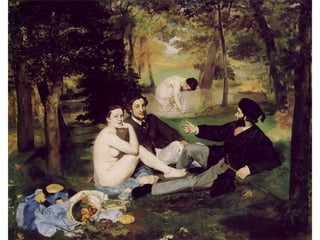
Manet, Luncheon on the Grass
• A modern response to Giorgione and Raphael
• Rejected by the official salon and exhibited in the Salon of the Refuses
• Models are obviously posing, no unity of figures and landscape
• She is undressed rather than nude
• Two men dressed in contemporary clothes contrasts with the nudity of
  the foreground female
• Nude figure directly engages us
• Still life very unrealistic
• Sketchy broad brushstrokes
• Triangular composition
• Flattening of perspective
The Judgement of Paris
Engraving after Raphael
 Marcantonio Raimondi
        c. 1516
Giorgione, Pastoral Concert, 1508-09
Olympia, 1863 (Victorine Meurent)
Manet, Olympia
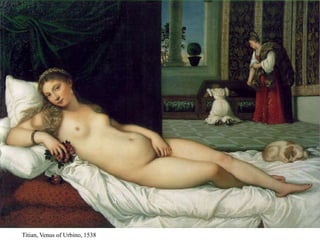
• Based on Giorgione and Titian
• Unashamed of nudity; direct confrontational stare
• Absence of modeling
• Doubtful morals suggested; prostitute receiving flowers from an
  admirer
• Created a scandal at the Salon of 1865
• Black cat: an exclamation point at her feet
• Bouquet from a customer
• Cold and practical look, no curiosity, no joy
• Realistic nude, contemporary setting
• Contrast of black and white tones
• Black servant caused concern: references to animal behavior and the
  lower classes
Ingres, The Grand Odalisque
1814
Titian, Venus of Urbino, 1538
Realism

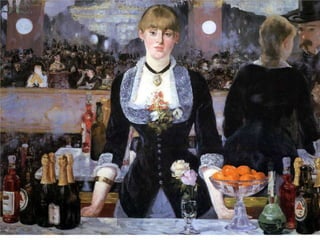
Manet, Bar at the Folies-Bergere
• Melancholy and absent gaze at
  customer ordering a drink
• Mirrors reflect the world around
  her
• Artificiality of perspective
• Strong verticals down center
• Impressionist brushwork
• Fruit and flowers defined by a few
  brushstrokes
• Is the woman in the back a
  reflection of the main figure in a
  mirror?
Influence of Japanese prints
    1867 Exposition Universelle in Paris introduced Japanese
    culture to Europe. European artists were inspired by the
    following characteristics of Japanese woodblock prints:

•   1   Flat quality that lacked perspective
•   2   Flat areas of color
•   3   Odd angles of composition
•   4   Curving lines
•   5   Charm, without sentimentality
•   6   Lack of shadow
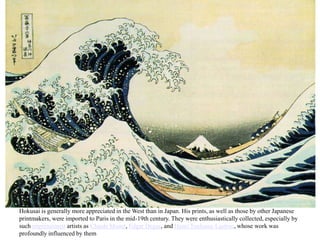
Hokusai is generally more appreciated in the West than in Japan. His prints, as well as those by other Japanese
printmakers, were imported to Paris in the mid-19th century. They were enthusiastically collected, especially by
such impressionist artists as Claude Monet, Edgar Degas, and Henri Toulouse-Lautrec, whose work was
profoundly influenced by them
Sanno Festival Procession at Kojimachi
      I-chome
      1857 (130 Kb); From "One Hundred
      Famous Views of Edo"; Woodblock
      print, 13 1/4 x 8 5/8 in; The Brooklyn
      Museum


Hiroshige (1797-1858), Japanese
painter and printmaker, known especially for his
landscape prints. The last great figure of the Ukiyo-e, or
popular, school of printmaking, he transmuted everyday
landscapes into intimate, lyrical scenes that made him
even more successful than his contemporary, Hokusai.
Ushimachi, Takanawa
1857 (130 Kb); From "One Hundred
Famous Views of Edo"; Woodblock print,
13 1/4 x 8 5/8 in; The Brooklyn Museum
Mary Cassatt, 1890,The bath
1876, Camille Monet in
Japanese Costume
Monet
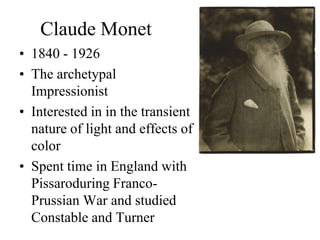
Claude Monet
• 1840 - 1926
• The archetypal
  Impressionist
• Interested in in the transient
  nature of light and effects of
  color
• Spent time in England with
  Pissaroduring Franco-
  Prussian War and studied
  Constable and Turner
Impression Sunrise from the 1874 Impressionist Show
Monet, Impression: Sunrise
•Painting inadvertently founded the name of
Impressionism
•Form and substance vanish
•Light transforms objects and surfaces into atmospheric
spaces
•Color was not the property of an object, but the light
controls color intensity
•Color affected by time or day and movement of the sun
•Monet worked outdoors, plein-air
Monet, Rouen Cathedral
•One of Monet’s paintings in a series
•Cf. Muybridge
•Fixed composition and view in most of
the series
•Subtle gradations of tone and color
•Limited palette, subtle handling of paint
•Gothic cathedral, religious and cultural
significance
•Stone work of cathedral dissolves in light
Berthe Morisot

• 1841-1895
• First Woman to Join the
  Impressionist Painters
• Friend and Model for
  Manetwho influenced her
  highly
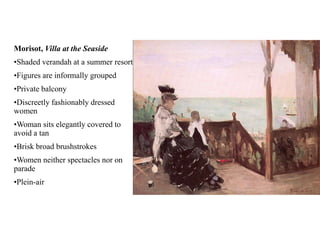
Morisot, Villa at the Seaside
•Shaded verandah at a summer resort
•Figures are informally grouped
•Private balcony
•Discreetly fashionably dressed
women
•Woman sits elegantly covered to
avoid a tan
•Brisk broad brushstrokes
•Women neither spectacles nor on
parade
•Plein-air

Impressionism slides1

  • 1.
    Impression Sunrise fromthe 1874 Impressionist Show
  • 2.
    Introduction to Photography Pre-PhotographicInventions Early Photographs Camera obscura Daguerreotype • A box (in earlier times a room) • A unique item of very high clarity with a hole and a lens at one end • Has a mirror surface • An image is projected onto the • Three-dimensional effects are opposite end striking • The image is traceable with pen • Highly vulnerable to physical and paper damage and scratching Photogram • Placed in an individualized frame • A flat object is placed on photo- with a top sensitive paper • Very expensive procedure • The paper is exposed to light and a • No negatives silhouette is rendered Calotype • Makes a positive and a negative image • Negatives were not clear • Has a grainy texture
  • 3.
    Questions about the Nature of Photography • Photography has become accepted as a fact. How can we question the facts that photographs present? • How can the vantage point change our impression of a subject in a photograph? • How is time the subject of all photographs? • Is photography a mirror of the world, or a window onto the world?
  • 4.
  • 6.
    Louis Daguerre • 1787– 1851 • Produced his first photo in 1939 • Inventor of the Daguerreotype • This used a copper plate with a finely polished silver layer on its surface. It was made light-sensitive by reaction with iodine (and later bromine) vapour which produced a coating of silver iodide. Following an exposure - perhaps 10 minutes using a camera in bright sunlight - the almost invisible image was made visible by suspending the plate above a heated mercury bath. The mercury did not alter the silver iodide, but where an image had been formed this consisted of small particles of silver. This combined with the mercury to form a light gray silver amalgam in the lighter parts of the image. The darker parts of the scene were unchanged silver iodide and this was dissolved using a strong salt (sodium chloride) solution, revealing the polished silver surface. Later hypo (sodium thiosulphate) was found to be better for this 'fixing' process.
  • 7.
    Early Photography Daguerre, Still Life in a Studio • First photographs imitate painted still lives • Long shutter speeds meant that inanimate objects were a natural choice • Variety of textures in this photography to reveal its capabilities” cloth, flask, sculpted cherub heads, framed painting, relief sculpture, etc. • Reference to the vanitas of Dutch still life painting
  • 8.
    Atelier of theArtist, 1837
  • 9.
    Henry Fox Talbot •1800 –1877 • Invented the Calotype
  • 11.
  • 12.
  • 13.
    Ever open tonew ideas and discoveries, Nadar was the first in France to make photographs underground with artificial light and the first to photograph Paris from the basket of an ascendant balloon. Even though a proponent of heavier-than- air traveling devices, he financed the construction of Le Giant, a balloon that met with an unfortunate accident on its second trip. Nonetheless, he was instrumental in setting up the balloon postal service that made it possible for the French government to communicate with those in Paris during the German blockade in the Franco-Prussian War of 1870. Ruined financially by this brief but devastating conflict, Nadar continued to write and photograph, running an establishment with his son Paul that turned out slick commercial work. Always a rebel, at one point he lent the photo studio to a group of painters who wished to bypass the Salon in order to exhibit their work, thus making possible the first exhibition of the Impressionists in April, 1874. Although he was to operate still another studio in Marseilles during the 1880s and '90s Nadar's last photographic idea of significance was a series of exposures made by his son in 1886 as he interviewed chemist Eugene Chevreul on his 100th birthday, thus foreshadowing the direction that picture journalism was to take. During his last years he continued to think of himself as "a daredevil, always on the lookout for currents to swim against." At his death, just before the age of ninety, he had outlived all those he had satirized in the famous Pantheon, which had started him in photography Nadar
  • 14.
  • 15.
  • 16.
  • 18.
    •Portrait photography becomes popular with shorter shutter speeds •Deeper richer black and white tones in more modern photography •Figures still had to hold a pose for a long time •Stern, severe, commanding presence •Artistic genius at the summit of his career •Autocratic looking Manet Delacroix
  • 19.
    Muybridge, Horse Galloping •Muybridge settleda debate about whether or not a horse, in full gallop, would naturally have all four hoofs off the ground at the same time •Successive camera shots at paced intervals revealed the answer •Multiple-camera motion studies with a zoopraxiscope •The transitional figure between still photography and motion pictures 1878
  • 20.
  • 21.
    Pre-Raphaelites • The Pre-Raphaelite Brotherhood • The Brotherhood's early doctrines (also known as the Pre- were expressed in four Raphaelites) was a group of declarations: English painters, poets and 1. To have genuine ideas to express; critics, founded in 1848 by John 2. To study Nature attentively, so as Everret Millais, Dante Gabriel to know how to express them; Rossetti and William Holman 3. To sympathise with what is direct Hunt. and serious and heartfelt in • Against the what they perceived as previous art, to the exclusion of the mechanistic approach to art what is conventional and self- parading and learned by rote; from the Mannerists on. Felt raphael’s classical influence to be 4. And, most indispensable of all, to produce thoroughly good pictures bad. and statues. • Often considered the first avant- garde movement in art
  • 22.
    Christ In theHouse of His Parents, John Everett Millais, 1850
  • 23.
    The Barbizon School •Name derived from a village in Northern France • Rejected Classical Landscape style and insisted on Direct Observation • Inspired by Constable (Salon of 1824) • Closely allied with Realists, pre-cursors to the Impressionists • Artists included Millet and Courbet as well as Jean- Baptiste-Camille Corot and Theodore Rousseau
  • 24.
  • 25.
    Impressionism Timeline • 1863– Le Dejeuner sur l’herbe • 1870 – Franco-Prussian War & the Salon des Refuses (50 • 1871 – France defeated women artists, 13%) • 100 or more women at the Napolean III unseated, Adolphe official salon yearly Theirs becomes President of the • 1865 – Olympia accepted and Third Republic jeered. American Civil War Kaiser Wilhelm crowned Emperor ends of Germany at Versailles • 1866- Baudelaire dies, Monet at • 1874 – The First “Impressionist the Salon Exhibtion” • 1867 - Maximillian is executed. “Salon of Newcomers” (Renoir, Monet, Pissaro, Degas)
  • 26.
    Impressionist Artists ofNote • Eduoard Manet • Claude Monet • Berthe Morisot • Auguste Renoir • Camille Pissaro • Edgar Degas • James McNeil Whistler • Mary Cassatt • August Rodin
  • 27.
    Eduoard Manet • 1832– 1883 • Considered the Godfather of the Impressionists • Never Showed in an Impressionist Exhibition • Well educated, close friends with Baudelaire and Zola • Achieved both Notoriety and some recognition through the official Salon • Became Friends with Monet and painted some “au plein air” • Influenced other Impressionists through his unique technique
  • 28.
    Realism Manet, Luncheon onthe Grass • A modern response to Giorgione and Raphael • Rejected by the official salon and exhibited in the Salon of the Refuses • Models are obviously posing, no unity of figures and landscape • She is undressed rather than nude • Two men dressed in contemporary clothes contrasts with the nudity of the foreground female • Nude figure directly engages us • Still life very unrealistic • Sketchy broad brushstrokes • Triangular composition • Flattening of perspective
  • 30.
    The Judgement ofParis Engraving after Raphael Marcantonio Raimondi c. 1516
  • 32.
  • 34.
  • 35.
    Manet, Olympia • Basedon Giorgione and Titian • Unashamed of nudity; direct confrontational stare • Absence of modeling • Doubtful morals suggested; prostitute receiving flowers from an admirer • Created a scandal at the Salon of 1865 • Black cat: an exclamation point at her feet • Bouquet from a customer • Cold and practical look, no curiosity, no joy • Realistic nude, contemporary setting • Contrast of black and white tones • Black servant caused concern: references to animal behavior and the lower classes
  • 36.
    Ingres, The GrandOdalisque 1814
  • 37.
    Titian, Venus ofUrbino, 1538
  • 39.
    Realism Manet, Bar atthe Folies-Bergere • Melancholy and absent gaze at customer ordering a drink • Mirrors reflect the world around her • Artificiality of perspective • Strong verticals down center • Impressionist brushwork • Fruit and flowers defined by a few brushstrokes • Is the woman in the back a reflection of the main figure in a mirror?
  • 41.
    Influence of Japaneseprints 1867 Exposition Universelle in Paris introduced Japanese culture to Europe. European artists were inspired by the following characteristics of Japanese woodblock prints: • 1 Flat quality that lacked perspective • 2 Flat areas of color • 3 Odd angles of composition • 4 Curving lines • 5 Charm, without sentimentality • 6 Lack of shadow
  • 42.
    Hokusai is generallymore appreciated in the West than in Japan. His prints, as well as those by other Japanese printmakers, were imported to Paris in the mid-19th century. They were enthusiastically collected, especially by such impressionist artists as Claude Monet, Edgar Degas, and Henri Toulouse-Lautrec, whose work was profoundly influenced by them
  • 43.
    Sanno Festival Processionat Kojimachi I-chome 1857 (130 Kb); From "One Hundred Famous Views of Edo"; Woodblock print, 13 1/4 x 8 5/8 in; The Brooklyn Museum Hiroshige (1797-1858), Japanese painter and printmaker, known especially for his landscape prints. The last great figure of the Ukiyo-e, or popular, school of printmaking, he transmuted everyday landscapes into intimate, lyrical scenes that made him even more successful than his contemporary, Hokusai.
  • 44.
    Ushimachi, Takanawa 1857 (130Kb); From "One Hundred Famous Views of Edo"; Woodblock print, 13 1/4 x 8 5/8 in; The Brooklyn Museum
  • 45.
  • 46.
    1876, Camille Monetin Japanese Costume Monet
  • 47.
    Claude Monet • 1840- 1926 • The archetypal Impressionist • Interested in in the transient nature of light and effects of color • Spent time in England with Pissaroduring Franco- Prussian War and studied Constable and Turner
  • 48.
    Impression Sunrise fromthe 1874 Impressionist Show
  • 49.
    Monet, Impression: Sunrise •Paintinginadvertently founded the name of Impressionism •Form and substance vanish •Light transforms objects and surfaces into atmospheric spaces •Color was not the property of an object, but the light controls color intensity •Color affected by time or day and movement of the sun •Monet worked outdoors, plein-air
  • 50.
    Monet, Rouen Cathedral •Oneof Monet’s paintings in a series •Cf. Muybridge •Fixed composition and view in most of the series •Subtle gradations of tone and color •Limited palette, subtle handling of paint •Gothic cathedral, religious and cultural significance •Stone work of cathedral dissolves in light
  • 53.
    Berthe Morisot • 1841-1895 •First Woman to Join the Impressionist Painters • Friend and Model for Manetwho influenced her highly
  • 54.
    Morisot, Villa atthe Seaside •Shaded verandah at a summer resort •Figures are informally grouped •Private balcony •Discreetly fashionably dressed women •Woman sits elegantly covered to avoid a tan •Brisk broad brushstrokes •Women neither spectacles nor on parade •Plein-air