Impressionism to Post- Impressionism
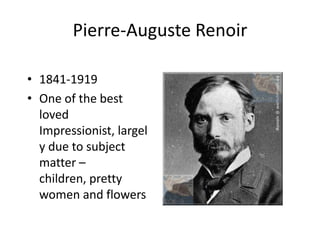
Pierre-Auguste Renoir1841-1919One of the best loved Impressionist, largely due to subject matter – children, pretty women and flowers
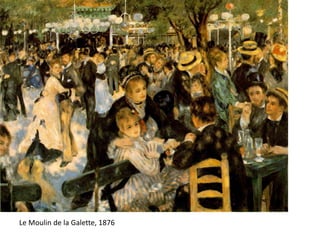
Renoir, Le Moulin de la GaletteEnergetic dancing by the middle class in Paris
Dappling of light and shade
Artfully blurred figures in the picture
Casual and unposed natural placement of figures
Suggested space goes beyond the boundaries of the painting
People go about their business, don’t pose
Influence of candid photography in the casualness of groupings and the cut off figures at the edgesLe Moulin de la Galette, 1876
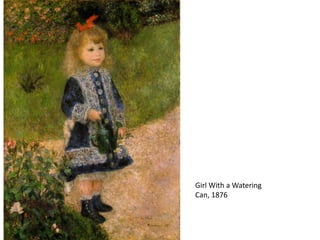
Girl With a Watering Can, 1876
Camille Pissaro1830 –1903Big Proponet of Plein Air paintingMentor to CezanneOnly Painter to show in ALL Impressionist exhibitions (8 in total)
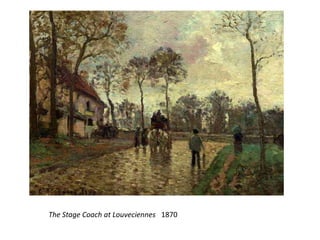
The Stage Coach at Louveciennes   1870
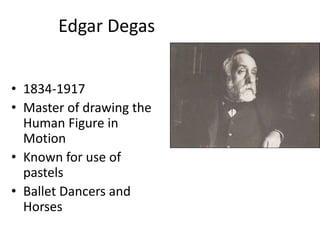
Edgar Degas1834-1917Master of drawing the Human Figure in MotionKnown for use of pastelsBallet Dancers and Horses
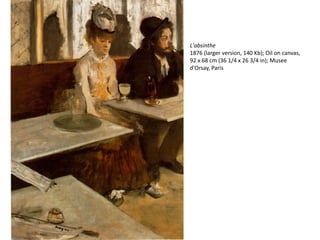
L'absinthe1876 (larger version, 140 Kb); Oil on canvas, 92 x 68 cm (36 1/4 x 26 3/4 in); Musee d'Orsay, Paris
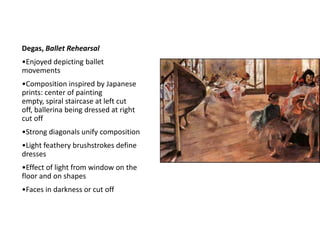
Degas, Ballet RehearsalEnjoyed depicting ballet movements
Composition inspired by Japanese prints: center of painting empty, spiral staircase at left cut off, ballerina being dressed at right cut off
Strong diagonals unify composition
Light feathery brushstrokes define dresses
Effect of light from window on the floor and on shapes
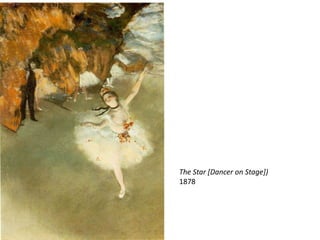
Faces in darkness or cut offThe Star [Dancer on Stage])1878
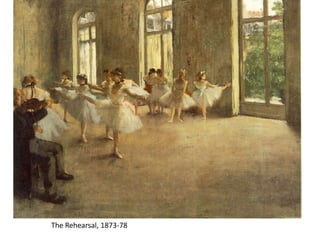
The Rehearsal, 1873-78
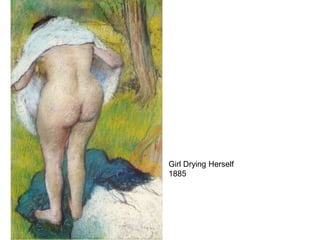
Girl Drying Herself1885
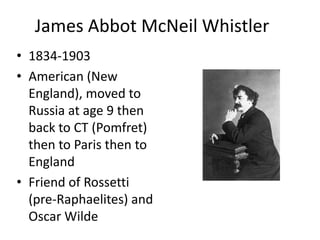
James Abbot McNeil Whistler1834-1903American (New England), moved to Russia at age 9 then back to CT (Pomfret) then to Paris then to EnglandFriend of Rossetti (pre-Raphaelites) and Oscar Wilde
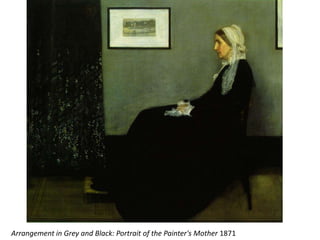
Arrangement in Grey and Black: Portrait of the Painter's Mother 1871
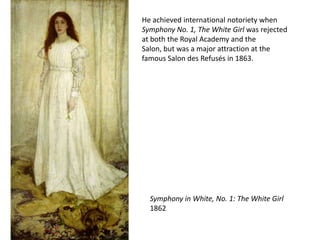
He achieved international notoriety when Symphony No. 1, The White Girl was rejected at both the Royal Academy and the Salon, but was a major attraction at the famous Salon des Refusés in 1863.Symphony in White, No. 1: The White Girl1862
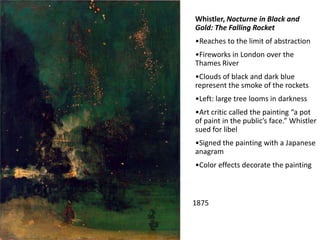
Whistler, Nocturne in Black and Gold: The Falling RocketReaches to the limit of abstraction
Fireworks in London over the Thames River
Clouds of black and dark blue represent the smoke of the rockets
Left: large tree looms in darkness
Art critic called the painting “a pot of paint in the public’s face.” Whistler sued for libel
Signed the painting with a Japanese anagram
Color effects decorate the painting1875
In 1877 the critic John Ruskin denounced Whistler's Nocturne in Black and Gold: The Falling Rocket (1875; Detroit Institute of Arts), accusing him of "flinging a pot of paint in the public's face", and Whistler sued him for libel the following year. He won the action, but the awarding of only a farthing's damages with no costs was in effect a justification for Ruskin. Potential patrons were repelled by the negative publicity surrounding the case, and the expense of the trial led to Whistler's bankruptcy in 1879. His house was sold and he proceeded to Italy with a commission from the Fine Arts Society to make twelve etchings of Venice. He spent a year in Venice (1879-80), concentrating on the etchings-- among the masterpieces of 19th-century graphic art-- that helped to restore his fortunes when he returned to London. After returning to England in 1880 he painted a wide variety of subjects, continued with his interest in the graphic arts, and promulgated his aesthetic theories in print and in the Ten O'Clock lecture (1885); his polemical The Gentle Art of Making Enemies was published in 1890. In 1886 he was elected president of the Society of British Artists, but despite some successes his revolutionary ideas ran afoul of the conservative members, and he was voted out of office within two years.
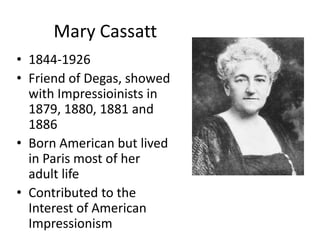
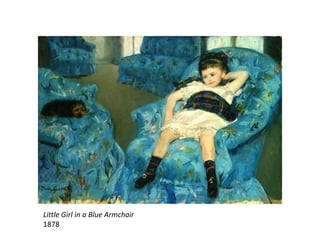
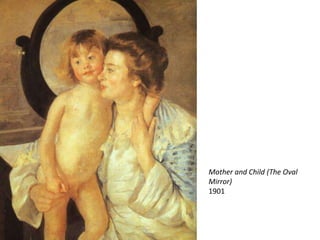
Mary Cassatt1844-1926Friend of Degas, showed with Impressioinists in 1879, 1880, 1881 and 1886Born American but lived in Paris most of her adult lifeContributed to the Interest of American Impressionism
Cassatt, The BathNot like other Impressionists, not a landscape or still life painter
Figures are never actors, nor do they appear to be models posing
Mother and child theme her specialty
Has a tenderness foreign to Impressionism
Figures seen from unusual angles as in Japanese prints
Flatness of background forms
Solidity of main figures
Japanese decorative details in backgroundLa Toilettec. 1891
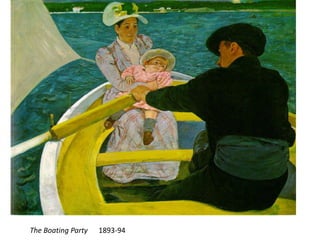
The Boating Party      1893-94
Little Girl in a Blue Armchair1878
Mother and Child (The Oval Mirror)1901
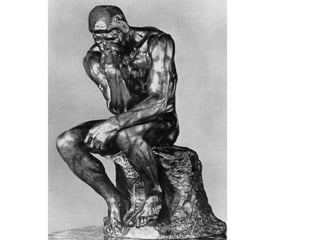
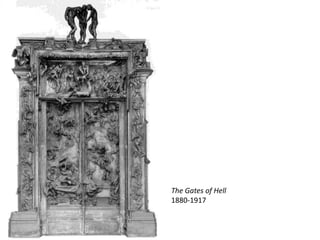
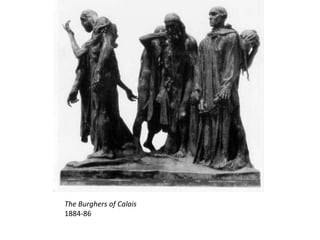
Auguste Rodin1840 –1917Stunning Strength and realismConfronts distress and moral weakness as well as noble themesEmphasis on Hands and feet in his worksA turn away from the smooth neo-classical styling common in sculpture

Impressionist2