
Gianlorenzo Bernini
Introduction
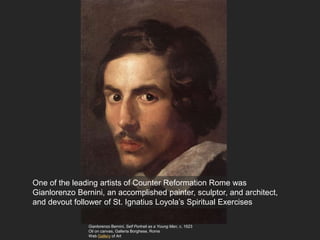
Gianlorenzo Bernini, Self Portrait as a Young Man, c. 1623
Oil on canvas, Galleria Borghese, Rome
Web Gallery of Art
One of the leading artists of Counter Reformation Rome was
Gianlorenzo Bernini, an accomplished painter, sculptor, and architect,
and devout follower of St. Ignatius Loyola’s Spiritual Exercises
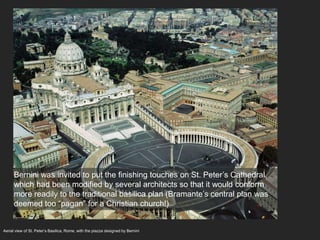
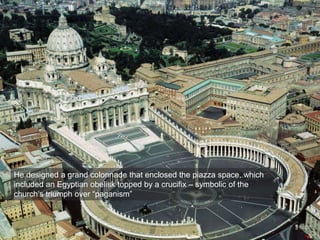
Aerial view of St. Peter’s Basilica, Rome, with the piazza designed by Bernini
Bernini was invited to put the finishing touches on St. Peter’s Cathedral,
which had been modified by several architects so that it would conform
more readily to the traditional basilica plan (Bramante’s central plan was
deemed too “pagan” for a Christian church!)
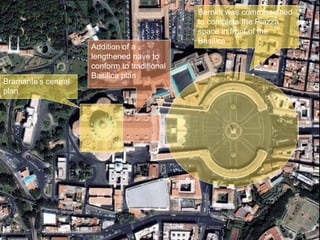
Bramante’s central
plan
Addition of a
lengthened nave to
conform to traditional
Basilica plan
Bernini was commissioned
to complete the Piazza
space in front of the
Basilica
He designed a grand colonnade that enclosed the piazza space, which
included an Egyptian obelisk topped by a crucifix – symbolic of the
church’s triumph over “paganism”
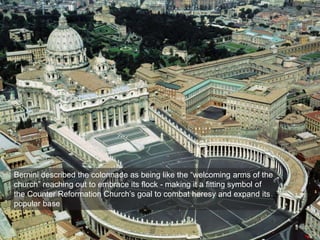
Bernini described the colonnade as being like the “welcoming arms of the
church” reaching out to embrace its flock - making it a fitting symbol of
the Counter Reformation Church’s goal to combat heresy and expand its
popular base
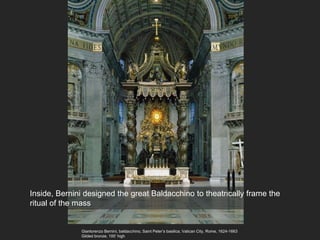
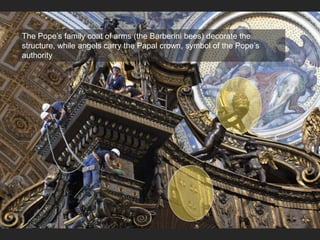
Gianlorenzo Bernini, baldacchino, Saint Peter’s basilica, Vatican City, Rome, 1624-1663
Gilded bronze, 100’ high
Inside, Bernini designed the great Baldacchino to theatrically frame the
ritual of the mass
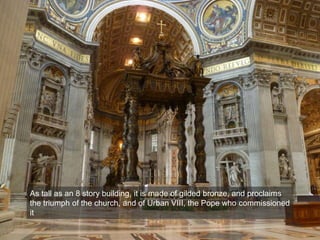
As tall as an 8 story building, it is made of gilded bronze, and proclaims
the triumph of the church, and of Urban VIII, the Pope who commissioned
it
The Pope’s family coat of arms (the Barberini bees) decorate the
structure, while angels carry the Papal crown, symbol of the Pope’s
authority
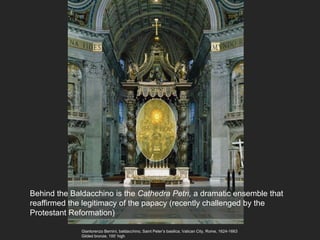
Gianlorenzo Bernini, baldacchino, Saint Peter’s basilica, Vatican City, Rome, 1624-1663
Gilded bronze, 100’ high
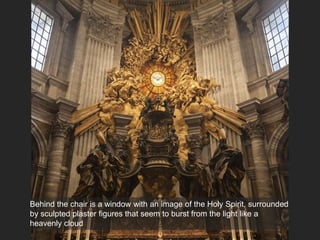
Behind the Baldacchino is the Cathedra Petri, a dramatic ensemble that
reaffirmed the legitimacy of the papacy (recently challenged by the
Protestant Reformation)
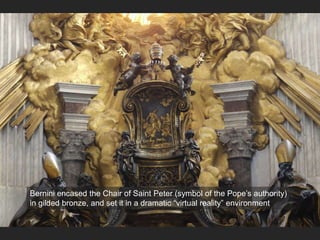
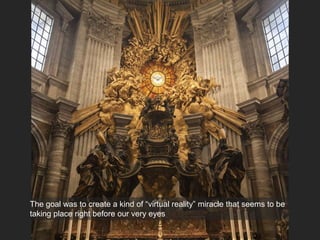
Bernini encased the Chair of Saint Peter (symbol of the Pope’s authority)
in gilded bronze, and set it in a dramatic “virtual reality” environment
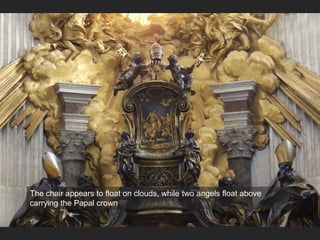
The chair appears to float on clouds, while two angels float above
carrying the Papal crown
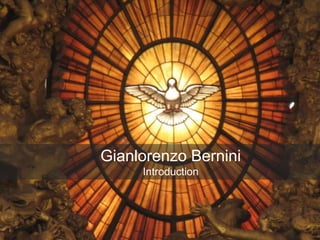
Behind the chair is a window with an image of the Holy Spirit, surrounded
by sculpted plaster figures that seem to burst from the light like a
heavenly cloud
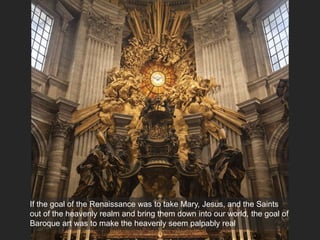
The goal was to create a kind of “virtual reality” miracle that seems to be
taking place right before our very eyes
If the goal of the Renaissance was to take Mary, Jesus, and the Saints
out of the heavenly realm and bring them down into our world, the goal of
Baroque art was to make the heavenly seem palpably real
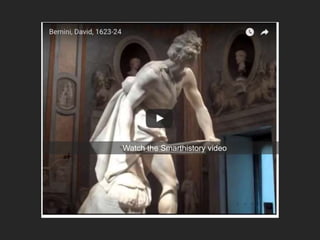
Watch the Smarthistory video
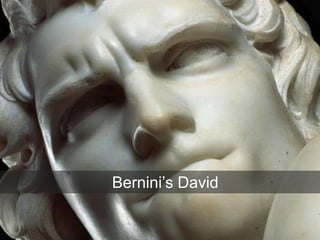
Bernini’s David
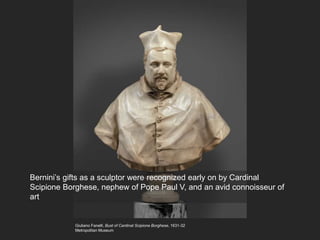
Giuliano Fanelli, Bust of Cardinal Scipione Borghese, 1631-32
Metropolitan Museum
Bernini’s gifts as a sculptor were recognized early on by Cardinal
Scipione Borghese, nephew of Pope Paul V, and an avid connoisseur of
art
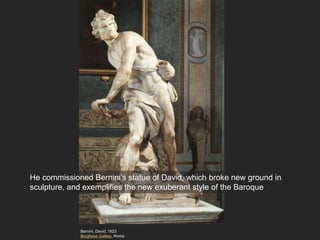
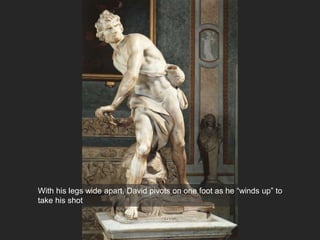
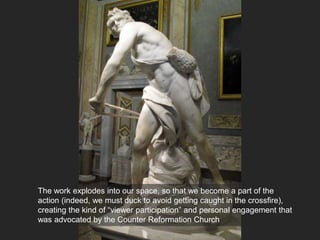
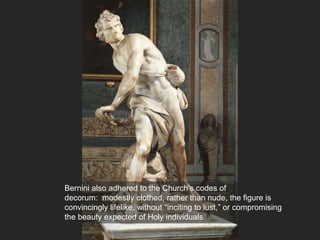
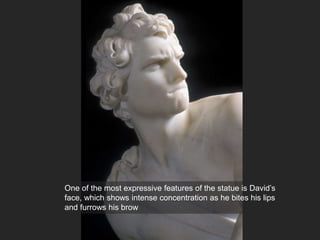
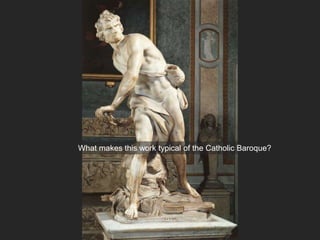
Bernini, David, 1623
Borghese Gallery, Rome
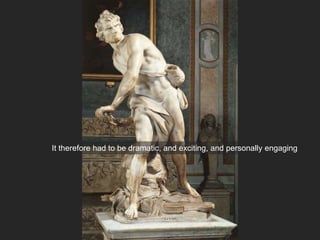
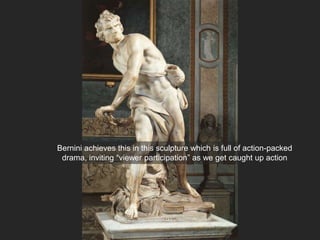
He commissioned Bernini’s statue of David, which broke new ground in
sculpture, and exemplifies the new exuberant style of the Baroque
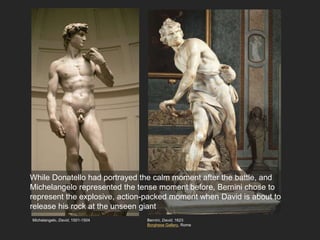
Bernini, David, 1623
Borghese Gallery, Rome
Michelangelo, David, 1501-1504
While Donatello had portrayed the calm moment after the battle, and
Michelangelo represented the tense moment before, Bernini chose to
represent the explosive, action-packed moment when David is about to
release his rock at the unseen giant
With his legs wide apart, David pivots on one foot as he “winds up” to
take his shot
The work explodes into our space, so that we become a part of the
action (indeed, we must duck to avoid getting caught in the crossfire),
creating the kind of “viewer participation” and personal engagement that
was advocated by the Counter Reformation Church
Bernini also adhered to the Church’s codes of
decorum: modestly clothed, rather than nude, the figure is
convincingly lifelike, without “inciting to lust,” or compromising
the beauty expected of Holy individuals
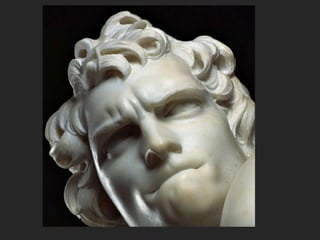
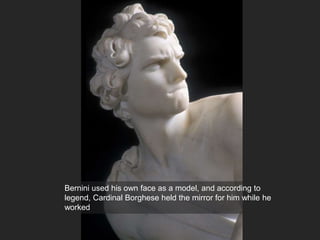
One of the most expressive features of the statue is David’s
face, which shows intense concentration as he bites his lips
and furrows his brow
Bernini used his own face as a model, and according to
legend, Cardinal Borghese held the mirror for him while he
worked
What makes this work typical of the Catholic Baroque?
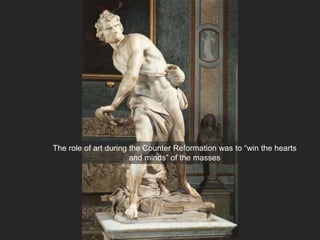
The role of art during the Counter Reformation was to “win the hearts
and minds” of the masses
It therefore had to be dramatic, and exciting, and personally engaging
Bernini achieves this in this sculpture which is full of action-packed
drama, inviting “viewer participation” as we get caught up action
Watch the Smarthistory video
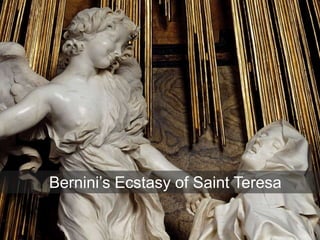
Bernini’s Ecstasy of Saint Teresa
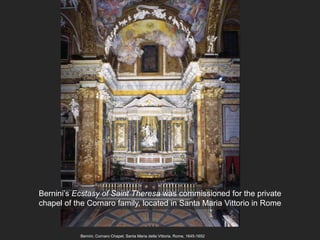
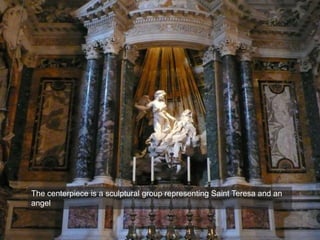
Bernini, Cornaro Chapel, Santa Maria della Vittoria, Rome, 1645-1652
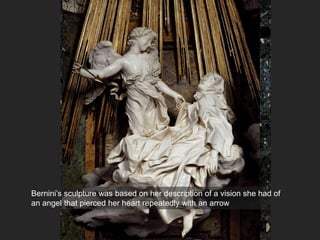
Bernini’s Ecstasy of Saint Theresa was commissioned for the private
chapel of the Cornaro family, located in Santa Maria Vittorio in Rome
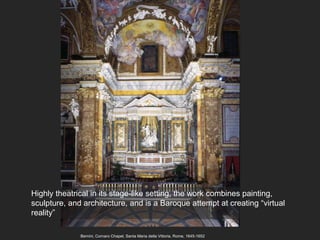
Bernini, Cornaro Chapel, Santa Maria della Vittoria, Rome, 1645-1652
Highly theatrical in its stage-like setting, the work combines painting,
sculpture, and architecture, and is a Baroque attempt at creating “virtual
reality”
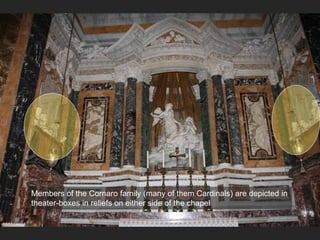
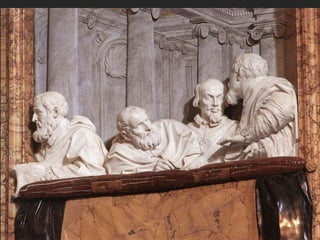
Members of the Cornaro family (many of them Cardinals) are depicted in
theater-boxes in reliefs on either side of the chapel
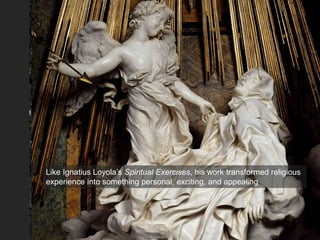
The centerpiece is a sculptural group representing Saint Teresa and an
angel
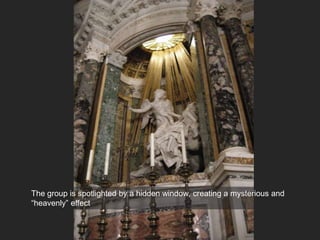
The group is spotlighted by a hidden window, creating a mysterious and
“heavenly” effect
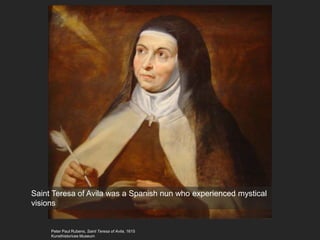
Peter Paul Rubens, Saint Teresa of Avila, 1615
Kunsthistorices Museum
Saint Teresa of Avila was a Spanish nun who experienced mystical
visions
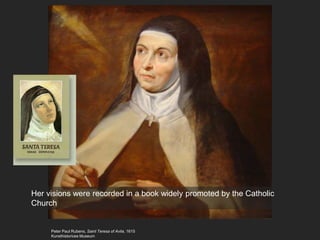
Peter Paul Rubens, Saint Teresa of Avila, 1615
Kunsthistorices Museum
Her visions were recorded in a book widely promoted by the Catholic
Church
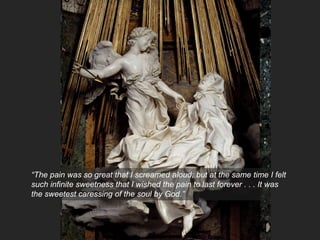
Bernini’s sculpture was based on her description of a vision she had of
an angel that pierced her heart repeatedly with an arrow
“The pain was so great that I screamed aloud; but at the same time I felt
such infinite sweetness that I wished the pain to last forever . . . It was
the sweetest caressing of the soul by God.”
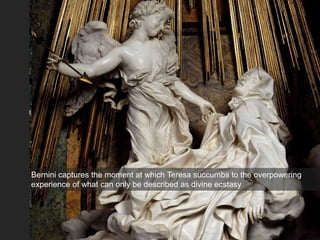
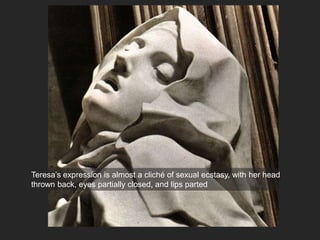
Bernini captures the moment at which Teresa succumbs to the overpowering
experience of what can only be described as divine ecstasy
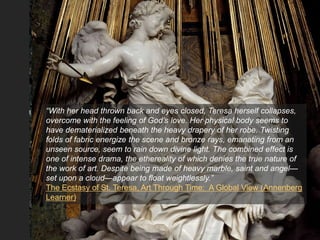
“With her head thrown back and eyes closed, Teresa herself collapses,
overcome with the feeling of God’s love. Her physical body seems to
have dematerialized beneath the heavy drapery of her robe. Twisting
folds of fabric energize the scene and bronze rays, emanating from an
unseen source, seem to rain down divine light. The combined effect is
one of intense drama, the ethereality of which denies the true nature of
the work of art. Despite being made of heavy marble, saint and angel—
set upon a cloud—appear to float weightlessly.”
The Ecstasy of St. Teresa, Art Through Time: A Global View (Annenberg
Learner)
Teresa’s expression is almost a cliché of sexual ecstasy, with her head
thrown back, eyes partially closed, and lips parted
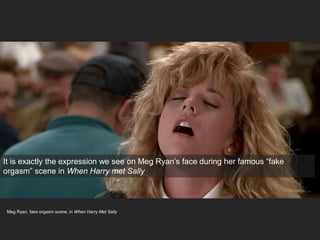
Meg Ryan, fake orgasm scene, in When Harry Met Sally
It is exactly the expression we see on Meg Ryan’s face during her famous “fake
orgasm” scene in When Harry met Sally
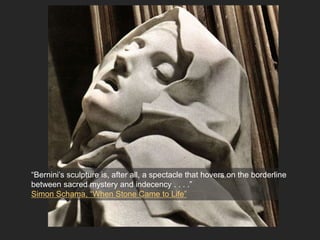
“Bernini’s sculpture is, after all, a spectacle that hovers on the borderline
between sacred mystery and indecency . . . .”
Simon Schama, “When Stone Came to Life”
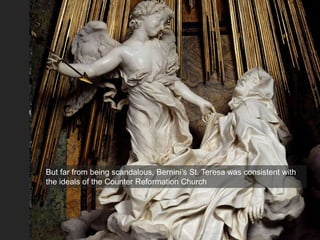
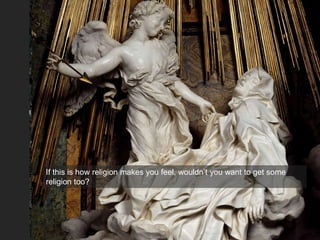
But far from being scandalous, Bernini’s St. Teresa was consistent with
the ideals of the Counter Reformation Church
Like Ignatius Loyola’s Spiritual Exercises, his work transformed religious
experience into something personal, exciting, and appealing
If this is how religion makes you feel, wouldn’t you want to get some
religion too?
Watch the Smarthistory video for a more in-depth discussion
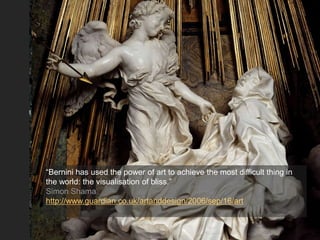
“Bernini has used the power of art to achieve the most difficult thing in
the world: the visualisation of bliss.”
Simon Shama
http://www.guardian.co.uk/artanddesign/2006/sep/16/art
Baroque Rome
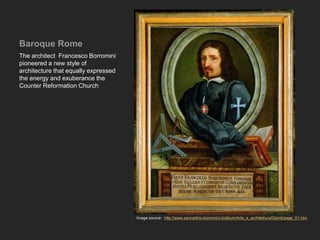
The architect Francesco Borromini
pioneered a new style of
architecture that equally expressed
the energy and exuberance the
Counter Reformation Church
Image source: http://www.sancarlino-borromini.it/album/Arte_e_architettura/Dipinti/page_01.htm
Baroque Rome
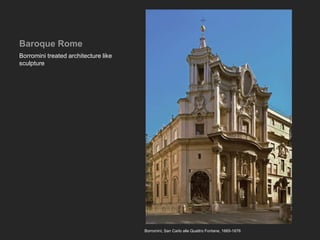
Borromini treated architecture like
sculpture
Borromini, San Carlo alle Quattro Fontane, 1665-1676
Baroque Rome
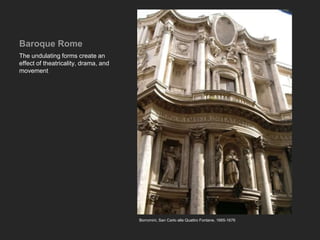
The undulating forms create an
effect of theatricality, drama, and
movement
Borromini, San Carlo alle Quattro Fontane, 1665-1676
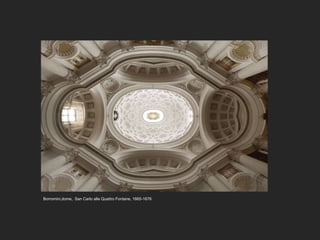
Borromini,dome, San Carlo alle Quattro Fontane, 1665-1676
Baroque Rome
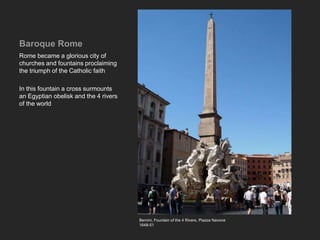
Rome became a glorious city of
churches and fountains proclaiming
the triumph of the Catholic faith
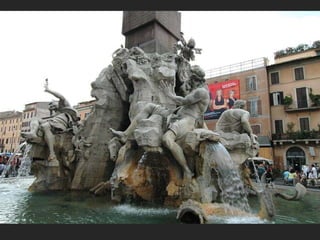
In this fountain a cross surmounts
an Egyptian obelisk and the 4 rivers
of the world
Bernini, Fountain of the 4 Rivers. Piazza Navone
1648-51
Baroque Ceiling
Decoration
New churches were built, and
needed decorations
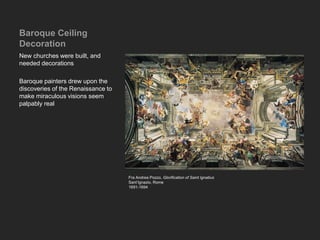
Baroque painters drew upon the
discoveries of the Renaissance to
make miraculous visions seem
palpably real
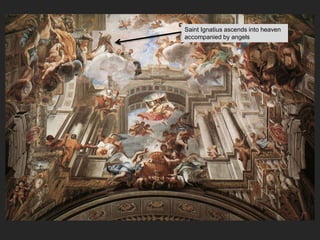
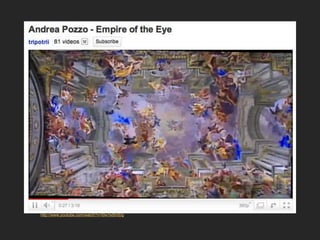
Fra Andrea Pozzo, Glorification of Saint Ignatius
Sant’Ignazio, Rome
1691-1694
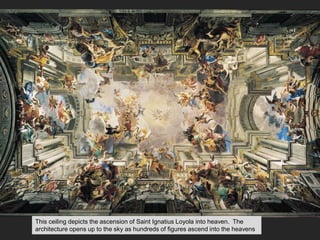
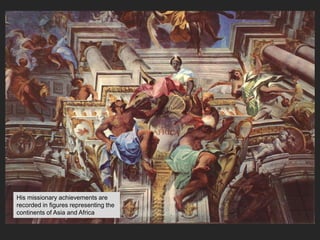
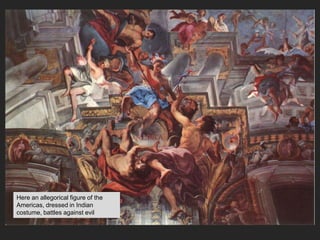
This ceiling depicts the ascension of Saint Ignatius Loyola into heaven. The
architecture opens up to the sky as hundreds of figures ascend into the heavens
Saint Ignatius ascends into heaven
accompanied by angels
His missionary achievements are
recorded in figures representing the
continents of Asia and Africa
Here an allegorical figure of the
Americas, dressed in Indian
costume, battles against evil
Baroque Ceiling
Decoration
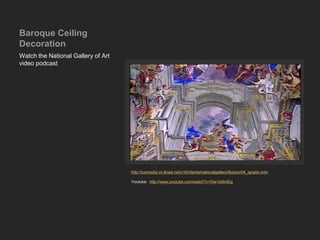
Watch the National Gallery of Art
video podcast
http://luxmedia.vo.llnwd.net/o10/clients/nationalgallery/illusion/04_ignatio.m4v
Youtube: http://www.youtube.com/watch?v=I0w1e5tntDg
http://www.youtube.com/watch?v=I0w1e5tntDg
Private Patronage
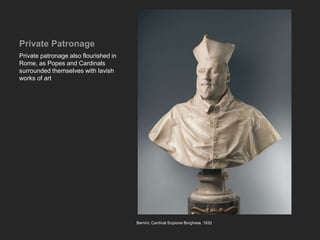
Private patronage also flourished in
Rome, as Popes and Cardinals
surrounded themselves with lavish
works of art
Bernini, Cardinal Scipione Borghese, 1632
Private Patronage
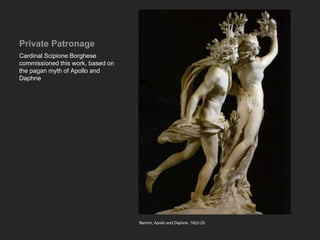
Cardinal Scipione Borghese
commissioned this work, based on
the pagan myth of Apollo and
Daphne
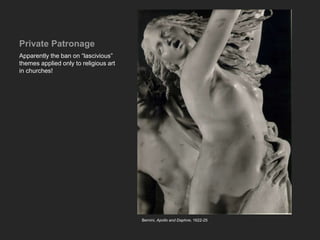
Bernini, Apollo and Daphne, 1622-25
Private Patronage
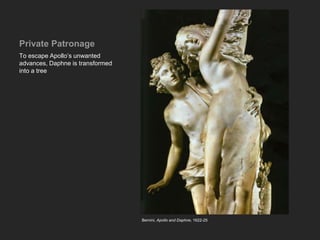
To escape Apollo’s unwanted
advances, Daphne is transformed
into a tree
Bernini, Apollo and Daphne, 1622-25
Private Patronage
Apparently the ban on “lascivious”
themes applied only to religious art
in churches!
Bernini, Apollo and Daphne, 1622-25
Private Patronage
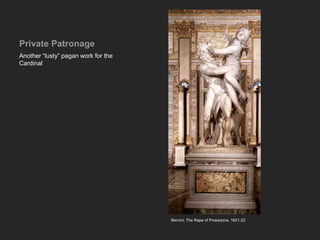
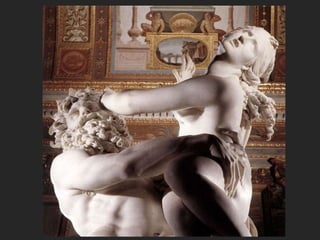
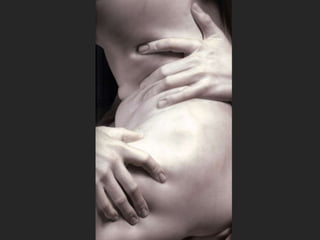
Another “lusty” pagan work for the
Cardinal
Bernini, The Rape of Proserpina, 1621-22
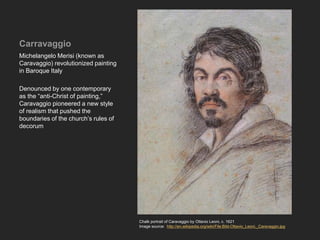
Carravaggio
Michelangelo Merisi (known as
Caravaggio) revolutionized painting
in Baroque Italy
Denounced by one contemporary
as the “anti-Christ of painting,”
Caravaggio pioneered a new style
of realism that pushed the
boundaries of the church’s rules of
decorum
Chalk portrait of Caravaggio by Ottavio Leoni, c. 1621
Image source: http://en.wikipedia.org/wiki/File:Bild-Ottavio_Leoni,_Caravaggio.jpg
http://www.youtube.com/watch?v=Gnv2aon8RM0
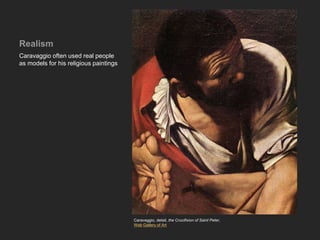
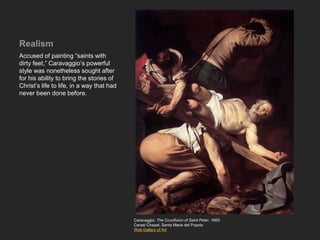
Realism
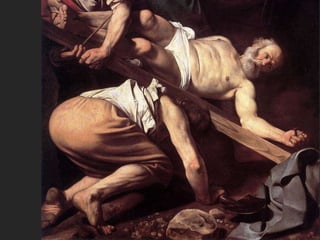
Caravaggio often used real people
as models for his religious paintings
Caravaggio, detail, the Crucifixion of Saint Peter,
Web Gallery of Art
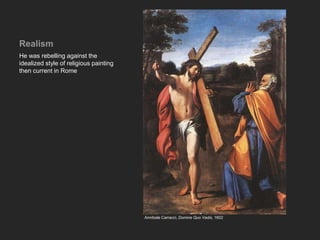
Realism
He was rebelling against the
idealized style of religious painting
then current in Rome
Annibale Carracci, Domine Quo Vadis, 1602
Realism
Accused of painting “saints with
dirty feet,” Caravaggio’s powerful
style was nonetheless sought after
for his ability to bring the stories of
Christ’s life to life, in a way that had
never been done before.
Caravaggio, The Crucifixion of Saint Peter, 1600
Cerasi Chapel, Santa Maria del Popolo
Web Gallery of Art
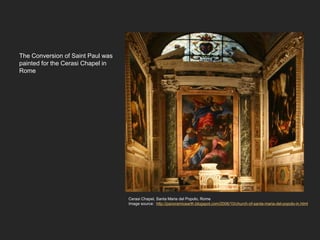
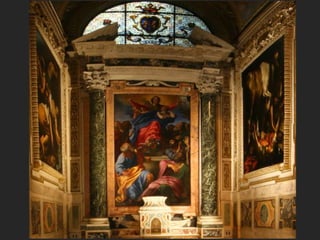
The Conversion of Saint Paul was
painted for the Cerasi Chapel in
Rome
Cerasi Chapel, Santa Maria del Popolo, Rome
Image source: http://panoramicearth.blogspot.com/2006/10/church-of-santa-maria-del-popolo-in.html
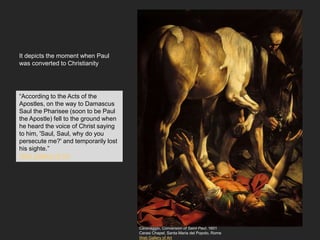
It depicts the moment when Paul
was converted to Christianity
Caravaggio, Conversion of Saint Paul, 1601
Cerasi Chapel, Santa Maria del Popolo, Rome
Web Gallery of Art
“According to the Acts of the
Apostles, on the way to Damascus
Saul the Pharisee (soon to be Paul
the Apostle) fell to the ground when
he heard the voice of Christ saying
to him, 'Saul, Saul, why do you
persecute me?' and temporarily lost
his sighte.”
Web Gallery of Art
Lighting
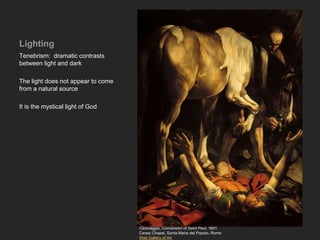
Tenebrism: dramatic contrasts
between light and dark
The light does not appear to come
from a natural source
It is the mystical light of God
Caravaggio, Conversion of Saint Paul, 1601
Cerasi Chapel, Santa Maria del Popolo, Rome
Web Gallery of Art
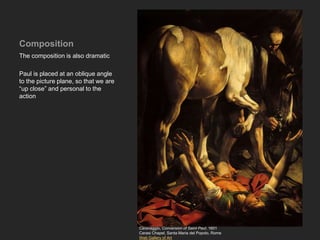
Composition
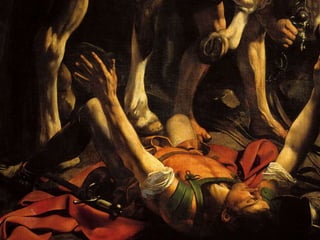
The composition is also dramatic
Paul is placed at an oblique angle
to the picture plane, so that we are
“up close” and personal to the
action
Caravaggio, Conversion of Saint Paul, 1601
Cerasi Chapel, Santa Maria del Popolo, Rome
Web Gallery of Art
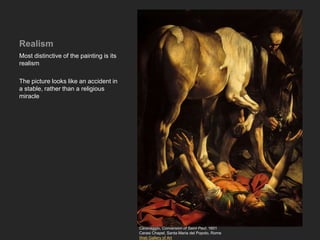
Realism
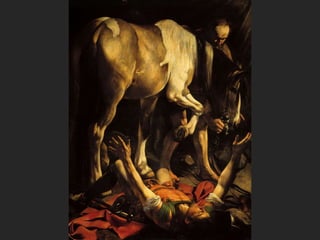
Most distinctive of the painting is its
realism
The picture looks like an accident in
a stable, rather than a religious
miracle
Caravaggio, Conversion of Saint Paul, 1601
Cerasi Chapel, Santa Maria del Popolo, Rome
Web Gallery of Art
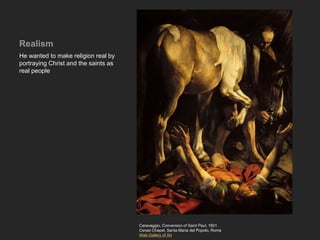
Realism
He wanted to make religion real by
portraying Christ and the saints as
real people
Caravaggio, Conversion of Saint Paul, 1601
Cerasi Chapel, Santa Maria del Popolo, Rome
Web Gallery of Art
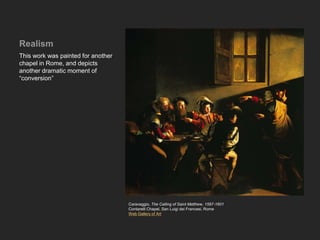
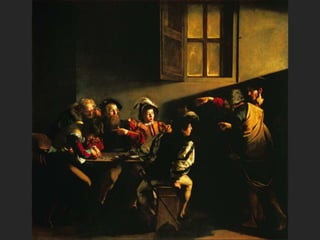
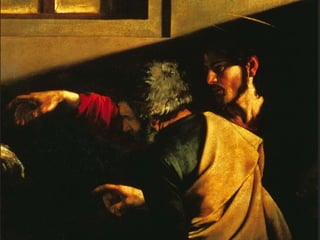
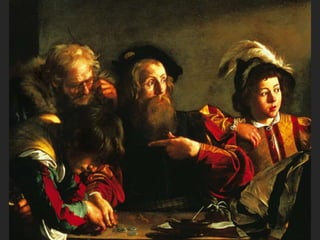
Realism
This work was painted for another
chapel in Rome, and depicts
another dramatic moment of
“conversion”
Caravaggio, The Calling of Saint Matthew, 1597-1601
Contarelli Chapel, San Luigi dei Francesi, Rome
Web Gallery of Art
http://www.youtube.com/watch?v=gMp7hpzF5lQ&feature=relate
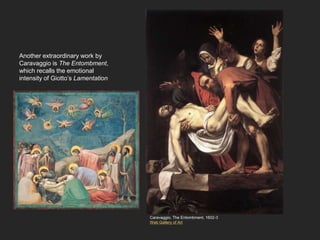
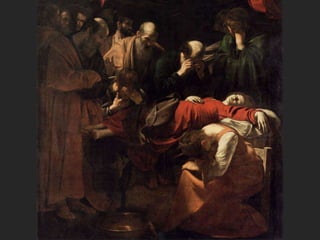
Another extraordinary work by
Caravaggio is The Entombment,
which recalls the emotional
intensity of Giotto’s Lamentation
Caravaggio, The Entombment, 1602-3
Web Gallery of Art
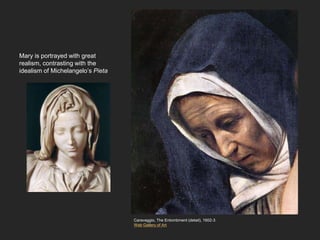
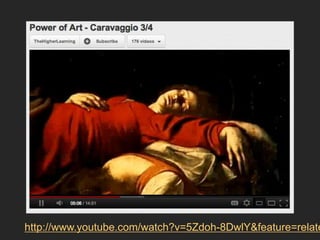
Mary is portrayed with great
realism, contrasting with the
idealism of Michelangelo’s Pieta
Caravaggio, The Entombment (detail), 1602-3
Web Gallery of Art
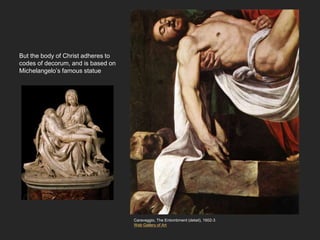
But the body of Christ adheres to
codes of decorum, and is based on
Michelangelo’s famous statue
Caravaggio, The Entombment (detail), 1602-3
Web Gallery of Art
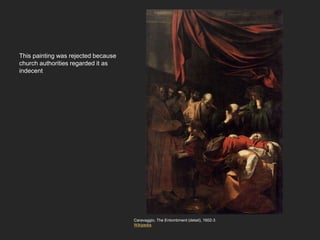
This painting was rejected because
church authorities regarded it as
indecent
Caravaggio, The Entombment (detail), 1602-3
Wikipedia
http://www.youtube.com/watch?v=5Zdoh-8DwlY&feature=relate
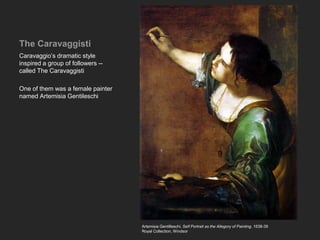
The Caravaggisti
Caravaggio’s dramatic style
inspired a group of followers --
called The Caravaggisti
One of them was a female painter
named Artemisia Gentileschi
Artemisia Gentilleschi, Self Portrait as the Allegory of Painting, 1638-39
Royal Collection, Windsor
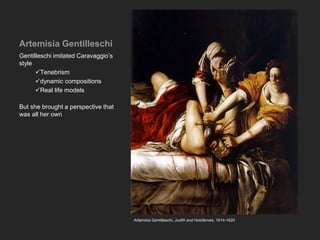
Artemisia Gentilleschi
Gentilleschi imitated Caravaggio’s
style
Tenebrism
dynamic compositions
Real life models
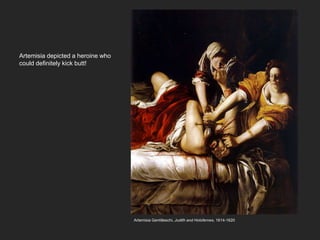
But she brought a perspective that
was all her own
Artemisia Gentilleschi, Judith and Holofernes, 1614-1620
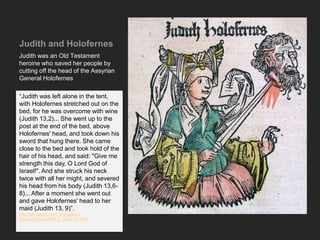
Judith and Holofernes
Judith was an Old Testament
heroine who saved her people by
cutting off the head of the Assyrian
General Holofernes
“Judith was left alone in the tent,
with Holofernes stretched out on the
bed, for he was overcome with wine
(Judith 13,2)... She went up to the
post at the end of the bed, above
Holofernes' head, and took down his
sword that hung there. She came
close to the bed and took hold of the
hair of his head, and said: "Give me
strength this day, O Lord God of
Israel!". And she struck his neck
twice with all her might, and severed
his head from his body (Judith 13,6-
8)... After a moment she went out
and gave Holofernes' head to her
maid (Judith 13, 9)”.
http://mv.vatican.va/3_EN/pages/x-
Schede/CSNs/CSNs_V_Penn_01.html
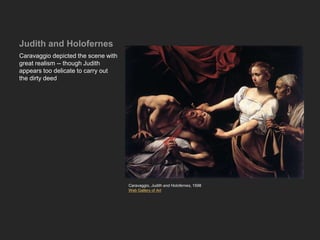
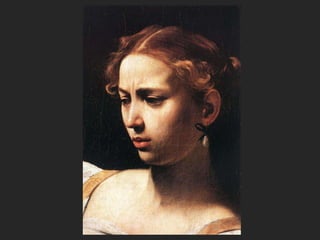
Judith and Holofernes
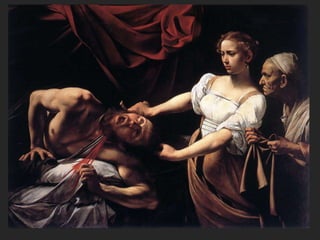
Caravaggio depicted the scene with
great realism -- though Judith
appears too delicate to carry out
the dirty deed
Caravaggio, Judith and Holofernes, 1598
Web Gallery of Art
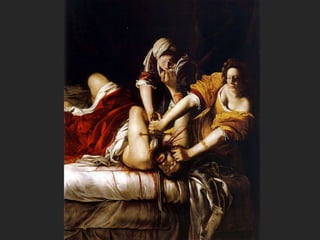
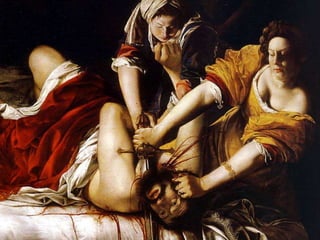
Artemisia depicted a heroine who
could definitely kick butt!
Artemisia Gentilleschi, Judith and Holofernes, 1614-1620
Baroque painters strove for the kind
of special effects that movie makers
use today
Drama
Action
Sex
Violence
Special fx
Viewer participation
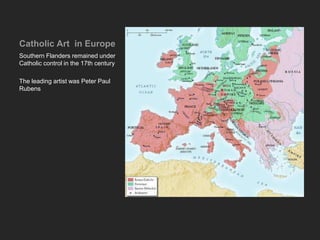
Catholic Art in Europe
Southern Flanders remained under
Catholic control in the 17th century
The leading artist was Peter Paul
Rubens
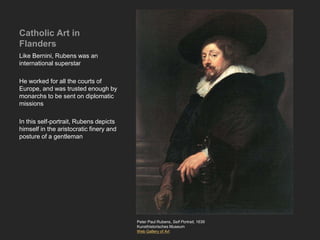
Catholic Art in
Flanders
Like Bernini, Rubens was an
international superstar
He worked for all the courts of
Europe, and was trusted enough by
monarchs to be sent on diplomatic
missions
In this self-portrait, Rubens depicts
himself in the aristocratic finery and
posture of a gentleman
Peter Paul Rubens, Self Portrait, 1639
Kunsthistorisches Museum
Web Gallery of Art
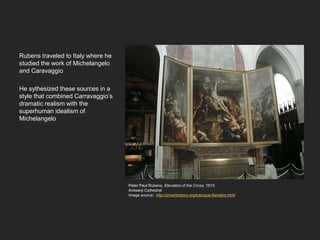
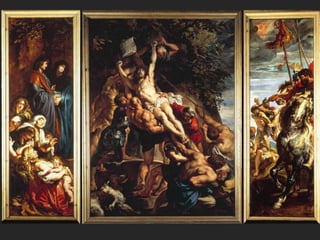
Rubens traveled to Italy where he
studied the work of Michelangelo
and Caravaggio
He sythesized these sources in a
style that combined Carravaggio’s
dramatic realism with the
superhuman idealism of
Michelangelo
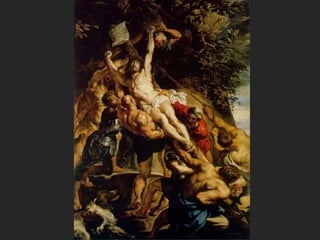
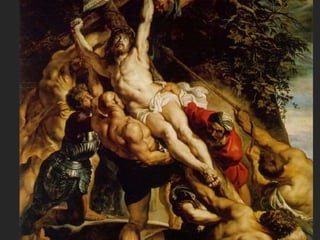
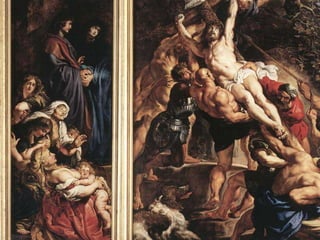
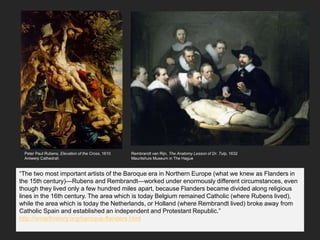
Peter Paul Rubens, Elevation of the Cross, 1610
Antwerp Cathedral
Image source: http://smarthistory.org/baroque-flanders.html
Peter Paul Rubens, Elevation of the Cross, 1610
Antwerp Cathedral
“The two most important artists of the Baroque era in Northern Europe (what we knew as Flanders in
the 15th century)—Rubens and Rembrandt—worked under enormously different circumstances, even
though they lived only a few hundred miles apart, because Flanders became divided along religious
lines in the 16th century. The area which is today Belgium remained Catholic (where Rubens lived),
while the area which is today the Netherlands, or Holland (where Rembrandt lived) broke away from
Catholic Spain and established an independent and Protestant Republic.”
http://smarthistory.org/baroque-flanders.html
Rembrandt van Rijn, The Anatomy Lesson of Dr. Tulp, 1632
Mauritshuis Museum in The Hague
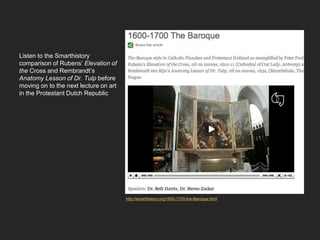
Listen to the Smarthistory
comparison of Rubens’ Elevation of
the Cross and Rembrandt’s
Anatomy Lesson of Dr. Tulp before
moving on to the next lecture on art
in the Protestant Dutch Republic
http://smarthistory.org/1600-1700-the-Baroque.html

Baroque 2: Bernini

  • 1.
  • 2.
    Gianlorenzo Bernini, SelfPortrait as a Young Man, c. 1623 Oil on canvas, Galleria Borghese, Rome Web Gallery of Art One of the leading artists of Counter Reformation Rome was Gianlorenzo Bernini, an accomplished painter, sculptor, and architect, and devout follower of St. Ignatius Loyola’s Spiritual Exercises
  • 3.
    Aerial view ofSt. Peter’s Basilica, Rome, with the piazza designed by Bernini Bernini was invited to put the finishing touches on St. Peter’s Cathedral, which had been modified by several architects so that it would conform more readily to the traditional basilica plan (Bramante’s central plan was deemed too “pagan” for a Christian church!)
  • 4.
    Bramante’s central plan Addition ofa lengthened nave to conform to traditional Basilica plan Bernini was commissioned to complete the Piazza space in front of the Basilica
  • 5.
    He designed agrand colonnade that enclosed the piazza space, which included an Egyptian obelisk topped by a crucifix – symbolic of the church’s triumph over “paganism”
  • 6.
    Bernini described thecolonnade as being like the “welcoming arms of the church” reaching out to embrace its flock - making it a fitting symbol of the Counter Reformation Church’s goal to combat heresy and expand its popular base
  • 7.
    Gianlorenzo Bernini, baldacchino,Saint Peter’s basilica, Vatican City, Rome, 1624-1663 Gilded bronze, 100’ high Inside, Bernini designed the great Baldacchino to theatrically frame the ritual of the mass
  • 8.
    As tall asan 8 story building, it is made of gilded bronze, and proclaims the triumph of the church, and of Urban VIII, the Pope who commissioned it
  • 9.
    The Pope’s familycoat of arms (the Barberini bees) decorate the structure, while angels carry the Papal crown, symbol of the Pope’s authority
  • 10.
    Gianlorenzo Bernini, baldacchino,Saint Peter’s basilica, Vatican City, Rome, 1624-1663 Gilded bronze, 100’ high Behind the Baldacchino is the Cathedra Petri, a dramatic ensemble that reaffirmed the legitimacy of the papacy (recently challenged by the Protestant Reformation)
  • 11.
    Bernini encased theChair of Saint Peter (symbol of the Pope’s authority) in gilded bronze, and set it in a dramatic “virtual reality” environment
  • 12.
    The chair appearsto float on clouds, while two angels float above carrying the Papal crown
  • 13.
    Behind the chairis a window with an image of the Holy Spirit, surrounded by sculpted plaster figures that seem to burst from the light like a heavenly cloud
  • 14.
    The goal wasto create a kind of “virtual reality” miracle that seems to be taking place right before our very eyes
  • 15.
    If the goalof the Renaissance was to take Mary, Jesus, and the Saints out of the heavenly realm and bring them down into our world, the goal of Baroque art was to make the heavenly seem palpably real
  • 16.
  • 17.
  • 18.
    Giuliano Fanelli, Bustof Cardinal Scipione Borghese, 1631-32 Metropolitan Museum Bernini’s gifts as a sculptor were recognized early on by Cardinal Scipione Borghese, nephew of Pope Paul V, and an avid connoisseur of art
  • 19.
    Bernini, David, 1623 BorgheseGallery, Rome He commissioned Bernini’s statue of David, which broke new ground in sculpture, and exemplifies the new exuberant style of the Baroque
  • 20.
    Bernini, David, 1623 BorgheseGallery, Rome Michelangelo, David, 1501-1504 While Donatello had portrayed the calm moment after the battle, and Michelangelo represented the tense moment before, Bernini chose to represent the explosive, action-packed moment when David is about to release his rock at the unseen giant
  • 21.
    With his legswide apart, David pivots on one foot as he “winds up” to take his shot
  • 22.
    The work explodesinto our space, so that we become a part of the action (indeed, we must duck to avoid getting caught in the crossfire), creating the kind of “viewer participation” and personal engagement that was advocated by the Counter Reformation Church
  • 23.
    Bernini also adheredto the Church’s codes of decorum: modestly clothed, rather than nude, the figure is convincingly lifelike, without “inciting to lust,” or compromising the beauty expected of Holy individuals
  • 24.
    One of themost expressive features of the statue is David’s face, which shows intense concentration as he bites his lips and furrows his brow
  • 26.
    Bernini used hisown face as a model, and according to legend, Cardinal Borghese held the mirror for him while he worked
  • 27.
    What makes thiswork typical of the Catholic Baroque?
  • 28.
    The role ofart during the Counter Reformation was to “win the hearts and minds” of the masses
  • 29.
    It therefore hadto be dramatic, and exciting, and personally engaging
  • 30.
    Bernini achieves thisin this sculpture which is full of action-packed drama, inviting “viewer participation” as we get caught up action
  • 31.
  • 32.
  • 33.
    Bernini, Cornaro Chapel,Santa Maria della Vittoria, Rome, 1645-1652 Bernini’s Ecstasy of Saint Theresa was commissioned for the private chapel of the Cornaro family, located in Santa Maria Vittorio in Rome
  • 34.
    Bernini, Cornaro Chapel,Santa Maria della Vittoria, Rome, 1645-1652 Highly theatrical in its stage-like setting, the work combines painting, sculpture, and architecture, and is a Baroque attempt at creating “virtual reality”
  • 35.
    Members of theCornaro family (many of them Cardinals) are depicted in theater-boxes in reliefs on either side of the chapel
  • 37.
    The centerpiece isa sculptural group representing Saint Teresa and an angel
  • 38.
    The group isspotlighted by a hidden window, creating a mysterious and “heavenly” effect
  • 39.
    Peter Paul Rubens,Saint Teresa of Avila, 1615 Kunsthistorices Museum Saint Teresa of Avila was a Spanish nun who experienced mystical visions
  • 40.
    Peter Paul Rubens,Saint Teresa of Avila, 1615 Kunsthistorices Museum Her visions were recorded in a book widely promoted by the Catholic Church
  • 41.
    Bernini’s sculpture wasbased on her description of a vision she had of an angel that pierced her heart repeatedly with an arrow
  • 42.
    “The pain wasso great that I screamed aloud; but at the same time I felt such infinite sweetness that I wished the pain to last forever . . . It was the sweetest caressing of the soul by God.”
  • 43.
    Bernini captures themoment at which Teresa succumbs to the overpowering experience of what can only be described as divine ecstasy
  • 44.
    “With her headthrown back and eyes closed, Teresa herself collapses, overcome with the feeling of God’s love. Her physical body seems to have dematerialized beneath the heavy drapery of her robe. Twisting folds of fabric energize the scene and bronze rays, emanating from an unseen source, seem to rain down divine light. The combined effect is one of intense drama, the ethereality of which denies the true nature of the work of art. Despite being made of heavy marble, saint and angel— set upon a cloud—appear to float weightlessly.” The Ecstasy of St. Teresa, Art Through Time: A Global View (Annenberg Learner)
  • 45.
    Teresa’s expression isalmost a cliché of sexual ecstasy, with her head thrown back, eyes partially closed, and lips parted
  • 46.
    Meg Ryan, fakeorgasm scene, in When Harry Met Sally It is exactly the expression we see on Meg Ryan’s face during her famous “fake orgasm” scene in When Harry met Sally
  • 47.
    “Bernini’s sculpture is,after all, a spectacle that hovers on the borderline between sacred mystery and indecency . . . .” Simon Schama, “When Stone Came to Life”
  • 48.
    But far frombeing scandalous, Bernini’s St. Teresa was consistent with the ideals of the Counter Reformation Church
  • 49.
    Like Ignatius Loyola’sSpiritual Exercises, his work transformed religious experience into something personal, exciting, and appealing
  • 50.
    If this ishow religion makes you feel, wouldn’t you want to get some religion too?
  • 51.
    Watch the Smarthistoryvideo for a more in-depth discussion
  • 52.
    “Bernini has usedthe power of art to achieve the most difficult thing in the world: the visualisation of bliss.” Simon Shama http://www.guardian.co.uk/artanddesign/2006/sep/16/art
  • 53.
    Baroque Rome The architectFrancesco Borromini pioneered a new style of architecture that equally expressed the energy and exuberance the Counter Reformation Church Image source: http://www.sancarlino-borromini.it/album/Arte_e_architettura/Dipinti/page_01.htm
  • 54.
    Baroque Rome Borromini treatedarchitecture like sculpture Borromini, San Carlo alle Quattro Fontane, 1665-1676
  • 55.
    Baroque Rome The undulatingforms create an effect of theatricality, drama, and movement Borromini, San Carlo alle Quattro Fontane, 1665-1676
  • 56.
    Borromini,dome, San Carloalle Quattro Fontane, 1665-1676
  • 57.
    Baroque Rome Rome becamea glorious city of churches and fountains proclaiming the triumph of the Catholic faith In this fountain a cross surmounts an Egyptian obelisk and the 4 rivers of the world Bernini, Fountain of the 4 Rivers. Piazza Navone 1648-51
  • 59.
    Baroque Ceiling Decoration New churcheswere built, and needed decorations Baroque painters drew upon the discoveries of the Renaissance to make miraculous visions seem palpably real Fra Andrea Pozzo, Glorification of Saint Ignatius Sant’Ignazio, Rome 1691-1694
  • 60.
    This ceiling depictsthe ascension of Saint Ignatius Loyola into heaven. The architecture opens up to the sky as hundreds of figures ascend into the heavens
  • 61.
    Saint Ignatius ascendsinto heaven accompanied by angels
  • 62.
    His missionary achievementsare recorded in figures representing the continents of Asia and Africa
  • 63.
    Here an allegoricalfigure of the Americas, dressed in Indian costume, battles against evil
  • 64.
    Baroque Ceiling Decoration Watch theNational Gallery of Art video podcast http://luxmedia.vo.llnwd.net/o10/clients/nationalgallery/illusion/04_ignatio.m4v Youtube: http://www.youtube.com/watch?v=I0w1e5tntDg
  • 65.
  • 66.
    Private Patronage Private patronagealso flourished in Rome, as Popes and Cardinals surrounded themselves with lavish works of art Bernini, Cardinal Scipione Borghese, 1632
  • 67.
    Private Patronage Cardinal ScipioneBorghese commissioned this work, based on the pagan myth of Apollo and Daphne Bernini, Apollo and Daphne, 1622-25
  • 68.
    Private Patronage To escapeApollo’s unwanted advances, Daphne is transformed into a tree Bernini, Apollo and Daphne, 1622-25
  • 69.
    Private Patronage Apparently theban on “lascivious” themes applied only to religious art in churches! Bernini, Apollo and Daphne, 1622-25
  • 70.
    Private Patronage Another “lusty”pagan work for the Cardinal Bernini, The Rape of Proserpina, 1621-22
  • 73.
    Carravaggio Michelangelo Merisi (knownas Caravaggio) revolutionized painting in Baroque Italy Denounced by one contemporary as the “anti-Christ of painting,” Caravaggio pioneered a new style of realism that pushed the boundaries of the church’s rules of decorum Chalk portrait of Caravaggio by Ottavio Leoni, c. 1621 Image source: http://en.wikipedia.org/wiki/File:Bild-Ottavio_Leoni,_Caravaggio.jpg
  • 74.
  • 75.
    Realism Caravaggio often usedreal people as models for his religious paintings Caravaggio, detail, the Crucifixion of Saint Peter, Web Gallery of Art
  • 76.
    Realism He was rebellingagainst the idealized style of religious painting then current in Rome Annibale Carracci, Domine Quo Vadis, 1602
  • 77.
    Realism Accused of painting“saints with dirty feet,” Caravaggio’s powerful style was nonetheless sought after for his ability to bring the stories of Christ’s life to life, in a way that had never been done before. Caravaggio, The Crucifixion of Saint Peter, 1600 Cerasi Chapel, Santa Maria del Popolo Web Gallery of Art
  • 79.
    The Conversion ofSaint Paul was painted for the Cerasi Chapel in Rome Cerasi Chapel, Santa Maria del Popolo, Rome Image source: http://panoramicearth.blogspot.com/2006/10/church-of-santa-maria-del-popolo-in.html
  • 81.
    It depicts themoment when Paul was converted to Christianity Caravaggio, Conversion of Saint Paul, 1601 Cerasi Chapel, Santa Maria del Popolo, Rome Web Gallery of Art “According to the Acts of the Apostles, on the way to Damascus Saul the Pharisee (soon to be Paul the Apostle) fell to the ground when he heard the voice of Christ saying to him, 'Saul, Saul, why do you persecute me?' and temporarily lost his sighte.” Web Gallery of Art
  • 84.
    Lighting Tenebrism: dramatic contrasts betweenlight and dark The light does not appear to come from a natural source It is the mystical light of God Caravaggio, Conversion of Saint Paul, 1601 Cerasi Chapel, Santa Maria del Popolo, Rome Web Gallery of Art
  • 85.
    Composition The composition isalso dramatic Paul is placed at an oblique angle to the picture plane, so that we are “up close” and personal to the action Caravaggio, Conversion of Saint Paul, 1601 Cerasi Chapel, Santa Maria del Popolo, Rome Web Gallery of Art
  • 86.
    Realism Most distinctive ofthe painting is its realism The picture looks like an accident in a stable, rather than a religious miracle Caravaggio, Conversion of Saint Paul, 1601 Cerasi Chapel, Santa Maria del Popolo, Rome Web Gallery of Art
  • 87.
    Realism He wanted tomake religion real by portraying Christ and the saints as real people Caravaggio, Conversion of Saint Paul, 1601 Cerasi Chapel, Santa Maria del Popolo, Rome Web Gallery of Art
  • 88.
    Realism This work waspainted for another chapel in Rome, and depicts another dramatic moment of “conversion” Caravaggio, The Calling of Saint Matthew, 1597-1601 Contarelli Chapel, San Luigi dei Francesi, Rome Web Gallery of Art
  • 92.
  • 93.
    Another extraordinary workby Caravaggio is The Entombment, which recalls the emotional intensity of Giotto’s Lamentation Caravaggio, The Entombment, 1602-3 Web Gallery of Art
  • 94.
    Mary is portrayedwith great realism, contrasting with the idealism of Michelangelo’s Pieta Caravaggio, The Entombment (detail), 1602-3 Web Gallery of Art
  • 95.
    But the bodyof Christ adheres to codes of decorum, and is based on Michelangelo’s famous statue Caravaggio, The Entombment (detail), 1602-3 Web Gallery of Art
  • 96.
    This painting wasrejected because church authorities regarded it as indecent Caravaggio, The Entombment (detail), 1602-3 Wikipedia
  • 98.
  • 99.
    The Caravaggisti Caravaggio’s dramaticstyle inspired a group of followers -- called The Caravaggisti One of them was a female painter named Artemisia Gentileschi Artemisia Gentilleschi, Self Portrait as the Allegory of Painting, 1638-39 Royal Collection, Windsor
  • 100.
    Artemisia Gentilleschi Gentilleschi imitatedCaravaggio’s style Tenebrism dynamic compositions Real life models But she brought a perspective that was all her own Artemisia Gentilleschi, Judith and Holofernes, 1614-1620
  • 101.
    Judith and Holofernes Judithwas an Old Testament heroine who saved her people by cutting off the head of the Assyrian General Holofernes “Judith was left alone in the tent, with Holofernes stretched out on the bed, for he was overcome with wine (Judith 13,2)... She went up to the post at the end of the bed, above Holofernes' head, and took down his sword that hung there. She came close to the bed and took hold of the hair of his head, and said: "Give me strength this day, O Lord God of Israel!". And she struck his neck twice with all her might, and severed his head from his body (Judith 13,6- 8)... After a moment she went out and gave Holofernes' head to her maid (Judith 13, 9)”. http://mv.vatican.va/3_EN/pages/x- Schede/CSNs/CSNs_V_Penn_01.html
  • 102.
    Judith and Holofernes Caravaggiodepicted the scene with great realism -- though Judith appears too delicate to carry out the dirty deed Caravaggio, Judith and Holofernes, 1598 Web Gallery of Art
  • 106.
    Artemisia depicted aheroine who could definitely kick butt! Artemisia Gentilleschi, Judith and Holofernes, 1614-1620
  • 109.
    Baroque painters strovefor the kind of special effects that movie makers use today Drama Action Sex Violence Special fx Viewer participation
  • 110.
    Catholic Art inEurope Southern Flanders remained under Catholic control in the 17th century The leading artist was Peter Paul Rubens
  • 111.
    Catholic Art in Flanders LikeBernini, Rubens was an international superstar He worked for all the courts of Europe, and was trusted enough by monarchs to be sent on diplomatic missions In this self-portrait, Rubens depicts himself in the aristocratic finery and posture of a gentleman Peter Paul Rubens, Self Portrait, 1639 Kunsthistorisches Museum Web Gallery of Art
  • 112.
    Rubens traveled toItaly where he studied the work of Michelangelo and Caravaggio He sythesized these sources in a style that combined Carravaggio’s dramatic realism with the superhuman idealism of Michelangelo Peter Paul Rubens, Elevation of the Cross, 1610 Antwerp Cathedral Image source: http://smarthistory.org/baroque-flanders.html
  • 120.
    Peter Paul Rubens,Elevation of the Cross, 1610 Antwerp Cathedral “The two most important artists of the Baroque era in Northern Europe (what we knew as Flanders in the 15th century)—Rubens and Rembrandt—worked under enormously different circumstances, even though they lived only a few hundred miles apart, because Flanders became divided along religious lines in the 16th century. The area which is today Belgium remained Catholic (where Rubens lived), while the area which is today the Netherlands, or Holland (where Rembrandt lived) broke away from Catholic Spain and established an independent and Protestant Republic.” http://smarthistory.org/baroque-flanders.html Rembrandt van Rijn, The Anatomy Lesson of Dr. Tulp, 1632 Mauritshuis Museum in The Hague
  • 121.
    Listen to theSmarthistory comparison of Rubens’ Elevation of the Cross and Rembrandt’s Anatomy Lesson of Dr. Tulp before moving on to the next lecture on art in the Protestant Dutch Republic http://smarthistory.org/1600-1700-the-Baroque.html