Introduction to Art HistoryArt History Starter Kit and MethodologyMagister RicardSomerset Academy 2009-2010
Slide ContentsWhat is Art? Its Purpose and Its FunctionFundamentals of Interpretation: Formal and Contextual AnalysisPrinciples of Design: Style
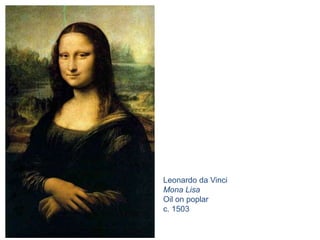
Leonardo da VinciMona LisaOil on poplarc. 1503
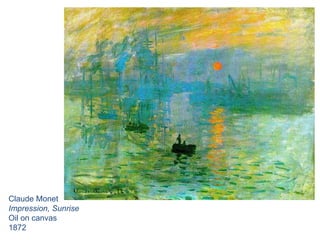
Claude MonetImpression, SunriseOil on canvas1872
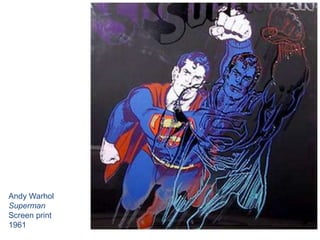
Andy WarholSupermanScreen print1961
What is Art?Art (art), n. 1. the quality, production, or expression of what is beautiful, appealing, or of more than ordinary significanceWork of art = visual expression of an ideaMedium = a particular material, along with its accompanying technique (plural = media)
Popular MediaPaint mediaAcrylic, Enamel, Gesso, Glaze, Ink, Oil, Tempera, WatercolorUsed on: Canvas, Cloth, Glass, Metal, Paper, WoodDrawing mediaChalk pastel, Charcoal, Colored pencil, Marker, Oil pastel, Pen and inkSculpture materialsBeads, Clay, Found objects, Jewels, Marble, Metals, Papier-mache, Plaster, Plastic, Sand, Stone, Textile, Wax, Wire, Wood
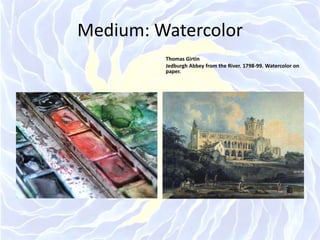
Medium: WatercolorThomas GirtinJedburgh Abbey from the River. 1798-99. Watercolor on paper.
What is “History”?History (his-tuh-ree), n. 1. the branch of knowledge dealing with past events. 2. a continuous, systematic narrative of past events as relating to a particular people, country, period, person, etc., usually written as a chronological account; chronicle: a history of France; a medical history of the patient. economic realitieshistorical eventssocial dynamicsreligious and spiritual organizationstechnological advancements
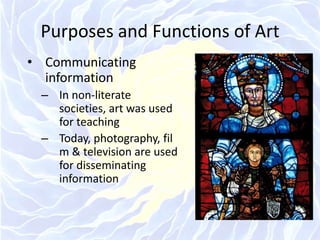
Purposes and Functions of ArtCommunicating informationIn non-literate societies, art was used for teachingToday, photography, film & television are used for disseminating information
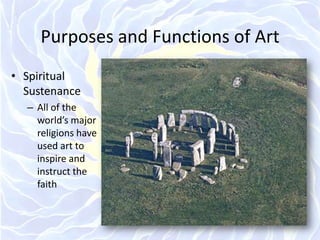
Purposes and Functions of ArtSpiritual SustenanceAll of the world’s major religions have used art to inspire and instruct the faith
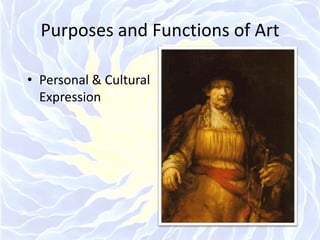
Purposes and Functions of ArtPersonal & Cultural Expression
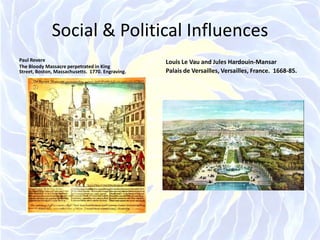
Purposes and Functions of ArtSocial & Political PurposesArtist have criticized or influenced values or public opinionOften it is clear & directOther times, it is less obvious Monarchs who commissioned projects to symbolize their strength & power
Social & Political InfluencesPaul RevereThe Bloody Massacre perpetrated in King Street, Boston, Massachusetts.  1770. Engraving.Louis Le Vau and Jules Hardouin-MansarPalais de Versailles, Versailles, France.  1668-85.
II. Fundamentals of Interpretation:Formal and Contextual Analysis
Art = Form + ContentIn the most basic way art can be thought of as having two parts:its formits contentForm relates to the “formal” aspects of art or how the art is made.Content relates to the subject of the art.
Formal Analysis of PaintingLooking at a work of art to try to understand what the artist wants to convey visuallyLine and ShapeColorTextureSpace and MassCompositionScale
1. Line and ShapeLines define space and may create an outline or contour, as style called “linear.”They can be visible or impliedIt may be two-dimensional, three-dimensional (as with a wire), or suggested or implied.Wherever there is an edge, the place where one object or plane appears to end and other object or space
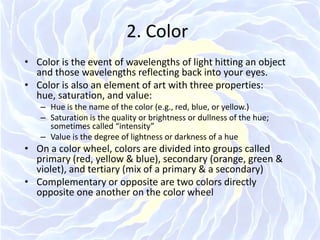
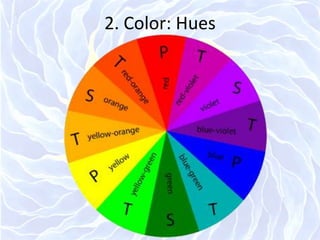
2. ColorColor is the event of wavelengths of light hitting an object and those wavelengths reflecting back into your eyes.Color is also an element of art with three properties: hue, saturation, and value:Hue is the name of the color (e.g., red, blue, or yellow.)Saturation is the quality or brightness or dullness of the hue; sometimes called “intensity”Value is the degree of lightness or darkness of a hueOn a color wheel, colors are divided into groups called primary (red, yellow & blue), secondary (orange, green & violet), and tertiary (mix of a primary & a secondary) Complementary or opposite are two colors directly opposite one another on the color wheel
2. Color: Hues
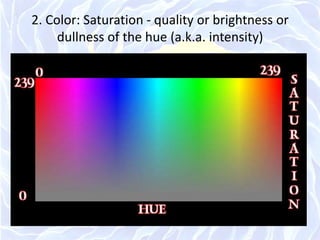
2. Color: Saturation - quality or brightness or dullness of the hue (a.k.a. intensity)
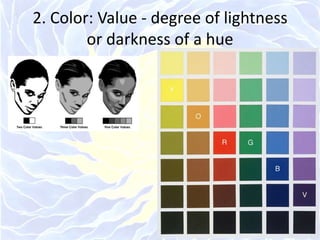
2. Color: Value - degree of lightness or darkness of a hue
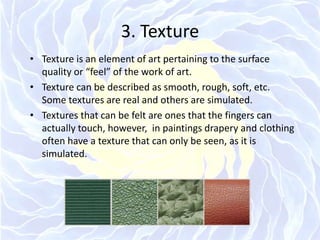
3. TextureTexture is an element of art pertaining to the surface quality or “feel” of the work of art.Texture can be described as smooth, rough, soft, etc. Some textures are real and others are simulated.Textures that can be felt are ones that the fingers can actually touch, however,  in paintings drapery and clothing often have a texture that can only be seen, as it is simulated.
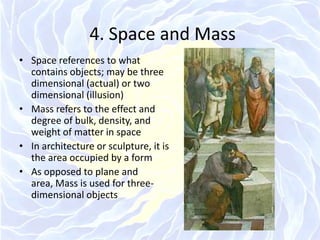
4. Space and MassSpace references to what contains objects; may be three dimensional (actual) or two dimensional (illusion)Mass refers to the effect and degree of bulk, density, and weight of matter in spaceIn architecture or sculpture, it is the area occupied by a formAs opposed to plane and area, Mass is used for three-dimensional objects
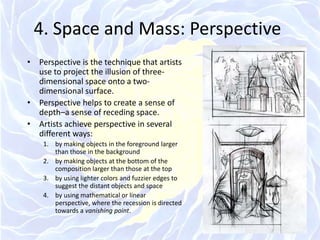
4. Space and Mass: PerspectivePerspective is the technique that artists use to project the illusion of three-dimensional space onto a two-dimensional surface.Perspective helps to create a sense of depth–a sense of receding space.Artists achieve perspective in several different ways: by making objects in the foreground larger than those in the background by making objects at the bottom of the composition larger than those at the topby using lighter colors and fuzzier edges to suggest the distant objects and spaceby using mathematical or linear perspective, where the recession is directed towards a vanishing point.
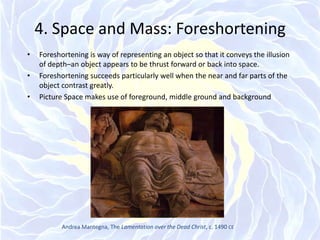
4. Space and Mass: ForeshorteningForeshortening is way of representing an object so that it conveys the illusion of depth–an object appears to be thrust forward or back into space.Foreshortening succeeds particularly well when the near and far parts of the object contrast greatly.Picture Space makes use of foreground, middle ground and backgroundAndrea Mantegna, The Lamentation over the Dead Christ, c. 1490 CE
5. CompositionHow items are arranged or organized in a work of artSymmetrical or assymetricalStatic or dynamicConsider pictorial depth (illusion) rendering 3D on 2D surface or plane (picture plane)Picture space is comprised of foreground, middle ground, and background and extends from beyond the picture plane
5. CompositionComposition, then, is the relationship of the parts of a painting, sculpture, or work of architecture.Artists consider composition when they structure the relationships of colors, lines, shapes, and masses in their art.Artists generally try to make the composition  of their works pleasing by balancing the aforementioned relations.Other times, artists will use composition to be expressive in some way, for example making some aspect of their art unbalanced or asymmetrical.
6. ScaleAs an art history term, scale refers to the size of the art object at hand or the size of the objects represented in a particular art object.Scale can also have to do with the size of a building as compared with the people who inhabit that space.Artists often use scale to suggest relationships between figures and landscape, figures and other figures, and/or sometimes a figure’s importance.
MovementAnother quality an artist might utilize Gives lifelike feeling to a workArtists often search for ways to create a sense of movement, from manipulating the objects within a work to the medium itself
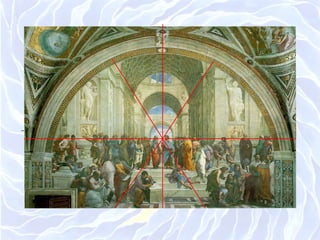
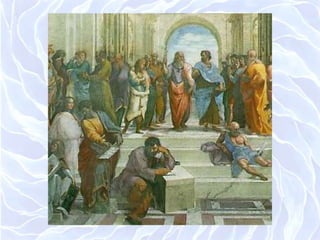
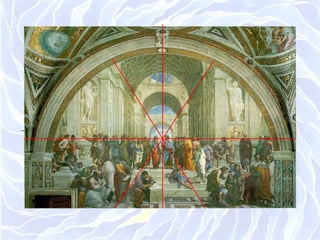
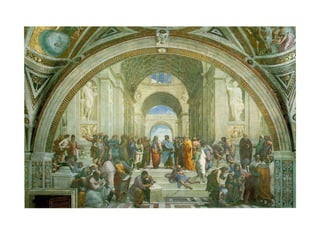
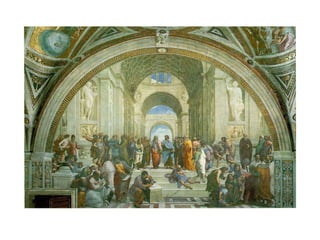
Analysis of Raphael’s School of Athens Subject Matter/Content: It is not a school but a gathering of important Greek philosophers. Materials and Technique: Raphael painted in the style of fresco. Fresco means painting on wet plaster. Composition: The School of Athens is done in a pyramidal composition which is very characteristic of Raphael and the High Renaissance. Use of Color: Raphael uses mostly natural colors with lots of browns and greys. He uses some orange and blue but mostly very earthly tones. Raphael did not use bright colors because he intended the mood to be more solemn.Lines and Forms: Raphael gives his figures mass, bulk and weight by using perspective, drapery, chiaroscuro, and contropposto. The way the clothing of the figures falls on their bodies gives them a sense of underlying body structure. All the lines converge between Plato and Aristotle's heads which gives it the pyramidal composition. "There is also an interest in accurate body proportion, which is reminiscent of classical Greek works." (http://hyper.vcsun.org...)Sense of Movement: All characters in "The School of Athens" are doing something. This indicts a great sense of motion which is visible in the poses of the figures. Use of Space: Although the painting seems crowded in some parts (especially around Plato and Aristotle) Raphael creates a great sense of space. He has a vanishing point so the painting looks like it goes back forever. He also paints the figures in the foreground larger than the rest which adds to the sense of space.
III. Principles of Design:Style
StyleStyle refers to the consistent and characteristic handling of media, elements of form, and principles of design that make a work identifiable as the particular culture, period, region, group, or personStyle = Form and Composition Makes a work distinctive!
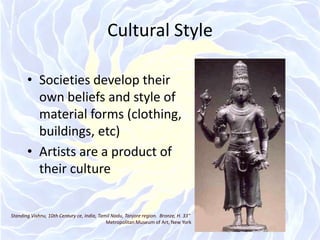
Cultural StyleSocieties develop their own beliefs and style of material forms (clothing, buildings, etc)Artists are a product of their cultureStanding Vishnu, 10th Century ce, India, Tamil Nadu, Tanjore region.  Bronze, H. 33"  Metropolitan Museum of Art, New York
Period StyleStyles change over timeArt changes because of economic & political changes, new technology, religious insightSometimes a desire for something new comes along
Regional StyleGeography also leads to diverse stylesMay be conscious decision or caused by a mere lack of communication over distanceEx: variations in Maya architecture; Hindu sculpture in India varies from North to South India; and abstract paintings produced in California differed from New York in the 1950s
Group StyleSometimes artist form alliances, exhibit together and publicize their aims as a group to promote a distinct styleOne of the best known group styles is Impressionism
Personal StyleIndividual artists often have characteristic modes of personal expression
Two Basic Forms of StyleRepresentationalSeeks to create recognizable subject matterAbstractSeeks to capture the essence of a form, not literal representation
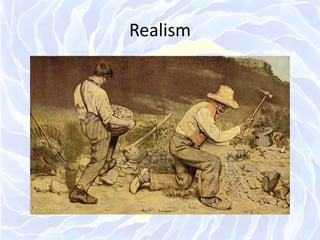
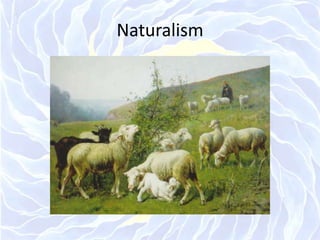
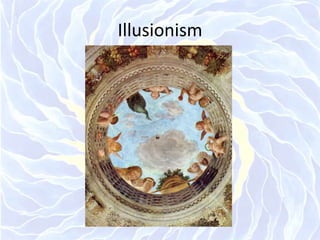
Representational StylesRealism – the attempt to depict objects accurately, objectivelyNaturalism – similar to Realism except often implies a grim subjectIllusionism – seeks to create a convincing representation or illusion of reality
Realism
Naturalism
Illusionism
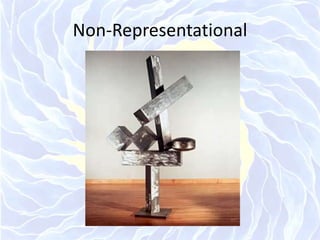
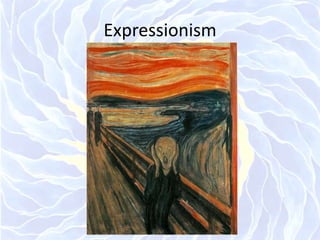
Abstract StylesNon-representational – does not produce recognizable imageryExpressionism – Plays with subjectivity, artist’s own ideas/feelings or viewer’s ideas/feelingsExaggerates to get the essence of a form
Non-Representational
Expressionism
Websites About ArtChris Whitcombe’s web site - Dr. Whitcombe hosts the singularly best resource for art history on the Internet. (This would be my first stop if I were looking for an image or additional resources.)ArtLex - ArtLex is a hyperlinked dictionary of art terms, and it includes abundant examples to illustrate the meanings of terms.Artchive - Mark Harden’s Artchive is an image resource arranged alphabetically by artist, as well as by school and/or era.Olga’s Gallery - Like Harden’s Artchive. (Don’t ask me about the name.)Timeline of Art History (Met) - Self-explanatoryHumanities Web - Humanities Web “shows the interconnections, the web, the links, between history, the arts, and culture - and how each plays off and influences the others.”

Introduction to Art History

  • 1.
    Introduction to ArtHistoryArt History Starter Kit and MethodologyMagister RicardSomerset Academy 2009-2010
  • 2.
    Slide ContentsWhat isArt? Its Purpose and Its FunctionFundamentals of Interpretation: Formal and Contextual AnalysisPrinciples of Design: Style
  • 3.
    Leonardo da VinciMonaLisaOil on poplarc. 1503
  • 4.
  • 5.
  • 6.
    What is Art?Art(art), n. 1. the quality, production, or expression of what is beautiful, appealing, or of more than ordinary significanceWork of art = visual expression of an ideaMedium = a particular material, along with its accompanying technique (plural = media)
  • 7.
    Popular MediaPaint mediaAcrylic,Enamel, Gesso, Glaze, Ink, Oil, Tempera, WatercolorUsed on: Canvas, Cloth, Glass, Metal, Paper, WoodDrawing mediaChalk pastel, Charcoal, Colored pencil, Marker, Oil pastel, Pen and inkSculpture materialsBeads, Clay, Found objects, Jewels, Marble, Metals, Papier-mache, Plaster, Plastic, Sand, Stone, Textile, Wax, Wire, Wood
  • 8.
    Medium: WatercolorThomas GirtinJedburghAbbey from the River. 1798-99. Watercolor on paper.
  • 9.
    What is “History”?History(his-tuh-ree), n. 1. the branch of knowledge dealing with past events. 2. a continuous, systematic narrative of past events as relating to a particular people, country, period, person, etc., usually written as a chronological account; chronicle: a history of France; a medical history of the patient. economic realitieshistorical eventssocial dynamicsreligious and spiritual organizationstechnological advancements
  • 10.
    Purposes and Functionsof ArtCommunicating informationIn non-literate societies, art was used for teachingToday, photography, film & television are used for disseminating information
  • 11.
    Purposes and Functionsof ArtSpiritual SustenanceAll of the world’s major religions have used art to inspire and instruct the faith
  • 12.
    Purposes and Functionsof ArtPersonal & Cultural Expression
  • 13.
    Purposes and Functionsof ArtSocial & Political PurposesArtist have criticized or influenced values or public opinionOften it is clear & directOther times, it is less obvious Monarchs who commissioned projects to symbolize their strength & power
  • 14.
    Social & PoliticalInfluencesPaul RevereThe Bloody Massacre perpetrated in King Street, Boston, Massachusetts. 1770. Engraving.Louis Le Vau and Jules Hardouin-MansarPalais de Versailles, Versailles, France. 1668-85.
  • 15.
    II. Fundamentals ofInterpretation:Formal and Contextual Analysis
  • 16.
    Art = Form+ ContentIn the most basic way art can be thought of as having two parts:its formits contentForm relates to the “formal” aspects of art or how the art is made.Content relates to the subject of the art.
  • 17.
    Formal Analysis ofPaintingLooking at a work of art to try to understand what the artist wants to convey visuallyLine and ShapeColorTextureSpace and MassCompositionScale
  • 18.
    1. Line andShapeLines define space and may create an outline or contour, as style called “linear.”They can be visible or impliedIt may be two-dimensional, three-dimensional (as with a wire), or suggested or implied.Wherever there is an edge, the place where one object or plane appears to end and other object or space
  • 20.
    2. ColorColor isthe event of wavelengths of light hitting an object and those wavelengths reflecting back into your eyes.Color is also an element of art with three properties: hue, saturation, and value:Hue is the name of the color (e.g., red, blue, or yellow.)Saturation is the quality or brightness or dullness of the hue; sometimes called “intensity”Value is the degree of lightness or darkness of a hueOn a color wheel, colors are divided into groups called primary (red, yellow & blue), secondary (orange, green & violet), and tertiary (mix of a primary & a secondary) Complementary or opposite are two colors directly opposite one another on the color wheel
  • 21.
  • 22.
    2. Color: Saturation- quality or brightness or dullness of the hue (a.k.a. intensity)
  • 23.
    2. Color: Value- degree of lightness or darkness of a hue
  • 25.
    3. TextureTexture isan element of art pertaining to the surface quality or “feel” of the work of art.Texture can be described as smooth, rough, soft, etc. Some textures are real and others are simulated.Textures that can be felt are ones that the fingers can actually touch, however, in paintings drapery and clothing often have a texture that can only be seen, as it is simulated.
  • 26.
    4. Space andMassSpace references to what contains objects; may be three dimensional (actual) or two dimensional (illusion)Mass refers to the effect and degree of bulk, density, and weight of matter in spaceIn architecture or sculpture, it is the area occupied by a formAs opposed to plane and area, Mass is used for three-dimensional objects
  • 27.
    4. Space andMass: PerspectivePerspective is the technique that artists use to project the illusion of three-dimensional space onto a two-dimensional surface.Perspective helps to create a sense of depth–a sense of receding space.Artists achieve perspective in several different ways: by making objects in the foreground larger than those in the background by making objects at the bottom of the composition larger than those at the topby using lighter colors and fuzzier edges to suggest the distant objects and spaceby using mathematical or linear perspective, where the recession is directed towards a vanishing point.
  • 29.
    4. Space andMass: ForeshorteningForeshortening is way of representing an object so that it conveys the illusion of depth–an object appears to be thrust forward or back into space.Foreshortening succeeds particularly well when the near and far parts of the object contrast greatly.Picture Space makes use of foreground, middle ground and backgroundAndrea Mantegna, The Lamentation over the Dead Christ, c. 1490 CE
  • 30.
    5. CompositionHow itemsare arranged or organized in a work of artSymmetrical or assymetricalStatic or dynamicConsider pictorial depth (illusion) rendering 3D on 2D surface or plane (picture plane)Picture space is comprised of foreground, middle ground, and background and extends from beyond the picture plane
  • 31.
    5. CompositionComposition, then,is the relationship of the parts of a painting, sculpture, or work of architecture.Artists consider composition when they structure the relationships of colors, lines, shapes, and masses in their art.Artists generally try to make the composition of their works pleasing by balancing the aforementioned relations.Other times, artists will use composition to be expressive in some way, for example making some aspect of their art unbalanced or asymmetrical.
  • 32.
    6. ScaleAs anart history term, scale refers to the size of the art object at hand or the size of the objects represented in a particular art object.Scale can also have to do with the size of a building as compared with the people who inhabit that space.Artists often use scale to suggest relationships between figures and landscape, figures and other figures, and/or sometimes a figure’s importance.
  • 33.
    MovementAnother quality anartist might utilize Gives lifelike feeling to a workArtists often search for ways to create a sense of movement, from manipulating the objects within a work to the medium itself
  • 35.
    Analysis of Raphael’sSchool of Athens Subject Matter/Content: It is not a school but a gathering of important Greek philosophers. Materials and Technique: Raphael painted in the style of fresco. Fresco means painting on wet plaster. Composition: The School of Athens is done in a pyramidal composition which is very characteristic of Raphael and the High Renaissance. Use of Color: Raphael uses mostly natural colors with lots of browns and greys. He uses some orange and blue but mostly very earthly tones. Raphael did not use bright colors because he intended the mood to be more solemn.Lines and Forms: Raphael gives his figures mass, bulk and weight by using perspective, drapery, chiaroscuro, and contropposto. The way the clothing of the figures falls on their bodies gives them a sense of underlying body structure. All the lines converge between Plato and Aristotle's heads which gives it the pyramidal composition. "There is also an interest in accurate body proportion, which is reminiscent of classical Greek works." (http://hyper.vcsun.org...)Sense of Movement: All characters in "The School of Athens" are doing something. This indicts a great sense of motion which is visible in the poses of the figures. Use of Space: Although the painting seems crowded in some parts (especially around Plato and Aristotle) Raphael creates a great sense of space. He has a vanishing point so the painting looks like it goes back forever. He also paints the figures in the foreground larger than the rest which adds to the sense of space.
  • 37.
    III. Principles ofDesign:Style
  • 38.
    StyleStyle refers tothe consistent and characteristic handling of media, elements of form, and principles of design that make a work identifiable as the particular culture, period, region, group, or personStyle = Form and Composition Makes a work distinctive!
  • 39.
    Cultural StyleSocieties developtheir own beliefs and style of material forms (clothing, buildings, etc)Artists are a product of their cultureStanding Vishnu, 10th Century ce, India, Tamil Nadu, Tanjore region.  Bronze, H. 33"  Metropolitan Museum of Art, New York
  • 40.
    Period StyleStyles changeover timeArt changes because of economic & political changes, new technology, religious insightSometimes a desire for something new comes along
  • 41.
    Regional StyleGeography alsoleads to diverse stylesMay be conscious decision or caused by a mere lack of communication over distanceEx: variations in Maya architecture; Hindu sculpture in India varies from North to South India; and abstract paintings produced in California differed from New York in the 1950s
  • 42.
    Group StyleSometimes artistform alliances, exhibit together and publicize their aims as a group to promote a distinct styleOne of the best known group styles is Impressionism
  • 43.
    Personal StyleIndividual artistsoften have characteristic modes of personal expression
  • 44.
    Two Basic Formsof StyleRepresentationalSeeks to create recognizable subject matterAbstractSeeks to capture the essence of a form, not literal representation
  • 45.
    Representational StylesRealism –the attempt to depict objects accurately, objectivelyNaturalism – similar to Realism except often implies a grim subjectIllusionism – seeks to create a convincing representation or illusion of reality
  • 46.
  • 47.
  • 48.
  • 49.
    Abstract StylesNon-representational –does not produce recognizable imageryExpressionism – Plays with subjectivity, artist’s own ideas/feelings or viewer’s ideas/feelingsExaggerates to get the essence of a form
  • 50.
  • 51.
  • 52.
    Websites About ArtChrisWhitcombe’s web site - Dr. Whitcombe hosts the singularly best resource for art history on the Internet. (This would be my first stop if I were looking for an image or additional resources.)ArtLex - ArtLex is a hyperlinked dictionary of art terms, and it includes abundant examples to illustrate the meanings of terms.Artchive - Mark Harden’s Artchive is an image resource arranged alphabetically by artist, as well as by school and/or era.Olga’s Gallery - Like Harden’s Artchive. (Don’t ask me about the name.)Timeline of Art History (Met) - Self-explanatoryHumanities Web - Humanities Web “shows the interconnections, the web, the links, between history, the arts, and culture - and how each plays off and influences the others.”

Editor's Notes

  • #36 Have students copy down main components of an analysis.
  • #47 Gustav Courbet, The Stone Breakers, 1849
  • #48 Albert Charpin, The Return of the Flock, 1887
  • #49 Andrea Mantegna, Oculus, 1474