Japanese Art After 1392By Christina Andrzejewski, Ashley Kosa,Xurong Liu
Japanese PeriodsMuromachi Period (1392- 1573)Momoyama Period(1573–1615)Edo Period (1615-1868)The Meji and Modern Period (1868-present)
Muromachi PeriodThe Ashikaga family established a new military regime in KyotoDaimyo strongly influenced political events and cultural trendsRivalry caused tension, creating instability and leading to the Onin War (1467-77)War ended in a stalemate and with Hosowaka gaining control of the government Country plummeted into a century of warfare and social chaosSengoku, the Age of the Country at War, lasted from the last quarter of the fifteenth to the end of the sixteenth centuryOverall, economically and artistically innovativeContact with China transformed Japanese thought and aesthetics
Period impacted by Zen Buddhism It became the dominant cultural force in JapanInk monochrome painting became extremely popularThe intensity of the masters created a subtle and more refined approach to painting. Chinese style landscapes were the most important theme. Shubun (c. 1418-63) was Japans first great monk-artist who mastered ink landscapes. Muromachi Period
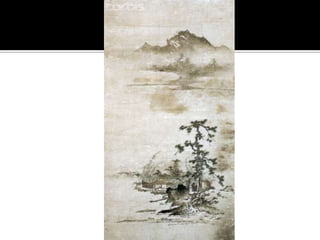
The foreground reveals rocky land that overlaps with spiky pine trees, a weathered rock, a poet seated, and a fence made of brushwood holding back a small garden of trees and bamboo.
The gray ink suggests distant fisherman
The top and bottom half echo off of each other.
In the middle is empty space, which is supposed to represent water. Landscape
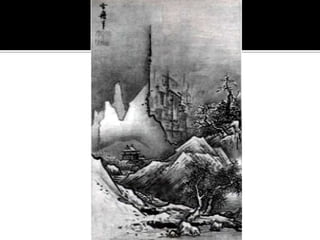
Sesshu (1420-1506)By the sixteenth century, temples staffed monks who specialized in art rather than religious or ritual teachingSesshu devoted himself to paintingWas inspired by Chinese scenery and Zen monasteriesPeaceful art was no longer possible and the violent energy of the time impacted landscape paintingThis new spit was especially evident in his Winter Landscape
Uses a forceful styleShort, jagged brushstrokes  create the rocky hillsA cliff coming from the mist seems to break the piece into twoFlat overlapping planes break the piece into clear facetsThe white of the paper in the bottom left is supposed to indicate snow, while the sky uses tones of gray. Winter Landscape
One of the most famous Zen masters in Japanese historyNow, Zen monks acted as government advisers, teachers, and leaders of merchant missions to China. Ikkyu mocked this “fake Zen”  and displayed the intensity of Zen through his calligraphy Ikkyu (1394-1481)
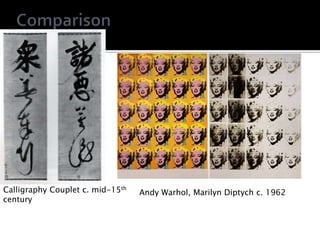
ComparisonCalligraphy Couplet c. mid-15th centuryAndy Warhol, Marilyn Diptych c. 1962
ComparisionBoth were not attached by a hinge and meant to be hung next to one anotherBoth made for a purposeThe couplet “Abjure, evil, practice only the good,” was written out on single line scrolls. The calligraphy is meant to be read starting with the right scroll and then the leftEach stroke is separate and distinctThe diptych 50 images is exactly the same and repeated The 25 images on the left hand side of the piece are all in black and white, providing a stark contrast to the bright colors of the other side.
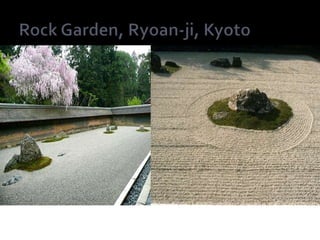
Zen monks saw their gardens as objects of constant vigilance and workThis philosophy influenced Japanese artKaresansui are dry landscape gardensThe main elements of karesansui are rocks and sand, with the sea symbolized by sand raked in patterns that suggest rippling water.The dry garden in the Zen temple of Ryoan-ji is one of the most renowned Zen creations n JapanThe Zen Dry Garden
Rock Garden, Ryoan-ji, Kyoto
Dates back to the mid-seventeenth centuryThe stones are set in asymmetrical groups of two, three, and fiveThe “borrowed scenery” is beyond the perimeter wall, and is made up of maple, pine, and cherry trees Is celebrated for its severity and emptinessThe austere beauty of the naked gravel allows people to meditate. Ryoan-ji
The Ashikaga’s power began to decline The daimyos began to fight for control over JapanUnity was gradually resorted by three warlordsThe first as Oda Nobunaga (1534-82)He invaded Kyoto in 1568, ending the Ashikaga’s authority. Was a patron of the arts and was assassinated on a military campaignMomoyama Period (1573–1615)
Toyotomi Hideyoshi (1537-98) succeeded him Was an overly ambitious military commanderBelieved he could conquer both Korea and ChinaTokugawa Ieyasu (1543-1616) emerged and established the shogunate in 1603.Was one of the most creative eras in Japanese history. Momoyama Period
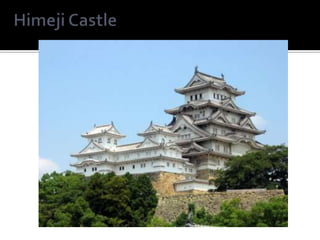
Europeans made an impact on JapanPortuguese explorers arrived in 1543and allowed to extend trade beyond the ports of KyushuEuropean muskets and cannons changed Japanese warfare and architectureMonumental castles were built in the late sixteenth centuryHimeji Castle is one of the most beautiful surviving castles todayThe castle had steep walls, stone ramparts, narrow fortified gates,  and narrow laddersMeant to confuse invaders and make them feel as though lost in a maze with little sense of direction or progressProvided artists opportunities to work on a grand scaleArchitecture
Himeji Castle
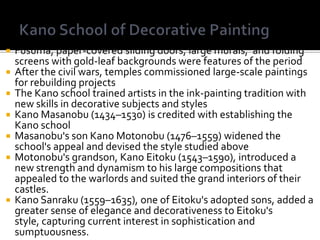
Kano School of Decorative PaintingFusuma, paper-covered sliding doors, large murals,  and folding screens with gold-leaf backgrounds were features of the periodAfter the civil wars, temples commissioned large-scale paintings for rebuilding projectsThe Kano school trained artists in the ink-painting tradition with new skills in decorative subjects and stylesKano Masanobu (1434–1530) is credited with establishing the Kano schoolMasanobu's son Kano Motonobu (1476–1559) widened the school's appeal and devised the style studied aboveMotonobu's grandson, Kano Eitoku (1543–1590), introduced a new strength and dynamism to his large compositions that appealed to the warlords and suited the grand interiors of their castles.Kano Sanraku (1559–1635), one of Eitoku's adopted sons, added a greater sense of elegance and decorativeness to Eitoku's style, capturing current interest in sophistication and sumptuousness.
Birds and Flowers of the Four Seasons
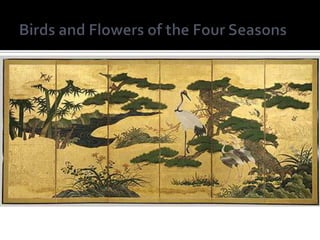
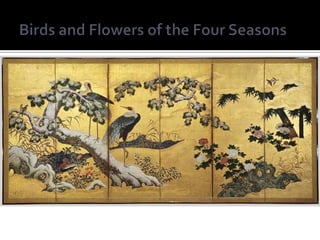
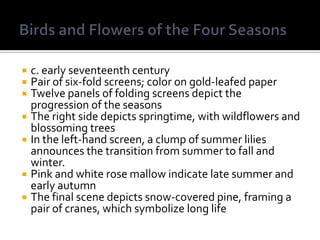
c. early seventeenth centuryPair of six-fold screens; color on gold-leafed paper Twelve panels of folding screens depict the progression of the seasons The right side depicts springtime, with wildflowers and blossoming treesIn the left-hand screen, a clump of summer lilies announces the transition from summer to fall and winter.Pink and white rose mallow indicate late summer and early autumnThe final scene depicts snow-covered pine, framing a pair of cranes, which symbolize long lifeBirds and Flowers of the Four Seasons
Tea CeremonyThe quiet, restrained, and the natural world was expressed through tea ceremoniesZen monks used tea as a mild stimulant to aid meditation, and as a form of medicineSen no Rikyu (1522-91) is the most famous tea master in Japanese history. He established the aesthetic of modesty, refinement, and rusticityThe tearoom allowed people to get a way from the chaotic and violent world outside.
Edo Period (1615-1868)1615 marks the rise of a new Shogun from the Tokugawa family.
 The capital is moved from Kyoto to Edo.
 Culture flourishes
 Reading and writing become widespread among all classes.
 Increased patronage of the arts
 New hierarchy; samurai officials, farmers, artisans, and merchants.
 Neo-Confucianism gains importance because of emphasis on loyalty to the state.
 Peaceful, though the government was rigid and oftentimes repressive.
By the mid 1630s Japan is isolated
Except for Nagasaki’s Dutch and Chinese trading communities.Edo Period1657 The Great Meireki Fire burns down most of Edo.
 100,000 people are killed.
 Rebuilt the city in a more intelligent manner, with special attention to the market district boosting the economy.
 Revival of Edo brings cultural growth and a distinctive character.
 1853 Isolationism of Japan ends, influx of trade.
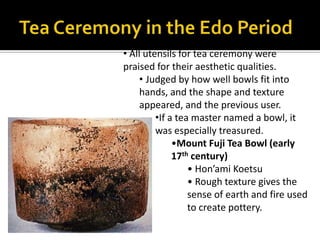
 Ends in 1868 with the Meiji Restoration Tea Ceremony in the Edo Period All utensils for tea ceremony were praised for their aesthetic qualities.
Judged by how well bowls fit into hands, and the shape and texture appeared, and the previous user.
If a tea master named a bowl, it was especially treasured.
Mount Fuji Tea Bowl (early 17th century)
Hon’amiKoetsu
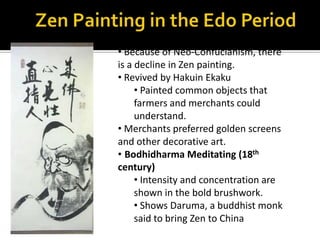
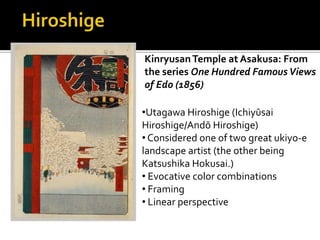
 Rough texture gives the sense of earth and fire used to create pottery.Zen Painting in the Edo Period Because of Neo-Confucianism, there is a decline in Zen painting.
 Revived by Hakuin Ekaku
 Painted common objects that farmers and merchants could understand.
 Merchants preferred golden screens and other decorative art.
Bodhidharma Meditating (18th century)
Intensity and concentration are shown in the bold brushwork.
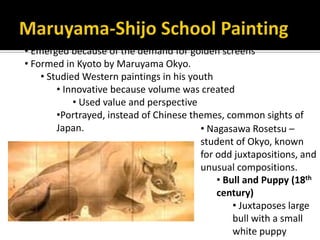
 Shows Daruma, a buddhist monk said to bring Zen to ChinaMaruyama-Shijo School Painting Emerged because of the demand for golden screens

Japanese art after 1392 (full)

  • 1.
    Japanese Art After1392By Christina Andrzejewski, Ashley Kosa,Xurong Liu
  • 2.
    Japanese PeriodsMuromachi Period(1392- 1573)Momoyama Period(1573–1615)Edo Period (1615-1868)The Meji and Modern Period (1868-present)
  • 3.
    Muromachi PeriodThe Ashikagafamily established a new military regime in KyotoDaimyo strongly influenced political events and cultural trendsRivalry caused tension, creating instability and leading to the Onin War (1467-77)War ended in a stalemate and with Hosowaka gaining control of the government Country plummeted into a century of warfare and social chaosSengoku, the Age of the Country at War, lasted from the last quarter of the fifteenth to the end of the sixteenth centuryOverall, economically and artistically innovativeContact with China transformed Japanese thought and aesthetics
  • 4.
    Period impacted byZen Buddhism It became the dominant cultural force in JapanInk monochrome painting became extremely popularThe intensity of the masters created a subtle and more refined approach to painting. Chinese style landscapes were the most important theme. Shubun (c. 1418-63) was Japans first great monk-artist who mastered ink landscapes. Muromachi Period
  • 6.
    The foreground revealsrocky land that overlaps with spiky pine trees, a weathered rock, a poet seated, and a fence made of brushwood holding back a small garden of trees and bamboo.
  • 7.
    The gray inksuggests distant fisherman
  • 8.
    The top andbottom half echo off of each other.
  • 9.
    In the middleis empty space, which is supposed to represent water. Landscape
  • 10.
    Sesshu (1420-1506)By thesixteenth century, temples staffed monks who specialized in art rather than religious or ritual teachingSesshu devoted himself to paintingWas inspired by Chinese scenery and Zen monasteriesPeaceful art was no longer possible and the violent energy of the time impacted landscape paintingThis new spit was especially evident in his Winter Landscape
  • 12.
    Uses a forcefulstyleShort, jagged brushstrokes create the rocky hillsA cliff coming from the mist seems to break the piece into twoFlat overlapping planes break the piece into clear facetsThe white of the paper in the bottom left is supposed to indicate snow, while the sky uses tones of gray. Winter Landscape
  • 13.
    One of themost famous Zen masters in Japanese historyNow, Zen monks acted as government advisers, teachers, and leaders of merchant missions to China. Ikkyu mocked this “fake Zen” and displayed the intensity of Zen through his calligraphy Ikkyu (1394-1481)
  • 14.
    ComparisonCalligraphy Couplet c.mid-15th centuryAndy Warhol, Marilyn Diptych c. 1962
  • 15.
    ComparisionBoth were notattached by a hinge and meant to be hung next to one anotherBoth made for a purposeThe couplet “Abjure, evil, practice only the good,” was written out on single line scrolls. The calligraphy is meant to be read starting with the right scroll and then the leftEach stroke is separate and distinctThe diptych 50 images is exactly the same and repeated The 25 images on the left hand side of the piece are all in black and white, providing a stark contrast to the bright colors of the other side.
  • 16.
    Zen monks sawtheir gardens as objects of constant vigilance and workThis philosophy influenced Japanese artKaresansui are dry landscape gardensThe main elements of karesansui are rocks and sand, with the sea symbolized by sand raked in patterns that suggest rippling water.The dry garden in the Zen temple of Ryoan-ji is one of the most renowned Zen creations n JapanThe Zen Dry Garden
  • 17.
  • 18.
    Dates back tothe mid-seventeenth centuryThe stones are set in asymmetrical groups of two, three, and fiveThe “borrowed scenery” is beyond the perimeter wall, and is made up of maple, pine, and cherry trees Is celebrated for its severity and emptinessThe austere beauty of the naked gravel allows people to meditate. Ryoan-ji
  • 19.
    The Ashikaga’s powerbegan to decline The daimyos began to fight for control over JapanUnity was gradually resorted by three warlordsThe first as Oda Nobunaga (1534-82)He invaded Kyoto in 1568, ending the Ashikaga’s authority. Was a patron of the arts and was assassinated on a military campaignMomoyama Period (1573–1615)
  • 20.
    Toyotomi Hideyoshi (1537-98)succeeded him Was an overly ambitious military commanderBelieved he could conquer both Korea and ChinaTokugawa Ieyasu (1543-1616) emerged and established the shogunate in 1603.Was one of the most creative eras in Japanese history. Momoyama Period
  • 21.
    Europeans made animpact on JapanPortuguese explorers arrived in 1543and allowed to extend trade beyond the ports of KyushuEuropean muskets and cannons changed Japanese warfare and architectureMonumental castles were built in the late sixteenth centuryHimeji Castle is one of the most beautiful surviving castles todayThe castle had steep walls, stone ramparts, narrow fortified gates, and narrow laddersMeant to confuse invaders and make them feel as though lost in a maze with little sense of direction or progressProvided artists opportunities to work on a grand scaleArchitecture
  • 22.
  • 23.
    Kano School ofDecorative PaintingFusuma, paper-covered sliding doors, large murals, and folding screens with gold-leaf backgrounds were features of the periodAfter the civil wars, temples commissioned large-scale paintings for rebuilding projectsThe Kano school trained artists in the ink-painting tradition with new skills in decorative subjects and stylesKano Masanobu (1434–1530) is credited with establishing the Kano schoolMasanobu's son Kano Motonobu (1476–1559) widened the school's appeal and devised the style studied aboveMotonobu's grandson, Kano Eitoku (1543–1590), introduced a new strength and dynamism to his large compositions that appealed to the warlords and suited the grand interiors of their castles.Kano Sanraku (1559–1635), one of Eitoku's adopted sons, added a greater sense of elegance and decorativeness to Eitoku's style, capturing current interest in sophistication and sumptuousness.
  • 24.
    Birds and Flowersof the Four Seasons
  • 25.
    Birds and Flowersof the Four Seasons
  • 26.
    c. early seventeenthcenturyPair of six-fold screens; color on gold-leafed paper Twelve panels of folding screens depict the progression of the seasons The right side depicts springtime, with wildflowers and blossoming treesIn the left-hand screen, a clump of summer lilies announces the transition from summer to fall and winter.Pink and white rose mallow indicate late summer and early autumnThe final scene depicts snow-covered pine, framing a pair of cranes, which symbolize long lifeBirds and Flowers of the Four Seasons
  • 27.
    Tea CeremonyThe quiet,restrained, and the natural world was expressed through tea ceremoniesZen monks used tea as a mild stimulant to aid meditation, and as a form of medicineSen no Rikyu (1522-91) is the most famous tea master in Japanese history. He established the aesthetic of modesty, refinement, and rusticityThe tearoom allowed people to get a way from the chaotic and violent world outside.
  • 28.
    Edo Period (1615-1868)1615marks the rise of a new Shogun from the Tokugawa family.
  • 29.
    The capitalis moved from Kyoto to Edo.
  • 30.
  • 31.
    Reading andwriting become widespread among all classes.
  • 32.
  • 33.
    New hierarchy;samurai officials, farmers, artisans, and merchants.
  • 34.
    Neo-Confucianism gainsimportance because of emphasis on loyalty to the state.
  • 35.
    Peaceful, thoughthe government was rigid and oftentimes repressive.
  • 36.
    By the mid1630s Japan is isolated
  • 37.
    Except for Nagasaki’sDutch and Chinese trading communities.Edo Period1657 The Great Meireki Fire burns down most of Edo.
  • 38.
    100,000 peopleare killed.
  • 39.
    Rebuilt thecity in a more intelligent manner, with special attention to the market district boosting the economy.
  • 40.
    Revival ofEdo brings cultural growth and a distinctive character.
  • 41.
    1853 Isolationismof Japan ends, influx of trade.
  • 42.
    Ends in1868 with the Meiji Restoration Tea Ceremony in the Edo Period All utensils for tea ceremony were praised for their aesthetic qualities.
  • 43.
    Judged by howwell bowls fit into hands, and the shape and texture appeared, and the previous user.
  • 44.
    If a teamaster named a bowl, it was especially treasured.
  • 45.
    Mount Fuji TeaBowl (early 17th century)
  • 46.
  • 47.
    Rough texturegives the sense of earth and fire used to create pottery.Zen Painting in the Edo Period Because of Neo-Confucianism, there is a decline in Zen painting.
  • 48.
    Revived byHakuin Ekaku
  • 49.
    Painted commonobjects that farmers and merchants could understand.
  • 50.
    Merchants preferredgolden screens and other decorative art.
  • 51.
  • 52.
    Intensity and concentrationare shown in the bold brushwork.
  • 53.
    Shows Daruma,a buddhist monk said to bring Zen to ChinaMaruyama-Shijo School Painting Emerged because of the demand for golden screens