 Radio-frequency identification (RFID) is an 
automatic identification method, relying on storing 
and remotely retrieving data using devices called 
RFID tags or transponders. The technology 
requires some extent of cooperation of an RFID 
reader and an RFID tag. 
 An RFID tag is an object that can be applied to or 
incorporated into a product, animal, or person for 
the purpose of identification and tracking using 
radio waves. Some tags can be read from several 
meters away and beyond the line of sight of the 
reader.
 A basic RFID system consist of three components: 
An antenna or coil -: The antenna emits radio signals to 
activate the tag and read and write data to it. Antennas are 
the conduits between the tag and the transceiver, which 
controls the system's data acquisition and communication. 
A transceiver (with decoder) -: The RF transceiver is the source 
of the RF energy used to activate and power the passive RFID 
tags. The RF transceiver controls and modulates the radio 
frequencies that the antenna transmits and receives. The 
transceiver filters and amplifies the backscatter signal from a 
passive RFID tag. 
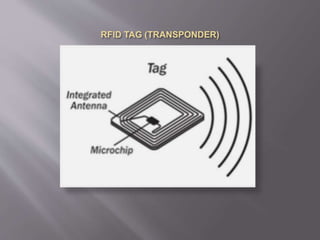
A transponder (RF tag): An RFID tag is comprised of a 
microchip containing identifying information and an antenna that 
transmits this data wirelessly to a reader. E.G.-: MAC Address, 
unique bluetooth addresses in devices.
 RFID full form being Radio Frequency identification 
was first used in 1940’s to identify aeroplanes mainly 
for military application. Like planes of allies or enemies 
 Modern applications being identification of electronic 
devices 
 In wireless sensors laptops in mobile phones having a 
unique MAC (Media Access Control) address 
 In Bluetooth Devices as we have a different bluetooth 
address for different devices leading to ease of 
identification. 
 IMEI(International Mobile Station Equipment Identity) 
Indentification 
 Student ID Card, Implemented in Indentifcation Cards 
for corporations(Through RFID card Reader)
 RFID is a very useful technology in automation 
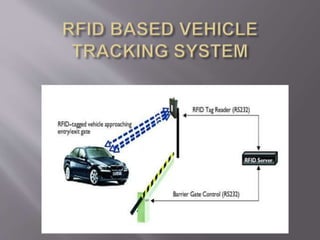
of Car Tracking System in a Mall/Building. It 
will automatically deduct the amount from the 
RFID tag of vehicle owner and open the door 
for parking and increment the counter of 
parking. Similarly it will open the door on exit 
and decrement the parking counter. It will also 
provide the security besides automation of 
parking through RFID technology.
 Switch On device 
 LCD Display uses Car Tracking System 
 Microcontroller- ATMEGA 16  16 bit 
Microconroller 
 D.C. Motor- For opening Closing Gate in the 
clockwise and anticlockwise directions 
 Buzzer-To check validity of RFID card 
 Switches– To enter the amount
MICROCONTROLLER 
RFID READER 
LCD 
BUZZER 
KEYPAD 
PC INTERFACING 
(OPTIONAL) 
RFID CARD 
BLOCK DIAGRAM FOR THE PROJECT MODULE
 The circuitry will consist 
of 4 switches 1 for reset 
another three for different 
amounts 
 Amount is entered 
through switches. 
 It will consist of RFID card 
reader different vehicles 
will have different RFID 
identification codes. And 
get activated when is read 
by the RFID reader. 
 LCD shown will display 
the amount deducted
 The circuitry will consist of 4 switches  1 for reset another three for 
different amounts 
 Power Supply 
 2 pin connector- 4 diodes bridge rectifier 1 on off switch 
 A capacitor of 1000 microfarad 
 Voltage regulator 5 v and 12 v 
 Crystal oscillator connected to micro controller provides clock frequency 
 L293D motor driver IC 
 connected to microcontroller and output is connected to DC MOTOR 
 It will consist of RFID card reader different vehicles will have different 
RFID identification codes. And get activated when is read by the RFID 
reader.
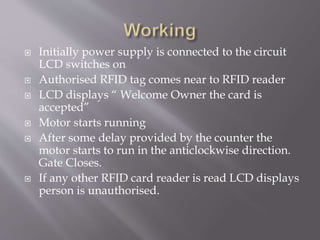
 Initially power supply is connected to the circuit 
LCD switches on 
 Authorised RFID tag comes near to RFID reader 
 LCD displays “ Welcome Owner the card is 
accepted” 
 Motor starts running 
 After some delay provided by the counter the 
motor starts to run in the anticlockwise direction. 
Gate Closes. 
 If any other RFID card reader is read LCD displays 
person is unauthorised.
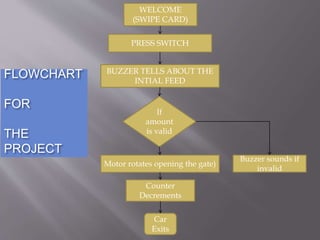
WELCOME 
(SWIPE CARD) 
PRESS SWITCH 
BUZZER TELLS ABOUT THE 
INTIAL FEED 
If 
amount 
is valid 
Motor rotates opening the gate) 
Buzzer sounds if 
invalid 
Counter 
Decrements 
Car 
Exits 
FLOWCHART 
FOR 
THE 
PROJECT
 No "line of sight" requirements: Bar code reads can sometimes be 
limited or problematic due to the need to have a direct "line of 
sight" between a scanner and a bar code. RFID tags can be read 
through materials without line of sight. 
 More automated reading: RFID tags can be read automatically 
when a tagged product comes past or near a reader, reducing the 
labor required to scan product and allowing more proactive, real-time 
tracking. 
 Improved read rates: RFID tags ultimately offer the promise of 
higher read rates than bar codes, especially in high- speed 
operations such as carton sortation. 
 Greater data capacity: RFID tags can be easily encoded with item 
details such as lot and batch, weight, etc. 
 "Write" capabilities: Because RFID tags can be rewritten with new 
data as supply chain activities are completed, tagged products 
carry updated information as they move throughout the supply 
chain.
 Some common problems with RFID are reader 
collision and tag collision. Reader collision 
occurs when the signals from two or more 
readers overlap. The tag is unable to respond to 
simultaneous queries. Systems must be 
carefully set up to avoid this problem. Tag 
collision occurs when many tags are present in 
a small area; but since the read time is very 
fast, it is easier for vendors to develop systems 
that ensure that tags respond one at a time.
 Epcglobal inc., EPC radio-frequency identity protocols class-1 generation- 
2 UHF RFID protocol for communications at 860 MHz – 960 MHz, version 
1.0.9. Online, September 2005. 
http://www.epcglobalinc.org/standards_technology/ 
EPCglobal2UHFRFIDProtocolV109122005.pdf. 
 CCC-TV lightning talks day 1. Online, 2005. 
http://media.ccc.de/browse/ congress/2005/22C3-911-en-lightning_ 
talk_day_1.html. 
 J. H. Conway. On Numbers and Games. Academic Press, 1976. 
 Y. Desmedt, C. Goutier, and S. Bengio. Special uses and abuses of the 
Fiat-Shamir passport protocol. In CRYPTO, pages 21–39, 1987. 
 B. Dolev. Laying the groundwork for electronic elections in Israel (in 
Hebrew). Invited Talk, CPIIS IDC/TAU Workshop on Electronic Voting, 
May 2009. http: //www.cs.tau.ac.il/voting/. 
 S. Drimer and S. J. Murdoch. Keep your enemies close: distance bounding 
against smartcard relay attacks. In Proceedings of 16th USENIX Security 
Symposium, pages 1–16, Boston,
RFID BASED VEHICLE TRACKING SYSTEM

RFID BASED VEHICLE TRACKING SYSTEM

  • 2.
     Radio-frequency identification(RFID) is an automatic identification method, relying on storing and remotely retrieving data using devices called RFID tags or transponders. The technology requires some extent of cooperation of an RFID reader and an RFID tag.  An RFID tag is an object that can be applied to or incorporated into a product, animal, or person for the purpose of identification and tracking using radio waves. Some tags can be read from several meters away and beyond the line of sight of the reader.
  • 3.
     A basicRFID system consist of three components: An antenna or coil -: The antenna emits radio signals to activate the tag and read and write data to it. Antennas are the conduits between the tag and the transceiver, which controls the system's data acquisition and communication. A transceiver (with decoder) -: The RF transceiver is the source of the RF energy used to activate and power the passive RFID tags. The RF transceiver controls and modulates the radio frequencies that the antenna transmits and receives. The transceiver filters and amplifies the backscatter signal from a passive RFID tag. A transponder (RF tag): An RFID tag is comprised of a microchip containing identifying information and an antenna that transmits this data wirelessly to a reader. E.G.-: MAC Address, unique bluetooth addresses in devices.
  • 7.
     RFID fullform being Radio Frequency identification was first used in 1940’s to identify aeroplanes mainly for military application. Like planes of allies or enemies  Modern applications being identification of electronic devices  In wireless sensors laptops in mobile phones having a unique MAC (Media Access Control) address  In Bluetooth Devices as we have a different bluetooth address for different devices leading to ease of identification.  IMEI(International Mobile Station Equipment Identity) Indentification  Student ID Card, Implemented in Indentifcation Cards for corporations(Through RFID card Reader)
  • 8.
     RFID isa very useful technology in automation of Car Tracking System in a Mall/Building. It will automatically deduct the amount from the RFID tag of vehicle owner and open the door for parking and increment the counter of parking. Similarly it will open the door on exit and decrement the parking counter. It will also provide the security besides automation of parking through RFID technology.
  • 9.
     Switch Ondevice  LCD Display uses Car Tracking System  Microcontroller- ATMEGA 16  16 bit Microconroller  D.C. Motor- For opening Closing Gate in the clockwise and anticlockwise directions  Buzzer-To check validity of RFID card  Switches– To enter the amount
  • 10.
    MICROCONTROLLER RFID READER LCD BUZZER KEYPAD PC INTERFACING (OPTIONAL) RFID CARD BLOCK DIAGRAM FOR THE PROJECT MODULE
  • 11.
     The circuitrywill consist of 4 switches 1 for reset another three for different amounts  Amount is entered through switches.  It will consist of RFID card reader different vehicles will have different RFID identification codes. And get activated when is read by the RFID reader.  LCD shown will display the amount deducted
  • 12.
     The circuitrywill consist of 4 switches  1 for reset another three for different amounts  Power Supply  2 pin connector- 4 diodes bridge rectifier 1 on off switch  A capacitor of 1000 microfarad  Voltage regulator 5 v and 12 v  Crystal oscillator connected to micro controller provides clock frequency  L293D motor driver IC  connected to microcontroller and output is connected to DC MOTOR  It will consist of RFID card reader different vehicles will have different RFID identification codes. And get activated when is read by the RFID reader.
  • 13.
     Initially powersupply is connected to the circuit LCD switches on  Authorised RFID tag comes near to RFID reader  LCD displays “ Welcome Owner the card is accepted”  Motor starts running  After some delay provided by the counter the motor starts to run in the anticlockwise direction. Gate Closes.  If any other RFID card reader is read LCD displays person is unauthorised.
  • 14.
    WELCOME (SWIPE CARD) PRESS SWITCH BUZZER TELLS ABOUT THE INTIAL FEED If amount is valid Motor rotates opening the gate) Buzzer sounds if invalid Counter Decrements Car Exits FLOWCHART FOR THE PROJECT
  • 15.
     No "lineof sight" requirements: Bar code reads can sometimes be limited or problematic due to the need to have a direct "line of sight" between a scanner and a bar code. RFID tags can be read through materials without line of sight.  More automated reading: RFID tags can be read automatically when a tagged product comes past or near a reader, reducing the labor required to scan product and allowing more proactive, real-time tracking.  Improved read rates: RFID tags ultimately offer the promise of higher read rates than bar codes, especially in high- speed operations such as carton sortation.  Greater data capacity: RFID tags can be easily encoded with item details such as lot and batch, weight, etc.  "Write" capabilities: Because RFID tags can be rewritten with new data as supply chain activities are completed, tagged products carry updated information as they move throughout the supply chain.
  • 16.
     Some commonproblems with RFID are reader collision and tag collision. Reader collision occurs when the signals from two or more readers overlap. The tag is unable to respond to simultaneous queries. Systems must be carefully set up to avoid this problem. Tag collision occurs when many tags are present in a small area; but since the read time is very fast, it is easier for vendors to develop systems that ensure that tags respond one at a time.
  • 17.
     Epcglobal inc.,EPC radio-frequency identity protocols class-1 generation- 2 UHF RFID protocol for communications at 860 MHz – 960 MHz, version 1.0.9. Online, September 2005. http://www.epcglobalinc.org/standards_technology/ EPCglobal2UHFRFIDProtocolV109122005.pdf.  CCC-TV lightning talks day 1. Online, 2005. http://media.ccc.de/browse/ congress/2005/22C3-911-en-lightning_ talk_day_1.html.  J. H. Conway. On Numbers and Games. Academic Press, 1976.  Y. Desmedt, C. Goutier, and S. Bengio. Special uses and abuses of the Fiat-Shamir passport protocol. In CRYPTO, pages 21–39, 1987.  B. Dolev. Laying the groundwork for electronic elections in Israel (in Hebrew). Invited Talk, CPIIS IDC/TAU Workshop on Electronic Voting, May 2009. http: //www.cs.tau.ac.il/voting/.  S. Drimer and S. J. Murdoch. Keep your enemies close: distance bounding against smartcard relay attacks. In Proceedings of 16th USENIX Security Symposium, pages 1–16, Boston,