A Presentation on project 
“Vehicle Tracking System Using 
GPS and GSM” 
1 9/22/2014
Outline: 
1. Introduction 
2. Hardware Components 
Laxmi 
3.Hardware Programming Algorithm 
4.User Interface 
Anit 
a 
Ras 
mi 
Ras 
u 
2 9/22/2014
1. INTRODUCTION 
1.1 Problem Statements 
1.2 Introduction 
1.3 Scope and Possible Application 
1.4 Objective 
1.5 System Overview 
3 9/22/2014
1.1 Problem statements 
Unsystematic Transportation Management 
Unmanaged Public Vehicle arrival time at bus 
stations. 
4 9/22/2014
1.2 Introduction 
 “Intelligent Transportation System” 
 Automated system 
 a tracking system for vehicle 
 uses GPS/GSM for tracking 
 determines precise location of a vehicle . 
 Uses tracking server to store data 
 Includes notice board to display current location of vehicle 
 Provides user interface like web and android application 
5 9/22/2014
1.3 Scope and Possible 
Applications 
 Accurate vehicle tracking 
 Systematic transportation management 
 Animal tracking 
 Security purpose 
 Implementation with Sajha Yatayat 
6 9/22/2014
1.4 Objective 
 To develop vehicular tracking system to monitor and 
manage a public transportation system 
 To provide commuters with exact location and estimated 
schedule of buses through notification board at bus stops or 
more conveniently through a website and an android 
application. 
7 9/22/2014
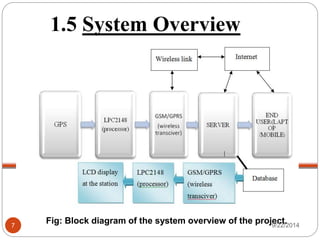
1.5 System Overview 
Fig: Block diagram of the system overview of the project. 
8 9/22/2014
2. Hardware Components 
2.1 GPS 
2.2 GSM 
2.3 NXP LPC 2148 
2.4 UART 
2.5 System Hardware 
9 9/22/2014
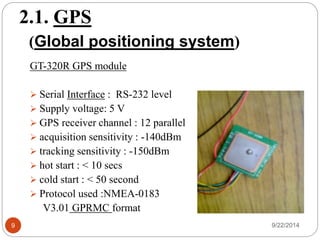
2.1. GPS 
(Global positioning system) 
GT-320R GPS module 
 Serial Interface : RS-232 level 
 Supply voltage: 5 V 
 GPS receiver channel : 12 parallel 
 acquisition sensitivity : -140dBm 
 tracking sensitivity : -150dBm 
 hot start : < 10 secs 
 cold start : < 50 second 
 Protocol used :NMEA-0183 
V3.01 GPRMC format 
10 9/22/2014
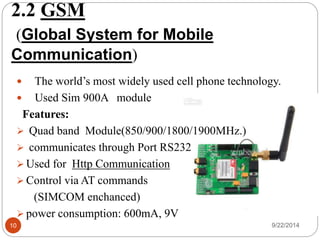
2.2 GSM 
(Global System for Mobile 
Communication) 
 The world’s most widely used cell phone technology. 
 Used Sim 900A module 
Features: 
 Quad band Module(850/900/1800/1900MHz.) 
 communicates through Port RS232 
 Used for Http Communication 
 Control via AT commands 
(SIMCOM enchanced) 
 power consumption: 600mA, 9V 
11 9/22/2014
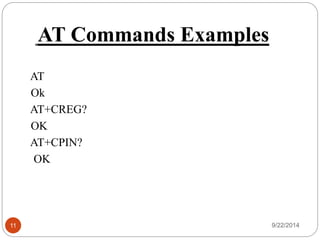
AT Commands Examples 
AT 
Ok 
AT+CREG? 
OK 
AT+CPIN? 
OK 
12 9/22/2014
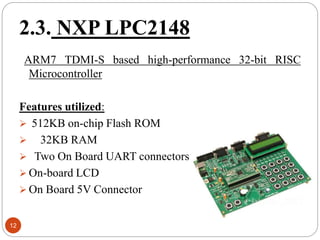
2.3. NXP LPC2148 
ARM7 TDMI-S based high-performance 32-bit RISC 
Microcontroller 
Features utilized: 
 512KB on-chip Flash ROM 
 32KB RAM 
 Two On Board UART connectors 
 On-board LCD 
 On Board 5V Connector 
13 9/22/2014
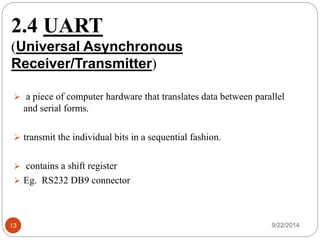
2.4 UART 
(Universal Asynchronous 
Receiver/Transmitter) 
 a piece of computer hardware that translates data between parallel 
and serial forms. 
 transmit the individual bits in a sequential fashion. 
 contains a shift register 
 Eg. RS232 DB9 connector 
14 9/22/2014
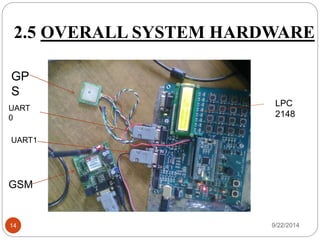
2.5 OVERALL SYSTEM HARDWARE 
GP 
S 
UART 
0 
UART1 
GSM 
LPC 
2148 
15 9/22/2014
3. Hardware Programming 
Algorithm 
3.1 Vehicle Tracking System 
3.2 Route Display Notice Board 
16 9/22/2014
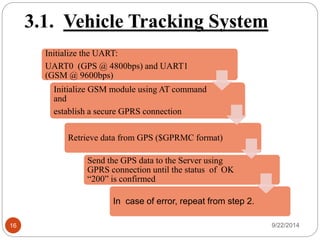
3.1. Vehicle Tracking System 
Initialize the UART: 
UART0 (GPS @ 4800bps) and UART1 
(GSM @ 9600bps) 
Initialize GSM module using AT command 
and 
establish a secure GPRS connection 
Retrieve data from GPS ($GPRMC format) 
Send the GPS data to the Server using 
GPRS connection until the status of OK 
“200” is confirmed 
In case of error, repeat from step 2. 
17 9/22/2014
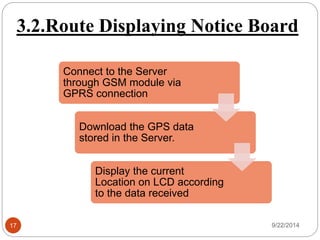
3.2.Route Displaying Notice Board 
Connect to the Server 
through GSM module via 
GPRS connection 
Download the GPS data 
stored in the Server. 
Display the current 
Location on LCD according 
to the data received 
18 9/22/2014
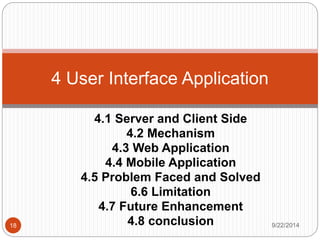
4 User Interface Application 
4.1 Server and Client Side 
4.2 Mechanism 
4.3 Web Application 
4.4 Mobile Application 
4.5 Problem Faced and Solved 
6.6 Limitation 
4.7 Future Enhancement 
19 4.8 conclusion 9/22/2014
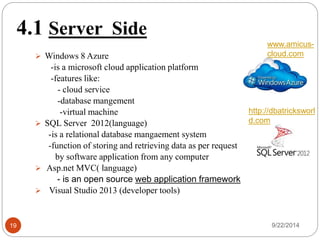
4.1 Server Side 
 Windows 8 Azure 
-is a microsoft cloud application platform 
-features like: 
- cloud service 
-database mangement 
-virtual machine 
 SQL Server 2012(language) 
-is a relational database mangaement system 
-function of storing and retrieving data as per request 
by software application from any computer 
 Asp.net MVC( language) 
- is an open source web application framework 
 Visual Studio 2013 (developer tools) 
www.amicus-cloud. 
com 
http://dbatricksworl 
d.com 
20 9/22/2014
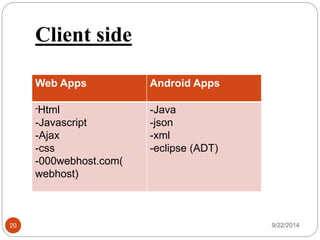
Client side 
Web Apps Android Apps 
-Html 
-Javascript 
-Ajax 
-css 
-000webhost.com( 
webhost) 
-Java 
-json 
-xml 
-eclipse (ADT) 
21 9/22/2014
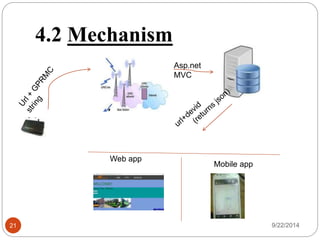
4.2 Mechanism 
Asp.net 
MVC 
Web app 
Mobile app 
22 9/22/2014
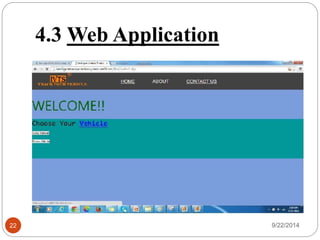
4.3 Web Application 
23 9/22/2014
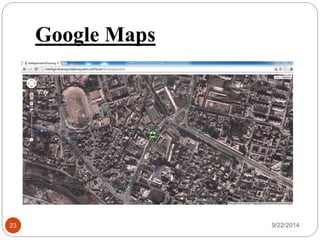
Google Maps 
24 9/22/2014
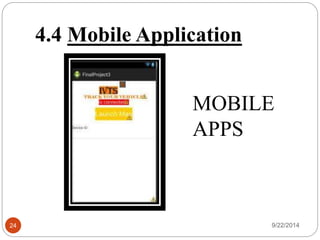
4.4 Mobile Application 
MOBILE 
APPS 
25 9/22/2014
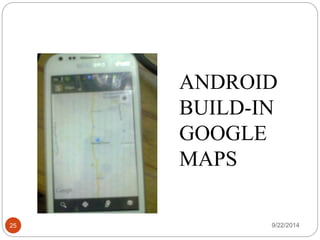
ANDROID 
BUILD-IN 
GOOGLE 
MAPS 
26 9/22/2014
4.5 Problem Faced and Solved 
 The GPS module returned garbage data in initial days 
-solved by frequent powering gps module. 
 Connecting to the Server through GPRS due to network 
errors. 
-solved by placing module to open area 
 Frequent Failure Connecting to database (@webhost.com) 
- solved by moving database to Windows 8 
Azure cloud. 
 Uncomplete data display at LCD (sometimes) 
- by reseting microcontroller 
27 9/22/2014
4.6 limitation 
 Android application has to be refreshed each time as it 
receives new data from the server. 
 Due to network problem, people might face problem 
on their internet access due to which this service may 
get halt. 
28 9/22/2014
4.7 Scope and Future Enhancement 
Notice board with audio speakers for visually 
impaired and uneducated people. 
 Departed and Arrival time can be displayed at 
station. 
 Improvement in Android Application for 
continuous data refreshing. 
29 9/22/2014
Recommendation and Conclusion 
30 9/22/2014
References 
 [1] B. C. B. S. Anil Gaire, "GPS GSM Integration for Enhancing Public 
Transportation System," Lalitpur, 2013. 
 [2] D. S. W. Andrew Sloss, ARM System Developer's Guide, San 
Francisco: Morgan Kaufmann, March 2004. pg. 103-155 
 
 [3] E. H. H. J. Xiaoya Guo, "Design a Smart Bus System," [Online]. 
Available: http://www.ece.uvic.ca/~bhung/399/minutes/Final_Report.pdf. 
[Accessed 20 february 2014]. 
 [4] G. Developers, "Android Application Development.," [Online]. 
Available: http://developer.android.com/training/index.html. [Accessed 
20 july 2014]. 
 [5] "Manual of Board ET-BASE GSM SIM900," [Online]. Available: 
http://www.etteam.com. [Accessed 6 june 2014]. 
 [6] P. K. R. C. Bikash Poudel, "A Training M anual on FPGA and ARM," 
kathmandu. 
31 9/22/2014

Vehicle tracking system using gps and gsm

  • 1.
    A Presentation onproject “Vehicle Tracking System Using GPS and GSM” 1 9/22/2014
  • 2.
    Outline: 1. Introduction 2. Hardware Components Laxmi 3.Hardware Programming Algorithm 4.User Interface Anit a Ras mi Ras u 2 9/22/2014
  • 3.
    1. INTRODUCTION 1.1Problem Statements 1.2 Introduction 1.3 Scope and Possible Application 1.4 Objective 1.5 System Overview 3 9/22/2014
  • 4.
    1.1 Problem statements Unsystematic Transportation Management Unmanaged Public Vehicle arrival time at bus stations. 4 9/22/2014
  • 5.
    1.2 Introduction “Intelligent Transportation System”  Automated system  a tracking system for vehicle  uses GPS/GSM for tracking  determines precise location of a vehicle .  Uses tracking server to store data  Includes notice board to display current location of vehicle  Provides user interface like web and android application 5 9/22/2014
  • 6.
    1.3 Scope andPossible Applications  Accurate vehicle tracking  Systematic transportation management  Animal tracking  Security purpose  Implementation with Sajha Yatayat 6 9/22/2014
  • 7.
    1.4 Objective To develop vehicular tracking system to monitor and manage a public transportation system  To provide commuters with exact location and estimated schedule of buses through notification board at bus stops or more conveniently through a website and an android application. 7 9/22/2014
  • 8.
    1.5 System Overview Fig: Block diagram of the system overview of the project. 8 9/22/2014
  • 9.
    2. Hardware Components 2.1 GPS 2.2 GSM 2.3 NXP LPC 2148 2.4 UART 2.5 System Hardware 9 9/22/2014
  • 10.
    2.1. GPS (Globalpositioning system) GT-320R GPS module  Serial Interface : RS-232 level  Supply voltage: 5 V  GPS receiver channel : 12 parallel  acquisition sensitivity : -140dBm  tracking sensitivity : -150dBm  hot start : < 10 secs  cold start : < 50 second  Protocol used :NMEA-0183 V3.01 GPRMC format 10 9/22/2014
  • 11.
    2.2 GSM (GlobalSystem for Mobile Communication)  The world’s most widely used cell phone technology.  Used Sim 900A module Features:  Quad band Module(850/900/1800/1900MHz.)  communicates through Port RS232  Used for Http Communication  Control via AT commands (SIMCOM enchanced)  power consumption: 600mA, 9V 11 9/22/2014
  • 12.
    AT Commands Examples AT Ok AT+CREG? OK AT+CPIN? OK 12 9/22/2014
  • 13.
    2.3. NXP LPC2148 ARM7 TDMI-S based high-performance 32-bit RISC Microcontroller Features utilized:  512KB on-chip Flash ROM  32KB RAM  Two On Board UART connectors  On-board LCD  On Board 5V Connector 13 9/22/2014
  • 14.
    2.4 UART (UniversalAsynchronous Receiver/Transmitter)  a piece of computer hardware that translates data between parallel and serial forms.  transmit the individual bits in a sequential fashion.  contains a shift register  Eg. RS232 DB9 connector 14 9/22/2014
  • 15.
    2.5 OVERALL SYSTEMHARDWARE GP S UART 0 UART1 GSM LPC 2148 15 9/22/2014
  • 16.
    3. Hardware Programming Algorithm 3.1 Vehicle Tracking System 3.2 Route Display Notice Board 16 9/22/2014
  • 17.
    3.1. Vehicle TrackingSystem Initialize the UART: UART0 (GPS @ 4800bps) and UART1 (GSM @ 9600bps) Initialize GSM module using AT command and establish a secure GPRS connection Retrieve data from GPS ($GPRMC format) Send the GPS data to the Server using GPRS connection until the status of OK “200” is confirmed In case of error, repeat from step 2. 17 9/22/2014
  • 18.
    3.2.Route Displaying NoticeBoard Connect to the Server through GSM module via GPRS connection Download the GPS data stored in the Server. Display the current Location on LCD according to the data received 18 9/22/2014
  • 19.
    4 User InterfaceApplication 4.1 Server and Client Side 4.2 Mechanism 4.3 Web Application 4.4 Mobile Application 4.5 Problem Faced and Solved 6.6 Limitation 4.7 Future Enhancement 19 4.8 conclusion 9/22/2014
  • 20.
    4.1 Server Side  Windows 8 Azure -is a microsoft cloud application platform -features like: - cloud service -database mangement -virtual machine  SQL Server 2012(language) -is a relational database mangaement system -function of storing and retrieving data as per request by software application from any computer  Asp.net MVC( language) - is an open source web application framework  Visual Studio 2013 (developer tools) www.amicus-cloud. com http://dbatricksworl d.com 20 9/22/2014
  • 21.
    Client side WebApps Android Apps -Html -Javascript -Ajax -css -000webhost.com( webhost) -Java -json -xml -eclipse (ADT) 21 9/22/2014
  • 22.
    4.2 Mechanism Asp.net MVC Web app Mobile app 22 9/22/2014
  • 23.
    4.3 Web Application 23 9/22/2014
  • 24.
    Google Maps 249/22/2014
  • 25.
    4.4 Mobile Application MOBILE APPS 25 9/22/2014
  • 26.
    ANDROID BUILD-IN GOOGLE MAPS 26 9/22/2014
  • 27.
    4.5 Problem Facedand Solved  The GPS module returned garbage data in initial days -solved by frequent powering gps module.  Connecting to the Server through GPRS due to network errors. -solved by placing module to open area  Frequent Failure Connecting to database (@webhost.com) - solved by moving database to Windows 8 Azure cloud.  Uncomplete data display at LCD (sometimes) - by reseting microcontroller 27 9/22/2014
  • 28.
    4.6 limitation Android application has to be refreshed each time as it receives new data from the server.  Due to network problem, people might face problem on their internet access due to which this service may get halt. 28 9/22/2014
  • 29.
    4.7 Scope andFuture Enhancement Notice board with audio speakers for visually impaired and uneducated people.  Departed and Arrival time can be displayed at station.  Improvement in Android Application for continuous data refreshing. 29 9/22/2014
  • 30.
  • 31.
    References  [1]B. C. B. S. Anil Gaire, "GPS GSM Integration for Enhancing Public Transportation System," Lalitpur, 2013.  [2] D. S. W. Andrew Sloss, ARM System Developer's Guide, San Francisco: Morgan Kaufmann, March 2004. pg. 103-155   [3] E. H. H. J. Xiaoya Guo, "Design a Smart Bus System," [Online]. Available: http://www.ece.uvic.ca/~bhung/399/minutes/Final_Report.pdf. [Accessed 20 february 2014].  [4] G. Developers, "Android Application Development.," [Online]. Available: http://developer.android.com/training/index.html. [Accessed 20 july 2014].  [5] "Manual of Board ET-BASE GSM SIM900," [Online]. Available: http://www.etteam.com. [Accessed 6 june 2014].  [6] P. K. R. C. Bikash Poudel, "A Training M anual on FPGA and ARM," kathmandu. 31 9/22/2014