L.D. College of Engineering
Tilak Parmar - 130280111065
Pranav Veerani - 130280111117
Guided By:
Prof. Abhay B. Upadhyay
Problem Summary
Barcode Scanner Pushing Heavy Trolleys
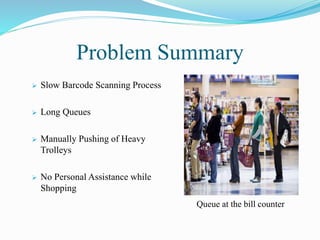
Problem Summary
 Slow Barcode Scanning Process
 Long Queues
 Manually Pushing of Heavy
Trolleys
 No Personal Assistance while
Shopping
Queue at the bill counter
Purpose
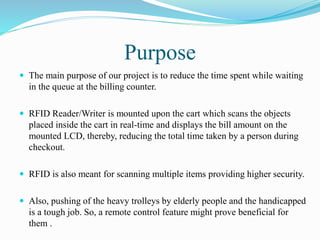
 The main purpose of our project is to reduce the time spent while waiting
in the queue at the billing counter.
 RFID Reader/Writer is mounted upon the cart which scans the objects
placed inside the cart in real-time and displays the bill amount on the
mounted LCD, thereby, reducing the total time taken by a person during
checkout.
 RFID is also meant for scanning multiple items providing higher security.
 Also, pushing of the heavy trolleys by elderly people and the handicapped
is a tough job. So, a remote control feature might prove beneficial for
them .
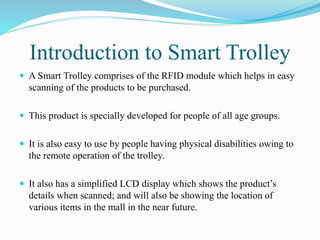
Introduction to Smart Trolley
 A Smart Trolley comprises of the RFID module which helps in easy
scanning of the products to be purchased.
 This product is specially developed for people of all age groups.
 It is also easy to use by people having physical disabilities owing to
the remote operation of the trolley.
 It also has a simplified LCD display which shows the product’s
details when scanned; and will also be showing the location of
various items in the mall in the near future.
Main Components
 RFID Module (Radio Frequency Identification Device)
 RFID Tags
 Microcontroller (ATMega32)
 RF Module (TX/RX)
 Encoder/Decoder
 LCD display
 Motor Driver
 DC motors
Main Components
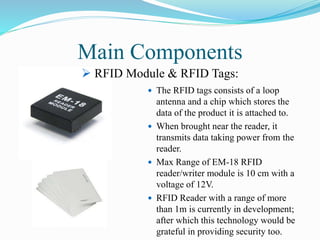
 The RFID tags consists of a loop
antenna and a chip which stores the
data of the product it is attached to.
 When brought near the reader, it
transmits data taking power from the
reader.
 Max Range of EM-18 RFID
reader/writer module is 10 cm with a
voltage of 12V.
 RFID Reader with a range of more
than 1m is currently in development;
after which this technology would be
grateful in providing security too.
 RFID Module & RFID Tags:
Main Components
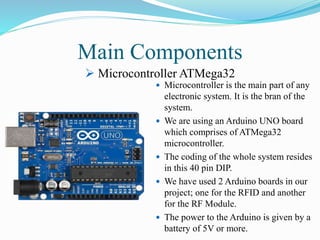
 Microcontroller is the main part of any
electronic system. It is the bran of the
system.
 We are using an Arduino UNO board
which comprises of ATMega32
microcontroller.
 The coding of the whole system resides
in this 40 pin DIP.
 We have used 2 Arduino boards in our
project; one for the RFID and another
for the RF Module.
 The power to the Arduino is given by a
battery of 5V or more.
 Microcontroller ATMega32
Main Components
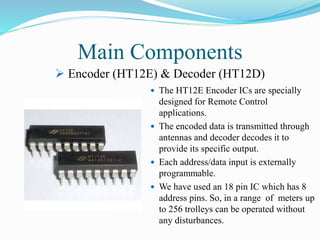
 The HT12E Encoder ICs are specially
designed for Remote Control
applications.
 The encoded data is transmitted through
antennas and decoder decodes it to
provide its specific output.
 Each address/data input is externally
programmable.
 We have used an 18 pin IC which has 8
address pins. So, in a range of meters up
to 256 trolleys can be operated without
any disturbances.
 Encoder (HT12E) & Decoder (HT12D)
Main Components
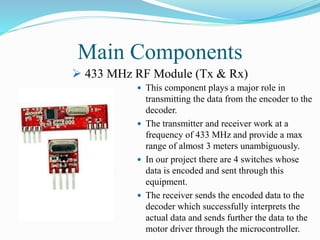
 This component plays a major role in
transmitting the data from the encoder to the
decoder.
 The transmitter and receiver work at a
frequency of 433 MHz and provide a max
range of almost 3 meters unambiguously.
 In our project there are 4 switches whose
data is encoded and sent through this
equipment.
 The receiver sends the encoded data to the
decoder which successfully interprets the
actual data and sends further the data to the
motor driver through the microcontroller.
 433 MHz RF Module (Tx & Rx)
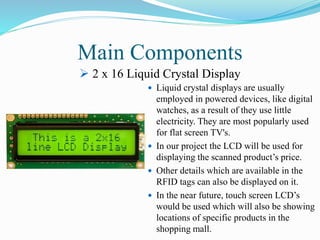
 Liquid crystal displays are usually
employed in powered devices, like digital
watches, as a result of they use little
electricity. They are most popularly used
for flat screen TV's.
 In our project the LCD will be used for
displaying the scanned product’s price.
 Other details which are available in the
RFID tags can also be displayed on it.
 In the near future, touch screen LCD’s
would be used which will also be showing
locations of specific products in the
shopping mall.
Main Components
 2 x 16 Liquid Crystal Display
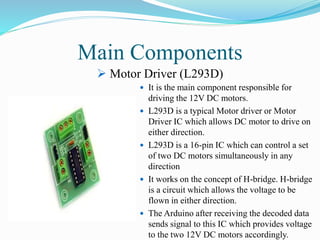
 It is the main component responsible for
driving the 12V DC motors.
 L293D is a typical Motor driver or Motor
Driver IC which allows DC motor to drive on
either direction.
 L293D is a 16-pin IC which can control a set
of two DC motors simultaneously in any
direction
 It works on the concept of H-bridge. H-bridge
is a circuit which allows the voltage to be
flown in either direction.
 The Arduino after receiving the decoded data
sends signal to this IC which provides voltage
to the two 12V DC motors accordingly.
Main Components
 Motor Driver (L293D)
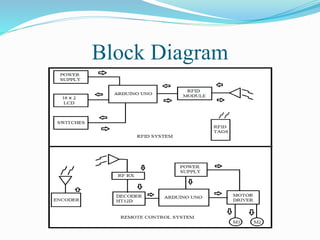
Block Diagram
Working
 The microcontroller is connected with the RFID Reader.
 RFID Reader scans the product’s tags and shows the details of the product
in the display. It also shows all the details regarding the product unlike
barcode which only shows the price.
 When a customer wants to buy an item he/she first scans the RFID tag of
the product and its price is added in the total. Now, if he/she wants to
remove the product from the cart he may scan the product again and the
item automatically gets removed.
 The trolley is also wirelessly connected with 4 switches for remote
operation.
 Encoder and Decoder with RF Module at 433 MHz frequency is used to
drive the trolley remotely.
Advantages
 Time management
 User-friendly
 Crowd control
 Simple user interface
 Theft immunity
 Faster checkout
 Scanning of multiple items together
 Minimal manual labor
Future Scope
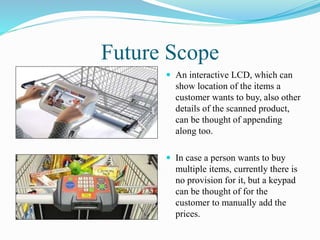
 An interactive LCD, which can
show location of the items a
customer wants to buy, also other
details of the scanned product,
can be thought of appending
along too.
 In case a person wants to buy
multiple items, currently there is
no provision for it, but a keypad
can be thought of for the
customer to manually add the
prices.
Future Scope
 The RFID system which can
scan multiple tags at a time with
100% accuracy is still under
development. Once it is
available, this technology can
attain new heights with least
time consumption and higher
security.
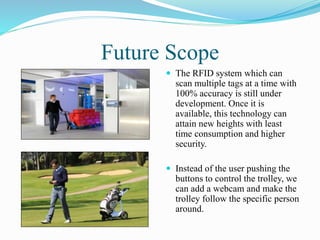
 Instead of the user pushing the
buttons to control the trolley, we
can add a webcam and make the
trolley follow the specific person
around.
Smart shopping trolley using rfid and remote controlling

Smart shopping trolley using rfid and remote controlling

  • 1.
    L.D. College ofEngineering Tilak Parmar - 130280111065 Pranav Veerani - 130280111117 Guided By: Prof. Abhay B. Upadhyay
  • 2.
    Problem Summary Barcode ScannerPushing Heavy Trolleys
  • 3.
    Problem Summary  SlowBarcode Scanning Process  Long Queues  Manually Pushing of Heavy Trolleys  No Personal Assistance while Shopping Queue at the bill counter
  • 4.
    Purpose  The mainpurpose of our project is to reduce the time spent while waiting in the queue at the billing counter.  RFID Reader/Writer is mounted upon the cart which scans the objects placed inside the cart in real-time and displays the bill amount on the mounted LCD, thereby, reducing the total time taken by a person during checkout.  RFID is also meant for scanning multiple items providing higher security.  Also, pushing of the heavy trolleys by elderly people and the handicapped is a tough job. So, a remote control feature might prove beneficial for them .
  • 5.
    Introduction to SmartTrolley  A Smart Trolley comprises of the RFID module which helps in easy scanning of the products to be purchased.  This product is specially developed for people of all age groups.  It is also easy to use by people having physical disabilities owing to the remote operation of the trolley.  It also has a simplified LCD display which shows the product’s details when scanned; and will also be showing the location of various items in the mall in the near future.
  • 6.
    Main Components  RFIDModule (Radio Frequency Identification Device)  RFID Tags  Microcontroller (ATMega32)  RF Module (TX/RX)  Encoder/Decoder  LCD display  Motor Driver  DC motors
  • 7.
    Main Components  TheRFID tags consists of a loop antenna and a chip which stores the data of the product it is attached to.  When brought near the reader, it transmits data taking power from the reader.  Max Range of EM-18 RFID reader/writer module is 10 cm with a voltage of 12V.  RFID Reader with a range of more than 1m is currently in development; after which this technology would be grateful in providing security too.  RFID Module & RFID Tags:
  • 8.
    Main Components  Microcontrolleris the main part of any electronic system. It is the bran of the system.  We are using an Arduino UNO board which comprises of ATMega32 microcontroller.  The coding of the whole system resides in this 40 pin DIP.  We have used 2 Arduino boards in our project; one for the RFID and another for the RF Module.  The power to the Arduino is given by a battery of 5V or more.  Microcontroller ATMega32
  • 9.
    Main Components  TheHT12E Encoder ICs are specially designed for Remote Control applications.  The encoded data is transmitted through antennas and decoder decodes it to provide its specific output.  Each address/data input is externally programmable.  We have used an 18 pin IC which has 8 address pins. So, in a range of meters up to 256 trolleys can be operated without any disturbances.  Encoder (HT12E) & Decoder (HT12D)
  • 10.
    Main Components  Thiscomponent plays a major role in transmitting the data from the encoder to the decoder.  The transmitter and receiver work at a frequency of 433 MHz and provide a max range of almost 3 meters unambiguously.  In our project there are 4 switches whose data is encoded and sent through this equipment.  The receiver sends the encoded data to the decoder which successfully interprets the actual data and sends further the data to the motor driver through the microcontroller.  433 MHz RF Module (Tx & Rx)
  • 11.
     Liquid crystaldisplays are usually employed in powered devices, like digital watches, as a result of they use little electricity. They are most popularly used for flat screen TV's.  In our project the LCD will be used for displaying the scanned product’s price.  Other details which are available in the RFID tags can also be displayed on it.  In the near future, touch screen LCD’s would be used which will also be showing locations of specific products in the shopping mall. Main Components  2 x 16 Liquid Crystal Display
  • 12.
     It isthe main component responsible for driving the 12V DC motors.  L293D is a typical Motor driver or Motor Driver IC which allows DC motor to drive on either direction.  L293D is a 16-pin IC which can control a set of two DC motors simultaneously in any direction  It works on the concept of H-bridge. H-bridge is a circuit which allows the voltage to be flown in either direction.  The Arduino after receiving the decoded data sends signal to this IC which provides voltage to the two 12V DC motors accordingly. Main Components  Motor Driver (L293D)
  • 13.
  • 14.
    Working  The microcontrolleris connected with the RFID Reader.  RFID Reader scans the product’s tags and shows the details of the product in the display. It also shows all the details regarding the product unlike barcode which only shows the price.  When a customer wants to buy an item he/she first scans the RFID tag of the product and its price is added in the total. Now, if he/she wants to remove the product from the cart he may scan the product again and the item automatically gets removed.  The trolley is also wirelessly connected with 4 switches for remote operation.  Encoder and Decoder with RF Module at 433 MHz frequency is used to drive the trolley remotely.
  • 15.
    Advantages  Time management User-friendly  Crowd control  Simple user interface  Theft immunity  Faster checkout  Scanning of multiple items together  Minimal manual labor
  • 16.
    Future Scope  Aninteractive LCD, which can show location of the items a customer wants to buy, also other details of the scanned product, can be thought of appending along too.  In case a person wants to buy multiple items, currently there is no provision for it, but a keypad can be thought of for the customer to manually add the prices.
  • 17.
    Future Scope  TheRFID system which can scan multiple tags at a time with 100% accuracy is still under development. Once it is available, this technology can attain new heights with least time consumption and higher security.  Instead of the user pushing the buttons to control the trolley, we can add a webcam and make the trolley follow the specific person around.