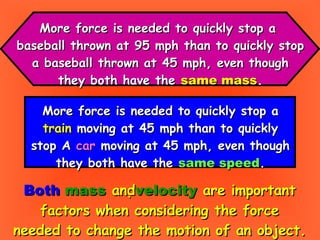
More force is needed to quickly stop a  baseball thrown at 95 mph than to quickly stop a baseball thrown at 45 mph, even though they both have the  same mass . Both   mass  and  velocity  are important factors when considering the force needed to change the motion of an object. More force is needed to quickly stop a train  moving at 45 mph than to quickly stop A  car  moving at 45 mph, even though they both have the  same speed .
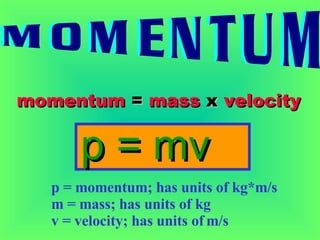
momentum  =  mass  x  velocity p = mv p = momentum; has units of kg*m/s m = mass; has units of kg v = velocity; has units of   m/s
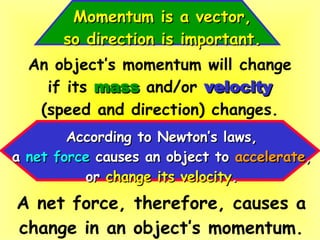
Momentum is a vector, so direction is important. An object’s momentum will change if its  mass   and/or  velocity (speed and direction) changes. According to Newton’s laws, a  net force  causes an object to  accelerate , or  change its velocity . A net force, therefore, causes a change in an object’s momentum.
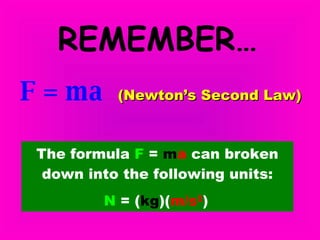
F = ma (Newton’s Second Law) The formula  F  =  m a  can broken down into the following units: N  = ( kg )( m/s 2 )   REMEMBER…
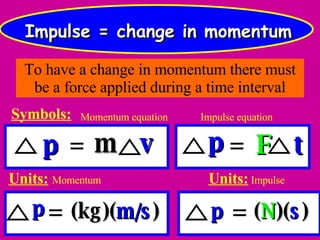
Impulse = change in momentum To have a change in momentum there must be a force applied during a time interval Symbols: Units:   Momentum Momentum equation Impulse equation Units:   Impulse m   v = p F   t = p (kg)( m/s ) = p ( N )( s ) = p
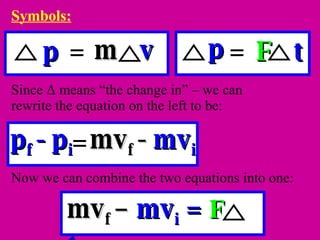
Symbols: Since  Δ  means “the change in” – we can rewrite the equation on the left to be: Now we can combine the two equations into one: mv f  -  mv i = p f  - p i F   t = p m   v = p mv f  –  mv i  =  F   t
The greatest change in velocity will occur when the impulse is the greatest. By increasing the amount of force and the amount of time the force is applied, the greatest change in velocity can be achieved.
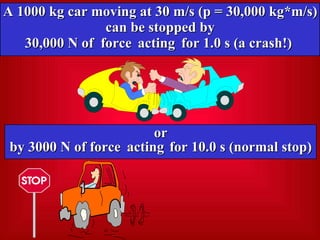
A 1000 kg car moving at 30 m/s (p = 30,000 kg*m/s) can be stopped by 30,000 N of  force  acting  for 1.0 s (a crash!)  or by 3000 N of force  acting   for 10.0 s (normal stop)

04-14-08 - Momentum And Impulse

  • 1.
  • 2.
    More force isneeded to quickly stop a baseball thrown at 95 mph than to quickly stop a baseball thrown at 45 mph, even though they both have the same mass . Both mass and  velocity are important factors when considering the force needed to change the motion of an object. More force is needed to quickly stop a train moving at 45 mph than to quickly stop A car moving at 45 mph, even though they both have the same speed .
  • 3.
    momentum = mass x velocity p = mv p = momentum; has units of kg*m/s m = mass; has units of kg v = velocity; has units of m/s
  • 4.
    Momentum is avector, so direction is important. An object’s momentum will change if its mass and/or velocity (speed and direction) changes. According to Newton’s laws, a net force causes an object to accelerate , or change its velocity . A net force, therefore, causes a change in an object’s momentum.
  • 5.
    F = ma(Newton’s Second Law) The formula F = m a can broken down into the following units: N = ( kg )( m/s 2 ) REMEMBER…
  • 6.
    Impulse = changein momentum To have a change in momentum there must be a force applied during a time interval Symbols: Units: Momentum Momentum equation Impulse equation Units: Impulse m v = p F t = p (kg)( m/s ) = p ( N )( s ) = p
  • 7.
    Symbols: Since Δ means “the change in” – we can rewrite the equation on the left to be: Now we can combine the two equations into one: mv f - mv i = p f - p i F t = p m v = p mv f – mv i = F t
  • 8.
    The greatest changein velocity will occur when the impulse is the greatest. By increasing the amount of force and the amount of time the force is applied, the greatest change in velocity can be achieved.
  • 9.
    A 1000 kgcar moving at 30 m/s (p = 30,000 kg*m/s) can be stopped by 30,000 N of force acting for 1.0 s (a crash!) or by 3000 N of force acting for 10.0 s (normal stop)