Scalar and Vector
Week 2 Lesson 1
12th grade
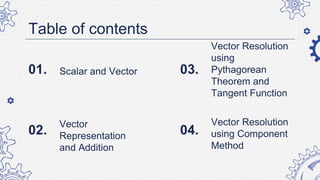
Table of contents
01.
02. 04.
03.
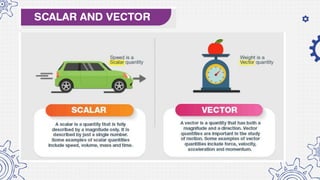
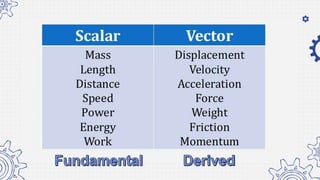
Scalar and Vector
Vector Resolution
using Component
Method
Vector Resolution
using
Pythagorean
Theorem and
Tangent Function
Vector
Representation
and Addition
Quote for Today!
Scalar and Vector
01.
Vector
Representation
02.
How to read and
draw Vectors?
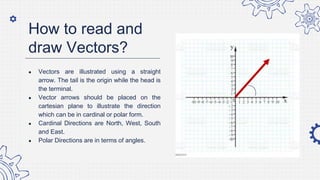
● Vectors are illustrated using a straight
arrow. The tail is the origin while the head is
the terminal.
● Vector arrows should be placed on the
cartesian plane to illustrate the direction
which can be in cardinal or polar form.
● Cardinal Directions are North, West, South
and East.
● Polar Directions are in terms of angles.
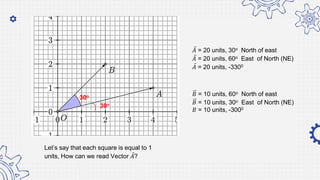
Let’s say that each square is equal to 1
units, How can we read Vector 𝐴?
𝐴 = 20 units, 30o North of east
𝐴 = 20 units, 60o East of North (NE)
𝐴 = 20 units, -3300
30o
30o 𝐵 = 10 units, 60o North of east
𝐵 = 10 units, 30o East of North (NE)
𝐵 = 10 units, -3000
Adding vectors can be resolved geometrically
because of their directions. The sum of the
vectors is commonly known as Resultant Vector.
It can be expressed as:
Vector Addition
𝑅 = 𝐴 + 𝐵 + …. +
𝑛
The Resultant vector can be determined by
Graphical Solution and Analytical Solution
Graphical Solution
Known as Tail-Tail Method.
Both tails of the two vectors
are connected at the origin of
the cartesian plane. At each
head of the vectors, draw line
parallel to the other
Known as Tail-Head Method.
Connect the tail of the first
vector at the origin of the
cartesian plane and the
succeding tails of vectors are
connected at the head of the
last vector drawn.
Polygon Method
Parallelogram
Method
Polygon Method
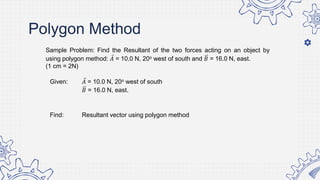
Sample Problem: Find the Resultant of the two forces acting on an object by
using polygon method: 𝐴 = 10.0 N, 20o west of south and 𝐵 = 16.0 N, east.
(1 cm = 2N)
Given: 𝐴 = 10.0 N, 20o west of south
𝐵 = 16.0 N, east.
Find: Resultant vector using polygon method
Polygon Method
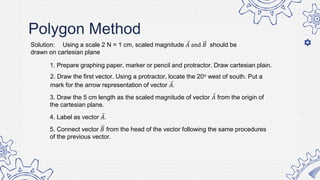
Solution: Using a scale 2 N = 1 cm, scaled magnitude 𝐴 and 𝐵 should be
drawn on cartesian plane
1. Prepare graphing paper, marker or pencil and protractor. Draw cartesian plain.
2. Draw the first vector. Using a protractor, locate the 20o west of south. Put a
mark for the arrow representation of vector 𝐴.
3. Draw the 5 cm length as the scaled magnitude of vector 𝐴 from the origin of
the cartesian plane.
4. Label as vector 𝐴.
5. Connect vector 𝐵 from the head of the vector following the same procedures
of the previous vector.
Polygon Method
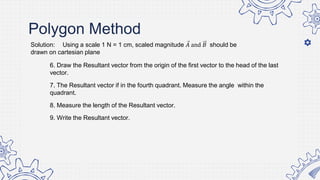
Solution: Using a scale 1 N = 1 cm, scaled magnitude 𝐴 and 𝐵 should be
drawn on cartesian plane
6. Draw the Resultant vector from the origin of the first vector to the head of the last
vector.
7. The Resultant vector if in the fourth quadrant. Measure the angle within the
quadrant.
8. Measure the length of the Resultant vector.
9. Write the Resultant vector.
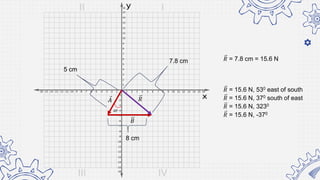
5 cm
𝐴
𝐵
200
8 cm
𝑅
𝑅 = 7.8 cm = 15.6 N
𝑅 = 15.6 N, 530 east of south
𝑅 = 15.6 N, 370 south of east
𝑅 = 15.6 N, 3230
𝑅 = 15.6 N, -370
7.8 cm
Parallelogram Method
Sample Problem: Find the Resultant of the two forces acting on an object by
using polygon method: 𝐴 = 10.0 N, 20o west of south and 𝐵 = 16.0 N, east.
(1 cm = 2N)
Given: 𝐴 = 10.0 N, 20o west of south
𝐵 = 16.0 N, east.
Find: Resultant vector using parallelogram method
Parallelogram Method
1. Construct the two vectors in the same origin of a cartesian plane using protractor
and ruler
2. At the head of each vector, draw a line parallel to each other.
3. Draw the resultant vector from the origin to the point where parallel lines
intersect and measure the length and the angle.
4. Write the Resultant vector.
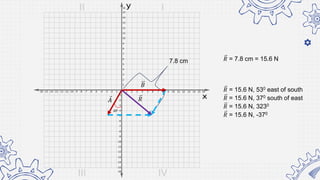
𝐴
𝐵
200
𝑅
𝑅 = 7.8 cm = 15.6 N
𝑅 = 15.6 N, 530 east of south
𝑅 = 15.6 N, 370 south of east
𝑅 = 15.6 N, 3230
𝑅 = 15.6 N, -370
7.8 cm
Clarissa walks 9.0 m to the east and then runs 12 m in
a direction of 750 south of east. Find the resultant
vector using polygon and parallelogram method.
3m = 1 cm
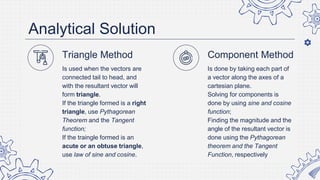
Analytical Solution
Is done by taking each part of
a vector along the axes of a
cartesian plane.
Solving for components is
done by using sine and cosine
function;
Finding the magnitude and the
angle of the resultant vector is
done using the Pythagorean
theorem and the Tangent
Function, respectively
Is used when the vectors are
connected tail to head, and
with the resultant vector will
form triangle.
If the triangle formed is a right
triangle, use Pythagorean
Theorem and the Tangent
function;
If the traingle formed is an
acute or an obtuse triangle,
use law of sine and cosine.
Triangle Method Component Method
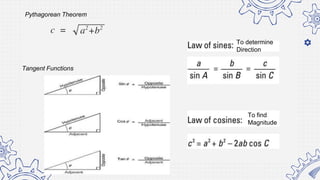
Pythagorean Theorem
Tangent Functions
To find
Magnitude
To determine
Direction
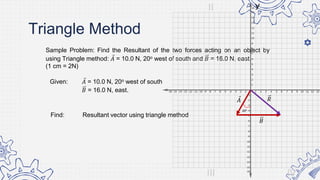
Sample Problem: Find the Resultant of the two forces acting on an object by
using Triangle method: 𝐴 = 10.0 N, 20o west of south and 𝐵 = 16.0 N, east.
(1 cm = 2N)
Given: 𝐴 = 10.0 N, 20o west of south
𝐵 = 16.0 N, east.
Find: Resultant vector using triangle method
Triangle Method
𝐴
𝐵
200
𝑅
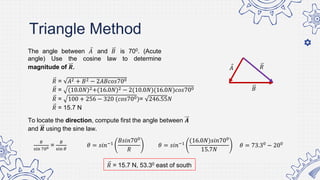
The angle between 𝐴 and 𝐵 is 700. (Acute
angle) Use the cosine law to determine
magnitude of 𝑹.
𝑅 = 𝐴2 + 𝐵2 − 2𝐴𝐵𝑐𝑜𝑠700
𝑅 = (10.0𝑁)2+(16.0𝑁)2 − 2(10.0𝑁)(16.0𝑁)𝑐𝑜𝑠700
𝑅 = 100 + 256 − 320 (𝑐𝑜𝑠700)= 246.55𝑁
𝑅 = 15.7 N
To locate the direction, compute first the angle between 𝑨
and 𝑹 using the sine law.
Triangle Method
𝐴
𝐵
𝑅
𝑅
sin 700 =
𝐵
sin 𝜃
𝜃 = 𝑠𝑖𝑛−1
𝐵𝑠𝑖𝑛700
𝑅
𝜃 = 𝑠𝑖𝑛−1
(16.0𝑁)𝑠𝑖𝑛700
15.7𝑁
𝜃 = 73.30
− 200
𝑅 = 15.7 N, 53.30 east of south
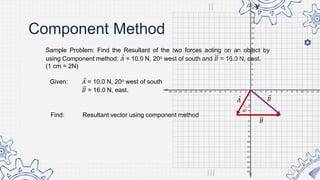
Sample Problem: Find the Resultant of the two forces acting on an object by
using Component method: 𝐴 = 10.0 N, 20o west of south and 𝐵 = 16.0 N, east.
(1 cm = 2N)
Given: 𝐴 = 10.0 N, 20o west of south
𝐵 = 16.0 N, east.
Find: Resultant vector using component method
Component Method
𝐴
𝐵
200
𝑅
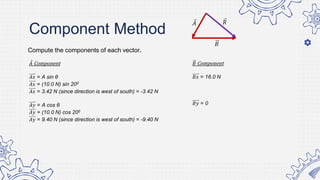
Compute the components of each vector.
𝐴 Component
𝐴𝑥 = A sin θ
𝐴𝑥 = (10.0 N) sin 200
𝐴𝑥 = 3.42 N (since direction is west of south) = -3.42 N
𝐴𝑦 = A cos θ
𝐴𝑦 = (10.0 N) cos 200
𝐴𝑦 = 9.40 N (since direction is west of south) = -9.40 N
Component Method
𝐴
𝐵
𝑅
𝐵 Component
𝐵𝑥 = 16.0 N
𝐵𝑦 = 0
Solve for the Resultant component.
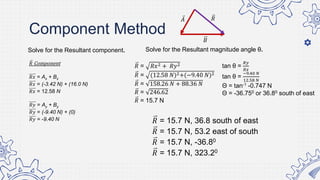
𝑅 Component
𝑅𝑥 = Ax + Bx
𝑅𝑥 = (-3.42 N) + (16.0 N)
𝑅𝑥 = 12.58 N
𝑅𝑦 = Ay + By
𝑅𝑦 = (-9.40 N) + (0)
𝑅𝑦 = -9.40 N
Component Method
𝐴
𝐵
𝑅
Solve for the Resultant magnitude angle θ.
𝑅 = 𝑅𝑥2 + 𝑅𝑦2
𝑅 = (12.58 𝑁)2+(−9.40 𝑁)2
𝑅 = 158.26 𝑁 + 88.36 𝑁
𝑅 = 246.62
𝑅 = 15.7 N
tan θ =
𝑅𝑦
𝑅𝑥
tan θ =
−9.40 𝑁
12.58 𝑁
Θ = tan-1 -0.747 N
Θ = -36.750 or 36.80 south of east
𝑅 = 15.7 N, 36.8 south of east
𝑅 = 15.7 N, 53.2 east of south
𝑅 = 15.7 N, -36.80
𝑅 = 15.7 N, 323.20
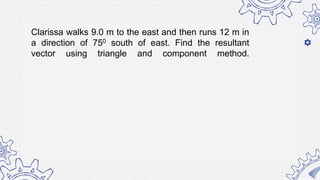
Clarissa walks 9.0 m to the east and then runs 12 m in
a direction of 750 south of east. Find the resultant
vector using triangle and component method.
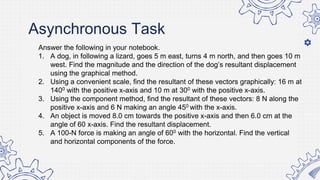
Asynchronous Task
Answer the following in your notebook.
1. A dog, in following a lizard, goes 5 m east, turns 4 m north, and then goes 10 m
west. Find the magnitude and the direction of the dog’s resultant displacement
using the graphical method.
2. Using a convenient scale, find the resultant of these vectors graphically: 16 m at
1400 with the positive x-axis and 10 m at 300 with the positive x-axis.
3. Using the component method, find the resultant of these vectors: 8 N along the
positive x-axis and 6 N making an angle 450 with the x-axis.
4. An object is moved 8.0 cm towards the positive x-axis and then 6.0 cm at the
angle of 60 x-axis. Find the resultant displacement.
5. A 100-N force is making an angle of 600 with the horizontal. Find the vertical
and horizontal components of the force.
Performance Task
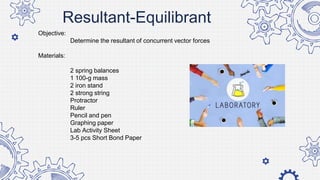
Resultant-Equilibrant
Objective:
Determine the resultant of concurrent vector forces
Materials:
2 spring balances
1 100-g mass
2 iron stand
2 strong string
Protractor
Ruler
Pencil and pen
Graphing paper
Lab Activity Sheet
3-5 pcs Short Bond Paper

GenPhy1W2L1 Scalar and Vector.pptx

  • 1.
    Scalar and Vector Week2 Lesson 1 12th grade
  • 2.
    Table of contents 01. 02.04. 03. Scalar and Vector Vector Resolution using Component Method Vector Resolution using Pythagorean Theorem and Tangent Function Vector Representation and Addition
  • 3.
  • 4.
  • 7.
  • 8.
    How to readand draw Vectors? ● Vectors are illustrated using a straight arrow. The tail is the origin while the head is the terminal. ● Vector arrows should be placed on the cartesian plane to illustrate the direction which can be in cardinal or polar form. ● Cardinal Directions are North, West, South and East. ● Polar Directions are in terms of angles.
  • 9.
    Let’s say thateach square is equal to 1 units, How can we read Vector 𝐴? 𝐴 = 20 units, 30o North of east 𝐴 = 20 units, 60o East of North (NE) 𝐴 = 20 units, -3300 30o 30o 𝐵 = 10 units, 60o North of east 𝐵 = 10 units, 30o East of North (NE) 𝐵 = 10 units, -3000
  • 10.
    Adding vectors canbe resolved geometrically because of their directions. The sum of the vectors is commonly known as Resultant Vector. It can be expressed as: Vector Addition 𝑅 = 𝐴 + 𝐵 + …. + 𝑛 The Resultant vector can be determined by Graphical Solution and Analytical Solution
  • 11.
    Graphical Solution Known asTail-Tail Method. Both tails of the two vectors are connected at the origin of the cartesian plane. At each head of the vectors, draw line parallel to the other Known as Tail-Head Method. Connect the tail of the first vector at the origin of the cartesian plane and the succeding tails of vectors are connected at the head of the last vector drawn. Polygon Method Parallelogram Method
  • 12.
    Polygon Method Sample Problem:Find the Resultant of the two forces acting on an object by using polygon method: 𝐴 = 10.0 N, 20o west of south and 𝐵 = 16.0 N, east. (1 cm = 2N) Given: 𝐴 = 10.0 N, 20o west of south 𝐵 = 16.0 N, east. Find: Resultant vector using polygon method
  • 13.
    Polygon Method Solution: Usinga scale 2 N = 1 cm, scaled magnitude 𝐴 and 𝐵 should be drawn on cartesian plane 1. Prepare graphing paper, marker or pencil and protractor. Draw cartesian plain. 2. Draw the first vector. Using a protractor, locate the 20o west of south. Put a mark for the arrow representation of vector 𝐴. 3. Draw the 5 cm length as the scaled magnitude of vector 𝐴 from the origin of the cartesian plane. 4. Label as vector 𝐴. 5. Connect vector 𝐵 from the head of the vector following the same procedures of the previous vector.
  • 14.
    Polygon Method Solution: Usinga scale 1 N = 1 cm, scaled magnitude 𝐴 and 𝐵 should be drawn on cartesian plane 6. Draw the Resultant vector from the origin of the first vector to the head of the last vector. 7. The Resultant vector if in the fourth quadrant. Measure the angle within the quadrant. 8. Measure the length of the Resultant vector. 9. Write the Resultant vector.
  • 15.
    5 cm 𝐴 𝐵 200 8 cm 𝑅 𝑅= 7.8 cm = 15.6 N 𝑅 = 15.6 N, 530 east of south 𝑅 = 15.6 N, 370 south of east 𝑅 = 15.6 N, 3230 𝑅 = 15.6 N, -370 7.8 cm
  • 16.
    Parallelogram Method Sample Problem:Find the Resultant of the two forces acting on an object by using polygon method: 𝐴 = 10.0 N, 20o west of south and 𝐵 = 16.0 N, east. (1 cm = 2N) Given: 𝐴 = 10.0 N, 20o west of south 𝐵 = 16.0 N, east. Find: Resultant vector using parallelogram method
  • 17.
    Parallelogram Method 1. Constructthe two vectors in the same origin of a cartesian plane using protractor and ruler 2. At the head of each vector, draw a line parallel to each other. 3. Draw the resultant vector from the origin to the point where parallel lines intersect and measure the length and the angle. 4. Write the Resultant vector.
  • 18.
    𝐴 𝐵 200 𝑅 𝑅 = 7.8cm = 15.6 N 𝑅 = 15.6 N, 530 east of south 𝑅 = 15.6 N, 370 south of east 𝑅 = 15.6 N, 3230 𝑅 = 15.6 N, -370 7.8 cm
  • 19.
    Clarissa walks 9.0m to the east and then runs 12 m in a direction of 750 south of east. Find the resultant vector using polygon and parallelogram method. 3m = 1 cm
  • 20.
    Analytical Solution Is doneby taking each part of a vector along the axes of a cartesian plane. Solving for components is done by using sine and cosine function; Finding the magnitude and the angle of the resultant vector is done using the Pythagorean theorem and the Tangent Function, respectively Is used when the vectors are connected tail to head, and with the resultant vector will form triangle. If the triangle formed is a right triangle, use Pythagorean Theorem and the Tangent function; If the traingle formed is an acute or an obtuse triangle, use law of sine and cosine. Triangle Method Component Method
  • 21.
    Pythagorean Theorem Tangent Functions Tofind Magnitude To determine Direction
  • 22.
    Sample Problem: Findthe Resultant of the two forces acting on an object by using Triangle method: 𝐴 = 10.0 N, 20o west of south and 𝐵 = 16.0 N, east. (1 cm = 2N) Given: 𝐴 = 10.0 N, 20o west of south 𝐵 = 16.0 N, east. Find: Resultant vector using triangle method Triangle Method 𝐴 𝐵 200 𝑅
  • 23.
    The angle between𝐴 and 𝐵 is 700. (Acute angle) Use the cosine law to determine magnitude of 𝑹. 𝑅 = 𝐴2 + 𝐵2 − 2𝐴𝐵𝑐𝑜𝑠700 𝑅 = (10.0𝑁)2+(16.0𝑁)2 − 2(10.0𝑁)(16.0𝑁)𝑐𝑜𝑠700 𝑅 = 100 + 256 − 320 (𝑐𝑜𝑠700)= 246.55𝑁 𝑅 = 15.7 N To locate the direction, compute first the angle between 𝑨 and 𝑹 using the sine law. Triangle Method 𝐴 𝐵 𝑅 𝑅 sin 700 = 𝐵 sin 𝜃 𝜃 = 𝑠𝑖𝑛−1 𝐵𝑠𝑖𝑛700 𝑅 𝜃 = 𝑠𝑖𝑛−1 (16.0𝑁)𝑠𝑖𝑛700 15.7𝑁 𝜃 = 73.30 − 200 𝑅 = 15.7 N, 53.30 east of south
  • 24.
    Sample Problem: Findthe Resultant of the two forces acting on an object by using Component method: 𝐴 = 10.0 N, 20o west of south and 𝐵 = 16.0 N, east. (1 cm = 2N) Given: 𝐴 = 10.0 N, 20o west of south 𝐵 = 16.0 N, east. Find: Resultant vector using component method Component Method 𝐴 𝐵 200 𝑅
  • 25.
    Compute the componentsof each vector. 𝐴 Component 𝐴𝑥 = A sin θ 𝐴𝑥 = (10.0 N) sin 200 𝐴𝑥 = 3.42 N (since direction is west of south) = -3.42 N 𝐴𝑦 = A cos θ 𝐴𝑦 = (10.0 N) cos 200 𝐴𝑦 = 9.40 N (since direction is west of south) = -9.40 N Component Method 𝐴 𝐵 𝑅 𝐵 Component 𝐵𝑥 = 16.0 N 𝐵𝑦 = 0
  • 26.
    Solve for theResultant component. 𝑅 Component 𝑅𝑥 = Ax + Bx 𝑅𝑥 = (-3.42 N) + (16.0 N) 𝑅𝑥 = 12.58 N 𝑅𝑦 = Ay + By 𝑅𝑦 = (-9.40 N) + (0) 𝑅𝑦 = -9.40 N Component Method 𝐴 𝐵 𝑅 Solve for the Resultant magnitude angle θ. 𝑅 = 𝑅𝑥2 + 𝑅𝑦2 𝑅 = (12.58 𝑁)2+(−9.40 𝑁)2 𝑅 = 158.26 𝑁 + 88.36 𝑁 𝑅 = 246.62 𝑅 = 15.7 N tan θ = 𝑅𝑦 𝑅𝑥 tan θ = −9.40 𝑁 12.58 𝑁 Θ = tan-1 -0.747 N Θ = -36.750 or 36.80 south of east 𝑅 = 15.7 N, 36.8 south of east 𝑅 = 15.7 N, 53.2 east of south 𝑅 = 15.7 N, -36.80 𝑅 = 15.7 N, 323.20
  • 27.
    Clarissa walks 9.0m to the east and then runs 12 m in a direction of 750 south of east. Find the resultant vector using triangle and component method.
  • 28.
    Asynchronous Task Answer thefollowing in your notebook. 1. A dog, in following a lizard, goes 5 m east, turns 4 m north, and then goes 10 m west. Find the magnitude and the direction of the dog’s resultant displacement using the graphical method. 2. Using a convenient scale, find the resultant of these vectors graphically: 16 m at 1400 with the positive x-axis and 10 m at 300 with the positive x-axis. 3. Using the component method, find the resultant of these vectors: 8 N along the positive x-axis and 6 N making an angle 450 with the x-axis. 4. An object is moved 8.0 cm towards the positive x-axis and then 6.0 cm at the angle of 60 x-axis. Find the resultant displacement. 5. A 100-N force is making an angle of 600 with the horizontal. Find the vertical and horizontal components of the force.
  • 29.
  • 30.
    Resultant-Equilibrant Objective: Determine the resultantof concurrent vector forces Materials: 2 spring balances 1 100-g mass 2 iron stand 2 strong string Protractor Ruler Pencil and pen Graphing paper Lab Activity Sheet 3-5 pcs Short Bond Paper