Representation
of
Signals
Today’s Outline
 Signal
 Types of Signal
 Signal Representation
 Elementary signals
What is signal?
Signal is a function that conveys information about
the behavior or attributes of some phenomenon.
Types of signal
Two main types of signals encountered in practice.
 Analog signal
 Digital Signal
Representation of Different
Signals
• Periodic & Aperiodic Signal
• Continuous & Discrete Signal
• Orthogonal Signal
• Even & Odd signal
• Power & Energy Signal
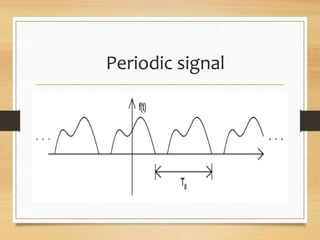
Periodic signal
 Completes a pattern within a measurable time
frame, called a period
 Repeats that pattern over identical subsequent
periods.
Periodic signal
Aperiodic Signal
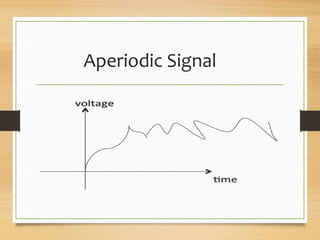
A signal that does not repeats its pattern over a
period is called aperiodic signal or non periodic
Aperiodic Signal
Continuous Signal
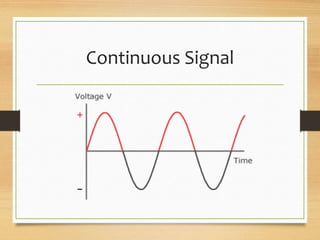
 Time is a continuum.
 The function's domain is an uncountable set.
 The function itself need not be continuous.
Continuous Signal
Discrete Signal
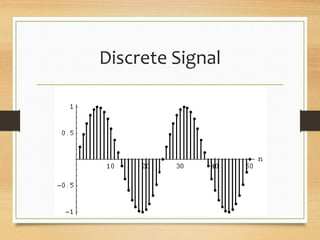
 Discrete-time signal is not a function of a continuous
argument.
 Obtained by sampling from a continuous-time signal.
Discrete Signal
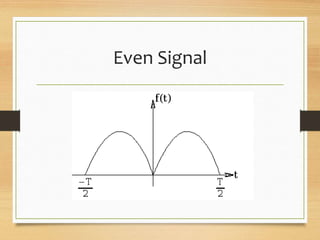
 A signal is referred to as an even if it is identical to
its time-reversed counterparts; x(t) = x(-t).
 Even signals are symmetric around vertical axis.
Even Signal
Even Signal
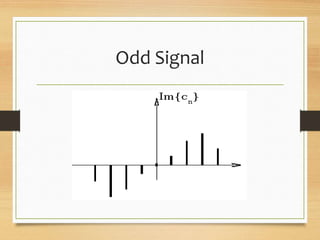
Odd Signal
 A signal is odd if x(t) = -x(-t).
 An odd signal must be 0 at t=0, in other words, odd
signal passes the origin.
Odd Signal
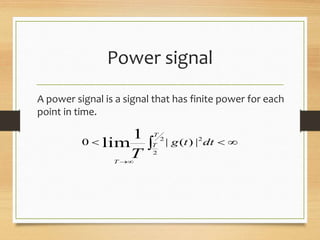
Power signal
A power signal is a signal that has finite power for each
point in time.
 

dttg
T
T
T
T
2
2
2
|)(|0
1
lim
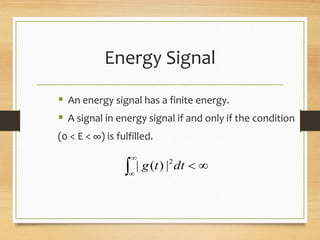
Energy Signal
 An energy signal has a finite energy.
 A signal in energy signal if and only if the condition
(0 < E < ∞) is fulfilled.



dttg 2
|)(|
Orthogonal Signals
 Each component signal has no relationship with
others.
 Orthogonal signal is denoted as φ(t).
Elementary Signals
• Unit step function
• Ramp function
Unit step function
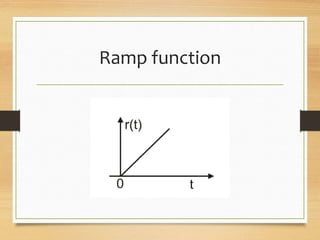
Ramp function
Any Questions ?
Thank You

Representation of signals