VECTOR SPACES 
4.1 VECTORS IN RN 
4.2 VECTOR SPACES 
4.3 SUBSPACES OF VECTOR SPACES 
4.4 SPANNING SETS AND LINEAR INDEPENDENCE 
4.5 BASIS AND DIMENSION 
4.6 RANK OF A MATRIX AND SYSTEMS OF LINEAR 
EQUATIONS 
4.7 COORDINATES AND CHANGE OF BASIS
WEL COME 
• PATEL SUJAY A (130390119086) 
• PATEL TRUPAL S (130390119087) 
• PATEL KUNTAK (130390119070) 
• PATEL PARTH (130390119081) 
2 
/10 
7
4.1 VECTORS IN RN 
3 
/10 
7 
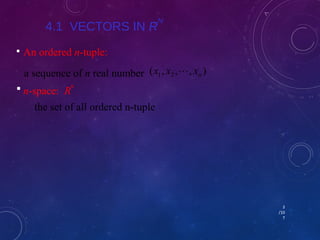
 An ordered n-tuple: 
a sequence of n real number ( , , , ) 1 2 n x x  x 
 n-space: Rn 
the set of all ordered n-tuple
4 
/10 
7 
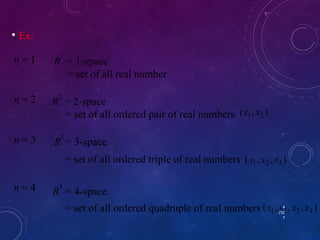
n = 4 
R4 = 4-space 
= set of all ordered quadruple of real numbers 
(x1, x2 , x3, x4 ) 
R1 = 1-space 
= set of all real number 
n = 1 
n = 2 R2 = 2-space 
= set of all ordered pair of real numbers (x1, x2 ) 
n = 3 R3 = 3-space 
= set of all ordered triple of real numbers (x1, x2 , x3 ) 
 Ex:
• Notes: 
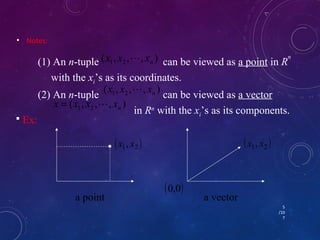
(1) An n-tuple can be viewed as a point in Rn 
with the xi’s as its coordinates. 
(2) An n-tuple can be viewed as a vector 
in Rn with the xi’s as its components. 
5 
/10 
7 
 Ex: 
a point 
( x1, x2 ) 
a vector 
( ) x1, x2 
(0,0) 
( , , , ) 1 2 n x x  x 
( , , , ) 1 2 n x = x x  x
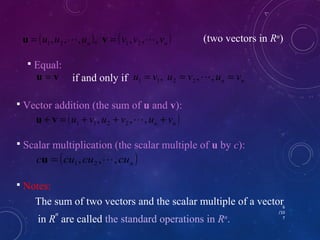
( n ) ( n ) u ,u , ,u , v ,v , ,v u = 1 2  v = 1 2  (two vectors in Rn) 
6 
/10 
7 
 Equal: 
u = v if and only if n n u = v , u = v , , u = v 1 1 2 2  
 Vector addition (the sum of u and v): 
( ) n n + = u + v , u + v , , u + v u v 1 1 2 2  
 Scalar multiplication (the scalar multiple of u by c): 
( ) n c cu ,cu , ,cu u = 1 2  
 Notes: 
The sum of two vectors and the scalar multiple of a vector 
in Rn are called the standard operations in Rn.
7 
/10 
7 
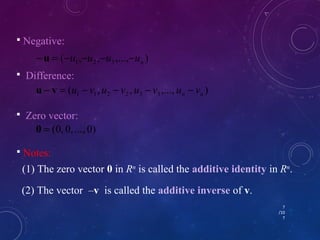
 Negative: 
( , , ,..., ) 1 2 3 n - u = -u -u -u -u 
 Difference: 
( , , ,..., ) 1 1 2 2 3 3 n n u - v = u - v u - v u - v u - v 
 Zero vector: 
0 = (0, 0, ..., 0) 
 Notes: 
(1) The zero vector 0 in Rn is called the additive identity in Rn. 
(2) The vector –v is called the additive inverse of v.
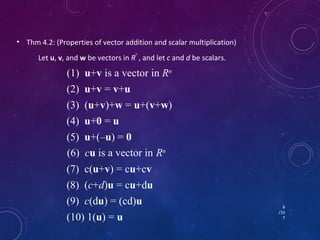
• Thm 4.2: (Properties of vector addition and scalar multiplication) 
Let u, v, and w be vectors in Rn , and let c and d be scalars. 
8 
/10 
7 
(1) u+v is a vector in Rn 
(2) u+v = v+u 
(3) (u+v)+w = u+(v+w) 
(4) u+0 = u 
(5) u+(–u) = 0 
(6) cu is a vector in Rn 
(7) c(u+v) = cu+cv 
(8) (c+d)u = cu+du 
(9) c(du) = (cd)u 
(10) 1(u) = u
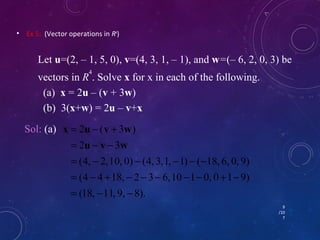
• Ex 5: (Vector operations in R4) 
Let u=(2, – 1, 5, 0), v=(4, 3, 1, – 1), and w=(– 6, 2, 0, 3) be 
vectors in R4. Solve x for x in each of the following. 
(a) x = 2u – (v + 3w) 
(b) 3(x+w) = 2u – v+x 
9 
/10 
7 
Sol: (a) 
x u v w 
= - + 
u v w 
2 ( 3 ) 
= - - 
2 3 
= - - - - - 
(4, 2, 10, 0) (4, 3, 1, 1) ( 18, 6, 0, 9) 
= - + - - - - - + - 
(4 4 18, 2 3 6, 10 1 0, 0 1 9) 
= - - 
(18, 11, 9, 8).
10 
/10 
7 
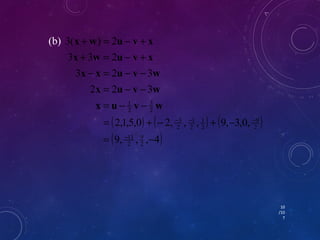
(b) 
x + w = u - v + 
x 
3( ) 2 
x + w = u - v + 
x 
3 3 2 
x - x = u - v - 
w 
3 2 3 
x = u - v - 
w 
2 2 3 
= - 1 
- 
( ) ( ) ( ) 
(9, , , 4) 
= + - + - 
2,1,5,0 2, , , 9, 3,0, 
9 
2 
11 
2 
9 
2 
1 
2 
1 
2 
3 
2 
2 3 
2 
= - 
- 
- - - 
x u v w
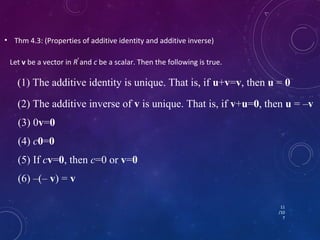
• Thm 4.3: (Properties of additive identity and additive inverse) 
Let v be a vector in Rn and c be a scalar. Then the following is true. 
(1) The additive identity is unique. That is, if u+v=v, then u = 0 
(2) The additive inverse of v is unique. That is, if v+u=0, then u = –v 
(3) 0v=0 
(4) c0=0 
(5) If cv=0, then c=0 or v=0 
(6) –(– v) = v 
11 
/10 
7
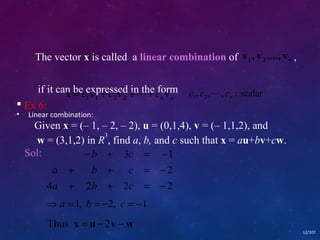
The vector x is called a linear combination of , 
if it can be expressed in the form 
• Linear combination: 
, , , : scalar 1 2 n c c  c 
12/107 
 Ex 6: 
Given x = (– 1, – 2, – 2), u = (0,1,4), v = (– 1,1,2), and 
w = (3,1,2) in R3, find a, b, and c such that x = au+bv+cw. 
Sol: 
b c 
- + = - 
3 1 
2 
a b c 
+ + = - 
a b c 
+ + = - 
4 2 2 2 
Þa =1, b = -2, c = -1 
Thus x = u - 2v -w 
n v , v ,..., v 1 2 
n n x c v c v c v 1 2 = 1 + 2 ++
 Notes: 
13 
/10 
7 
A vector ( , , , ) in can be viewed as: 1 2 n u = u u  u Rn 
[ , , , ] 1 2 n u = u u  u 
ù 
ú ú ú ú 
û 
u 
é 
= 
ê ê ê ê 
1 
u 
n u 
ë 
 
2 
u 
or 
a 1×n row matrix (row vector): 
a n×1 column matrix (column vector): 
(The matrix operations of addition and scalar multiplication 
give the same results as the corresponding vector operations)
Vector addition Scalar multiplication 
u v   
u u u v v v 
= + + + 
( , , , ) ( , , , ) 
n n 
u v   
u u u v v v 
= + + + 
[ , , , ] [ , , , ] 
n n 
ù 
ú ú ú ú 
û 
u v u v u v 
u v u v u v 
é 
= 
ê ê ê ê 
ë 
ù 
ú ú ú ú 
û 
1 2 1 2 
u 
1 2 1 2 
é 
= 
ê ê ê ê 
1 
ù 
u 
ë 
cu 
1 
cu 
n n cu 
u 
u + 
v 
c c 
  
2 
2 
u 
u = 
c c u u u 
( , , , ) 
u = 
c c u u u 
[ , , , ] 
14 
/10 
7 
( , , , ) 
1 1 2 2 
n n 
+ = + 
 
[ , , , ] 
1 1 2 2 
n n 
+ = + 
 
ú ú ú ú 
û 
é 
ê ê ê ê 
1 1 
u v 
1 
1 
   
ë 
+ 
+ 
= 
ù 
ú ú ú ú 
û 
é 
+ 
ê ê ê ê 
ë 
ù 
ú ú ú ú 
û 
u 
é 
ê ê ê ê 
u 
ë 
+ = 
v 
v 
v 
u v 
n n n n u 
2 2 
2 
2 
u v 
1 2 
 
( , , , ) 
1 2 
n 
n 
cu cu  
cu 
= 
1 2 
 
[ , , , ] 
1 2 
n 
n 
cu cu  
cu 
=
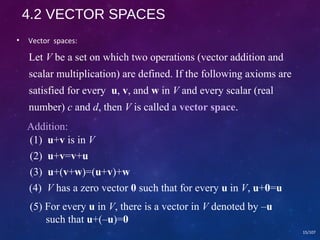
4.2 VECTOR SPACES 
• Vector spaces: 
15/107 
Let V be a set on which two operations (vector addition and 
scalar multiplication) are defined. If the following axioms are 
satisfied for every u, v, and w in V and every scalar (real 
number) c and d, then V is called a vector space. 
Addition: 
(1) u+v is in V 
(2) u+v=v+u 
(3) u+(v+w)=(u+v)+w 
(4) V has a zero vector 0 such that for every u in V, u+0=u 
(5) For every u in V, there is a vector in V denoted by –u 
such that u+(–u)=0
16 
/10 
7 
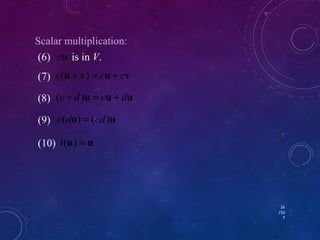
Scalar multiplication: 
(6) c u is in V. 
(7) c ( u + v ) = c u + c v 
(8) (c + d)u = cu + du 
(9) c(du) = (cd)u 
(10) 1(u) = u
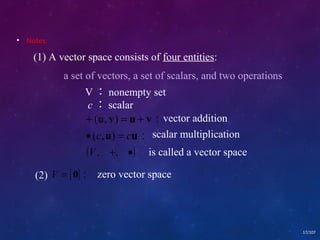
• Notes: 
17/107 
(1) A vector space consists of four entities: 
a set of vectors, a set of scalars, and two operations 
V:nonempty set 
c:scalar 
( , ) : 
u u 
+ = + vector addition 
u v u v 
· c = c 
( , ) : 
scalar multiplication 
(V, +, ·) is called a vector space 
(2) V = {0}: zero vector space
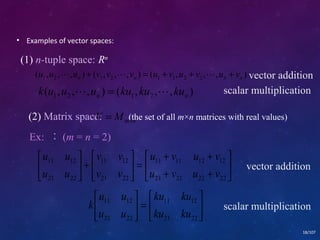
• Examples of vector spaces: 
( , , , ) ( , , , ) ( , , , ) 1 2 n 1 2 n 1 1 2 2 n n u u  u + v v  v = u + v u + v  u + v 
vector addition 
scalar multiplication 
18/107 
(1) n-tuple space: Rn 
( , , , ) ( , , , ) 1 2 n 1 2 n k u u  u = ku ku  ku 
(2) Matrix space: m (tnhe set of all m×n matrices with real values) V M ´ = 
Ex: :(m = n = 2) 
ù 
úû 
é 
êë 
u + v u + 
v 
11 11 12 12 
+ + 
ù 
= úû 
é 
+ úû ù 
êë 
é 
êë 
21 21 22 22 
v v 
11 12 
21 22 
u u 
11 12 
21 22 
u v u v 
v v 
u u 
ù 
úû 
é 
= úû 
êë 
ù 
é 
u u 
k 
êë 
ku ku 
11 12 
21 22 
11 12 
21 22 
ku ku 
u u 
vector addition 
scalar multiplication
19/107 
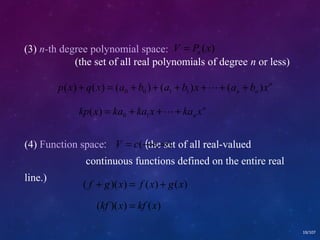
(3) n-th degree polynomial space: 
V P (x) n = 
(the set of all real polynomials of degree n or less) 
n 
n n p(x) q(x) (a b ) (a b )x (a b )x 0 0 1 1 + = + + + ++ + 
n 
nkp x = ka0 + ka1x ++ ka x ( ) 
(4) Function space: V = c(-¥(the ,¥set ) 
of all real-valued 
continuous functions defined on the entire real 
line.) ( f + g)(x) = f (x) + g(x) 
(kf )(x) = kf (x)
20/107 
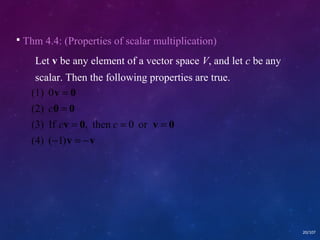
 Thm 4.4: (Properties of scalar multiplication) 
Let v be any element of a vector space V, and let c be any 
scalar. Then the following properties are true. 
v = 
0 
(1) 0 
0 = 
0 
v 0 v 0 
c c 
= = = 
(2) 
c 
(3) If , then 0 or 
v v 
- = - 
(4) ( 1)
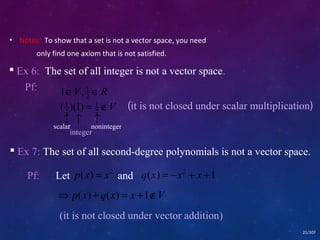
• Notes: To show that a set is not a vector space, you need 
only find one axiom that is not satisfied. 
 Ex 6: The set of all integer is not a vector space. 
ÎV , ÎR 2 
1 1 
(1 )(1) = 1 
ÏV (it is not closed under scalar multiplication) 
2 
2 
­ ­ ­ scalar 
noninteger 
 Ex 7: The set of all second-degree polynomials is not a vector space. 
21/107 
Pf: Let p ( x ) = x 2 and q(x) = -x2 + x +1 
Þ p(x) + q(x) = x +1ÏV 
(it is not closed under vector addition) 
Pf: 
integer
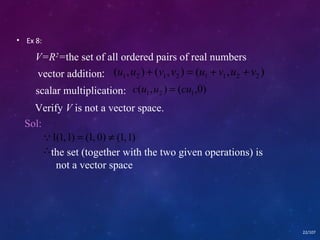
• Ex 8: 
( , ) ( , ) ( , ) 1 2 1 2 1 1 2 2 u u + v v = u + v u + v 
22/107 
V=R2=the set of all ordered pairs of real numbers 
vector addition: 
scalar multiplication: ( , ) ( ,0) 1 2 1 c u u = cu 
Verify V is not a vector space. 
Sol: 
1(1, 1) = (1, 0) ¹ (1, 1) 
 
the set (together with the two given operations) is 
not a vector space
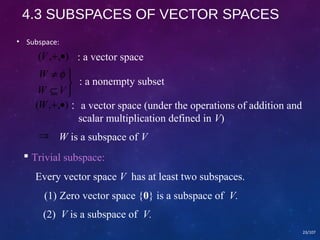
4.3 SUBSPACES OF VECTOR SPACES 
• Subspace: 
(V,+,·) 
W f 
þ ý ü 
¹ 
W Í 
V 
23/107 
: a vector space 
: a nonempty subset 
(W,+,·):a vector space (under the operations of addition and 
scalar multiplication defined in V) 
Þ W is a subspace of V 
 Trivial subspace: 
Every vector space V has at least two subspaces. 
(1) Zero vector space {0} is a subspace of V. 
(2) V is a subspace of V.
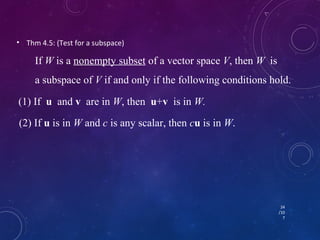
• Thm 4.5: (Test for a subspace) 
If W is a nonempty subset of a vector space V, then W is 
a subspace of V if and only if the following conditions hold. 
24 
/10 
7 
(1) If u and v are in W, then u+v is in W. 
(2) If u is in W and c is any scalar, then cu is in W.
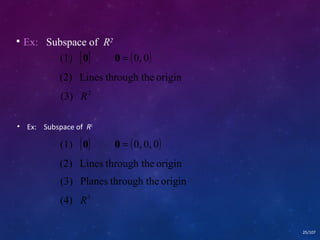
• Ex: Subspace of R3 
(1) {0} 0 = (0, 0, 0) 
(2) Lines through the origin 
25/107 
 Ex: Subspace of R2 
(1) {0} 0 = (0, 0) 
(2) Lines through the origin 
(3) R2 
(3) Planes through the origin 
(4) R3
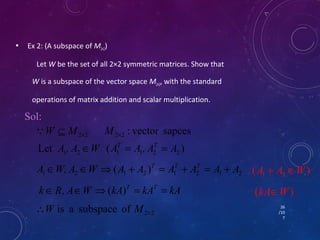
 Ex 2: (A subspace of M2×2) 
Let W be the set of all 2×2 symmetric matrices. Show that 
W is a subspace of the vector space M2×2, with the standard 
operations of matrix addition and scalar multiplication. 
26 
/10 
7 
Sol: 
: vector sapces 2´2 2´2 W Í M M 
Let ( ) 1 2 1 1 2 2 A , A ÎW AT = A , AT = A 
( ) 1 2 1 2 1 2 1 2 A ÎW, A ÎW Þ A + A T = AT + AT = A + A 
k ÎR, AÎW Þ(kA)T = kAT = kA 
2 2 is a subspace of ´ W M 
( ) 1 2 A + A ÎW 
(kAÎW)
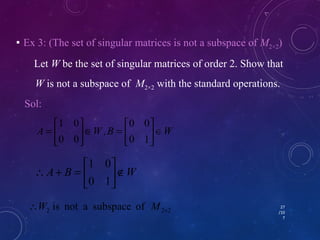
 Ex 3: (The set of singular matrices is not a subspace of M2×2) 
Let W be the set of singular matrices of order 2. Show that 
W is not a subspace of M2×2 with the standard operations. 
27 
/10 
7 
ù 
úû 
ù 
é 
Î = 1 0 
é 
= 
0 0 
Sol: 
W B , W A Î úû 
ù 
é 
1 0 
êë 
êë 
0 1 
0 0 
W B A Ï úû 
êë 
 + = 
0 1 
2 2 2 is not a subspace of ´ W M
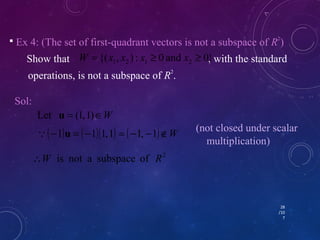
 Ex 4: (The set of first-quadrant vectors is not a subspace of R2) 
{( , ) : 0 and 0} 1 2 1 2 W = x x x ³ x ³ 
Show that , with the standard 
operations, is not a subspace of R2. 
Sol: 
(-1)u = (-1)(1, 1) = (-1, -1)ÏW (not closed under scalar 
28 
/10 
7 
Let u = (1, 1)ÎW 
W is not a subspace of R2 
multiplication)
29 
/10 
7 
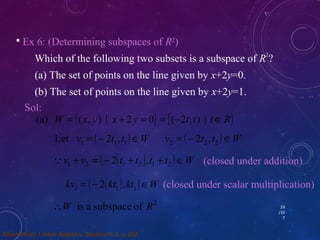
 Ex 6: (Determining subspaces of R2) 
Which of the following two subsets is a subspace of R2? 
(a) The set of points on the line given by x+2y=0. 
(b) The set of points on the line given by x+2y=1. 
Sol: 
(a) W = {(x, y) x + 2y = 0} = {(-2t,t) tÎR} 
v = (- t t ) ÎW v = (- t t ) ÎW 1 1 1 2 2 2 Let 2 , 2 , 
v + v = (- (t + t ),t + t )ÎW 1 2 1 2 1 2  2 
kv = (- (kt ),kt )ÎW 1 1 1 2 
W is a subspace of R2 
(closed under addition) 
(closed under scalar multiplication) 
Elementary Linear Algebra: Section 4.3, p.202
30 
/10 
7 
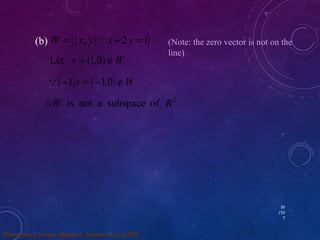
W = {( x, y) x + 2y =1} 
Let v = (1,0)ÎW 
(-1)v = (-1,0)ÏW 
W is not a subspace of R2 
(b) (Note: the zero vector is not on the 
line) 
Elementary Linear Algebra: Section 4.3, p.203
31 
/10 
7 
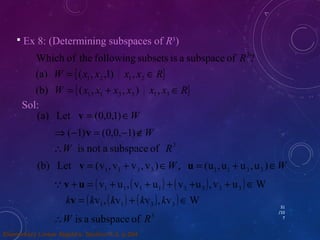
 Ex 8: (Determining subspaces of R3) 
Which of the following subsets is a subspace of ? 
{ } 
W = x x x x Î 
R 
(a) ( , ,1) , 
1 2 1 2 
W { x x x x x x R} 
R 
= + Î 
1 1 3 3 1 3 
3 
(b) ( , , ) , 
Sol: 
(a) Let v = (0,0,1)ÎW 
Þ(-1)v = (0,0,-1)ÏW 
W is not a subspace of R3 
(b) Let = (v , v + v , v )ÎW, = (u , u + u , u )ÎW 1 1 3 3 1 1 3 3 v u 
(v u ,(v u ) (v u ), v u ) W 1 1 1 1 3 3 3 3 v + u = + + + + + Î 
( v ,( v ) ( v ), v ) W 1 1 3 3 kv = k k + k k Î 
W is a subspace of R3 
Elementary Linear Algebra: Section 4.3, p.204
32 
/10 
7 
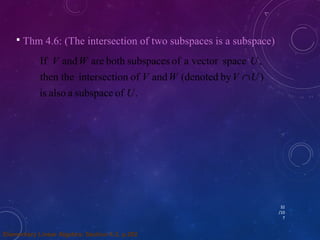
 Thm 4.6: (The intersection of two subspaces is a subspace) 
V W U 
If and are both subspaces of a vector space , 
then the intersection of and (denoted by ) 
U 
is also a subspace of . 
V W V Ç 
U 
Elementary Linear Algebra: Section 4.3, p.202

Ch4

  • 1.
    VECTOR SPACES 4.1VECTORS IN RN 4.2 VECTOR SPACES 4.3 SUBSPACES OF VECTOR SPACES 4.4 SPANNING SETS AND LINEAR INDEPENDENCE 4.5 BASIS AND DIMENSION 4.6 RANK OF A MATRIX AND SYSTEMS OF LINEAR EQUATIONS 4.7 COORDINATES AND CHANGE OF BASIS
  • 2.
    WEL COME •PATEL SUJAY A (130390119086) • PATEL TRUPAL S (130390119087) • PATEL KUNTAK (130390119070) • PATEL PARTH (130390119081) 2 /10 7
  • 3.
    4.1 VECTORS INRN 3 /10 7  An ordered n-tuple: a sequence of n real number ( , , , ) 1 2 n x x  x  n-space: Rn the set of all ordered n-tuple
  • 4.
    4 /10 7 n = 4 R4 = 4-space = set of all ordered quadruple of real numbers (x1, x2 , x3, x4 ) R1 = 1-space = set of all real number n = 1 n = 2 R2 = 2-space = set of all ordered pair of real numbers (x1, x2 ) n = 3 R3 = 3-space = set of all ordered triple of real numbers (x1, x2 , x3 )  Ex:
  • 5.
    • Notes: (1)An n-tuple can be viewed as a point in Rn with the xi’s as its coordinates. (2) An n-tuple can be viewed as a vector in Rn with the xi’s as its components. 5 /10 7  Ex: a point ( x1, x2 ) a vector ( ) x1, x2 (0,0) ( , , , ) 1 2 n x x  x ( , , , ) 1 2 n x x  x ( , , , ) 1 2 n x = x x  x
  • 6.
    ( n )( n ) u ,u , ,u , v ,v , ,v u = 1 2  v = 1 2  (two vectors in Rn) 6 /10 7  Equal: u = v if and only if n n u = v , u = v , , u = v 1 1 2 2   Vector addition (the sum of u and v): ( ) n n + = u + v , u + v , , u + v u v 1 1 2 2   Scalar multiplication (the scalar multiple of u by c): ( ) n c cu ,cu , ,cu u = 1 2   Notes: The sum of two vectors and the scalar multiple of a vector in Rn are called the standard operations in Rn.
  • 7.
    7 /10 7  Negative: ( , , ,..., ) 1 2 3 n - u = -u -u -u -u  Difference: ( , , ,..., ) 1 1 2 2 3 3 n n u - v = u - v u - v u - v u - v  Zero vector: 0 = (0, 0, ..., 0)  Notes: (1) The zero vector 0 in Rn is called the additive identity in Rn. (2) The vector –v is called the additive inverse of v.
  • 8.
    • Thm 4.2:(Properties of vector addition and scalar multiplication) Let u, v, and w be vectors in Rn , and let c and d be scalars. 8 /10 7 (1) u+v is a vector in Rn (2) u+v = v+u (3) (u+v)+w = u+(v+w) (4) u+0 = u (5) u+(–u) = 0 (6) cu is a vector in Rn (7) c(u+v) = cu+cv (8) (c+d)u = cu+du (9) c(du) = (cd)u (10) 1(u) = u
  • 9.
    • Ex 5:(Vector operations in R4) Let u=(2, – 1, 5, 0), v=(4, 3, 1, – 1), and w=(– 6, 2, 0, 3) be vectors in R4. Solve x for x in each of the following. (a) x = 2u – (v + 3w) (b) 3(x+w) = 2u – v+x 9 /10 7 Sol: (a) x u v w = - + u v w 2 ( 3 ) = - - 2 3 = - - - - - (4, 2, 10, 0) (4, 3, 1, 1) ( 18, 6, 0, 9) = - + - - - - - + - (4 4 18, 2 3 6, 10 1 0, 0 1 9) = - - (18, 11, 9, 8).
  • 10.
    10 /10 7 (b) x + w = u - v + x 3( ) 2 x + w = u - v + x 3 3 2 x - x = u - v - w 3 2 3 x = u - v - w 2 2 3 = - 1 - ( ) ( ) ( ) (9, , , 4) = + - + - 2,1,5,0 2, , , 9, 3,0, 9 2 11 2 9 2 1 2 1 2 3 2 2 3 2 = - - - - - x u v w
  • 11.
    • Thm 4.3:(Properties of additive identity and additive inverse) Let v be a vector in Rn and c be a scalar. Then the following is true. (1) The additive identity is unique. That is, if u+v=v, then u = 0 (2) The additive inverse of v is unique. That is, if v+u=0, then u = –v (3) 0v=0 (4) c0=0 (5) If cv=0, then c=0 or v=0 (6) –(– v) = v 11 /10 7
  • 12.
    The vector xis called a linear combination of , if it can be expressed in the form • Linear combination: , , , : scalar 1 2 n c c  c 12/107  Ex 6: Given x = (– 1, – 2, – 2), u = (0,1,4), v = (– 1,1,2), and w = (3,1,2) in R3, find a, b, and c such that x = au+bv+cw. Sol: b c - + = - 3 1 2 a b c + + = - a b c + + = - 4 2 2 2 Þa =1, b = -2, c = -1 Thus x = u - 2v -w n v , v ,..., v 1 2 n n x c v c v c v 1 2 = 1 + 2 ++
  • 13.
     Notes: 13 /10 7 A vector ( , , , ) in can be viewed as: 1 2 n u = u u  u Rn [ , , , ] 1 2 n u = u u  u ù ú ú ú ú û u é = ê ê ê ê 1 u n u ë  2 u or a 1×n row matrix (row vector): a n×1 column matrix (column vector): (The matrix operations of addition and scalar multiplication give the same results as the corresponding vector operations)
  • 14.
    Vector addition Scalarmultiplication u v   u u u v v v = + + + ( , , , ) ( , , , ) n n u v   u u u v v v = + + + [ , , , ] [ , , , ] n n ù ú ú ú ú û u v u v u v u v u v u v é = ê ê ê ê ë ù ú ú ú ú û 1 2 1 2 u 1 2 1 2 é = ê ê ê ê 1 ù u ë cu 1 cu n n cu u u + v c c   2 2 u u = c c u u u ( , , , ) u = c c u u u [ , , , ] 14 /10 7 ( , , , ) 1 1 2 2 n n + = +  [ , , , ] 1 1 2 2 n n + = +  ú ú ú ú û é ê ê ê ê 1 1 u v 1 1    ë + + = ù ú ú ú ú û é + ê ê ê ê ë ù ú ú ú ú û u é ê ê ê ê u ë + = v v v u v n n n n u 2 2 2 2 u v 1 2  ( , , , ) 1 2 n n cu cu  cu = 1 2  [ , , , ] 1 2 n n cu cu  cu =
  • 15.
    4.2 VECTOR SPACES • Vector spaces: 15/107 Let V be a set on which two operations (vector addition and scalar multiplication) are defined. If the following axioms are satisfied for every u, v, and w in V and every scalar (real number) c and d, then V is called a vector space. Addition: (1) u+v is in V (2) u+v=v+u (3) u+(v+w)=(u+v)+w (4) V has a zero vector 0 such that for every u in V, u+0=u (5) For every u in V, there is a vector in V denoted by –u such that u+(–u)=0
  • 16.
    16 /10 7 Scalar multiplication: (6) c u is in V. (7) c ( u + v ) = c u + c v (8) (c + d)u = cu + du (9) c(du) = (cd)u (10) 1(u) = u
  • 17.
    • Notes: 17/107 (1) A vector space consists of four entities: a set of vectors, a set of scalars, and two operations V:nonempty set c:scalar ( , ) : u u + = + vector addition u v u v · c = c ( , ) : scalar multiplication (V, +, ·) is called a vector space (2) V = {0}: zero vector space
  • 18.
    • Examples ofvector spaces: ( , , , ) ( , , , ) ( , , , ) 1 2 n 1 2 n 1 1 2 2 n n u u  u + v v  v = u + v u + v  u + v vector addition scalar multiplication 18/107 (1) n-tuple space: Rn ( , , , ) ( , , , ) 1 2 n 1 2 n k u u  u = ku ku  ku (2) Matrix space: m (tnhe set of all m×n matrices with real values) V M ´ = Ex: :(m = n = 2) ù úû é êë u + v u + v 11 11 12 12 + + ù = úû é + úû ù êë é êë 21 21 22 22 v v 11 12 21 22 u u 11 12 21 22 u v u v v v u u ù úû é = úû êë ù é u u k êë ku ku 11 12 21 22 11 12 21 22 ku ku u u vector addition scalar multiplication
  • 19.
    19/107 (3) n-thdegree polynomial space: V P (x) n = (the set of all real polynomials of degree n or less) n n n p(x) q(x) (a b ) (a b )x (a b )x 0 0 1 1 + = + + + ++ + n nkp x = ka0 + ka1x ++ ka x ( ) (4) Function space: V = c(-¥(the ,¥set ) of all real-valued continuous functions defined on the entire real line.) ( f + g)(x) = f (x) + g(x) (kf )(x) = kf (x)
  • 20.
    20/107  Thm4.4: (Properties of scalar multiplication) Let v be any element of a vector space V, and let c be any scalar. Then the following properties are true. v = 0 (1) 0 0 = 0 v 0 v 0 c c = = = (2) c (3) If , then 0 or v v - = - (4) ( 1)
  • 21.
    • Notes: Toshow that a set is not a vector space, you need only find one axiom that is not satisfied.  Ex 6: The set of all integer is not a vector space. ÎV , ÎR 2 1 1 (1 )(1) = 1 ÏV (it is not closed under scalar multiplication) 2 2 ­ ­ ­ scalar noninteger  Ex 7: The set of all second-degree polynomials is not a vector space. 21/107 Pf: Let p ( x ) = x 2 and q(x) = -x2 + x +1 Þ p(x) + q(x) = x +1ÏV (it is not closed under vector addition) Pf: integer
  • 22.
    • Ex 8: ( , ) ( , ) ( , ) 1 2 1 2 1 1 2 2 u u + v v = u + v u + v 22/107 V=R2=the set of all ordered pairs of real numbers vector addition: scalar multiplication: ( , ) ( ,0) 1 2 1 c u u = cu Verify V is not a vector space. Sol: 1(1, 1) = (1, 0) ¹ (1, 1) the set (together with the two given operations) is not a vector space
  • 23.
    4.3 SUBSPACES OFVECTOR SPACES • Subspace: (V,+,·) W f þ ý ü ¹ W Í V 23/107 : a vector space : a nonempty subset (W,+,·):a vector space (under the operations of addition and scalar multiplication defined in V) Þ W is a subspace of V  Trivial subspace: Every vector space V has at least two subspaces. (1) Zero vector space {0} is a subspace of V. (2) V is a subspace of V.
  • 24.
    • Thm 4.5:(Test for a subspace) If W is a nonempty subset of a vector space V, then W is a subspace of V if and only if the following conditions hold. 24 /10 7 (1) If u and v are in W, then u+v is in W. (2) If u is in W and c is any scalar, then cu is in W.
  • 25.
    • Ex: Subspaceof R3 (1) {0} 0 = (0, 0, 0) (2) Lines through the origin 25/107  Ex: Subspace of R2 (1) {0} 0 = (0, 0) (2) Lines through the origin (3) R2 (3) Planes through the origin (4) R3
  • 26.
     Ex 2:(A subspace of M2×2) Let W be the set of all 2×2 symmetric matrices. Show that W is a subspace of the vector space M2×2, with the standard operations of matrix addition and scalar multiplication. 26 /10 7 Sol: : vector sapces 2´2 2´2 W Í M M Let ( ) 1 2 1 1 2 2 A , A ÎW AT = A , AT = A ( ) 1 2 1 2 1 2 1 2 A ÎW, A ÎW Þ A + A T = AT + AT = A + A k ÎR, AÎW Þ(kA)T = kAT = kA 2 2 is a subspace of ´ W M ( ) 1 2 A + A ÎW (kAÎW)
  • 27.
     Ex 3:(The set of singular matrices is not a subspace of M2×2) Let W be the set of singular matrices of order 2. Show that W is not a subspace of M2×2 with the standard operations. 27 /10 7 ù úû ù é Î = 1 0 é = 0 0 Sol: W B , W A Î úû ù é 1 0 êë êë 0 1 0 0 W B A Ï úû êë + = 0 1 2 2 2 is not a subspace of ´ W M
  • 28.
     Ex 4:(The set of first-quadrant vectors is not a subspace of R2) {( , ) : 0 and 0} 1 2 1 2 W = x x x ³ x ³ Show that , with the standard operations, is not a subspace of R2. Sol: (-1)u = (-1)(1, 1) = (-1, -1)ÏW (not closed under scalar 28 /10 7 Let u = (1, 1)ÎW W is not a subspace of R2 multiplication)
  • 29.
    29 /10 7  Ex 6: (Determining subspaces of R2) Which of the following two subsets is a subspace of R2? (a) The set of points on the line given by x+2y=0. (b) The set of points on the line given by x+2y=1. Sol: (a) W = {(x, y) x + 2y = 0} = {(-2t,t) tÎR} v = (- t t ) ÎW v = (- t t ) ÎW 1 1 1 2 2 2 Let 2 , 2 , v + v = (- (t + t ),t + t )ÎW 1 2 1 2 1 2  2 kv = (- (kt ),kt )ÎW 1 1 1 2 W is a subspace of R2 (closed under addition) (closed under scalar multiplication) Elementary Linear Algebra: Section 4.3, p.202
  • 30.
    30 /10 7 W = {( x, y) x + 2y =1} Let v = (1,0)ÎW (-1)v = (-1,0)ÏW W is not a subspace of R2 (b) (Note: the zero vector is not on the line) Elementary Linear Algebra: Section 4.3, p.203
  • 31.
    31 /10 7  Ex 8: (Determining subspaces of R3) Which of the following subsets is a subspace of ? { } W = x x x x Î R (a) ( , ,1) , 1 2 1 2 W { x x x x x x R} R = + Î 1 1 3 3 1 3 3 (b) ( , , ) , Sol: (a) Let v = (0,0,1)ÎW Þ(-1)v = (0,0,-1)ÏW W is not a subspace of R3 (b) Let = (v , v + v , v )ÎW, = (u , u + u , u )ÎW 1 1 3 3 1 1 3 3 v u (v u ,(v u ) (v u ), v u ) W 1 1 1 1 3 3 3 3 v + u = + + + + + Î ( v ,( v ) ( v ), v ) W 1 1 3 3 kv = k k + k k Î W is a subspace of R3 Elementary Linear Algebra: Section 4.3, p.204
  • 32.
    32 /10 7  Thm 4.6: (The intersection of two subspaces is a subspace) V W U If and are both subspaces of a vector space , then the intersection of and (denoted by ) U is also a subspace of . V W V Ç U Elementary Linear Algebra: Section 4.3, p.202