醫學系「免疫與感染學 V 」模組 

Vasculitis
魏正宗
 

中山醫學大學附設醫院過敏免疫風濕科主任
Tel: 04 24729595 ext 34314; Email: wei3228@gmail.com
References


eMedicine :
– Microscopic Polyangiitis
http://www.emedicine.com/med/topic2931.htm
– Polyarteritis Nodosa
http://www.emedicine.com/neuro/topic314.htm
– Wegener Granulomatosis
http://www.emedicine.com/ped/topic2430.htm



UpToDate :vasculitis
http://www.lib.csmu.edu.tw/overlib/2305.php
學習目標
 Vasculitis

– Spectrum
– Pathophysiology
– Clinical manifestations
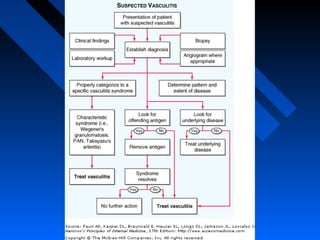
– Diagnosis
– Treatment
– Prognosis
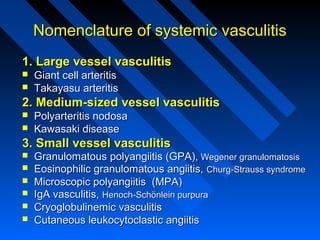
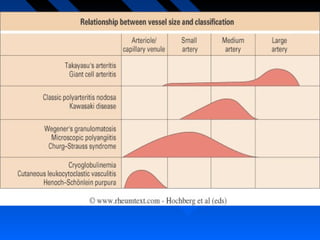
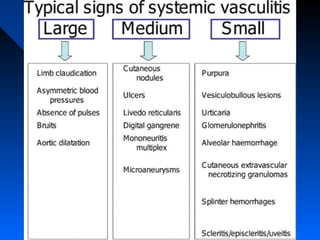
Nomenclature of systemic vasculitis
1. Large vessel vasculitis



Giant cell arteritis
Takayasu arteritis

2. Medium-sized vessel vasculitis



Polyarteritis nodosa
Kawasaki disease

3. Small vessel vasculitis







Granulomatous polyangiitis (GPA), Wegener granulomatosis
Eosinophilic granulomatous angiitis, Churg-Strauss syndrome
Microscopic polyangiitis (MPA)
IgA vasculitis, Henoch-Schönlein purpura
Cryoglobulinemic vasculitis
Cutaneous leukocytoclastic angiitis
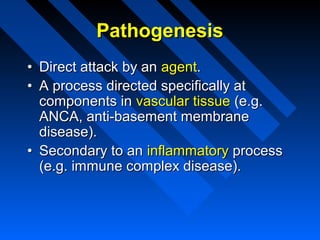
Pathogenesis
• Direct attack by an agent.
• A process directed specifically at
components in vascular tissue (e.g.
ANCA, anti-basement membrane
disease).
• Secondary to an inflammatory process
(e.g. immune complex disease).
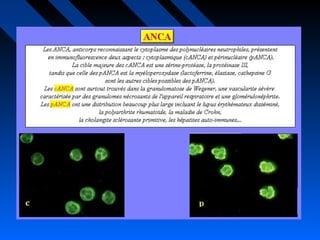
Antineutrophil cytoplasmic
antibodies, ANCA





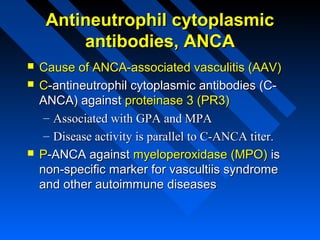
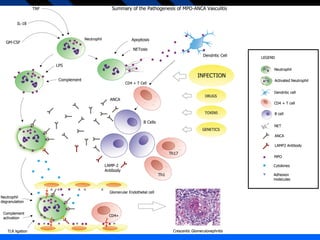
Cause of ANCA-associated vasculitis (AAV)
C-antineutrophil cytoplasmic antibodies (CANCA) against proteinase 3 (PR3)
– Associated with GPA and MPA
– Disease activity is parallel to C-ANCA titer.
P-ANCA against myeloperoxidase (MPO) is
non-specific marker for vascultiis syndrome
and other autoimmune diseases
血管炎的臨床表現










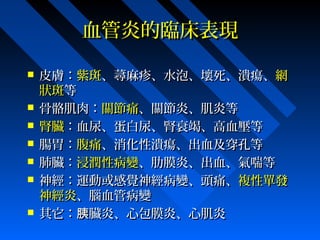
皮膚:紫斑、蕁麻疹、水泡、壞死、潰瘍、網
狀斑等
骨骼肌肉:關節痛、關節炎、肌炎等
腎臟:血尿、蛋白尿、腎衰竭、高血壓等
腸胃:腹痛、消化性潰瘍、出血及穿孔等
肺臟:浸潤性病變、肋膜炎、出血、氣喘等
神經:運動或感覺神經病變、頭痛、複性單發
神經炎、腦血管病變
其它:胰臟炎、心包膜炎、心肌炎
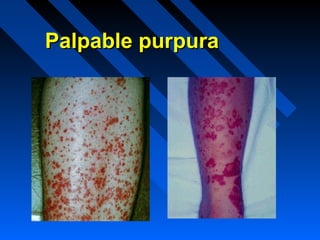
Palpable purpura
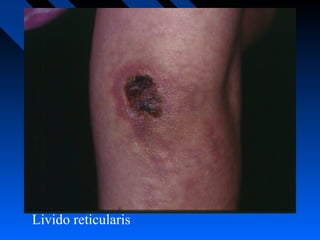
Livido reticularis
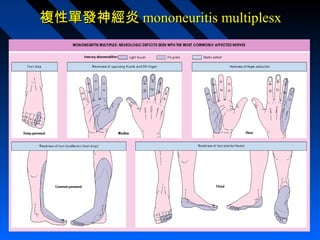
複性單發神經炎 mononeuritis multiplesx
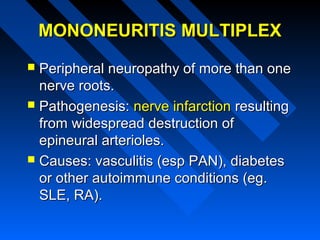
MONONEURITIS MULTIPLEX
Peripheral neuropathy of more than one
nerve roots.
 Pathogenesis: nerve infarction resulting
from widespread destruction of
epineural arterioles.
 Causes: vasculitis (esp PAN), diabetes
or other autoimmune conditions (eg.
SLE, RA).

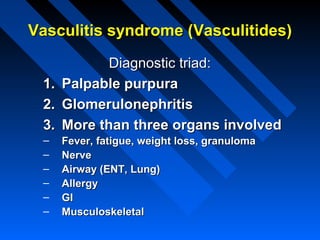
Vasculitis syndrome (Vasculitides)
1.
2.
3.

Diagnostic triad:
Palpable purpura
Glomerulonephritis
More than three organs involved

–
–
–
–
–
–

Fever, fatigue, weight loss, granuloma
Nerve
Airway (ENT, Lung)
Allergy
GI
Musculoskeletal
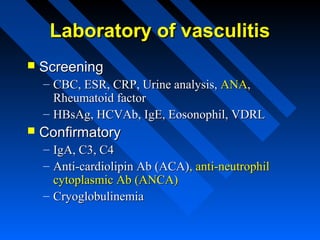
Laboratory of vasculitis


Screening
– CBC, ESR, CRP, Urine analysis, ANA,
Rheumatoid factor
– HBsAg, HCVAb, IgE, Eosonophil, VDRL



Confirmatory
– IgA, C3, C4
– Anti-cardiolipin Ab (ACA), anti-neutrophil
cytoplasmic Ab (ANCA)
– Cryoglobulinemia
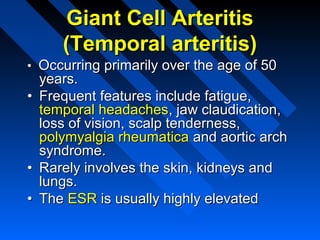
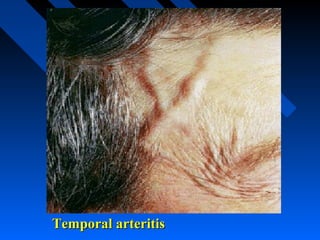
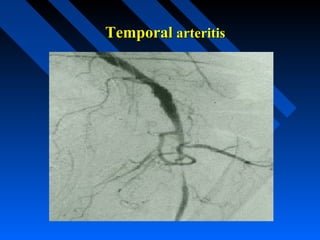
Giant Cell Arteritis
(Temporal arteritis)
• Occurring primarily over the age of 50

years.
• Frequent features include fatigue,
temporal headaches, jaw claudication,
loss of vision, scalp tenderness,
polymyalgia rheumatica and aortic arch
syndrome.
• Rarely involves the skin, kidneys and
lungs.
• The ESR is usually highly elevated
Temporal arteritis
Temporal arteritis
Polymyalgia Rheumatica







Myalgia, low-grade fever, fatigue, weight loss and
an elevated ESR.
May combined with temporal arteritis
Morning stiffness is usually the predominant
feature
Muscular pain is often diffuse and is accentuated
by movement; pain at night is common.
Muscle strength is unimpaired although the pain
makes interpretation of muscle testing difficult.
Rx: Corticosteroid treatment is for at least 2
years.
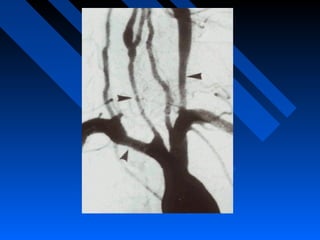
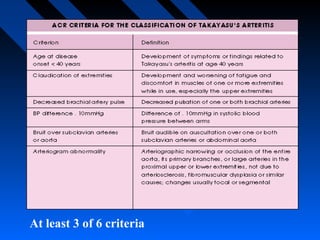
TAKAYASU’S ARTERITIS




Affecting aorta and its major branches.
most commonly in females under 40 years of
age.
Clinical features
• Systemic phase: malaise, fever, night
sweats and fatigue.
• Occlusive phase: upper limb claudication,
headaches, postural dizziness and visual
disturbances.
• Reduced or absent upper limb pulses.
• Arterial bruits over the carotid, abdominal
and subclavian vessels.
At least 3 of 6 criteria
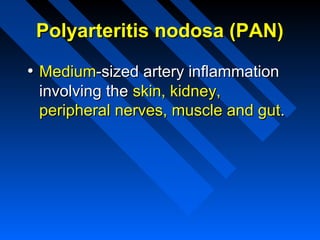
Polyarteritis nodosa (PAN)
• Medium-sized artery inflammation
involving the skin, kidney,
peripheral nerves, muscle and gut.
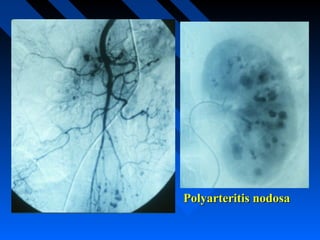
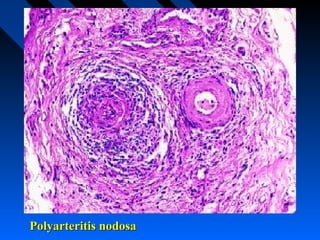
Polyarteritis nodosa
Kawasaki disease







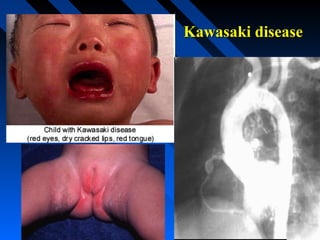
An acute febrile disease occuring most
commonly in infants and children under 5
years of age.
Sore red eyes , red lips tongue or mouth.
Redness or swelling of the hands and feet.
Rash all over the body.
Vasculitis, especially of the coronary arteries,
is the most serious and life-threatening
complication of the disease.
Kawasaki disease
Granulomatosis with polyangiitis, GPA


2011-4 前舊名 WEGENER'S GRANULOMATOSIS
韋格納氏肉芽腫 (WG)

Young and middle age adults
 Small and occasionally medium-sized
vessel vasculitis
 Midline granuloma


– Necrosis, granuloma formation and vasculitis of
the upper and lower respiratory tracts.

Glomerulonephritis in 75% of patients.
 Fever, malaise, weight loss, arthralgia, ,
sinusitis, nasal or oral ulceration, purpura
 C-ANCA related.

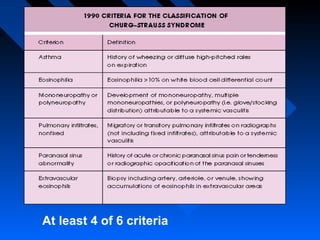
Eosinophilic granulomatous angiitis
(CHURG–STRAUSS SYNDROME)



Small sized artery granulomatous
inflammation.
Clinical features
• History of atopy.
• Constitutional symptoms – fever, anorexia,
weight loss.
• Asthma.
• Peripheral neuropathy.
• Skin involvement – nodular lesions over
pressure areas.
• Peripheral eosinophilia.
At least 4 of 6 criteria
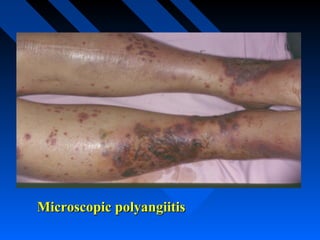
Microscopic polyangiitis, MPA








Pathogenesis is presumed to be due to
circulating immune complexes.
Cutaneous involvement – palpable purpura or
urticaria-like lesions are most common, less
common are livedo reticularis, ulcerations or
necrosis.
Systemic involvement – arthritis,
glomerulonephritis, gastrointestinal
hemorrhage or colic are most common.
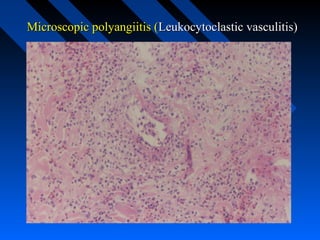
Skin biopsy: leukocytoclastic vasculitis
Kidney biopsy: pauci-immune segmental
necrotizing glomerulonephritis
Microscopic polyangiitis
Microscopic polyangiitis (Leukocytoclastic vasculitis)
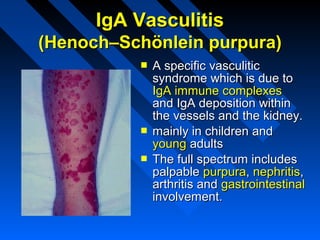
IgA Vasculitis
(Henoch–Schönlein purpura)





A specific vasculitic
syndrome which is due to
IgA immune complexes
and IgA deposition within
the vessels and the kidney.
mainly in children and
young adults
The full spectrum includes
palpable purpura, nephritis,
arthritis and gastrointestinal
involvement.
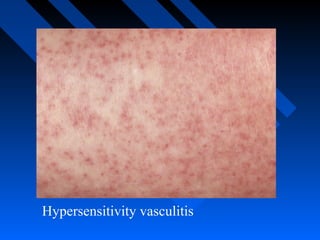
Hypersensitivity vasculitis
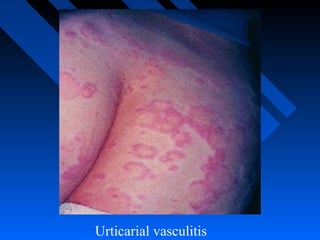
Urticarial vasculitis
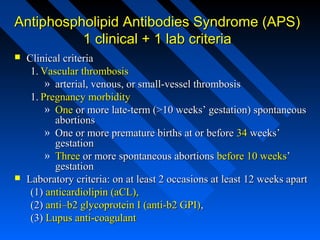
Antiphospholipid Antibodies Syndrome (APS)
1 clinical + 1 lab criteria




Clinical criteria
1. Vascular thrombosis
» arterial, venous, or small-vessel thrombosis
1. Pregnancy morbidity
» One or more late-term (>10 weeks’ gestation) spontaneous
abortions
» One or more premature births at or before 34 weeks’
gestation
» Three or more spontaneous abortions before 10 weeks’
gestation
Laboratory criteria: on at least 2 occasions at least 12 weeks apart
(1) anticardiolipin (aCL),
(2) anti–b2 glycoprotein I (anti-b2 GPI),
(3) Lupus anti-coagulant
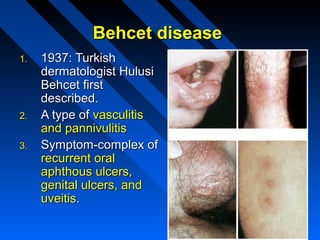
Behcet disease
1.

2.
3.

1937: Turkish
dermatologist Hulusi
Behcet first
described.
A type of vasculitis
and pannivulitis
Symptom-complex of
recurrent oral
aphthous ulcers,
genital ulcers, and
uveitis.
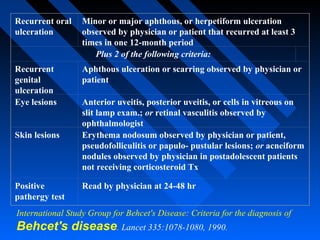
Recurrent oral
ulceration

Minor or major aphthous, or herpetiform ulceration
observed by physician or patient that recurred at least 3
times in one 12-month period
Plus 2 of the following criteria:

Recurrent
genital
ulceration
Eye lesions

Aphthous ulceration or scarring observed by physician or
patient

Skin lesions

Positive
pathergy test

Anterior uveitis, posterior uveitis, or cells in vitreous on
slit lamp exam.; or retinal vasculitis observed by
ophthalmologist
Erythema nodosum observed by physician or patient,
pseudofolliculitis or papulo- pustular lesions; or acneiform
nodules observed by physician in postadolescent patients
not receiving corticosteroid Tx
Read by physician at 24-48 hr

International Study Group for Behcet's Disease: Criteria for the diagnosis of

Behcet's disease. Lancet 335:1078-1080, 1990.
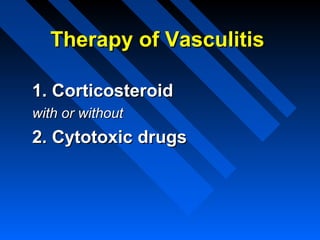
Therapy of Vasculitis
1. Corticosteroid
with or without

2. Cytotoxic drugs
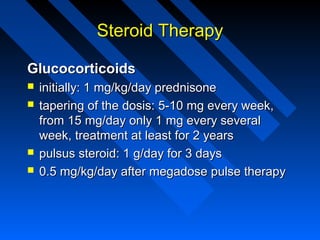
Steroid Therapy
Glucocorticoids






initially: 1 mg/kg/day prednisone
tapering of the dosis: 5-10 mg every week,
from 15 mg/day only 1 mg every several
week, treatment at least for 2 years
pulsus steroid: 1 g/day for 3 days
0.5 mg/kg/day after megadose pulse therapy
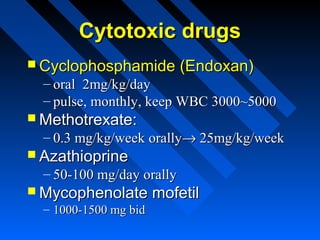
Cytotoxic drugs
 Cyclophosphamide

(Endoxan)

– oral 2mg/kg/day
– pulse, monthly, keep WBC 3000~5000

 Methotrexate:

– 0.3 mg/kg/week orally→ 25mg/kg/week

 Azathioprine

– 50-100 mg/day orally

 Mycophenolate
– 1000-1500 mg bid

mofetil
Indication for addition of
cytotoxic drug to prednisone
on initial evaluation, rapidly
progressive vasculitis with significant
visceral involvement
 prednisone in high daily divided dosis
is not controlling the activity and
progression of vasculitis
 prednisone dose cannot be tapered
to tolerable level and still controll the
disease

Other Treatment of Vasculitis
1.
2.
3.
4.
5.

Aspirin
Anticoagulants
Plasmapheresis
Intravenous immunoglobulin, IVIG
Biological agents
1. Anti-TNFα: (−)
2. Anti-CD20, Rituximab for ANCA-associated
vasculitis
Conclusion
Vasculitis is a syndrome and disease
spectrum
 Classification depends on vascular size
and clinical manifestations
 ANCA, anti-cardiolipin antibody are key
autoantibodies
 Treated by steroid and cytotoxic drugs


Vasculitis 2013

Editor's Notes

  • #42 sensitivity of 91 percent and specificity of 96 percent.