 Vasculitis- Inflammation of blood vessels
characterised by leucocytic infiltration of the
vessel walls
 Different patterns of vessels’ involvement in
different entities
 Vessel lumen compromisedischemia of the
corresponding organ
• 3 main groups of pathogenetic mechanisms
behind vasculitis-
1. Immune complex formation
2. ANCA mediated
3. T lymphocyte mediated with Granuloma
formation
• Henoch Schonlein purpura- IgA mediated
• SLE & other collagen vascular diseases-
ANA
• Serum sickness
• Polyarteritis Nodosa- Hepatitis B ag
• Essential Mixed Cryoglobinemia- Hepatitis
C virion
*deposition of immune complexes in the blood
vesselsactivation of
complementsdestruction of vessel wall
(acute & chronic inflammation)
• P-ANCA (anti-proteinase 3)- Wegener’s
• C-ANCA (anti-MPO)
- Churg Strauss vasculitis
- Microscopic Polyangiitis
- Wegener’s granulomatosis
* Aberrant expression of proteinase 3 and MPO
over the surface of the neutrophilsformation
of antibodiesdestruction of
neutrophilsvessel wall damage
• Giant cell arteritis
• Takayasu’s arteritis
• Wegener’s granulomatosis
• Churg Strauss vasculitis
*classical granuloma formation (giant cells and
epitheloid cells in a backround of fibrinoid
necrosis) can be demonstrated in the
corresponding vessel biopsy
“LEARN TO RECOGNISE
VASCULITIS”
 Palpable purpura (cutaneous vasculitis)
 Pulmonary infiltrates
 Glomerulonephritis (microscopic hematuria)
 Mononeuritis multiplex
 Unexplained ischemic events- Myocardial
Infarction, Stroke, Raynaud’s phenomena,
Digital gangrene, Mesentric Ischemia
RULE OUT SECONDARY CAUSES OF
VASCULITIS!!
i.e- diseases where vasculitis is one of the clinical
manifestations of the respective disease
 Infections
 Malignancies
 Thrombotic Microangiopathies
 Drugs
 Others
• Bacterial endocarditis
• Gonococcal Infection
• Syphilis
• Rickettsial diseases
• Histoplasmosis
• Coccidiomycosis
• Whipple’s
• Lyme’s
 Atrial Myxomas
 Carcinomatosis
 Lymphomas
Thrombotic Microangiopathies
• TTP
• HUS
• Cocaine
• Phenytoin
• Sulfa drugs
• Penicillins
• Hydralazine
• Allopurinol
• Propylthiouracil
• Thiazides
 SLE
 Amyloidosis
 Sarcoidosis
 Migraine
 Atheroembolic Disease
THE PATTERN OF VESSEL INVOLVEMENT
(Large vessel, Medium vessel, Small vessel)
 Giant cell arteritis
 Takayasu’s arteritis
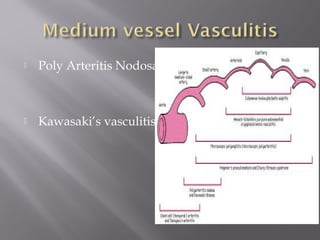
 Poly Arteritis Nodosa
 Kawasaki’s vasculitis
Pauci-immune (ANCA mediated)
Wegener’s Granulomatosis
Churg Strauss vasculitis
Microscopic Polyangiitis
Immune complex mediated
Henoch Schonlein Purpura
Essential Mixed Cryoglobulinemia
SLE and other collagen c=vascular diseases related
vascultis
 Thromb Angiitis Obliterans
 Behcet’s disease
 Idiopathic Cutaneous vasculitis
 Isolated Vasculitis of CNS
 Relapsing Polychondritis
 Polyangiitis overlap syndromes (features of
more than 1 vasculitis)
Learn the characteristic presentations of each vasculitis !
 Temporal arteritis
 Elderly persons more than 50 yrs. of age
 Non specific symptoms, Headache, Elevated
ESR
 BLINDNESS-most serious complication
 Jaw claudication, Scalp pain, Scalp Tenderness
 Polymyalgia Rheumatica- different end of the
spectrum of Giant Cell Arteritis
 Pulseless Disease
 Middle aged females
 Aorta and its branches mainly involved
 Subclavian vessels, Carotid vessels, Mesentric
vessels
 Chronic and Relapsing course
 Renal arteries most commonly involved
leading to renovascular hypertension
 Pulmonary vessels NEVER involved
 Association with patients of
o Hepatitis B
o Hairy cell leukemia
 MucoCutaneous Lymph node syndrome
 Children < 5 years of age mostly
 Desquamative erythematous rashes involving
the skin, mucus membranes, cervical
lymphadenopathy
 25 % develop coronary artery aneurysms in the
convalescent stage of the illness
Usually Pulmonary capillaritis PLUS
Glomerulonephritis
•Granulomas +, Asthma +  Churg Strauss
•Granulomas +, NO asthma  Wegener’s
•NO granulomas, NO asthma  Microscopic
Polyangiitis
• Classical triad  URT + LRT + renal
• Chronis sinusitis, Pulmonary nodules,
Pulmonary cavities, Rapidly Progressive
Glomerulonephritis
• Cutaneous vasculitis, Eye lesions may be
present
• Non specific symptoms may predominate
• Asthma, Eosinophilia with pulmonary infiltrates ,
glomerulonephritis
• Myocardial involvement  most common cause of
death
Microscopic Polyangiitis
• Pulmonary alveolar capillariitis,
glomerulonephritis
 2nd decade
 Palpable purpura over lower limbs,
 Gastrointestinal complaints (abd.colicky pain,
blood in stools),
 Fever, polyarthralgia
 Increased IgA levels in blood
 5 % of Chronic Hepatits C pts. Have EMC
 Cryoglobulins formed agianst HCV RNA
 Pulmonary, renal ( MPGN ), cutaneous
vasculitis
Thromb Angiitis Obliterans
• Chronic heavy Smokers
• Inflammation of arteries, veins, nerves
• Upper and lower limb gangrene, Instep
claudication, rest pain
 Behcet’s disease (Recurrent OculoOroGenital
ulcerations with vasculitis)
 Idiopathic Cutaneous vasculitis
 Isolated Vasculitis of CNS
 Relapsing Polychondritis
 Polyangiitis overlap syndromes (features of
more than 1 vasculitis)
 Step 1- Recognise vasculitis
 Step 2- Rule out Sec. Vasculitis
 Step 3- Study the pattern of vessels involved in
the patient
 Step 4- Remember the characteristic
presentations of each primary vasculitis
How to diagnose vasculitis???
• Mild Anemia – Anemia of Chronic Disease
• Differential Leucocyte Count:
Predominant eosinophils- Churg Strauss, HSP
ESR
• Non specific
• But useful test to suggest presence of
underlying inflammatory process
• Acute Phase Reactants
Highly sensitive C reactive Protein, Alpha 2
globulin
• Chest X ray / HRCT thorax:
-Pulmonary infiltrates- small vessel vasculitis
-Pulmonary cavities- Wegener’s granulomatosis
• Xray Para Nasal Sinuses
-Sinusitis of Wegener’s
• Urine routine- RBCs with active sediments
suggest Glomerulonephritis (Renal
involvement of small vessel vasculitis)
• Viral Markers
- Hep. B Poly Arteritis Nodosa
- Hep.C Essential Mixed Cryoglobulinemia
• Immunoglogulin levels (IgG, M, A)
- Usually hyper gammaglobulinemia seen
- Elevated IgA levelsHenoch Sconlein Purpura
• Cryoglobulins- Essential Mixed Cryoglobulinemia
• Rheumatoid Factors
-To detect secondary vasculitisRheumatoid Arthrits
-Significantly raised in Essential Mixed
Cryoglobulinemia also
• Complement levels (reduced in immune compex
mediated diseases)- EMC, HSP
• ANCA
 P-ANCA: Wegener’s Granulomatosis
 C-ANCA: Microscopic polyangiitis, Churg Strauss,
Wegener’s vasculitis
• ANA
-screening of SLE, collagen vascular disorders in
suspicion of secondary vasculitis
• Renal Biopsy- to detect glomerulonephritis
especially in small vessel vasculitis
 RPGN- seen in pauci immune vasculitis
 MPGN- seen in EMC
• Skin Biopsy- to detect “leukocytoclasis” in
cutaneous vasculitis all small vessel and
secondary vasculitides
• Temporal Artery Biopsy- Giant Cell Arteritis
• Pulmonary tissue Biopsy- Small vessel vascultides
• Upper Airway biopsies- Wegener’s Vasculitis
* Main purpose of biopsy is to study presence of
leukocytoclasis, characterisitc pathological
alterations in tissues, GRANULOMAS
* Immunofluorescence also helps to study immune
complex deposition, IgA deposition, Complement
deposition
 Helps specially in in arteries that cannot be
biopsied easily like Aorta, Coronary artery,
Mesentric vessels
 Presence of vascular patency, Aneurysms
• Aortic Angiography- Takayasu’s
• Cerebral Angiography- Isolated CNS vascultis
• Renal Angiography- PAN
• Coronary Angiography- Kawasaki’s
• Lower limb arteriography-Buerger’s Disease (TAO)
TREATMENT
• Immuno Suppression
Glucocorticoids- oral / IV methyl prednisolone
Cyclophosphamide
Methotrexate
Azathioprine
Cyclosporine
Rituximab- anti CD 20 ab
AntiTNF therapies- Infliximab, Adalimumab,
Etanacerpt, Certulizumab
• Choice of therapy depends on
 Severity of organ damage
 Extent of Multi System Involvement
 The vascular bed involved (renal, ocular,
coronary)
• Cyclophosphamide + Glucocorticoid therapy
preferred for severe / serious complications
• Glucocorticoids alone will suffice for isolated
mild vascultis like “idiopathic cutaneous
vascultis”
 Wherever possible secondary causes
(infections, malignancies) should be sought
and treated
 Anti viral therapy (HCV, HBV)
 ASPIRIN therapy – Kawasaki’s, Giant cell
arteritis
 Intravenous Immunogloguloin Therapy- Prevents
coronary aneurysms in Kawasaki’s
• Major toxic side effects of all prescribed drugs
need to be kept in mind
(Osteoporosis, growth retardation, bone marrow
suppression, hepatic toxicity, renal toxicity,
bladder cancer, cystitis …)
• Long term toxicities need to be prevented
• Long term prescription of a single group of
drug to be avoided change over to a drug
with lesser toxicity profile as soon as symptoms
are controlled
• Regular Monitoring of Blood Counts, Renal
and hepatic functions
• Most of the Primary vasculitides have one
thing in common
“Chronic, Responsive to treatment, But
Notoriously Relapsing”
 Step 1- Recognise vasculitis
 Step 2- Rule out Sec. Vasculitis
 Step 3- Study the pattern of vessels involved in
the patient
 Step 4- Remember the characteristic
presentations of each primary vasculitis
 Step 5- How to Diagnose
 Step 6- Principles of treatment
Dermatology(saculitis)

Dermatology(saculitis)

  • 2.
     Vasculitis- Inflammationof blood vessels characterised by leucocytic infiltration of the vessel walls  Different patterns of vessels’ involvement in different entities  Vessel lumen compromisedischemia of the corresponding organ
  • 3.
    • 3 maingroups of pathogenetic mechanisms behind vasculitis- 1. Immune complex formation 2. ANCA mediated 3. T lymphocyte mediated with Granuloma formation
  • 4.
    • Henoch Schonleinpurpura- IgA mediated • SLE & other collagen vascular diseases- ANA • Serum sickness • Polyarteritis Nodosa- Hepatitis B ag • Essential Mixed Cryoglobinemia- Hepatitis C virion *deposition of immune complexes in the blood vesselsactivation of complementsdestruction of vessel wall (acute & chronic inflammation)
  • 5.
    • P-ANCA (anti-proteinase3)- Wegener’s • C-ANCA (anti-MPO) - Churg Strauss vasculitis - Microscopic Polyangiitis - Wegener’s granulomatosis * Aberrant expression of proteinase 3 and MPO over the surface of the neutrophilsformation of antibodiesdestruction of neutrophilsvessel wall damage
  • 7.
    • Giant cellarteritis • Takayasu’s arteritis • Wegener’s granulomatosis • Churg Strauss vasculitis *classical granuloma formation (giant cells and epitheloid cells in a backround of fibrinoid necrosis) can be demonstrated in the corresponding vessel biopsy
  • 9.
  • 10.
     Palpable purpura(cutaneous vasculitis)  Pulmonary infiltrates  Glomerulonephritis (microscopic hematuria)  Mononeuritis multiplex  Unexplained ischemic events- Myocardial Infarction, Stroke, Raynaud’s phenomena, Digital gangrene, Mesentric Ischemia
  • 14.
    RULE OUT SECONDARYCAUSES OF VASCULITIS!! i.e- diseases where vasculitis is one of the clinical manifestations of the respective disease
  • 15.
     Infections  Malignancies Thrombotic Microangiopathies  Drugs  Others
  • 16.
    • Bacterial endocarditis •Gonococcal Infection • Syphilis • Rickettsial diseases • Histoplasmosis • Coccidiomycosis • Whipple’s • Lyme’s
  • 17.
     Atrial Myxomas Carcinomatosis  Lymphomas Thrombotic Microangiopathies • TTP • HUS
  • 18.
    • Cocaine • Phenytoin •Sulfa drugs • Penicillins • Hydralazine • Allopurinol • Propylthiouracil • Thiazides
  • 19.
     SLE  Amyloidosis Sarcoidosis  Migraine  Atheroembolic Disease
  • 20.
    THE PATTERN OFVESSEL INVOLVEMENT (Large vessel, Medium vessel, Small vessel)
  • 21.
     Giant cellarteritis  Takayasu’s arteritis
  • 22.
     Poly ArteritisNodosa  Kawasaki’s vasculitis
  • 23.
    Pauci-immune (ANCA mediated) Wegener’sGranulomatosis Churg Strauss vasculitis Microscopic Polyangiitis Immune complex mediated Henoch Schonlein Purpura Essential Mixed Cryoglobulinemia SLE and other collagen c=vascular diseases related vascultis
  • 24.
     Thromb AngiitisObliterans  Behcet’s disease  Idiopathic Cutaneous vasculitis  Isolated Vasculitis of CNS  Relapsing Polychondritis  Polyangiitis overlap syndromes (features of more than 1 vasculitis)
  • 25.
    Learn the characteristicpresentations of each vasculitis !
  • 26.
     Temporal arteritis Elderly persons more than 50 yrs. of age  Non specific symptoms, Headache, Elevated ESR  BLINDNESS-most serious complication  Jaw claudication, Scalp pain, Scalp Tenderness  Polymyalgia Rheumatica- different end of the spectrum of Giant Cell Arteritis
  • 28.
     Pulseless Disease Middle aged females  Aorta and its branches mainly involved  Subclavian vessels, Carotid vessels, Mesentric vessels  Chronic and Relapsing course
  • 30.
     Renal arteriesmost commonly involved leading to renovascular hypertension  Pulmonary vessels NEVER involved  Association with patients of o Hepatitis B o Hairy cell leukemia
  • 31.
     MucoCutaneous Lymphnode syndrome  Children < 5 years of age mostly  Desquamative erythematous rashes involving the skin, mucus membranes, cervical lymphadenopathy  25 % develop coronary artery aneurysms in the convalescent stage of the illness
  • 34.
    Usually Pulmonary capillaritisPLUS Glomerulonephritis •Granulomas +, Asthma +  Churg Strauss •Granulomas +, NO asthma  Wegener’s •NO granulomas, NO asthma  Microscopic Polyangiitis
  • 35.
    • Classical triad URT + LRT + renal • Chronis sinusitis, Pulmonary nodules, Pulmonary cavities, Rapidly Progressive Glomerulonephritis • Cutaneous vasculitis, Eye lesions may be present • Non specific symptoms may predominate
  • 37.
    • Asthma, Eosinophiliawith pulmonary infiltrates , glomerulonephritis • Myocardial involvement  most common cause of death Microscopic Polyangiitis • Pulmonary alveolar capillariitis, glomerulonephritis
  • 38.
     2nd decade Palpable purpura over lower limbs,  Gastrointestinal complaints (abd.colicky pain, blood in stools),  Fever, polyarthralgia  Increased IgA levels in blood
  • 40.
     5 %of Chronic Hepatits C pts. Have EMC  Cryoglobulins formed agianst HCV RNA  Pulmonary, renal ( MPGN ), cutaneous vasculitis Thromb Angiitis Obliterans • Chronic heavy Smokers • Inflammation of arteries, veins, nerves • Upper and lower limb gangrene, Instep claudication, rest pain
  • 41.
     Behcet’s disease(Recurrent OculoOroGenital ulcerations with vasculitis)  Idiopathic Cutaneous vasculitis  Isolated Vasculitis of CNS  Relapsing Polychondritis  Polyangiitis overlap syndromes (features of more than 1 vasculitis)
  • 42.
     Step 1-Recognise vasculitis  Step 2- Rule out Sec. Vasculitis  Step 3- Study the pattern of vessels involved in the patient  Step 4- Remember the characteristic presentations of each primary vasculitis
  • 43.
    How to diagnosevasculitis???
  • 44.
    • Mild Anemia– Anemia of Chronic Disease • Differential Leucocyte Count: Predominant eosinophils- Churg Strauss, HSP ESR • Non specific • But useful test to suggest presence of underlying inflammatory process
  • 45.
    • Acute PhaseReactants Highly sensitive C reactive Protein, Alpha 2 globulin • Chest X ray / HRCT thorax: -Pulmonary infiltrates- small vessel vasculitis -Pulmonary cavities- Wegener’s granulomatosis • Xray Para Nasal Sinuses -Sinusitis of Wegener’s
  • 47.
    • Urine routine-RBCs with active sediments suggest Glomerulonephritis (Renal involvement of small vessel vasculitis) • Viral Markers - Hep. B Poly Arteritis Nodosa - Hep.C Essential Mixed Cryoglobulinemia
  • 48.
    • Immunoglogulin levels(IgG, M, A) - Usually hyper gammaglobulinemia seen - Elevated IgA levelsHenoch Sconlein Purpura • Cryoglobulins- Essential Mixed Cryoglobulinemia • Rheumatoid Factors -To detect secondary vasculitisRheumatoid Arthrits -Significantly raised in Essential Mixed Cryoglobulinemia also
  • 49.
    • Complement levels(reduced in immune compex mediated diseases)- EMC, HSP • ANCA  P-ANCA: Wegener’s Granulomatosis  C-ANCA: Microscopic polyangiitis, Churg Strauss, Wegener’s vasculitis • ANA -screening of SLE, collagen vascular disorders in suspicion of secondary vasculitis
  • 50.
    • Renal Biopsy-to detect glomerulonephritis especially in small vessel vasculitis  RPGN- seen in pauci immune vasculitis  MPGN- seen in EMC • Skin Biopsy- to detect “leukocytoclasis” in cutaneous vasculitis all small vessel and secondary vasculitides
  • 51.
    • Temporal ArteryBiopsy- Giant Cell Arteritis • Pulmonary tissue Biopsy- Small vessel vascultides • Upper Airway biopsies- Wegener’s Vasculitis * Main purpose of biopsy is to study presence of leukocytoclasis, characterisitc pathological alterations in tissues, GRANULOMAS * Immunofluorescence also helps to study immune complex deposition, IgA deposition, Complement deposition
  • 52.
     Helps speciallyin in arteries that cannot be biopsied easily like Aorta, Coronary artery, Mesentric vessels  Presence of vascular patency, Aneurysms • Aortic Angiography- Takayasu’s • Cerebral Angiography- Isolated CNS vascultis • Renal Angiography- PAN • Coronary Angiography- Kawasaki’s • Lower limb arteriography-Buerger’s Disease (TAO)
  • 54.
  • 55.
    • Immuno Suppression Glucocorticoids-oral / IV methyl prednisolone Cyclophosphamide Methotrexate Azathioprine Cyclosporine Rituximab- anti CD 20 ab AntiTNF therapies- Infliximab, Adalimumab, Etanacerpt, Certulizumab
  • 56.
    • Choice oftherapy depends on  Severity of organ damage  Extent of Multi System Involvement  The vascular bed involved (renal, ocular, coronary) • Cyclophosphamide + Glucocorticoid therapy preferred for severe / serious complications • Glucocorticoids alone will suffice for isolated mild vascultis like “idiopathic cutaneous vascultis”
  • 57.
     Wherever possiblesecondary causes (infections, malignancies) should be sought and treated  Anti viral therapy (HCV, HBV)  ASPIRIN therapy – Kawasaki’s, Giant cell arteritis  Intravenous Immunogloguloin Therapy- Prevents coronary aneurysms in Kawasaki’s
  • 58.
    • Major toxicside effects of all prescribed drugs need to be kept in mind (Osteoporosis, growth retardation, bone marrow suppression, hepatic toxicity, renal toxicity, bladder cancer, cystitis …) • Long term toxicities need to be prevented • Long term prescription of a single group of drug to be avoided change over to a drug with lesser toxicity profile as soon as symptoms are controlled
  • 59.
    • Regular Monitoringof Blood Counts, Renal and hepatic functions • Most of the Primary vasculitides have one thing in common “Chronic, Responsive to treatment, But Notoriously Relapsing”
  • 60.
     Step 1-Recognise vasculitis  Step 2- Rule out Sec. Vasculitis  Step 3- Study the pattern of vessels involved in the patient  Step 4- Remember the characteristic presentations of each primary vasculitis  Step 5- How to Diagnose  Step 6- Principles of treatment